
HiTech currentlimiting fuses Safety reliability and service February
Hi-Tech® current-limiting fuses Safety, reliability and service. February 12, 2018 © Thomas & Betts Corporation | Slide 1
Hi-Tech current-limiting fuses Agenda © Thomas & Betts Corporation February 12, 2018 | Slide 2 § Why Hi-Tech? § Introduction to current-limiting fuses § Expulsion vs. current-limiting fuses § Current-limiting fuses § Applications § Standards § Products — features and benefits § Hi-Tech FACT program § Concluding points
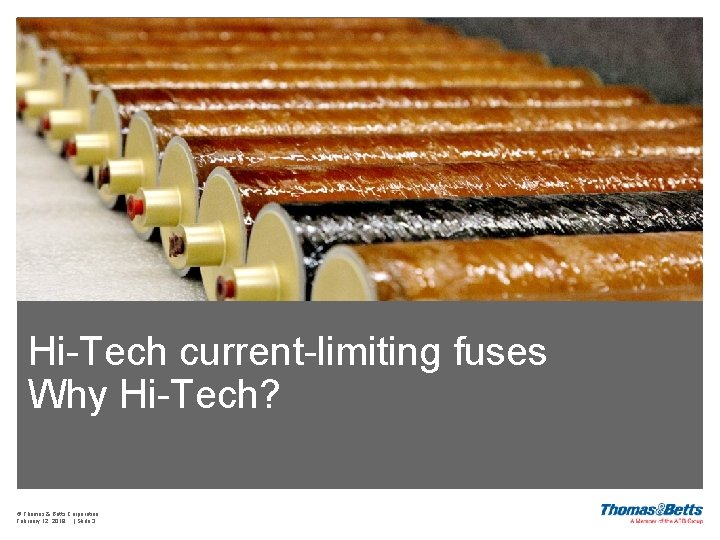
Hi-Tech current-limiting fuses Why Hi-Tech? © Thomas & Betts Corporation February 12, 2018 | Slide 3
Why Hi-Tech? Safety, reliability and service Safety § Provides maximum system protection that other protective devices may not fully cover § Space-saving form factors reduce equipment costs and provide easy installation even in retrofit applications Reliability § Complete line of current-limiting fuses with some of the lowest energy let-through values in the industry for maximum protection Service © Thomas & Betts Corporation February 12, 2018 | Slide 4 § Dedicated application support as well as online configurator for immediate information when it’s needed § Assembled in Hickory, North Carolina
Hi-Tech current-limiting fuses Introduction © Thomas & Betts Corporation February 12, 2018 | Slide 5
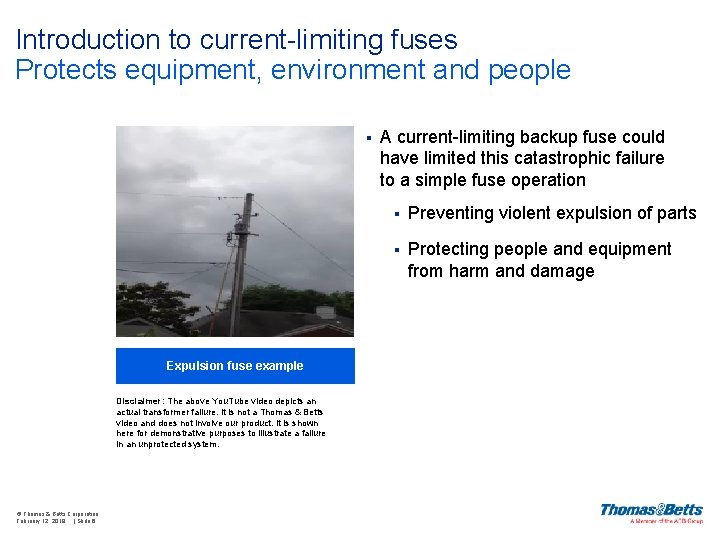
Introduction to current-limiting fuses Protects equipment, environment and people § Expulsion fuse example Disclaimer: The above You. Tube video depicts an actual transformer failure. It is not a Thomas & Betts video and does not involve our product. It is shown here for demonstrative purposes to illustrate a failure in an unprotected system. © Thomas & Betts Corporation February 12, 2018 | Slide 6 A current-limiting backup fuse could have limited this catastrophic failure to a simple fuse operation § Preventing violent expulsion of parts § Protecting people and equipment from harm and damage
Hi-Tech current-limiting fuses Expulsion vs. current-limiting fuses © Thomas & Betts Corporation February 12, 2018 | Slide 7
Expulsion vs. current-limiting fuses Product comparison Expulsion fuse § Traditional-type fuse § § § © Thomas & Betts Corporation February 12, 2018 | Slide 8 Interrupts the flow of current at the natural current zero Does not modify the circuit Does not reduce the energy levels during a fault Current-limiting fuse § Engineered to maximize protection § Interrupts high fault currents in one-half cycle or less § Creates an arc-voltage to modify the circuit and force current to zero § Drastically decreases the energy and duration of a short circuit fault to the highest levels of safety and minimizes damages
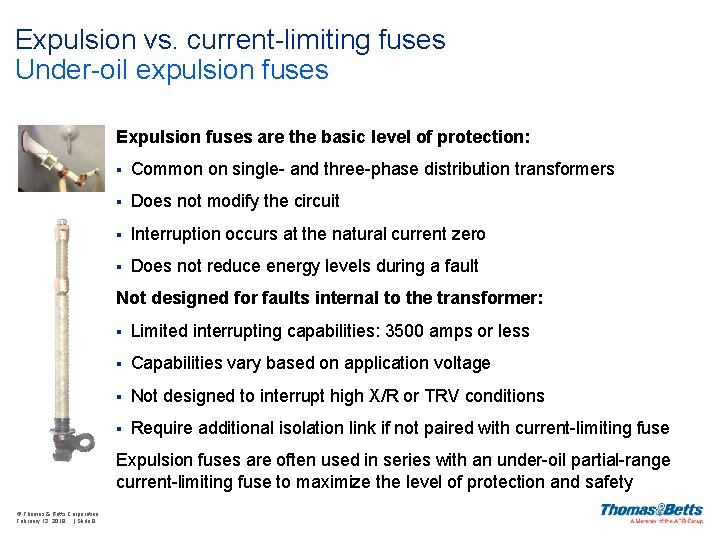
Expulsion vs. current-limiting fuses Under-oil expulsion fuses Expulsion fuses are the basic level of protection: § Common on single- and three-phase distribution transformers § Does not modify the circuit § Interruption occurs at the natural current zero § Does not reduce energy levels during a fault Not designed for faults internal to the transformer: § Limited interrupting capabilities: 3500 amps or less § Capabilities vary based on application voltage § Not designed to interrupt high X/R or TRV conditions § Require additional isolation link if not paired with current-limiting fuse Expulsion fuses are often used in series with an under-oil partial-range current-limiting fuse to maximize the level of protection and safety © Thomas & Betts Corporation February 12, 2018 | Slide 9
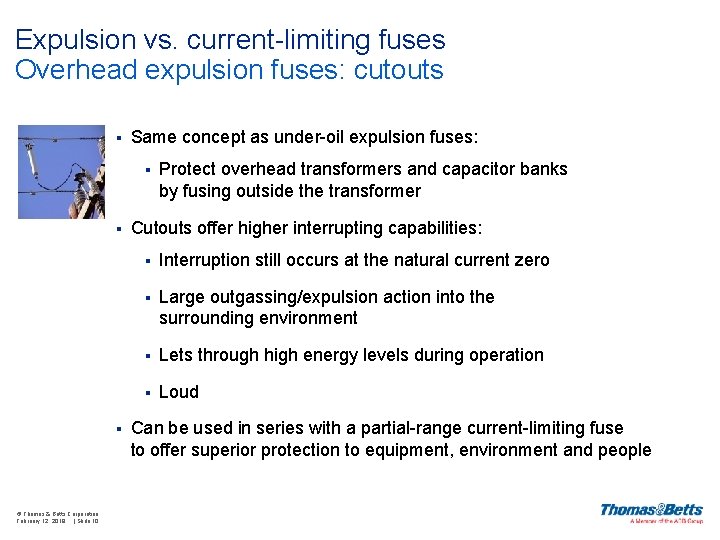
Expulsion vs. current-limiting fuses Overhead expulsion fuses: cutouts § Same concept as under-oil expulsion fuses: § § § © Thomas & Betts Corporation February 12, 2018 | Slide 10 Protect overhead transformers and capacitor banks by fusing outside the transformer Cutouts offer higher interrupting capabilities: § Interruption still occurs at the natural current zero § Large outgassing/expulsion action into the surrounding environment § Lets through high energy levels during operation § Loud Can be used in series with a partial-range current-limiting fuse to offer superior protection to equipment, environment and people
Hi-Tech current-limiting fuses Current-limiting fuses © Thomas & Betts Corporation February 12, 2018 | Slide 11
Current-limiting fuses Types Today there are two primary types of current-limiting fuses: § Backup fuses § Full-range fuses/capacitor fuses General-purpose fuses (outdated) § Only rated to clear currents that cause melting in 1 hour or less Designs are engineered to maximize protection: © Thomas & Betts Corporation February 12, 2018 | Slide 12 § Increases maximum interrupting capability § Creates an arc-voltage to modify the circuit and force current to zero § Interrupts high faults currents in one-half cycle or less § Drastically decreases the energy and duration of a short circuit fault to maximize safety and minimize equipment damage § Minimizes outage area and collateral damage that must be repaired

Current-limiting fuses Full-range backup fuses Backup fuses must be used in series with an expulsion fuse: § § © Thomas & Betts Corporation February 12, 2018 | Slide 13 Copper fuse element with precision notches for high fault currents The expulsion fuse protects the backup fuse from currents it cannot interrupt § The two-fuse approach minimizes the risk of eventful equipment failure § Selected based on time current curve coordination or match-melt coordination Full-range fuses are two fuses in one body: § Contains two types of fuse elements: high and low current § Self-protecting and capable of clearing any current that causes the fuse element to melt § No outgassing, flames or molten material released into environment § Selected based on continuous current requirement and overloading demands § Offered in many different hardware/ mounting configurations
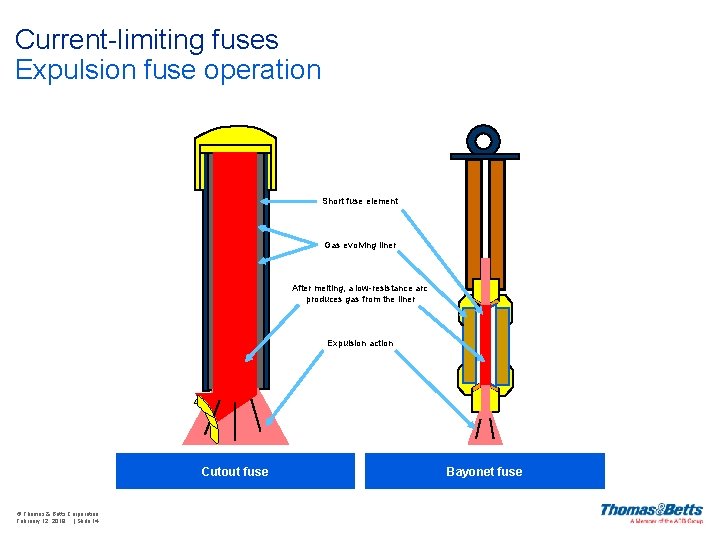
Current-limiting fuses Expulsion fuse operation Short fuse element Gas evolving liner After melting, a low-resistance arc produces gas from the liner Expulsion action Cutout fuse © Thomas & Betts Corporation February 12, 2018 | Slide 14 Bayonet fuse
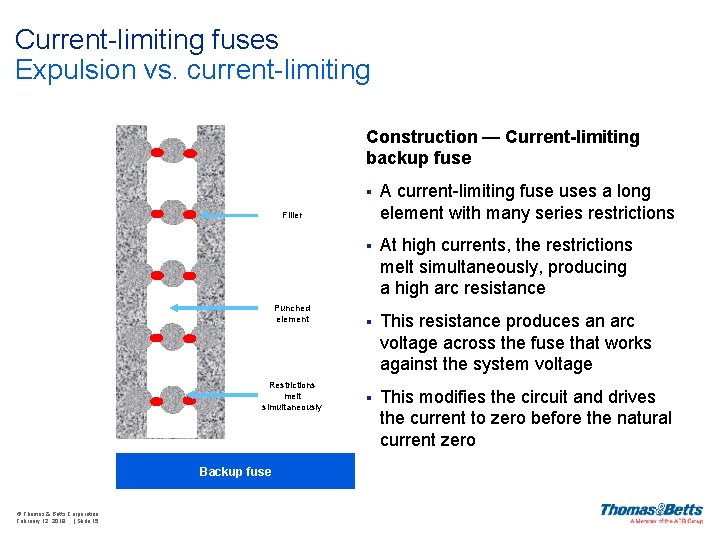
Current-limiting fuses Expulsion vs. current-limiting Construction — Current-limiting backup fuse § A current-limiting fuse uses a long element with many series restrictions § At high currents, the restrictions melt simultaneously, producing a high arc resistance § This resistance produces an arc voltage across the fuse that works against the system voltage § This modifies the circuit and drives the current to zero before the natural current zero Filler Punched element Restrictions melt simultaneously Backup fuse © Thomas & Betts Corporation February 12, 2018 | Slide 15
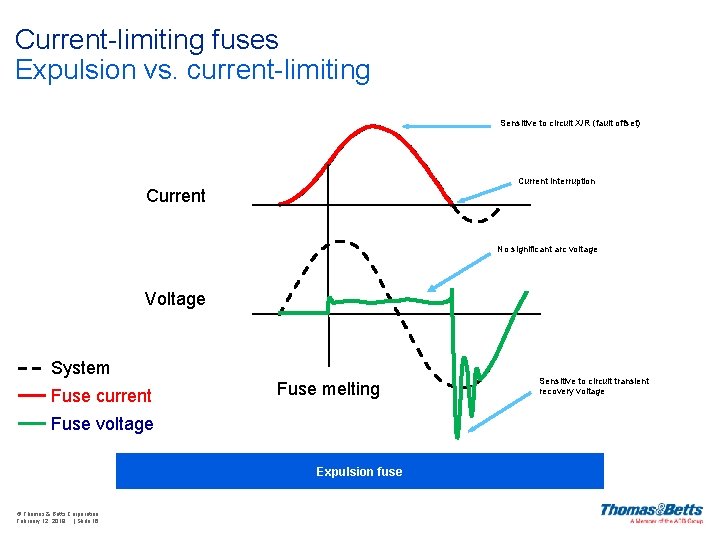
Current-limiting fuses Expulsion vs. current-limiting Sensitive to circuit X/R (fault offset) Current interruption Current No significant arc voltage Voltage System Fuse current Fuse melting Fuse voltage Expulsion fuse © Thomas & Betts Corporation February 12, 2018 | Slide 16 Sensitive to circuit transient recovery voltage
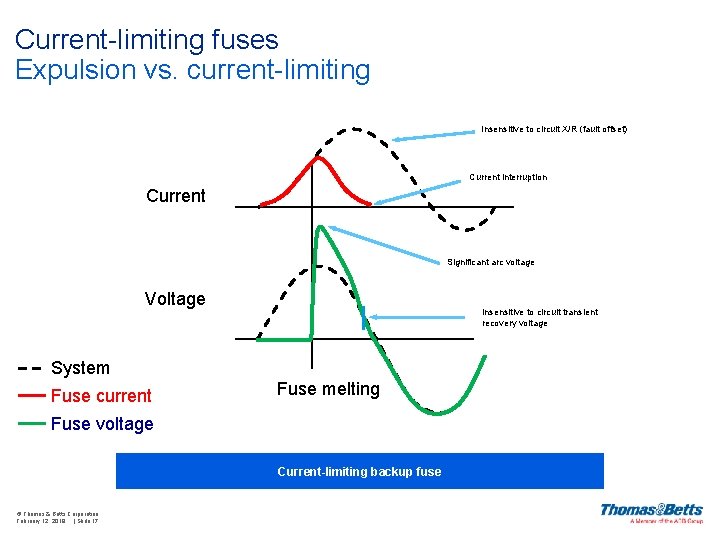
Current-limiting fuses Expulsion vs. current-limiting Insensitive to circuit X/R (fault offset) Current interruption Current Significant arc voltage Voltage Insensitive to circuit transient recovery voltage System Fuse current Fuse melting Fuse voltage Current-limiting backup fuse © Thomas & Betts Corporation February 12, 2018 | Slide 17
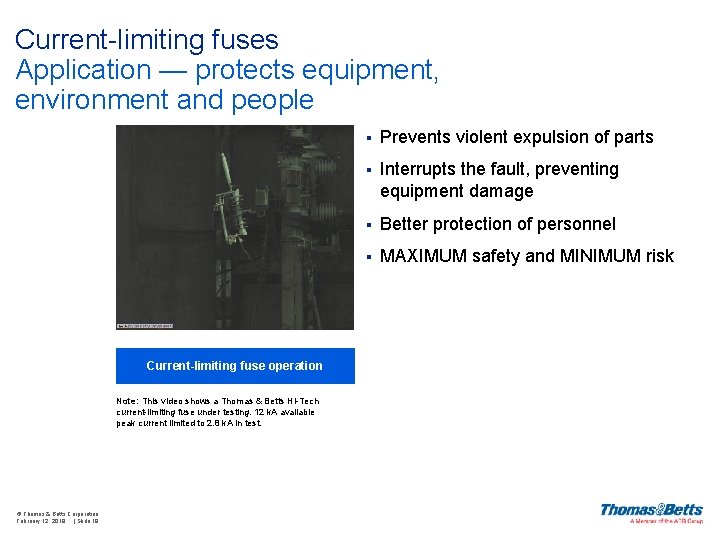
Current-limiting fuses Application — protects equipment, environment and people Current-limiting fuse operation Note: This video shows a Thomas & Betts Hi-Tech current-limiting fuse under testing. 12 k. A available peak current limited to 2. 8 k. A in test. © Thomas & Betts Corporation February 12, 2018 | Slide 18 § Prevents violent expulsion of parts § Interrupts the fault, preventing equipment damage § Better protection of personnel § MAXIMUM safety and MINIMUM risk
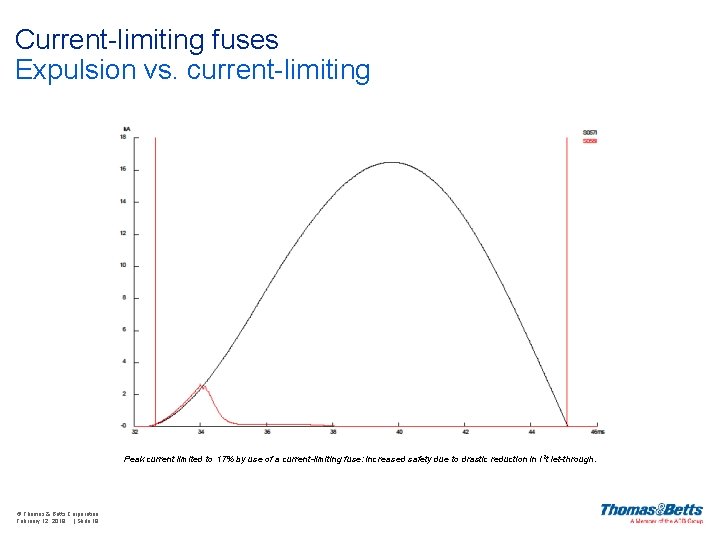
Current-limiting fuses Expulsion vs. current-limiting Peak current limited to 17% by use of a current-limiting fuse: Increased safety due to drastic reduction in I 2 t let-through. © Thomas & Betts Corporation February 12, 2018 | Slide 19
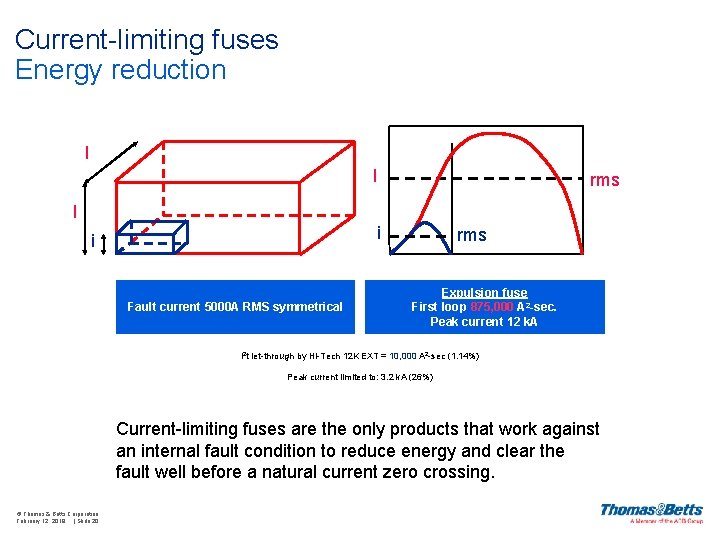
Current-limiting fuses Energy reduction I I rms I i i Fault current 5000 A RMS symmetrical rms Expulsion fuse First loop 875, 000 A 2 -sec. Peak current 12 k. A I 2 t let-through by Hi-Tech 12 K EXT = 10, 000 A 2 -sec (1. 14%) Peak current limited to: 3. 2 k. A (26%) Current-limiting fuses are the only products that work against an internal fault condition to reduce energy and clear the fault well before a natural current zero crossing. © Thomas & Betts Corporation February 12, 2018 | Slide 20
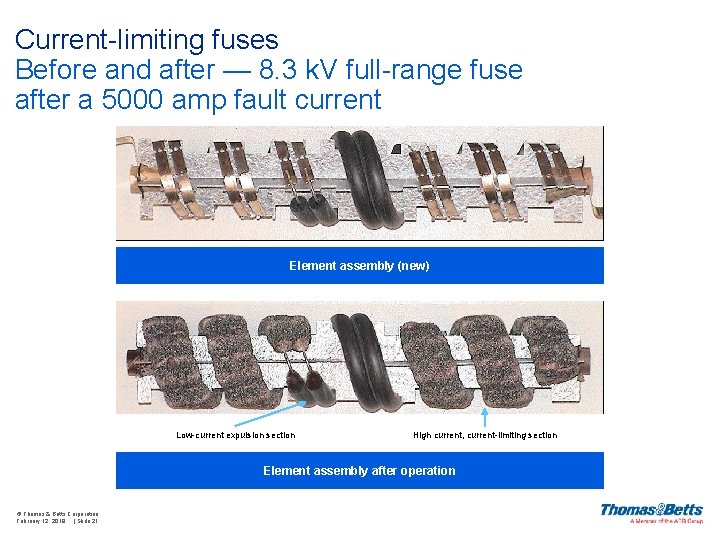
Current-limiting fuses Before and after — 8. 3 k. V full-range fuse after a 5000 amp fault current Element assembly (new) Low-current expulsion section High current, current-limiting section Element assembly after operation © Thomas & Betts Corporation February 12, 2018 | Slide 21
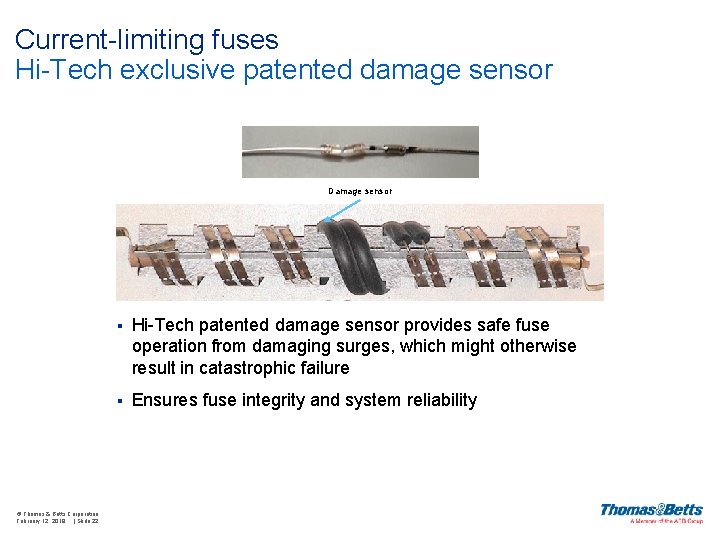
Current-limiting fuses Hi-Tech exclusive patented damage sensor Damage sensor © Thomas & Betts Corporation February 12, 2018 | Slide 22 § Hi-Tech patented damage sensor provides safe fuse operation from damaging surges, which might otherwise result in catastrophic failure § Ensures fuse integrity and system reliability
Hi-Tech current-limiting fuses Applications © Thomas & Betts Corporation February 12, 2018 | Slide 23
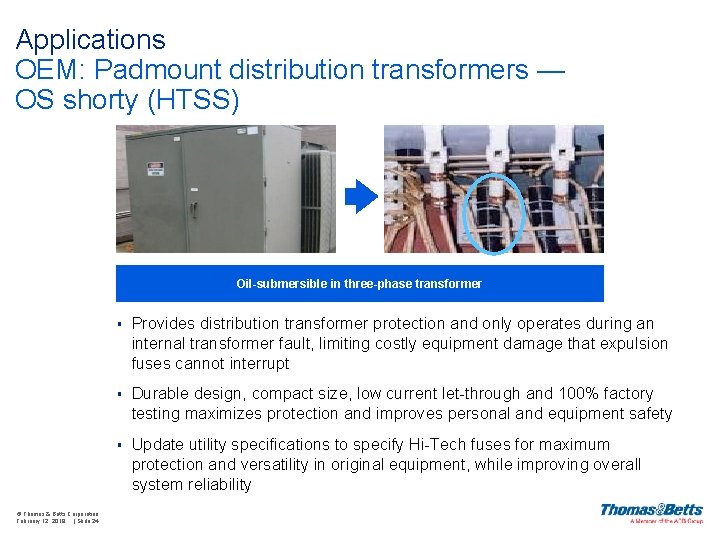
Applications OEM: Padmount distribution transformers — OS shorty (HTSS) Oil-submersible in three-phase transformer © Thomas & Betts Corporation February 12, 2018 | Slide 24 § Provides distribution transformer protection and only operates during an internal transformer fault, limiting costly equipment damage that expulsion fuses cannot interrupt § Durable design, compact size, low current let-through and 100% factory testing maximizes protection and improves personal and equipment safety § Update utility specifications to specify Hi-Tech fuses for maximum protection and versatility in original equipment, while improving overall system reliability
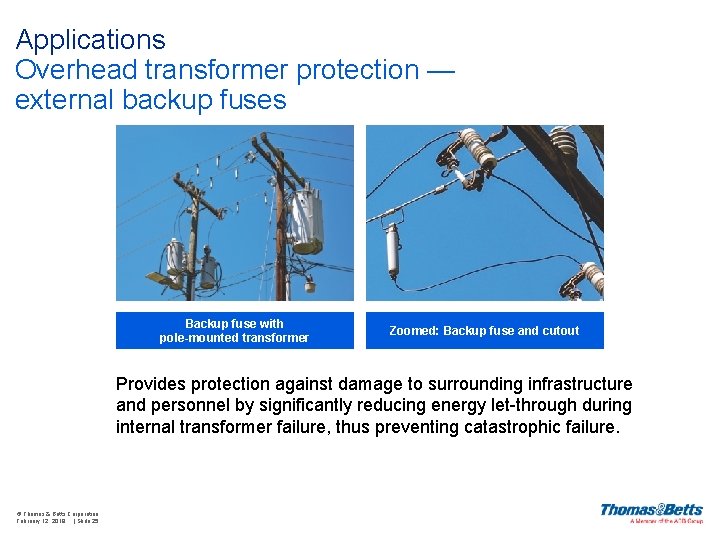
Applications Overhead transformer protection — external backup fuses Backup fuse with pole-mounted transformer Zoomed: Backup fuse and cutout Provides protection against damage to surrounding infrastructure and personnel by significantly reducing energy let-through during internal transformer failure, thus preventing catastrophic failure. © Thomas & Betts Corporation February 12, 2018 | Slide 25
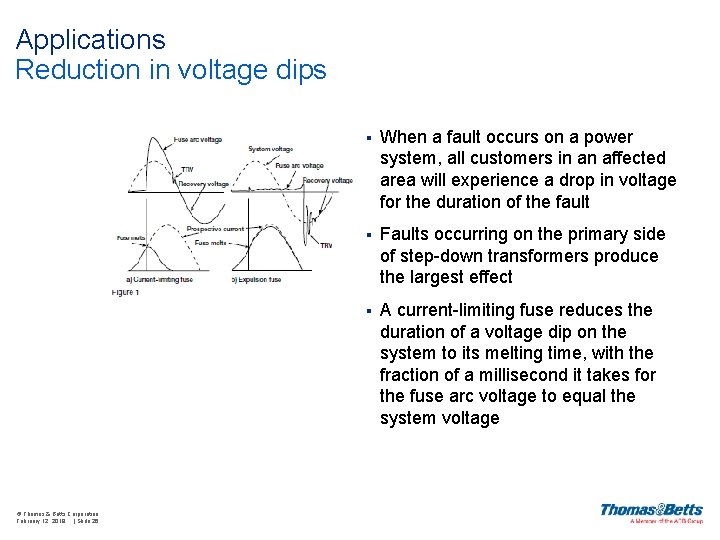
Applications Reduction in voltage dips © Thomas & Betts Corporation February 12, 2018 | Slide 26 § When a fault occurs on a power system, all customers in an affected area will experience a drop in voltage for the duration of the fault § Faults occurring on the primary side of step-down transformers produce the largest effect § A current-limiting fuse reduces the duration of a voltage dip on the system to its melting time, with the fraction of a millisecond it takes for the fuse arc voltage to equal the system voltage
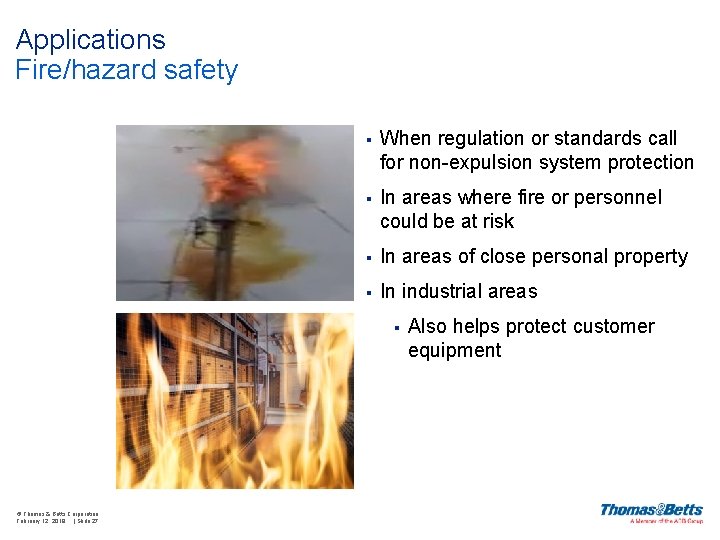
Applications Fire/hazard safety § When regulation or standards call for non-expulsion system protection § In areas where fire or personnel could be at risk § In areas of close personal property § In industrial areas § © Thomas & Betts Corporation February 12, 2018 | Slide 27 Also helps protect customer equipment
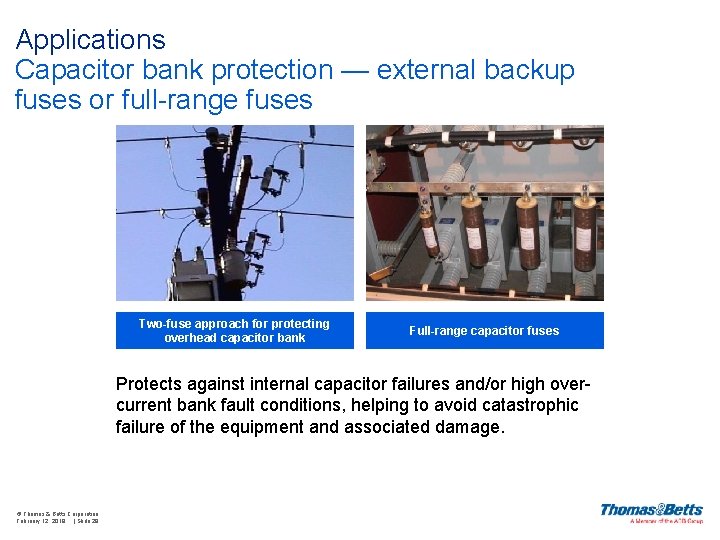
Applications Capacitor bank protection — external backup fuses or full-range fuses Two-fuse approach for protecting overhead capacitor bank Full-range capacitor fuses Protects against internal capacitor failures and/or high overcurrent bank fault conditions, helping to avoid catastrophic failure of the equipment and associated damage. © Thomas & Betts Corporation February 12, 2018 | Slide 28
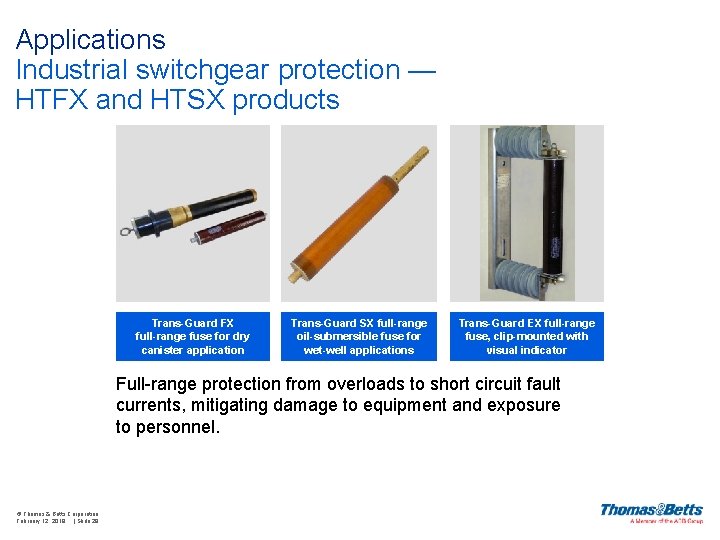
Applications Industrial switchgear protection — HTFX and HTSX products Trans-Guard FX full-range fuse for dry canister application Trans-Guard SX full-range oil-submersible fuse for wet-well applications Trans-Guard EX full-range fuse, clip-mounted with visual indicator Full-range protection from overloads to short circuit fault currents, mitigating damage to equipment and exposure to personnel. © Thomas & Betts Corporation February 12, 2018 | Slide 29
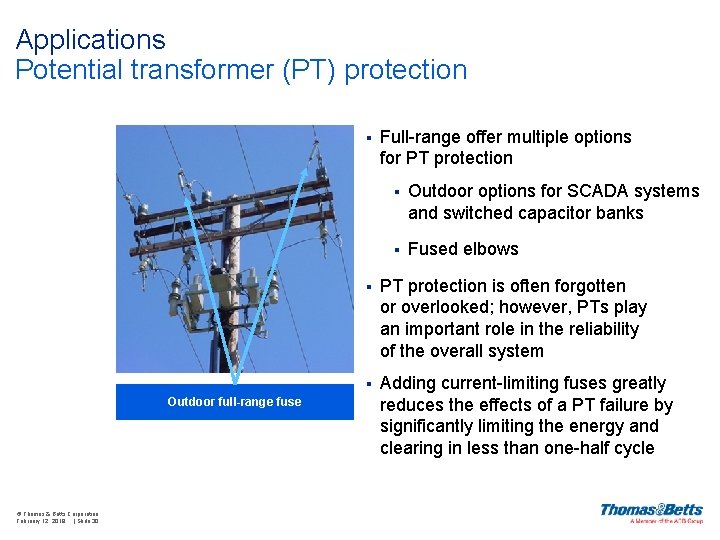
Applications Potential transformer (PT) protection § Outdoor full-range fuse © Thomas & Betts Corporation February 12, 2018 | Slide 30 Full-range offer multiple options for PT protection § Outdoor options for SCADA systems and switched capacitor banks § Fused elbows § PT protection is often forgotten or overlooked; however, PTs play an important role in the reliability of the overall system § Adding current-limiting fuses greatly reduces the effects of a PT failure by significantly limiting the energy and clearing in less than one-half cycle
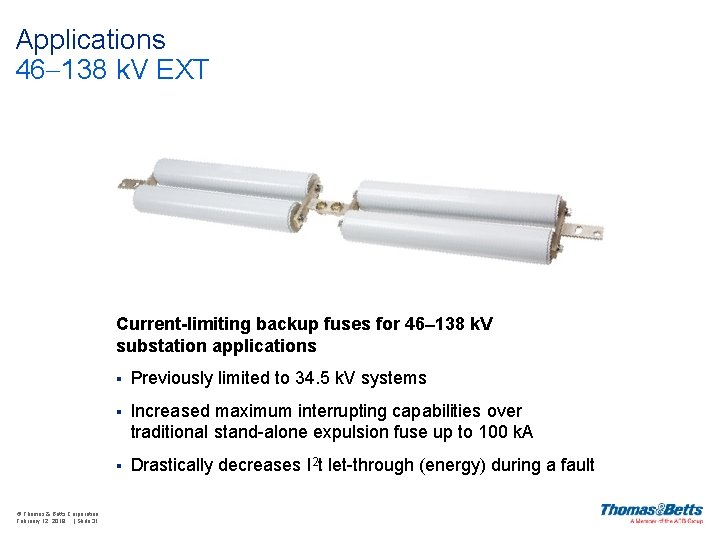
Applications 46 138 k. V EXT Current-limiting backup fuses for 46 138 k. V substation applications © Thomas & Betts Corporation February 12, 2018 | Slide 31 § Previously limited to 34. 5 k. V systems § Increased maximum interrupting capabilities over traditional stand-alone expulsion fuse up to 100 k. A § Drastically decreases I 2 t let-through (energy) during a fault
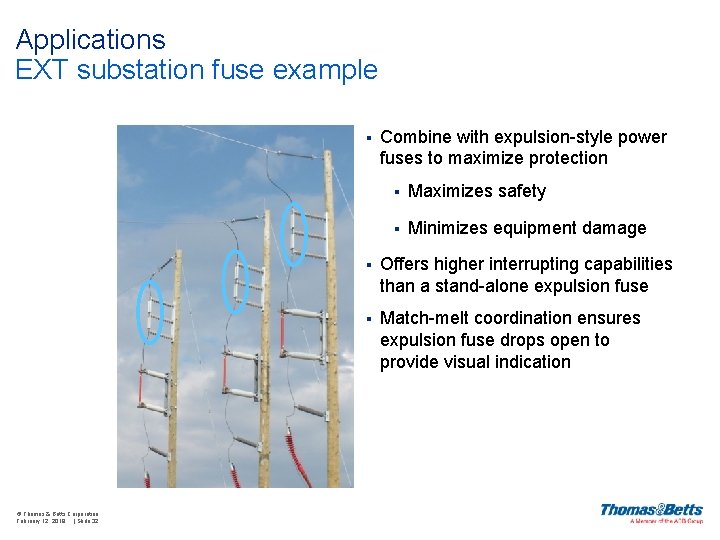
Applications EXT substation fuse example § © Thomas & Betts Corporation February 12, 2018 | Slide 32 Combine with expulsion-style power fuses to maximize protection § Maximizes safety § Minimizes equipment damage § Offers higher interrupting capabilities than a stand-alone expulsion fuse § Match-melt coordination ensures expulsion fuse drops open to provide visual indication
Hi-Tech current-limiting fuses Standards © Thomas & Betts Corporation February 12, 2018 | Slide 33
Standards IEEE/ANSI C 37. 40 Fuses are covered by the IEEE/ANSI C 37. 40 family, which defines, specifies and provides testing requirements for expulsion and current-limiting fuses. IEC standards are similar; however, assuming effectively grounded circuits and often tested at different voltages lower than actual nameplate voltage. Standards require various tests, which include: © Thomas & Betts Corporation February 12, 2018 | Slide 34 § Maximum interrupting capabilities § Maximum application temperatures and maximum energy scenarios § Minimum interrupting capabilities
Hi-Tech current-limiting fuses Products — features and benefits © Thomas & Betts Corporation February 12, 2018 | Slide 35
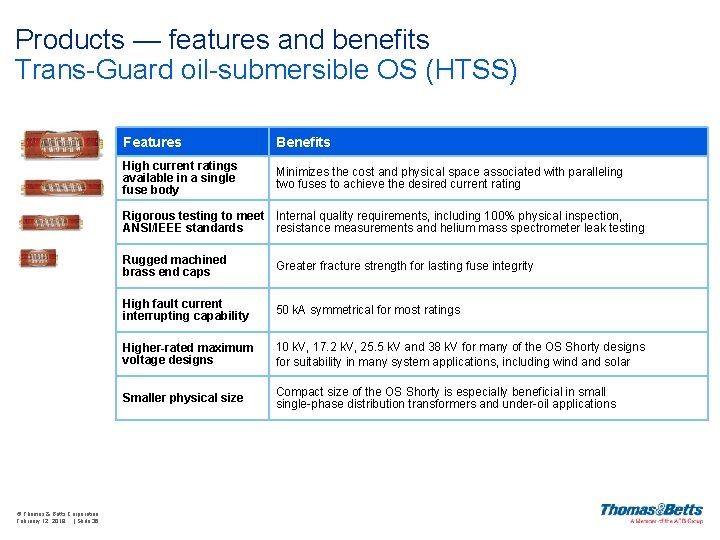
Products — features and benefits Trans-Guard oil-submersible OS (HTSS) Features Benefits High current ratings available in a single fuse body Minimizes the cost and physical space associated with paralleling two fuses to achieve the desired current rating Rigorous testing to meet Internal quality requirements, including 100% physical inspection, ANSI/IEEE standards resistance measurements and helium mass spectrometer leak testing © Thomas & Betts Corporation February 12, 2018 | Slide 36 Rugged machined brass end caps Greater fracture strength for lasting fuse integrity High fault current interrupting capability 50 k. A symmetrical for most ratings Higher-rated maximum voltage designs 10 k. V, 17. 2 k. V, 25. 5 k. V and 38 k. V for many of the OS Shorty designs for suitability in many system applications, including wind and solar Smaller physical size Compact size of the OS Shorty is especially beneficial in small single-phase distribution transformers and under-oil applications
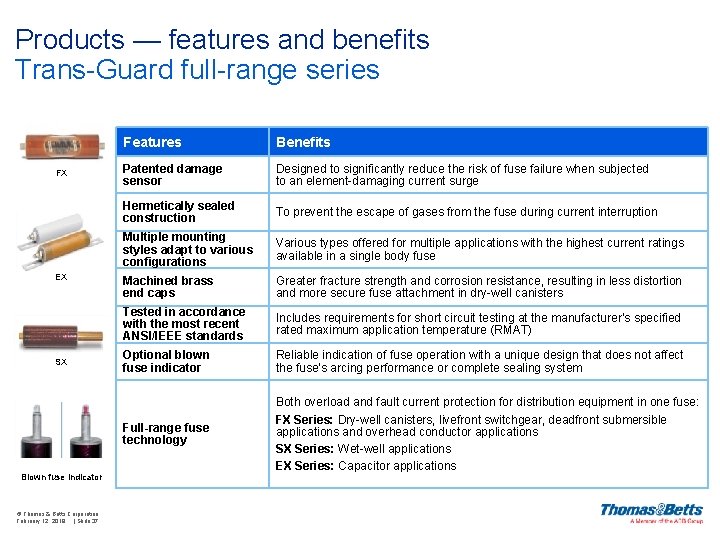
Products — features and benefits Trans-Guard full-range series FX EX SX Blown fuse indicator © Thomas & Betts Corporation February 12, 2018 | Slide 37 Features Benefits Patented damage sensor Designed to significantly reduce the risk of fuse failure when subjected to an element-damaging current surge Hermetically sealed construction To prevent the escape of gases from the fuse during current interruption Multiple mounting styles adapt to various configurations Various types offered for multiple applications with the highest current ratings available in a single body fuse Machined brass end caps Greater fracture strength and corrosion resistance, resulting in less distortion and more secure fuse attachment in dry-well canisters Tested in accordance with the most recent ANSI/IEEE standards Includes requirements for short circuit testing at the manufacturer’s specified rated maximum application temperature (RMAT) Optional blown fuse indicator Reliable indication of fuse operation with a unique design that does not affect the fuse’s arcing performance or complete sealing system Full-range fuse technology Both overload and fault current protection for distribution equipment in one fuse: FX Series: Dry-well canisters, livefront switchgear, deadfront submersible applications and overhead conductor applications SX Series: Wet-well applications EX Series: Capacitor applications
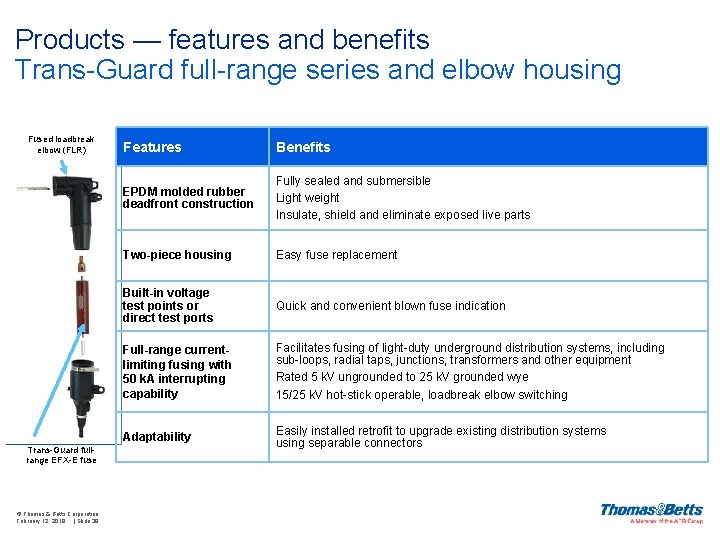
Products — features and benefits Trans-Guard full-range series and elbow housing Fused loadbreak elbow (FLR) Trans-Guard fullrange EFX-E fuse © Thomas & Betts Corporation February 12, 2018 | Slide 38 Features Benefits EPDM molded rubber deadfront construction Fully sealed and submersible Light weight Insulate, shield and eliminate exposed live parts Two-piece housing Easy fuse replacement Built-in voltage test points or direct test ports Quick and convenient blown fuse indication Full-range currentlimiting fusing with 50 k. A interrupting capability Facilitates fusing of light-duty underground distribution systems, including sub-loops, radial taps, junctions, transformers and other equipment Rated 5 k. V ungrounded to 25 k. V grounded wye 15/25 k. V hot-stick operable, loadbreak elbow switching Adaptability Easily installed retrofit to upgrade existing distribution systems using separable connectors
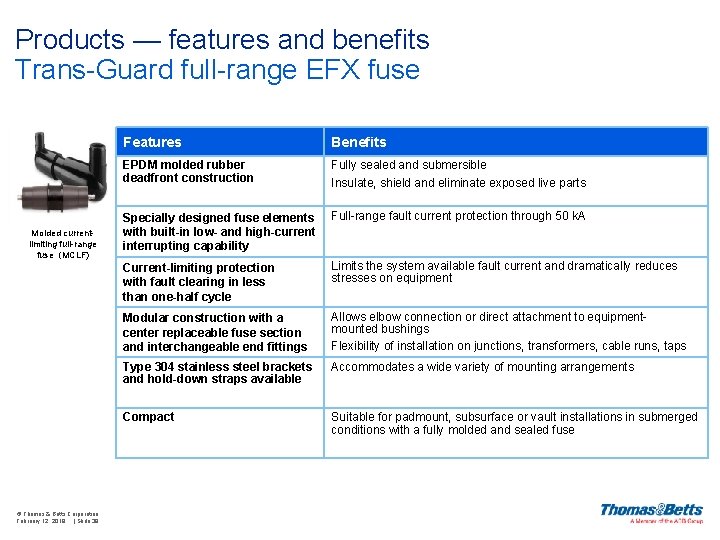
Products — features and benefits Trans-Guard full-range EFX fuse Molded currentlimiting full-range fuse (MCLF) © Thomas & Betts Corporation February 12, 2018 | Slide 39 Features Benefits EPDM molded rubber deadfront construction Fully sealed and submersible Insulate, shield and eliminate exposed live parts Specially designed fuse elements with built-in low- and high-current interrupting capability Full-range fault current protection through 50 k. A Current-limiting protection with fault clearing in less than one-half cycle Limits the system available fault current and dramatically reduces stresses on equipment Modular construction with a center replaceable fuse section and interchangeable end fittings Allows elbow connection or direct attachment to equipmentmounted bushings Flexibility of installation on junctions, transformers, cable runs, taps Type 304 stainless steel brackets and hold-down straps available Accommodates a wide variety of mounting arrangements Compact Suitable for padmount, subsurface or vault installations in submerged conditions with a fully molded and sealed fuse
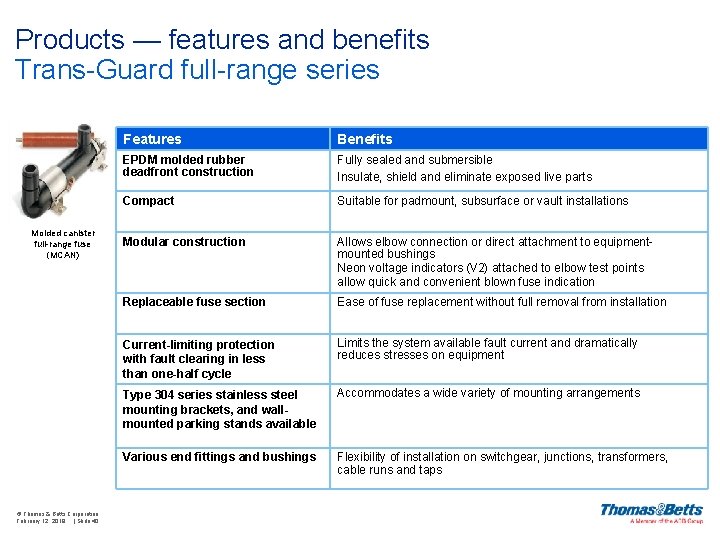
Products — features and benefits Trans-Guard full-range series Molded canister full-range fuse (MCAN) © Thomas & Betts Corporation February 12, 2018 | Slide 40 Features Benefits EPDM molded rubber deadfront construction Fully sealed and submersible Insulate, shield and eliminate exposed live parts Compact Suitable for padmount, subsurface or vault installations Modular construction Allows elbow connection or direct attachment to equipmentmounted bushings Neon voltage indicators (V 2) attached to elbow test points allow quick and convenient blown fuse indication Replaceable fuse section Ease of fuse replacement without full removal from installation Current-limiting protection with fault clearing in less than one-half cycle Limits the system available fault current and dramatically reduces stresses on equipment Type 304 series stainless steel mounting brackets, and wallmounted parking stands available Accommodates a wide variety of mounting arrangements Various end fittings and bushings Flexibility of installation on switchgear, junctions, transformers, cable runs and taps
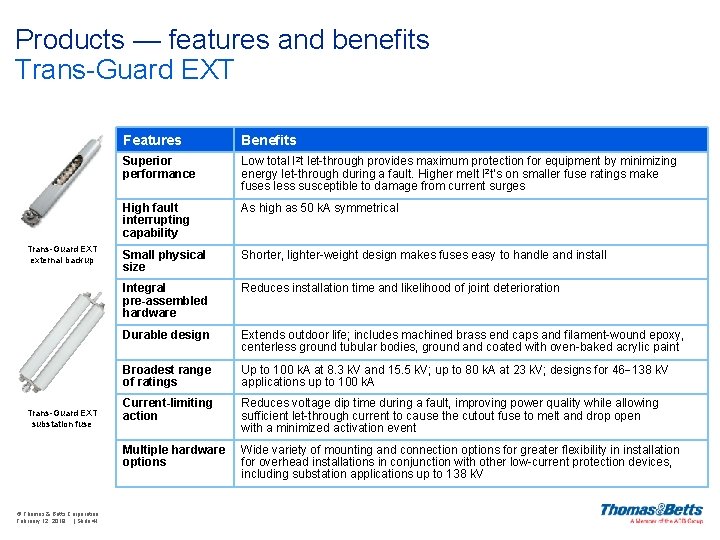
Products — features and benefits Trans-Guard EXT external backup Trans-Guard EXT substation fuse © Thomas & Betts Corporation February 12, 2018 | Slide 41 Features Benefits Superior performance Low total I 2 t let-through provides maximum protection for equipment by minimizing energy let-through during a fault. Higher melt I 2 t’s on smaller fuse ratings make fuses less susceptible to damage from current surges High fault interrupting capability As high as 50 k. A symmetrical Small physical size Shorter, lighter-weight design makes fuses easy to handle and install Integral pre-assembled hardware Reduces installation time and likelihood of joint deterioration Durable design Extends outdoor life; includes machined brass end caps and filament-wound epoxy, centerless ground tubular bodies, ground and coated with oven-baked acrylic paint Broadest range of ratings Up to 100 k. A at 8. 3 k. V and 15. 5 k. V; up to 80 k. A at 23 k. V; designs for 46 138 k. V applications up to 100 k. A Current-limiting action Reduces voltage dip time during a fault, improving power quality while allowing sufficient let-through current to cause the cutout fuse to melt and drop open with a minimized activation event Multiple hardware options Wide variety of mounting and connection options for greater flexibility in installation for overhead installations in conjunction with other low-current protection devices, including substation applications up to 138 k. V
Hi-Tech current-limiting fuses Hi-Tech FACT program © Thomas & Betts Corporation February 12, 2018 | Slide 42
Hi-Tech FACT program Fuse application coordination tool (FACT) FACT: Distribution transformer protection § Online program for coordinating under-oil expulsion fuses with currentlimiting backup fuses provides needed data with just a few clicks § § © Thomas & Betts Corporation February 12, 2018 | Slide 43 User inputs transformer data and preferred expulsion fuse type Outputs information for proper fuse coordination in seconds, customized for the existing application § I 2 t and other useful information provided for assurance of optimal protective limits and fuse selection § Additional product information readily available via web-linked catalog § Quickly provides information on the fly when it’s needed for ease and accuracy of fuse specification, saving valuable time § Live application and engineering support also available
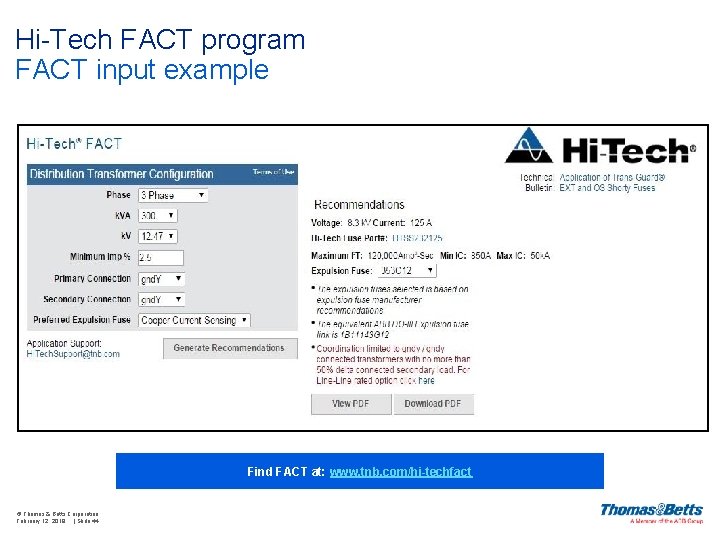
Hi-Tech FACT program FACT input example Find FACT at: www. tnb. com/hi-techfact © Thomas & Betts Corporation February 12, 2018 | Slide 44
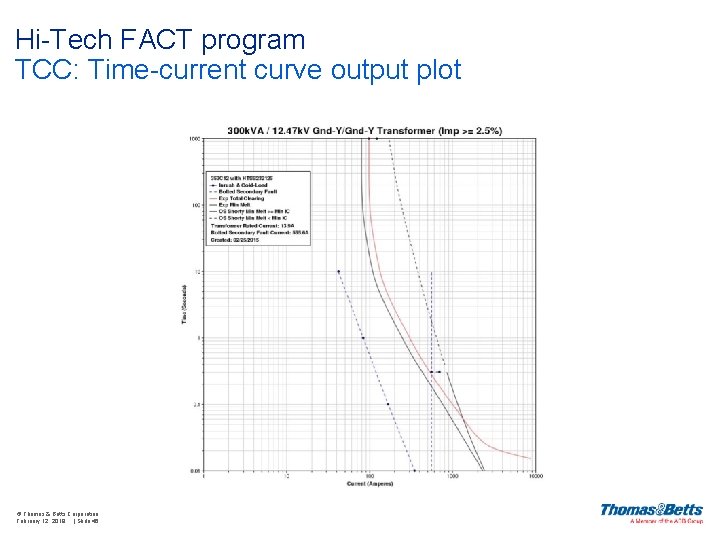
Hi-Tech FACT program TCC: Time-current curve output plot © Thomas & Betts Corporation February 12, 2018 | Slide 45
Hi-Tech current-limiting fuses Concluding points © Thomas & Betts Corporation February 12, 2018 | Slide 46
Concluding points Value proposition summary © Thomas & Betts Corporation February 12, 2018 | Slide 47 § Hi-Tech current-limiting fuses offer maximum reliability, system protection and flexibility in a cost-effective compact package § 100% factory sealed and tested to industry standards means quality product out of the box when it’s needed § Provides increased safety and ability to lower system costs in order to provide better service for utility customers by preventing equipment damage and adverse failure modes § Production in Hickory, North Carolina means product is available domestically without risk of international delay § Nationwide application support available when needed

- Slides: 48