
Historywriting in the Ancient World Sources The following
- Slides: 15
History-writing in the Ancient World Sources
The following pages are the six sources combined with the source analysis questions in a student scaffold
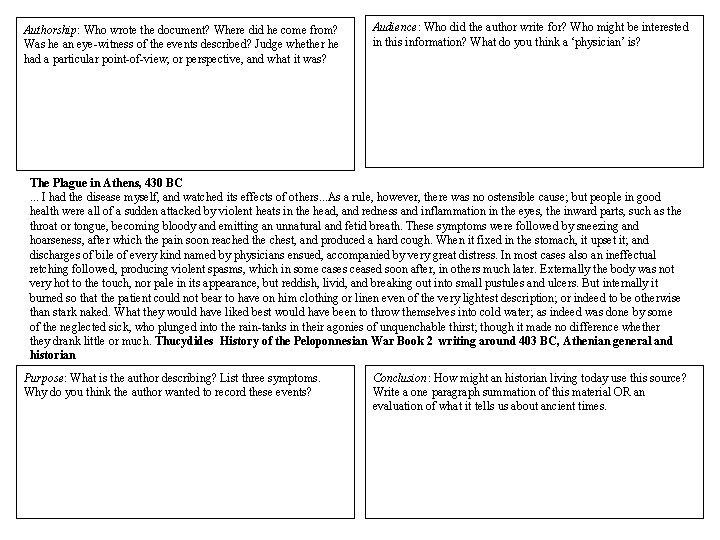
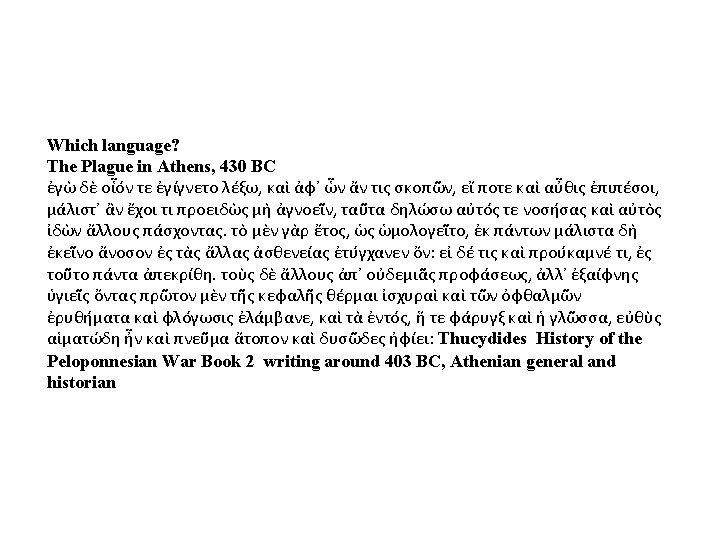
Authorship: Who wrote the document? Where did he come from? Was he an eye-witness of the events described? Judge whether he had a particular point-of-view, or perspective, and what it was? Audience: Who did the author write for? Who might be interested in this information? What do you think a ‘physician’ is? The Plague in Athens, 430 BC. . . I had the disease myself, and watched its effects of others. . . As a rule, however, there was no ostensible cause; but people in good health were all of a sudden attacked by violent heats in the head, and redness and inflammation in the eyes, the inward parts, such as the throat or tongue, becoming bloody and emitting an unnatural and fetid breath. These symptoms were followed by sneezing and hoarseness, after which the pain soon reached the chest, and produced a hard cough. When it fixed in the stomach, it upset it; and discharges of bile of every kind named by physicians ensued, accompanied by very great distress. In most cases also an ineffectual retching followed, producing violent spasms, which in some cases ceased soon after, in others much later. Externally the body was not very hot to the touch, nor pale in its appearance, but reddish, livid, and breaking out into small pustules and ulcers. But internally it burned so that the patient could not bear to have on him clothing or linen even of the very lightest description; or indeed to be otherwise than stark naked. What they would have liked best would have been to throw themselves into cold water; as indeed was done by some of the neglected sick, who plunged into the rain-tanks in their agonies of unquenchable thirst; though it made no difference whether they drank little or much. Thucydides History of the Peloponnesian War Book 2 writing around 403 BC, Athenian general and historian Purpose: What is the author describing? List three symptoms. Why do you think the author wanted to record these events? Conclusion: How might an historian living today use this source? Write a one paragraph summation of this material OR an evaluation of what it tells us about ancient times.
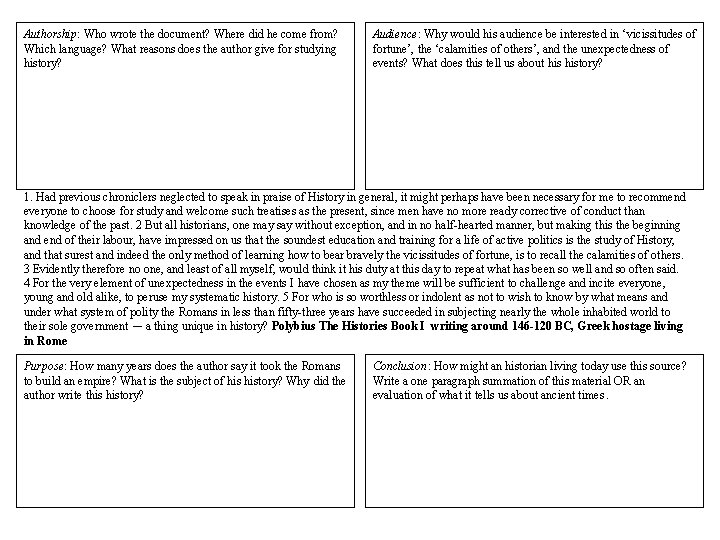
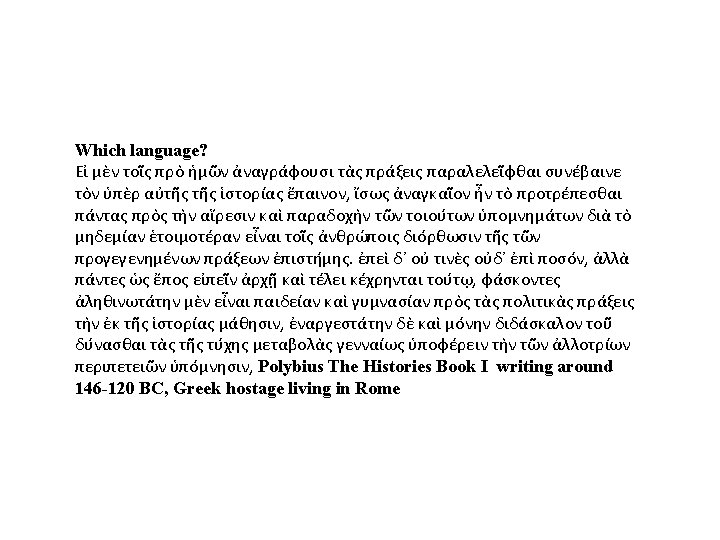
Authorship: Who wrote the document? Where did he come from? Which language? What reasons does the author give for studying history? Audience: Why would his audience be interested in ‘vicissitudes of fortune’, the ‘calamities of others’, and the unexpectedness of events? What does this tell us about history? 1. Had previous chroniclers neglected to speak in praise of History in general, it might perhaps have been necessary for me to recommend everyone to choose for study and welcome such treatises as the present, since men have no more ready corrective of conduct than knowledge of the past. 2 But all historians, one may say without exception, and in no half-hearted manner, but making this the beginning and end of their labour, have impressed on us that the soundest education and training for a life of active politics is the study of History, and that surest and indeed the only method of learning how to bear bravely the vicissitudes of fortune, is to recall the calamities of others. 3 Evidently therefore no one, and least of all myself, would think it his duty at this day to repeat what has been so well and so often said. 4 For the very element of unexpectedness in the events I have chosen as my theme will be sufficient to challenge and incite everyone, young and old alike, to peruse my systematic history. 5 For who is so worthless or indolent as not to wish to know by what means and under what system of polity the Romans in less than fifty-three years have succeeded in subjecting nearly the whole inhabited world to their sole government — a thing unique in history? Polybius The Histories Book I writing around 146 -120 BC, Greek hostage living in Rome Purpose: How many years does the author say it took the Romans to build an empire? What is the subject of history? Why did the author write this history? Conclusion: How might an historian living today use this source? Write a one paragraph summation of this material OR an evaluation of what it tells us about ancient times.
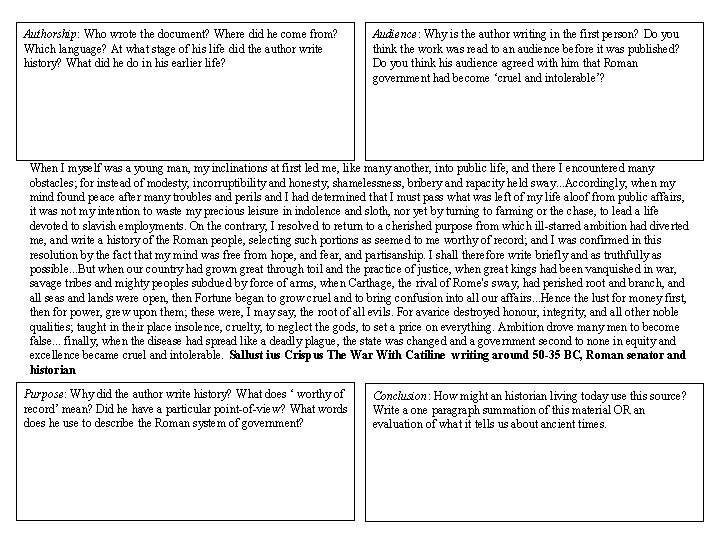
Authorship: Who wrote the document? Where did he come from? Which language? At what stage of his life did the author write history? What did he do in his earlier life? Audience: Why is the author writing in the first person? Do you think the work was read to an audience before it was published? Do you think his audience agreed with him that Roman government had become ‘cruel and intolerable’? When I myself was a young man, my inclinations at first led me, like many another, into public life, and there I encountered many obstacles; for instead of modesty, incorruptibility and honesty, shamelessness, bribery and rapacity held sway. . . Accordingly, when my mind found peace after many troubles and perils and I had determined that I must pass what was left of my life aloof from public affairs, it was not my intention to waste my precious leisure in indolence and sloth, nor yet by turning to farming or the chase, to lead a life devoted to slavish employments. On the contrary, I resolved to return to a cherished purpose from which ill-starred ambition had diverted me, and write a history of the Roman people, selecting such portions as seemed to me worthy of record; and I was confirmed in this resolution by the fact that my mind was free from hope, and fear, and partisanship. I shall therefore write briefly and as truthfully as possible. . . But when our country had grown great through toil and the practice of justice, when great kings had been vanquished in war, savage tribes and mighty peoples subdued by force of arms, when Carthage, the rival of Rome's sway, had perished root and branch, and all seas and lands were open, then Fortune began to grow cruel and to bring confusion into all our affairs. . . Hence the lust for money first, then for power, grew upon them; these were, I may say, the root of all evils. For avarice destroyed honour, integrity, and all other noble qualities; taught in their place insolence, cruelty, to neglect the gods, to set a price on everything. Ambition drove many men to become false. . . finally, when the disease had spread like a deadly plague, the state was changed and a government second to none in equity and excellence became cruel and intolerable. Sallust ius Crispus The War With Catiline writing around 50 -35 BC, Roman senator and historian Purpose: Why did the author write history? What does ‘ worthy of record’ mean? Did he have a particular point-of-view? What words does he use to describe the Roman system of government? Conclusion: How might an historian living today use this source? Write a one paragraph summation of this material OR an evaluation of what it tells us about ancient times.
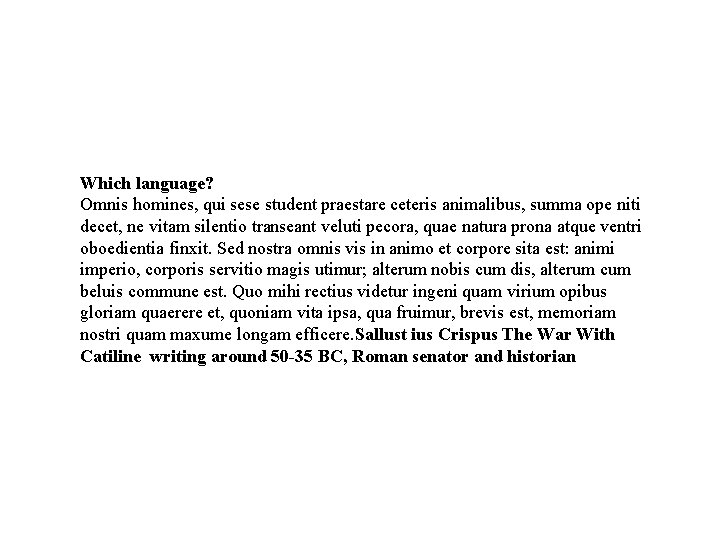
Which language? Omnis homines, qui sese student praestare ceteris animalibus, summa ope niti decet, ne vitam silentio transeant veluti pecora, quae natura prona atque ventri oboedientia finxit. Sed nostra omnis vis in animo et corpore sita est: animi imperio, corporis servitio magis utimur; alterum nobis cum dis, alterum cum beluis commune est. Quo mihi rectius videtur ingeni quam virium opibus gloriam quaerere et, quoniam vita ipsa, qua fruimur, brevis est, memoriam nostri quam maxume longam efficere. Sallust ius Crispus The War With Catiline writing around 50 -35 BC, Roman senator and historian
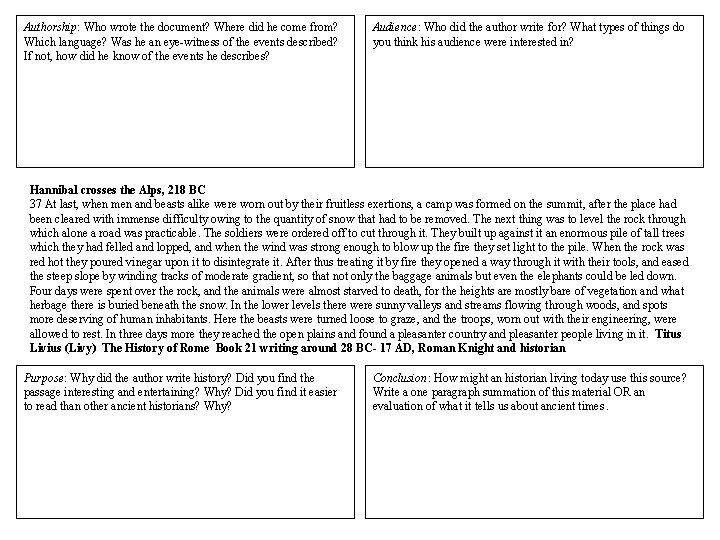
Authorship: Who wrote the document? Where did he come from? Which language? Was he an eye-witness of the events described? If not, how did he know of the events he describes? Audience: Who did the author write for? What types of things do you think his audience were interested in? Hannibal crosses the Alps, 218 BC 37 At last, when men and beasts alike were worn out by their fruitless exertions, a camp was formed on the summit, after the place had been cleared with immense difficulty owing to the quantity of snow that had to be removed. The next thing was to level the rock through which alone a road was practicable. The soldiers were ordered off to cut through it. They built up against it an enormous pile of tall trees which they had felled and lopped, and when the wind was strong enough to blow up the fire they set light to the pile. When the rock was red hot they poured vinegar upon it to disintegrate it. After thus treating it by fire they opened a way through it with their tools, and eased the steep slope by winding tracks of moderate gradient, so that not only the baggage animals but even the elephants could be led down. Four days were spent over the rock, and the animals were almost starved to death, for the heights are mostly bare of vegetation and what herbage there is buried beneath the snow. In the lower levels there were sunny valleys and streams flowing through woods, and spots more deserving of human inhabitants. Here the beasts were turned loose to graze, and the troops, worn out with their engineering, were allowed to rest. In three days more they reached the open plains and found a pleasanter country and pleasanter people living in it. Titus Livius (Livy) The History of Rome Book 21 writing around 28 BC- 17 AD, Roman Knight and historian Purpose: Why did the author write history? Did you find the passage interesting and entertaining? Why? Did you find it easier to read than other ancient historians? Why? Conclusion: How might an historian living today use this source? Write a one paragraph summation of this material OR an evaluation of what it tells us about ancient times.
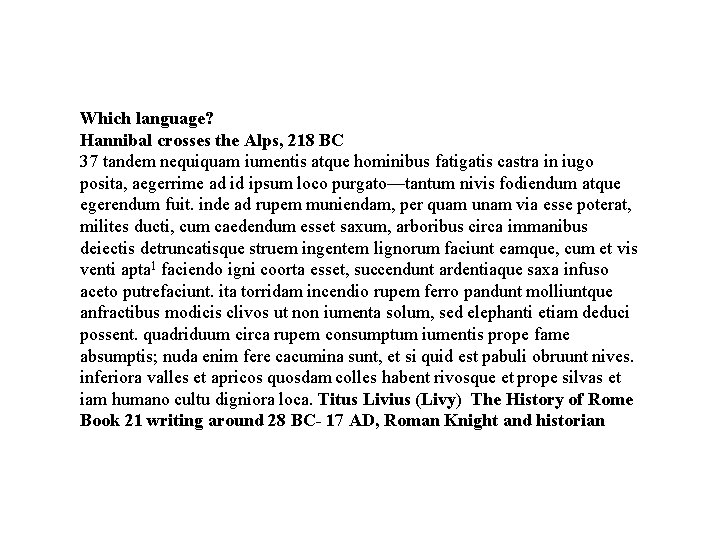
Which language? Hannibal crosses the Alps, 218 BC 37 tandem nequiquam iumentis atque hominibus fatigatis castra in iugo posita, aegerrime ad id ipsum loco purgato—tantum nivis fodiendum atque egerendum fuit. inde ad rupem muniendam, per quam unam via esse poterat, milites ducti, cum caedendum esset saxum, arboribus circa immanibus deiectis detruncatisque struem ingentem lignorum faciunt eamque, cum et vis venti apta 1 faciendo igni coorta esset, succendunt ardentiaque saxa infuso aceto putrefaciunt. ita torridam incendio rupem ferro pandunt molliuntque anfractibus modicis clivos ut non iumenta solum, sed elephanti etiam deduci possent. quadriduum circa rupem consumptum iumentis prope fame absumptis; nuda enim fere cacumina sunt, et si quid est pabuli obruunt nives. inferiora valles et apricos quosdam colles habent rivosque et prope silvas et iam humano cultu digniora loca. Titus Livius (Livy) The History of Rome Book 21 writing around 28 BC- 17 AD, Roman Knight and historian
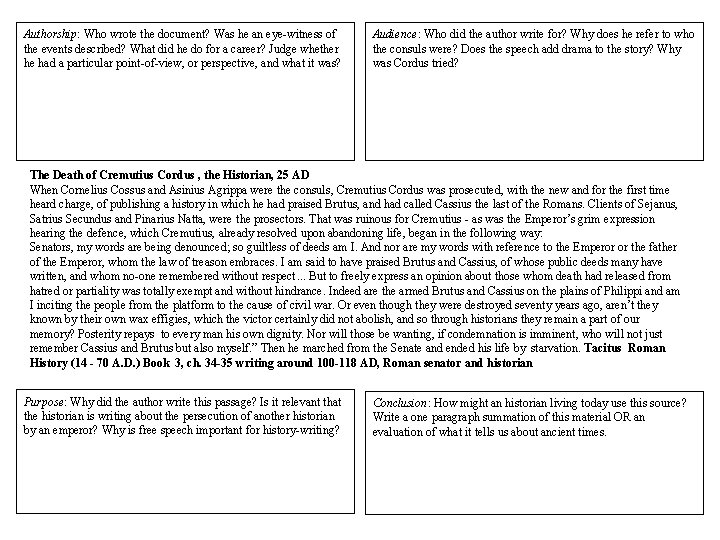
Authorship: Who wrote the document? Was he an eye-witness of the events described? What did he do for a career? Judge whether he had a particular point-of-view, or perspective, and what it was? Audience: Who did the author write for? Why does he refer to who the consuls were? Does the speech add drama to the story? Why was Cordus tried? The Death of Cremutius Cordus , the Historian, 25 AD When Cornelius Cossus and Asinius Agrippa were the consuls, Cremutius Cordus was prosecuted, with the new and for the first time heard charge, of publishing a history in which he had praised Brutus, and had called Cassius the last of the Romans. Clients of Sejanus, Satrius Secundus and Pinarius Natta, were the prosectors. That was ruinous for Cremutius - as was the Emperor’s grim expression hearing the defence, which Cremutius, already resolved upon abandoning life, began in the following way: Senators, my words are being denounced; so guiltless of deeds am I. And nor are my words with reference to the Emperor or the father of the Emperor, whom the law of treason embraces. I am said to have praised Brutus and Cassius, of whose public deeds many have written, and whom no-one remembered without respect. . . But to freely express an opinion about those whom death had released from hatred or partiality was totally exempt and without hindrance. Indeed are the armed Brutus and Cassius on the plains of Philippi and am I inciting the people from the platform to the cause of civil war. Or even though they were destroyed seventy years ago, aren’t they known by their own wax effigies, which the victor certainly did not abolish, and so through historians they remain a part of our memory? Posterity repays to every man his own dignity. Nor will those be wanting, if condemnation is imminent, who will not just remember Cassius and Brutus but also myself. ” Then he marched from the Senate and ended his life by starvation. Tacitus Roman History (14 - 70 A. D. ) Book 3, ch. 34 -35 writing around 100 -118 AD, Roman senator and historian Purpose: Why did the author write this passage? Is it relevant that the historian is writing about the persecution of another historian by an emperor? Why is free speech important for history-writing? Conclusion: How might an historian living today use this source? Write a one paragraph summation of this material OR an evaluation of what it tells us about ancient times.
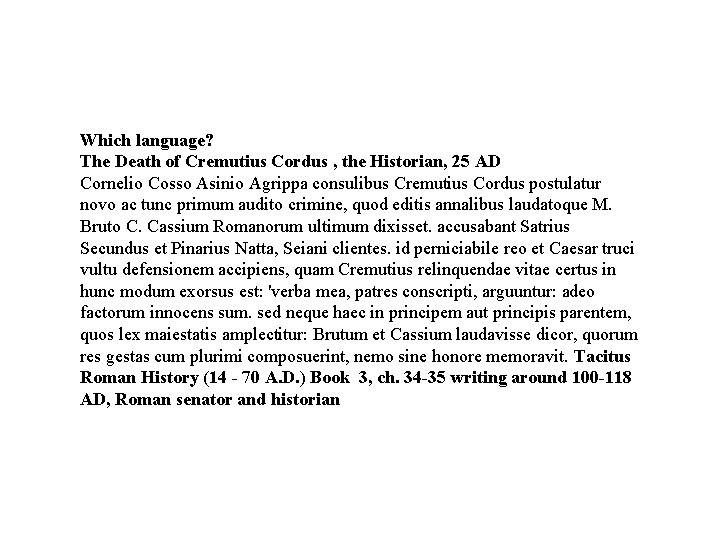
Which language? The Death of Cremutius Cordus , the Historian, 25 AD Cornelio Cosso Asinio Agrippa consulibus Cremutius Cordus postulatur novo ac tunc primum audito crimine, quod editis annalibus laudatoque M. Bruto C. Cassium Romanorum ultimum dixisset. accusabant Satrius Secundus et Pinarius Natta, Seiani clientes. id perniciabile reo et Caesar truci vultu defensionem accipiens, quam Cremutius relinquendae vitae certus in hunc modum exorsus est: 'verba mea, patres conscripti, arguuntur: adeo factorum innocens sum. sed neque haec in principem aut principis parentem, quos lex maiestatis amplectitur: Brutum et Cassium laudavisse dicor, quorum res gestas cum plurimi composuerint, nemo sine honore memoravit. Tacitus Roman History (14 - 70 A. D. ) Book 3, ch. 34 -35 writing around 100 -118 AD, Roman senator and historian
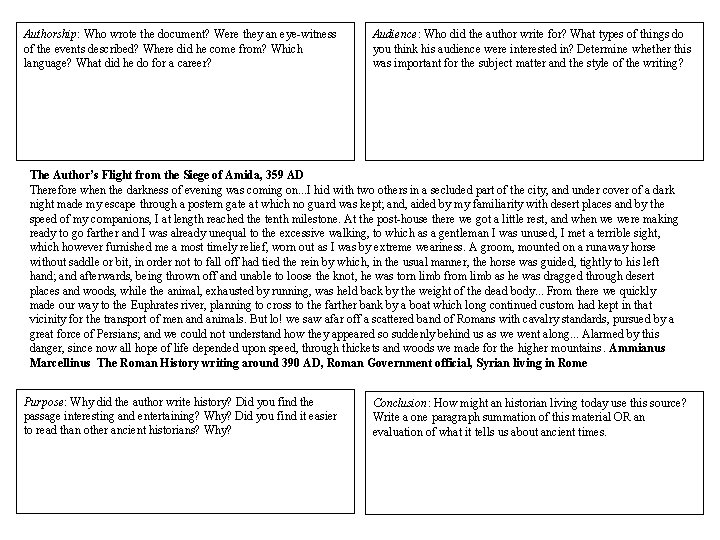
Authorship: Who wrote the document? Were they an eye-witness of the events described? Where did he come from? Which language? What did he do for a career? Audience: Who did the author write for? What types of things do you think his audience were interested in? Determine whether this was important for the subject matter and the style of the writing ? The Author’s Flight from the Siege of Amida, 359 AD Therefore when the darkness of evening was coming on. . . I hid with two others in a secluded part of the city, and under cover of a dark night made my escape through a postern gate at which no guard was kept; and, aided by my familiarity with desert places and by the speed of my companions, I at length reached the tenth milestone. At the post-house there we got a little rest, and when we were making ready to go farther and I was already unequal to the excessive walking, to which as a gentleman I was unused, I met a terrible sight, which however furnished me a most timely relief, worn out as I was by extreme weariness. A groom, mounted on a runaway horse without saddle or bit, in order not to fall off had tied the rein by which, in the usual manner, the horse was guided, tightly to his left hand; and afterwards, being thrown off and unable to loose the knot, he was torn limb from limb as he was dragged through desert places and woods, while the animal, exhausted by running, was held back by the weight of the dead body. . . From there we quickly made our way to the Euphrates river, planning to cross to the farther bank by a boat which long continued custom had kept in that vicinity for the transport of men and animals. But lo! we saw afar off a scattered band of Romans with cavalry standards, pursued by a great force of Persians; and we could not understand how they appeared so suddenly behind us as we went along. . . Alarmed by this danger, since now all hope of life depended upon speed, through thickets and woods we made for the higher mountains. Ammianus Marcellinus The Roman History writing around 390 AD, Roman Government official, Syrian living in Rome Purpose: Why did the author write history? Did you find the passage interesting and entertaining? Why? Did you find it easier to read than other ancient historians? Why? Conclusion: How might an historian living today use this source? Write a one paragraph summation of this material OR an evaluation of what it tells us about ancient times.
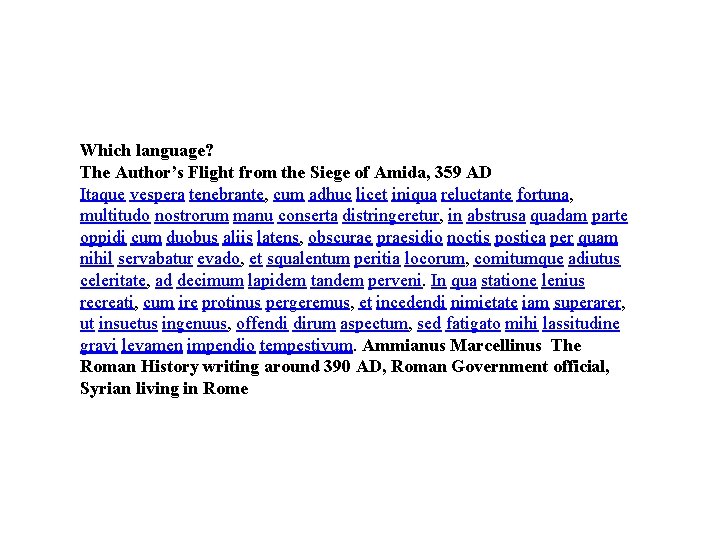
Which language? The Author’s Flight from the Siege of Amida, 359 AD Itaque vespera tenebrante, cum adhuc licet iniqua reluctante fortuna, multitudo nostrorum manu conserta distringeretur, in abstrusa quadam parte oppidi cum duobus aliis latens, obscurae praesidio noctis postica per quam nihil servabatur evado, et squalentum peritia locorum, comitumque adiutus celeritate, ad decimum lapidem tandem perveni. In qua statione lenius recreati, cum ire protinus pergeremus, et incedendi nimietate iam superarer, ut insuetus ingenuus, offendi dirum aspectum, sed fatigato mihi lassitudine gravi levamen impendio tempestivum. Ammianus Marcellinus The Roman History writing around 390 AD, Roman Government official, Syrian living in Rome
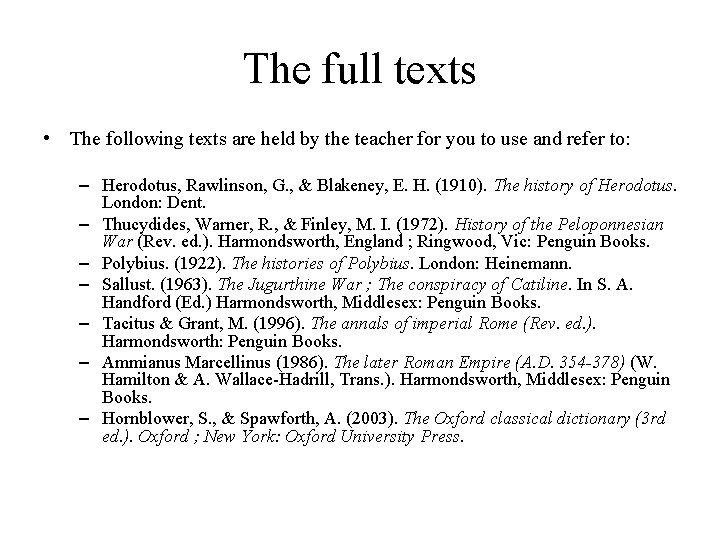
The full texts • The following texts are held by the teacher for you to use and refer to: – Herodotus, Rawlinson, G. , & Blakeney, E. H. (1910). The history of Herodotus. London: Dent. – Thucydides, Warner, R. , & Finley, M. I. (1972). History of the Peloponnesian War (Rev. ed. ). Harmondsworth, England ; Ringwood, Vic: Penguin Books. – Polybius. (1922). The histories of Polybius. London: Heinemann. – Sallust. (1963). The Jugurthine War ; The conspiracy of Catiline. In S. A. Handford (Ed. ) Harmondsworth, Middlesex: Penguin Books. – Tacitus & Grant, M. (1996). The annals of imperial Rome (Rev. ed. ). Harmondsworth: Penguin Books. – Ammianus Marcellinus (1986). The later Roman Empire (A. D. 354 -378) (W. Hamilton & A. Wallace-Hadrill, Trans. ). Harmondsworth, Middlesex: Penguin Books. – Hornblower, S. , & Spawforth, A. (2003). The Oxford classical dictionary (3 rd ed. ). Oxford ; New York: Oxford University Press.