
Historybased Construction of Log Process Alignments for Conformance

History-based Construction of Log. Process Alignments for Conformance Checking Mahdi Alizadeh Massimiliano de Leoni Nicola Zannone {m. alizadeh, m. d. leoni, n. zannone}@tue. nl
Agenda Alignment History-Aware Conformance Checking Department of Mathematics and Computer Science Evaluation Future Works 28 -05 -2014 PAGE 1
Alignment History-Aware Conformance Checking Department of Mathematics and Computer Science Evaluation Future Works 28 -05 -2014 PAGE 2
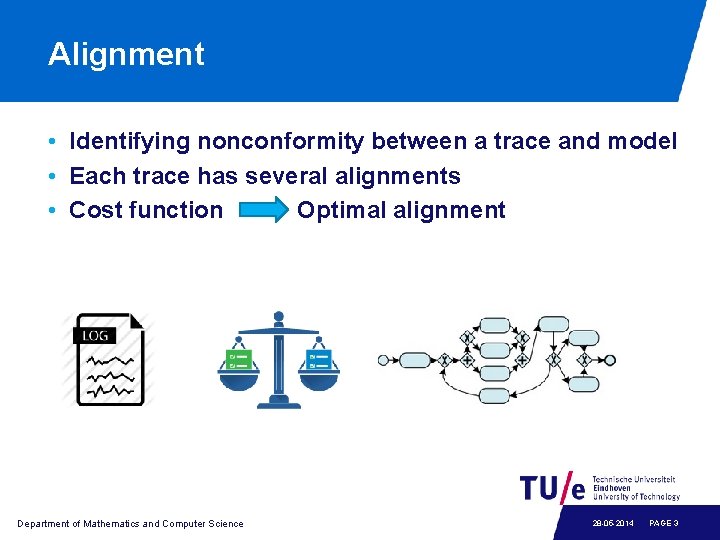
Alignment • Identifying nonconformity between a trace and model • Each trace has several alignments • Cost function Optimal alignment Department of Mathematics and Computer Science 28 -05 -2014 PAGE 3
Cost functions • Two types of cost functions • Computing an optimal alignment • Measuring the severity of deviations • Existing approaches for defining a cost function: • Background knowledge of process analysts − Not trivial and time-consuming − Based on the human judgment • Standard cost function Department of Mathematics and Computer Science 28 -05 -2014 PAGE 4
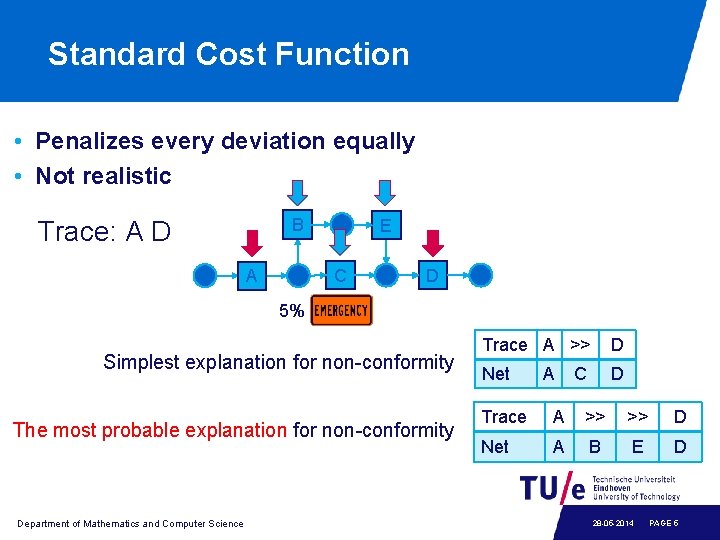
Standard Cost Function • Penalizes every deviation equally • Not realistic B Trace: A D E C A D 5% Simplest explanation for non-conformity The most probable explanation for non-conformity Department of Mathematics and Computer Science Trace A >> D Net D A C Trace A >> >> D Net A B E D 28 -05 -2014 PAGE 5
Alignment History-Aware Conformance Checking Department of Mathematics and Computer Science Evaluation Future Works 28 -05 -2014 PAGE 6
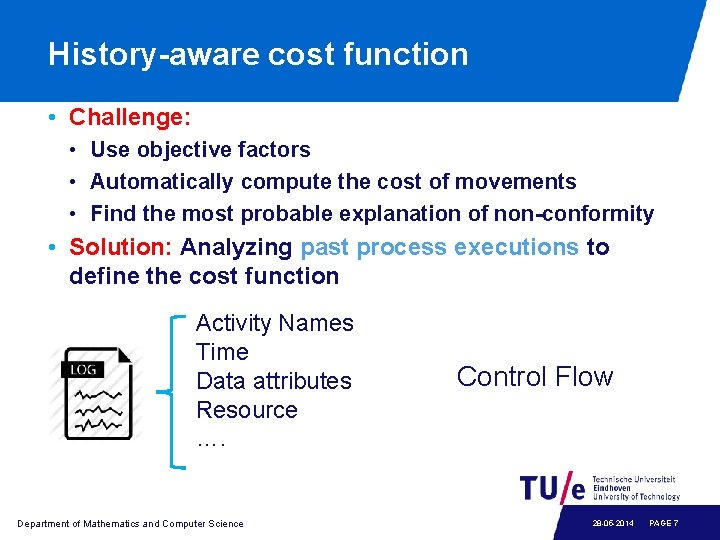
History-aware cost function • Challenge: • Use objective factors • Automatically compute the cost of movements • Find the most probable explanation of non-conformity • Solution: Analyzing past process executions to define the cost function Activity Names Time Data attributes Resource …. Department of Mathematics and Computer Science Control Flow 28 -05 -2014 PAGE 7
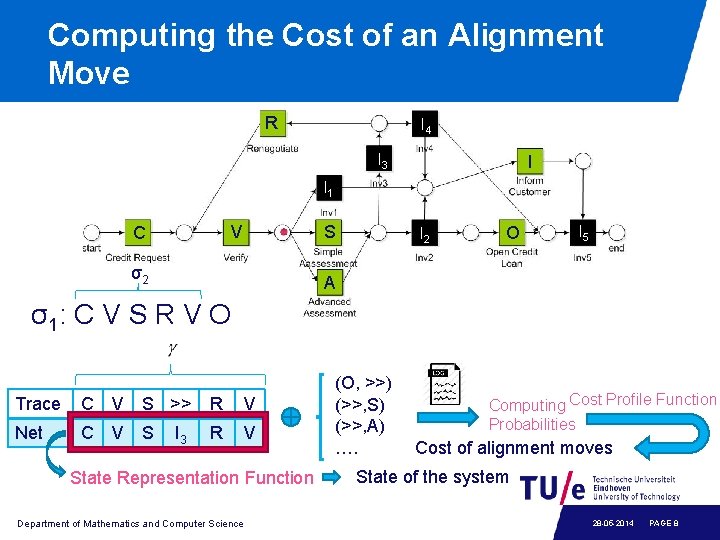
Computing the Cost of an Alignment Move R I 4 I 3 I I 1 V C S σ2 I 2 O I 5 A σ 1: C V S R V O Trace C V S >> R V Net C V S R V I 3 State Representation Function Department of Mathematics and Computer Science (O, >>) (>>, S) (>>, A) …. Computing Cost Profile Function Probabilities Cost of alignment moves State of the system 28 -05 -2014 PAGE 8
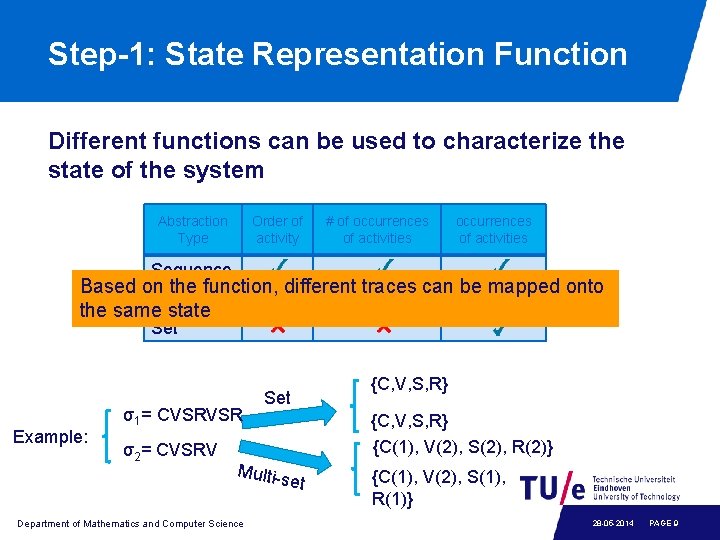
Step-1: State Representation Function Different functions can be used to characterize the state of the system Abstraction Type Order of activity # of occurrences of activities Sequence Based on the function, different traces can be mapped onto Multi-set the same state Set Example: σ1= CVSRVSR σ2= CVSRV Set {C, V, S, R} {C(1), V(2), S(2), R(2)} Multi- set Department of Mathematics and Computer Science {C, V, S, R} {C(1), V(2), S(1), R(1)} 28 -05 -2014 PAGE 9
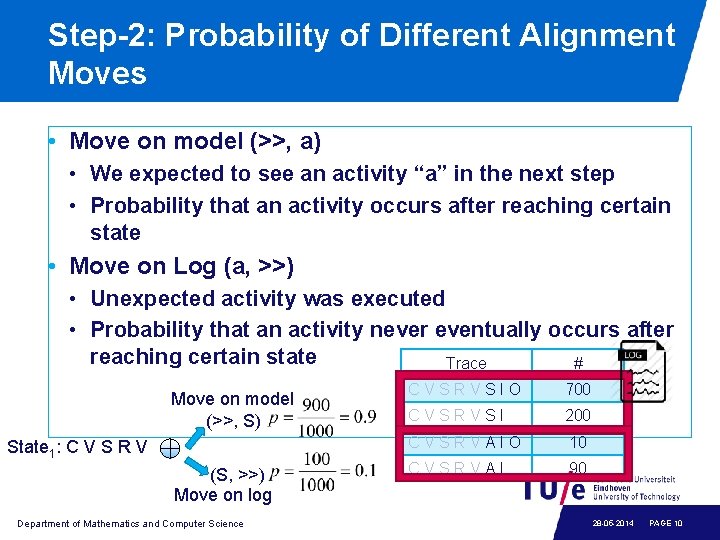
Step-2: Probability of Different Alignment Moves • Move on model (>>, a) • We expected to see an activity “a” in the next step • Probability that an activity occurs after reaching certain state • Move on Log (a, >>) • Unexpected activity was executed • Probability that an activity never eventually occurs after reaching certain state Trace # Move on model (>>, S) State 1: C V S R V (S, >>) Move on log Department of Mathematics and Computer Science CVSRVSIO 700 CVSRVSI 200 CVSRVAIO 10 CVSRVAI 90 28 -05 -2014 PAGE 10
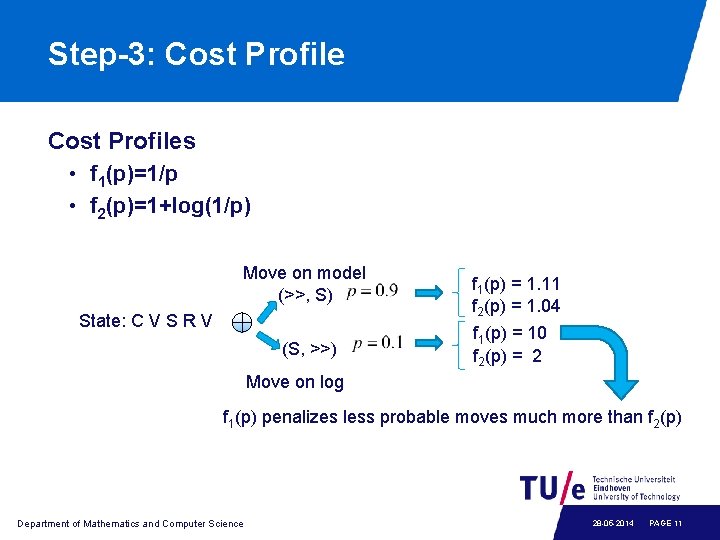
Step-3: Cost Profiles • f 1(p)=1/p • f 2(p)=1+log(1/p) Move on model (>>, S) State: C V S R V (S, >>) f 1(p) = 1. 11 f 2(p) = 1. 04 f 1(p) = 10 f 2(p) = 2 Move on log f 1(p) penalizes less probable moves much more than f 2(p) Department of Mathematics and Computer Science 28 -05 -2014 PAGE 11
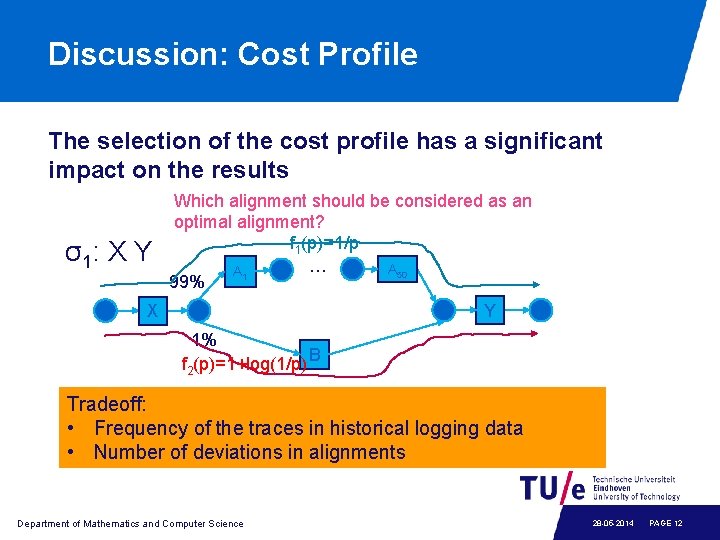
Discussion: Cost Profile The selection of the cost profile has a significant impact on the results σ 1: X Y Which alignment should be considered as an optimal alignment? f 1(p)=1/p … A 50 A 1 99% Y X 1% f 2(p)=1+log(1/p) B Tradeoff: • Frequency of the traces in historical logging data • Number of deviations in alignments Department of Mathematics and Computer Science 28 -05 -2014 PAGE 12
Alignment History-Aware Conformance Checking Department of Mathematics and Computer Science Evaluation Future Works 28 -05 -2014 PAGE 13
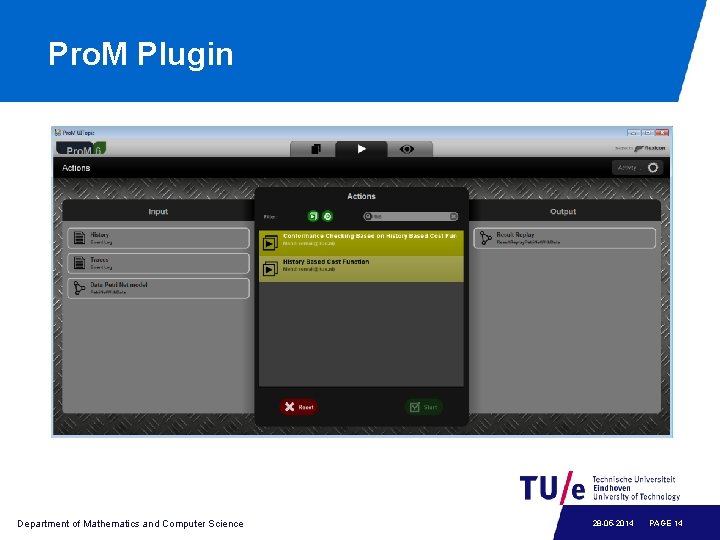
Pro. M Plugin Department of Mathematics and Computer Science 28 -05 -2014 PAGE 14
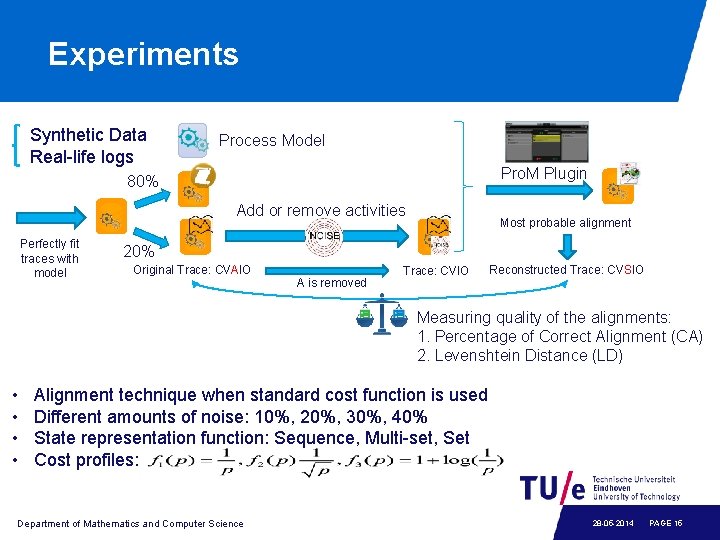
Experiments Synthetic Data Real-life logs Process Model Pro. M Plugin 80% Add or remove activities Perfectly fit traces with model Most probable alignment 20% Original Trace: CVAIO A is removed Trace: CVIO Reconstructed Trace: CVSIO Measuring quality of the alignments: 1. Percentage of Correct Alignment (CA) 2. Levenshtein Distance (LD) • • Alignment technique when standard cost function is used Different amounts of noise: 10%, 20%, 30%, 40% State representation function: Sequence, Multi-set, Set Cost profiles: Department of Mathematics and Computer Science 28 -05 -2014 PAGE 15
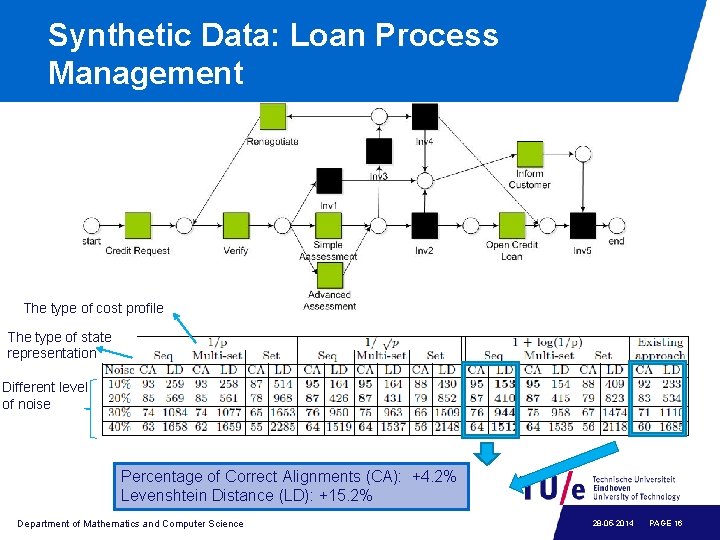
Synthetic Data: Loan Process Management The type of cost profile The type of state representation Different level of noise Percentage of Correct Alignments (CA): +4. 2% Levenshtein Distance (LD): +15. 2% Department of Mathematics and Computer Science 28 -05 -2014 PAGE 16
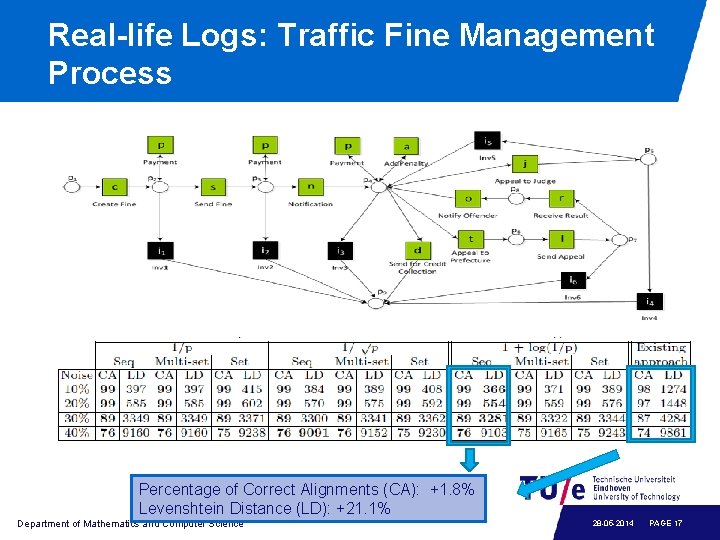
Real-life Logs: Traffic Fine Management Process Percentage of Correct Alignments (CA): +1. 8% Levenshtein Distance (LD): +21. 1% Department of Mathematics and Computer Science 28 -05 -2014 PAGE 17
Alignment History-Aware Conformance Checking Department of Mathematics and Computer Science Evaluation Future Works 28 -05 -2014 PAGE 18
Future Works • History-aware conformance checking • Cost-profile function • Considering other business process perspectives (e. g. data, context, resources) • Severity Cost function (quantification of deviations) Department of Mathematics and Computer Science 28 -05 -2014 PAGE 19

Thanks for your attention. Department of Mathematics and Computer Science 28 -05 -2014 PAGE 20
- Slides: 21