
History Unit 2 Lesson 29 of 30 Worksheet
- Slides: 10
History: Unit 2 Lesson 29 of 30 Worksheet: What was the impact of the colonisation of Virginia and why did it fail?
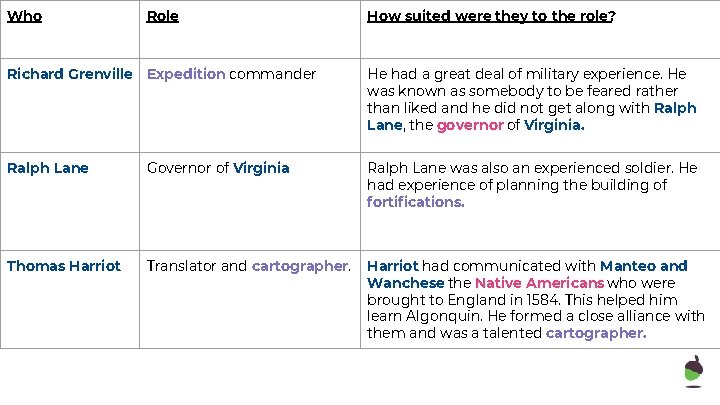
Who Role How suited were they to the role? Richard Grenville Expedition commander He had a great deal of military experience. He was known as somebody to be feared rather than liked and he did not get along with Ralph Lane, the governor of Virginia. Ralph Lane Governor of Virginia Ralph Lane was also an experienced soldier. He had experience of planning the building of fortifications. Thomas Harriot Translator and cartographer. Harriot had communicated with Manteo and Wanchese the Native Americans who were brought to England in 1584. This helped him learn Algonquin. He formed a close alliance with them and was a talented cartographer.
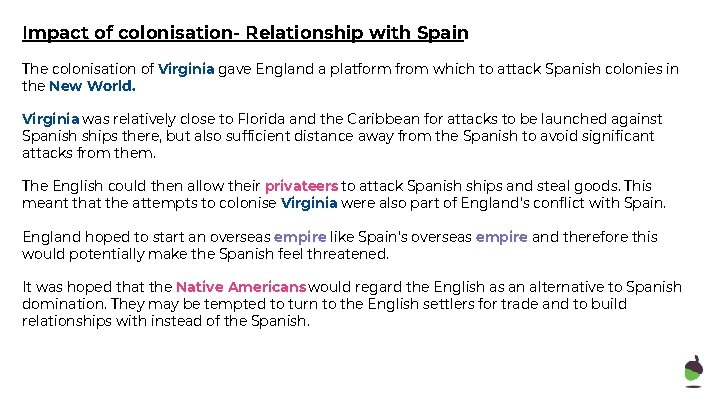
Impact of colonisation- Relationship with Spain The colonisation of Virginia gave England a platform from which to attack Spanish colonies in the New World. Virginia was relatively close to Florida and the Caribbean for attacks to be launched against Spanish ships there, but also sufficient distance away from the Spanish to avoid significant attacks from them. The English could then allow their privateers to attack Spanish ships and steal goods. This meant that the attempts to colonise Virginia were also part of England’s conflict with Spain. England hoped to start an overseas empire like Spain’s overseas empire and therefore this would potentially make the Spanish feel threatened. It was hoped that the Native Americans would regard the English as an alternative to Spanish domination. They may be tempted to turn to the English settlers for trade and to build relationships with instead of the Spanish.
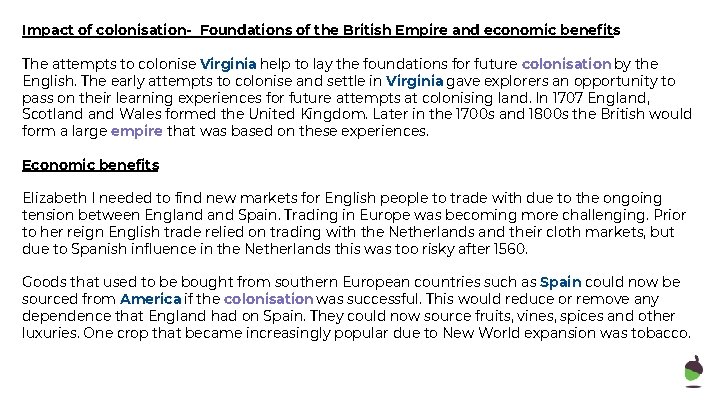
Impact of colonisation- Foundations of the British Empire and economic benefits The attempts to colonise Virginia help to lay the foundations for future colonisation by the English. The early attempts to colonise and settle in Virginia gave explorers an opportunity to pass on their learning experiences for future attempts at colonising land. In 1707 England, Scotland Wales formed the United Kingdom. Later in the 1700 s and 1800 s the British would form a large empire that was based on these experiences. Economic benefits Elizabeth I needed to find new markets for English people to trade with due to the ongoing tension between England Spain. Trading in Europe was becoming more challenging. Prior to her reign English trade relied on trading with the Netherlands and their cloth markets, but due to Spanish influence in the Netherlands this was too risky after 1560. Goods that used to be bought from southern European countries such as Spain could now be sourced from America if the colonisation was successful. This would reduce or remove any dependence that England had on Spain. They could now source fruits, vines, spices and other luxuries. One crop that became increasingly popular due to New World expansion was tobacco.
Why did it fail? Problems with the voyage: unrealistic expectations The voyage to the Americas proved challenging. The colonists left England later than they hoped to. This meant that when they arrived they had left it too late to plant crops that would grow and therefore supply the settlers when they arrived. One of the ships that Raleigh sent, known as the Tiger, was damaged on the voyage and the seawater caused ruined supplies. Worse was to come as the seeds that were going to be used to grow crops were also destroyed. They could now no longer rely on themselves for crops and supplies. They would now need help from the Native American people which may cause tension between the settlers and the Native Americans.
Why did it fail? Unrealistic expectations The colonists also had unrealistic expectations of life in Virginia. The Spanish missions and stories told by merchants who had travelled to the New World made potential settlers believe that the land would allow them to get rich quickly with little work. . The precious metals that they hoped to find were not there and their lack of resources after the voyage left them having to rely on the Native Americans and scavenging for food. The settlers did not work well together. The more well-off settlers were unhappy about the amount of physical work involved and wrongly believed that they could use the Native Americans as a workforce on their behalf. Many of the military personnel such as soldiers on the voyage were vital in defending the colonies but they were not necessarily able to farm the land. This contributed to the problems in supplying food to the settlers. They were also lacking discipline. One soldier is reported to have been executed as a way of trying to deter soldier from such ill discipline. They did take some skilled settlers but they had too many farmers and insufficient craftsmen. They had many artisans, such as bakers and weavers, but those artisans did not have the raw materials to work with. This meant that they were unable to use their skills when they arrived.
Why did it fail? Inexperience and Native American Resistance The settlers did not have enough knowledge of the area of Virginia and the problems they would face when they arrived. The English had not made such a mission to settle in this type of area before and were therefore not prepared for the environment they tried to settle in. This led to a reliance on the Native American people which led to tension between the settlers and their Native Americans. Despite taking Manteo and Wanchese with them to help establish relations with the Algonquian people, the settlers angered the Native Americans. A local chief named Wingina, was the ruler of the Roanake Island a small settlement on the mainland area of the Virginian settlement. He was wary of the English people. He believed they had supernatural powers to kill people without touching them. This was in reality due to the settlers bringing germs and diseases that the Native Americans had not faced before with deadly consequences for many Native Americans. This along with the anger over the settlers over reliance on the Native Americans for crops led to Wingina asking for other chiefs to join him in attacking the colonists. The attack in spring 1586 led to Wingina’s death as Ralph Lane ambushed the Native Americans. However this led to Lane and the settlers abandoning the settlement and arriving back in Portsmouth, England on the 27 th July 1586.
Glossary Colony - An area of land, usually a country, that is taken over and controlled by another country. Colonists - People who settle in an area of land that they have taken over that was not their original home. Fortification- A building or buildings designed for the protect the land that a group occupy in warfare. Cartographer- A person who studies the practice of making maps. Empire - A group of countries ruled over by one person or individual country.
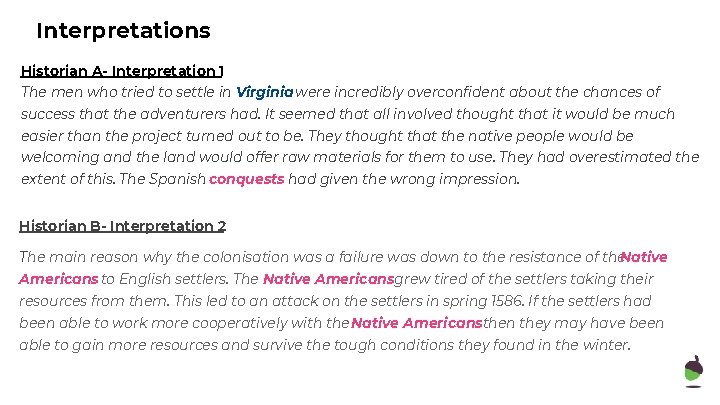
Interpretations Historian A- Interpretation 1 The men who tried to settle in Virginia were incredibly overconfident about the chances of success that the adventurers had. It seemed that all involved thought that it would be much easier than the project turned out to be. They thought that the native people would be welcoming and the land would offer raw materials for them to use. They had overestimated the extent of this. The Spanish conquests had given the wrong impression. Historian B- Interpretation 2 The main reason why the colonisation was a failure was down to the resistance of the. Native Americans to English settlers. The Native Americansgrew tired of the settlers taking their resources from them. This led to an attack on the settlers in spring 1586. If the settlers had been able to work more cooperatively with the Native Americansthen they may have been able to gain more resources and survive the tough conditions they found in the winter.
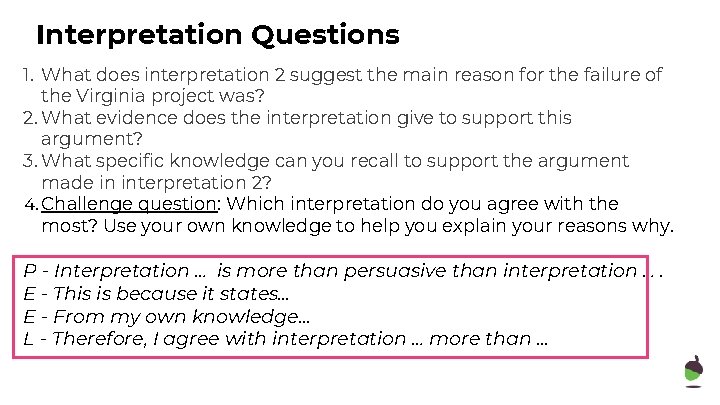
Interpretation Questions 1. What does interpretation 2 suggest the main reason for the failure of the Virginia project was? 2. What evidence does the interpretation give to support this argument? 3. What specific knowledge can you recall to support the argument made in interpretation 2? 4. Challenge question: Which interpretation do you agree with the most? Use your own knowledge to help you explain your reasons why. P - Interpretation … is more than persuasive than interpretation …. E - This is because it states. . . E - From my own knowledge. . . L - Therefore, I agree with interpretation … more than. . .