
History UK REF 2021 Impact Professor Dinah Birch
History UK REF 2021: Impact Professor Dinah Birch Chair, REF Main Panel D 4 th September 2019 Follow us on Twitter @REF_2021 Email us: info@ref. ac. uk
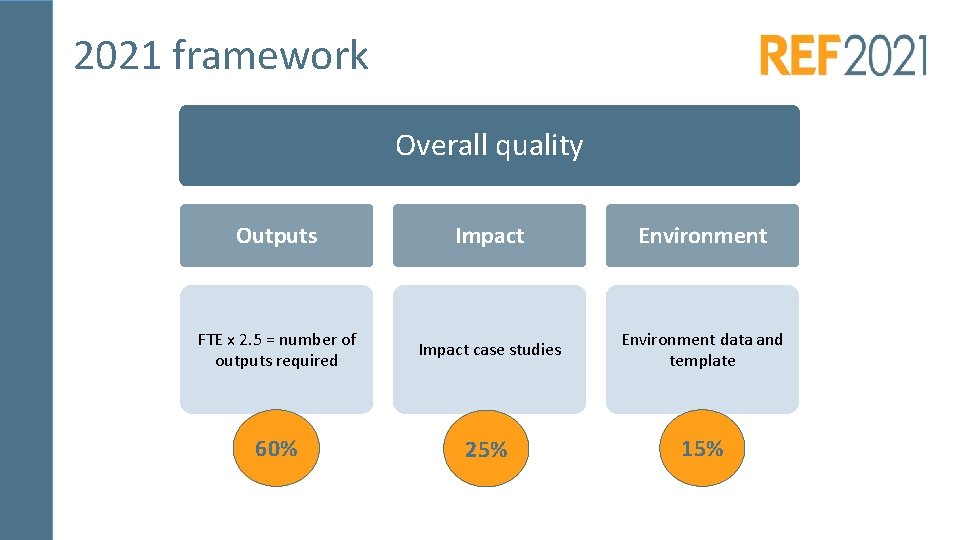
2021 framework Overall quality Outputs Impact Environment FTE x 2. 5 = number of outputs required Impact case studies Environment data and template 60% 25% 15%
Expert panels • 34 sub-panels working under the guidance of four main panels with advice from Equality and Diversity and Interdisciplinary Research advisory panels (EDAP and IDAP) • Two-stage appointment process (via nominations): 1. Criteria-setting phase – sufficient members appointed to ensure each sub-panel has appropriate expertise 2. Assessment phase – recruitment in 2020 of additional panel members and assessors to ensure appropriate breadth of expertise and number of panel members necessary for the assessment phase, informed by the survey of institutions’ submission intentions in 2019.
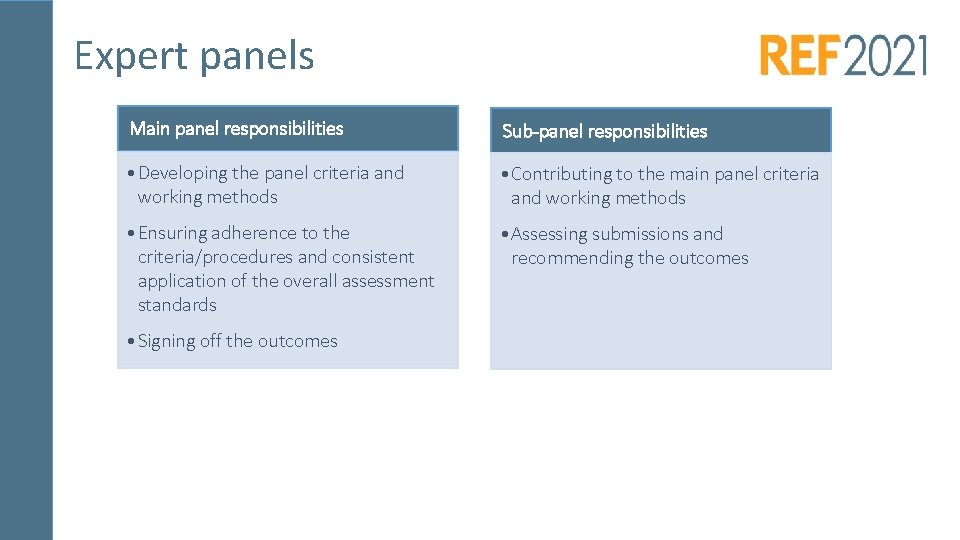
Expert panels Main panel responsibilities Sub-panel responsibilities • Developing the panel criteria and working methods • Contributing to the main panel criteria and working methods • Ensuring adherence to the criteria/procedures and consistent application of the overall assessment standards • Assessing submissions and recommending the outcomes • Signing off the outcomes
Panel criteria Aims • build on REF 2014 criteria to create continuity • achieve consistency across the main panels, where possible, while taking into account disciplinary differences Structure • Unit of assessment (UOA) descriptors • Panel criteria (submissions, outputs, impact, environment) • Working methods
Impact Consistency with REF 2014 • Impact remains non-portable • 2* quality threshold • Timeframe: • 1 January 2000 - 31 December 2020 for underpinning research • 1 August 2013 - 31 July 2020 for impacts Refinements • Impact template integrated into Environment statement • Impact on teaching within (and beyond) own HEI is eligible • Enhanced clarity on scope of underpinning research – bodies of work • Guidance on submitting continued impact case studies • Enhanced guidance on public engagement
Impact – criteria Assessed against two criteria: • Reach (updated definition): Reach will be understood as the extent and/or diversity of the beneficiaries of the impact, as relevant to the nature of the impact. Reach will be assessed in terms of the extent to which the potential constituencies, number or groups of beneficiaries have been reached; it will not be assessed in purely geographic terms, nor in terms of absolute numbers of beneficiaries. The criteria will be applied wherever the impact occurred, regardless of geography or location, and whether in the UK or abroad • Significance - the degree to which the impact has enabled, enriched, influenced, informed or changed the performance, policies, practices, products, services, understanding, awareness or wellbeing of the beneficiaries.
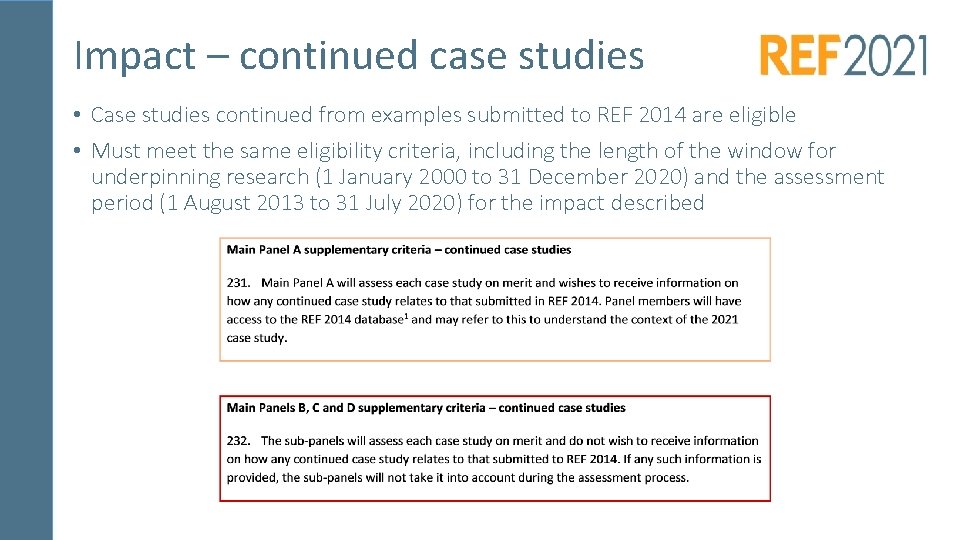
Impact – continued case studies • Case studies continued from examples submitted to REF 2014 are eligible • Must meet the same eligibility criteria, including the length of the window for underpinning research (1 January 2000 to 31 December 2020) and the assessment period (1 August 2013 to 31 July 2020) for the impact described
Impact – types and indicators • Panels welcome case studies that describe any type(s) of impact • Panel will welcome, and assess equitably, case studies describing impacts achieved through public engagement, either as the main impact described or as one facet of a wider range of impacts. • Impact on teaching within (and beyond) own HEI is eligible • Case studies must provide a clear and coherent narrative supported by verifiable evidence and indicators • Should provide evidence of reach and significance of the impacts, as distinct from evidence of dissemination or uptake • Annex A includes an extensive – but not exhaustive – list of examples of impact and indicators, including evaluation frameworks from non-HE organisations
Impact – underpinning research • Panels recognise that the relationship between research and impact can be indirect and non-linear • Underpinning research as a whole must be min. 2* quality • Case studies must include up to six key references (not every output referenced has to be 2*) – HEIs can consult the outputs glossary in the Guidance on submissions • Can also include indicators of quality e. g. evidence of peer-reviewed funding, prizes or awards for individual outputs etc. • May be a body of work produced over a number of years or may be the output(s) of a particular project • Must be produced by someone working at the HEI within the scope of the UOA descriptor • Does not need to be a Category A eligible staff member • Impact case study can be returned to different UOA from the outputs that underpin it
Impact – underpinning research Do all the outputs referenced in an impact case study need to be of at least two-star quality? Submitting units are required to provide up to six key references that represent the body of research or a research project produced by the submitting unit that underpins the impact described in the case study. The sub-panels will not expect each referenced item to meet the quality threshold, but will wish to be satisfied that the research as a whole was of at least two-star quality. Where sub-panels identify within the referenced research at least one output of two-star quality or higher, and this is a key output underpinning the impact, this will normally be sufficient to demonstrate that the underpinning research as a whole meets the quality threshold
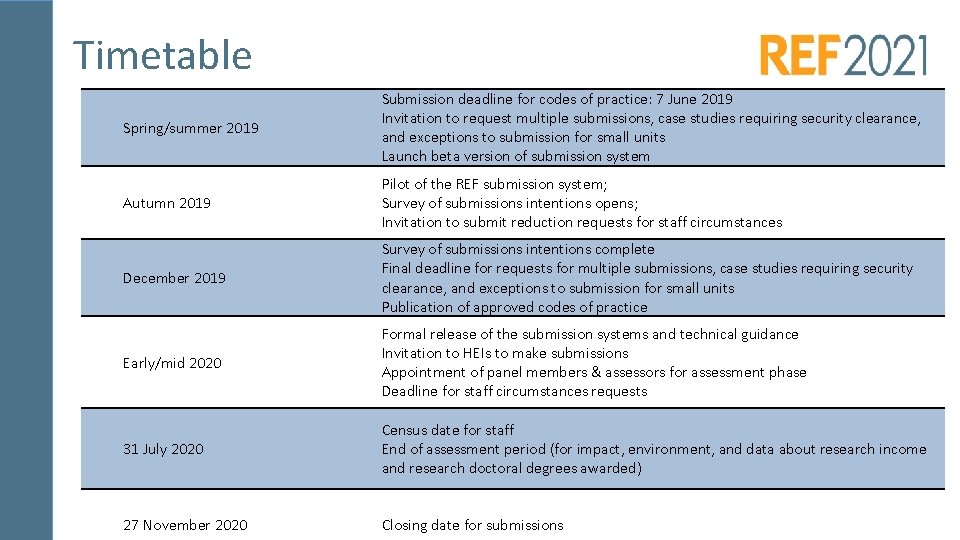
Timetable Spring/summer 2019 Submission deadline for codes of practice: 7 June 2019 Invitation to request multiple submissions, case studies requiring security clearance, and exceptions to submission for small units Launch beta version of submission system Autumn 2019 Pilot of the REF submission system; Survey of submissions intentions opens; Invitation to submit reduction requests for staff circumstances December 2019 Survey of submissions intentions complete Final deadline for requests for multiple submissions, case studies requiring security clearance, and exceptions to submission for small units Publication of approved codes of practice Early/mid 2020 Formal release of the submission systems and technical guidance Invitation to HEIs to make submissions Appointment of panel members & assessors for assessment phase Deadline for staff circumstances requests 31 July 2020 Census date for staff End of assessment period (for impact, environment, and data about research income and research doctoral degrees awarded) 27 November 2020 Closing date for submissions
Further information • www. ref. ac. uk (includes all relevant documents and FAQs) • Enquiries from staff at HEIs should be directed to their nominated institutional contact (available at www. ref. ac. uk/contact) • Other enquiries to info@ref. ac. uk
- Slides: 13