
History Techniques of Animation Chris Mc Brien Introduction
History & Techniques of Animation Chris Mc. Brien
Introduction • In this presentation I will be showing all the different types of animation techniques that has developed over the years and giving a brief history on were they came from and what they were used for in animation.
Animation Techniques • • • Zoetrope Kinetiscope flick book cel animation Rotoscoping drawn on film digital applications Claymation stop frame
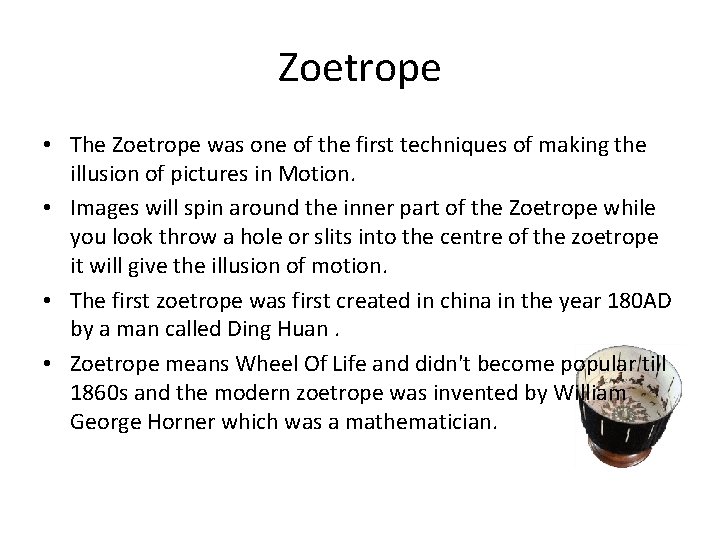
Zoetrope • The Zoetrope was one of the first techniques of making the illusion of pictures in Motion. • Images will spin around the inner part of the Zoetrope while you look throw a hole or slits into the centre of the zoetrope it will give the illusion of motion. • The first zoetrope was first created in china in the year 180 AD by a man called Ding Huan. • Zoetrope means Wheel Of Life and didn't become popular till 1860 s and the modern zoetrope was invented by William George Horner which was a mathematician.
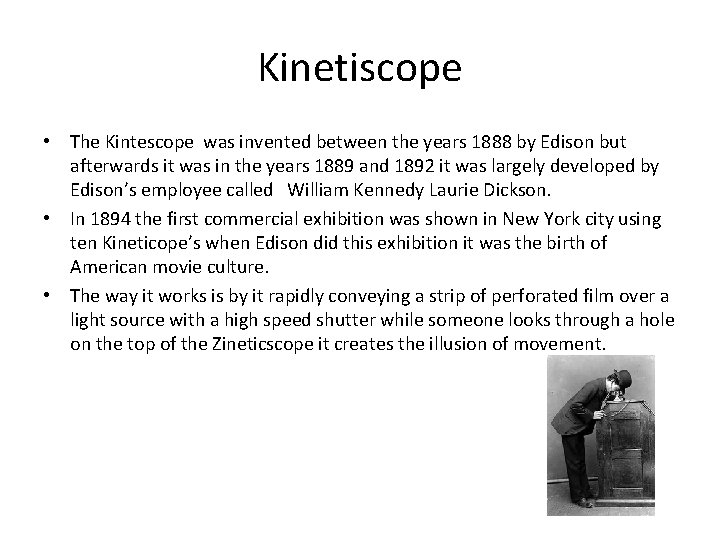
Kinetiscope • The Kintescope was invented between the years 1888 by Edison but afterwards it was in the years 1889 and 1892 it was largely developed by Edison’s employee called William Kennedy Laurie Dickson. • In 1894 the first commercial exhibition was shown in New York city using ten Kineticope’s when Edison did this exhibition it was the birth of American movie culture. • The way it works is by it rapidly conveying a strip of perforated film over a light source with a high speed shutter while someone looks through a hole on the top of the Zineticscope it creates the illusion of movement.
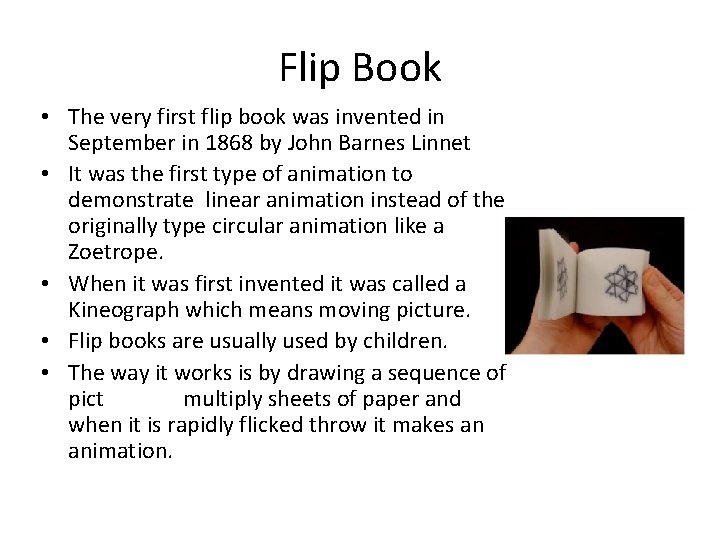
Flip Book • The very first flip book was invented in September in 1868 by John Barnes Linnet • It was the first type of animation to demonstrate linear animation instead of the originally type circular animation like a Zoetrope. • When it was first invented it was called a Kineograph which means moving picture. • Flip books are usually used by children. • The way it works is by drawing a sequence of pictures on multiply sheets of paper and when it is rapidly flicked throw it makes an animation.
Cel animation • Cel animation was first invented in 1915 by a man called Winsor Mc. Cay. • Cel animation is most popular among children cartoons like ‘Looney Toons’ and other cartoons like ‘Tom and Jerry’. • Cel animations are all ways laid out in the same steps – first you have to create a storyline then a soundtrack will have to be recorded for the background of your animation. – All drawings are made by lead animators. – Drawings will then have to be prepared for animating. – The drawings are then traced and painted onto the cels ready for animating. – The last step is then photographing each frame of the animation one by one and merging it all together to give life to the drawings.
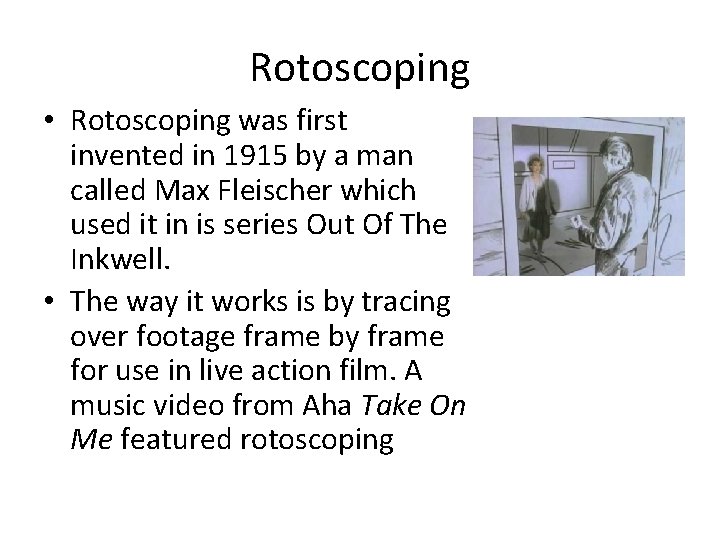
Rotoscoping • Rotoscoping was first invented in 1915 by a man called Max Fleischer which used it in is series Out Of The Inkwell. • The way it works is by tracing over footage frame by frame for use in live action film. A music video from Aha Take On Me featured rotoscoping
Drawn on film • Drawn on film or even known as direct animation is when you get film and you draw paint or glue objects onto the blank or developed film. • Large formats of film are used for drawn on film such as but 70 or 35 mm film are used more often because it has a larger area to work on • Direct animation 16 mm or 8 mm film is used because the 35 mm film is optical
Digital Applications • CGI stands for Computer Generated Imagery. • All CGI is done on a computer using software like Blender 3 D Max Maya and Unity etc. • The very first full motion picture to use CGI was Toy Story which was made by Pixar and every since Toy Story most Children and adults regularly watch films containing CGI. • Action films use CGI like 2012, Avatar, Monster inc and plenty more.
Clay mation • Clay motion is a form of stop motion using clay to sculpt your characters from hand to use in your clay mation. • Clay mation is very time consuming and very slow it can take weeks to get a few seconds of film. • You can do Claymation using you phone, webcam or the traditional way of using a camera. • You do Claymation or stop motion is by taking a picture every time you move your character
Stop Frame or Stop Motion • Stop motion animation is when you use household objects and give them motion. • Just like clay motion you have to move your object very slightly and you take a picture. • When you keep doing this it make the illusion of the object moving. • I think the best example of Stop Frame is ‘Morph’ which uses lots of household objects.
Influential Animators • • • Walt Disney, Hanna Barbera, Warner Bros, Norman Mc. Laren, Len Lye, Aardman Animations
Aardman animations • Aardman were founded in 1972 in Bristol England by Peter Lord and David Sproxton who had a dream of producing there own animated motion pictures. • They had a partnership with the BBC and created series for deaf children called Vision On after creating this they went on to create a Claymation show called Greeblies by doing this it give them the inspiration to create another T. V show called Morph • I think morph is one of my favourite pieces of work done by Aardman because I find it pretty good the way they make morph turn into different shapes and how they used things like a brush for the dog plus it really got me into doing my own stop motions
Aardman techniques • Aardman are well known for Claymation and stop motion. • They use 29. 98 frames per second • Aardman use plastersine and use a cine camera for there animations • My favourite films made by Aardman had to be Chicken Run because it was the first film I seen in the cinema a just found it amazing how they made clay figures move about the screen
Warner Bros • Warner Bros was first founded in 1918 by Albert Warner, Harry Warner, Sam Warner and Jack Warner in Burbank California USA. • They had been making films since 1904. In 192535 Warner brothers stared to make colour and sound films. • By the 1930 s they started doing cartoons like Looney Toons, Tom and Jerry and Flintstones Hanna Barbera also helped to make Tom and Jerry and Flintstones.
Warner Bros • Warner Bros use a few types of animation like cell animation and CGI • The reason why I like Warner bros is mostly because of there animation cartoons like Tom and Jerry and Loony toons and the style of drawing also the fact that in tom and jerry there is no dialog just animation.
Contemporary Uses • • • music videos, advertising, television programmes, computer games, mobile phones, internet
Music videos • There has been many music videos using animation one of the first well known tracks was Aha Take on me it was done using Rotoscopeing many more videos followed like (Queens of the stone age) go with the flow and Red Hot Chili Peppers – Californication
Advertising • Many adverts use animation because it can have a certain appeal which is hard to achieve with actors. The most common used animation techniques are traditional and CGI. Adverts that use animation can have a long running series of animations like the Kellogg's Snap crackle and pop or the coco pops adverts
Television programming • There are many show that do animation in there shows like family guy, south park and many others but the earliest were in the 1960 s from Hanna Barbara which was Flintstones which used cel animation
Computer Games • In most video games today most of the movement of charters are done by motion capture in a green room by doing this it makes the movement look more realistic and better looking for the game
Mobile phones • All mobile phones have a amount of animations like apps and games like anger birds and other things would use basic animations
Internet • The internet has millions of types of animations things like animated videos on the internet like youtube, mini games that you play on the internet also GIFs that are 3 seconds long and have a constant loop.
- Slides: 24