
History Taking in Paediatrics Hamish Robertson Paediatric Histories

History Taking in Paediatrics Hamish Robertson
Paediatric Histories • Mostly the same as adult histories • Some important extra questions to ask • Real Life: involve child as much as possible • Exam: no child, talking with the parent
Basics • Who are you talking to? • How old is the child? • Presenting complaint Confirm the problem list and screen for anything else • History of presenting complaint ICE – how is this affecting the child and the family? What are they worried about?
General Questions • Many paediatric conditions can present generally: • How is their general health? Any concerns? • Are they chronically unwell, or are they normally well and active? • Specifically: • Rashes • Fever • Eating & Drinking • Toileting • Behaviour
Systems Review
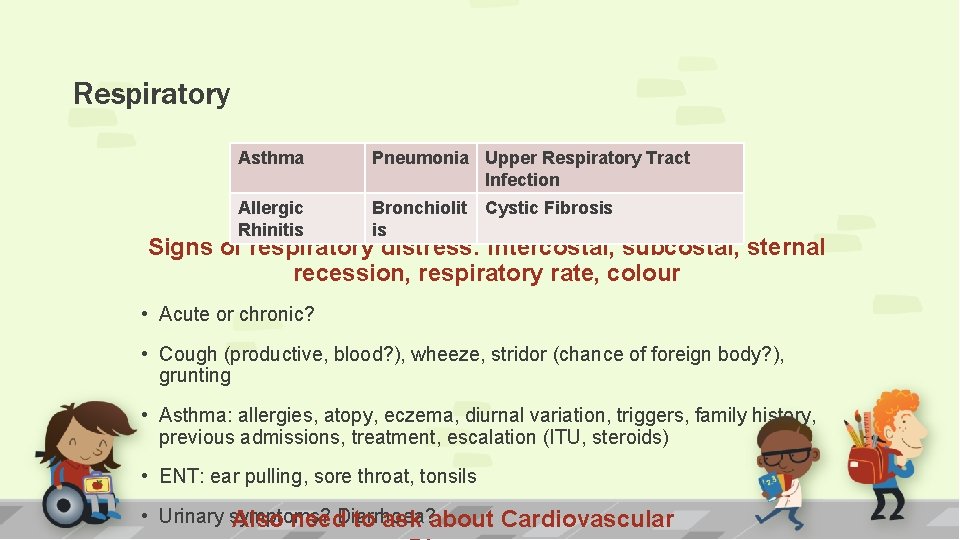
Respiratory Asthma Pneumonia Upper Respiratory Tract Infection Allergic Rhinitis Bronchiolit Cystic Fibrosis is Signs of respiratory distress: intercostal, subcostal, sternal recession, respiratory rate, colour • Acute or chronic? • Cough (productive, blood? ), wheeze, stridor (chance of foreign body? ), grunting • Asthma: allergies, atopy, eczema, diurnal variation, triggers, family history, previous admissions, treatment, escalation (ITU, steroids) • ENT: ear pulling, sore throat, tonsils • Urinary symptoms? Also need. Diarrhoea? to ask about Cardiovascular
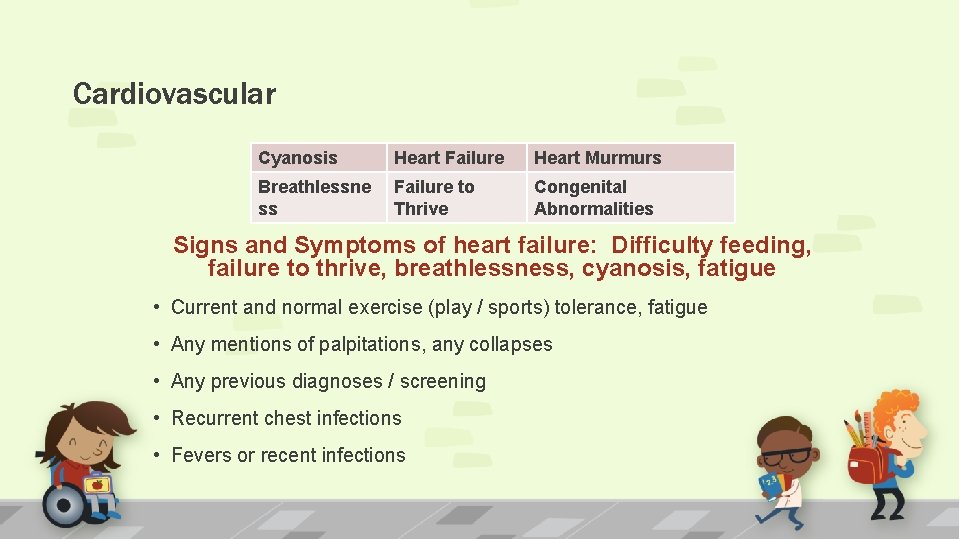
Cardiovascular Cyanosis Heart Failure Heart Murmurs Breathlessne ss Failure to Thrive Congenital Abnormalities Signs and Symptoms of heart failure: Difficulty feeding, failure to thrive, breathlessness, cyanosis, fatigue • Current and normal exercise (play / sports) tolerance, fatigue • Any mentions of palpitations, any collapses • Any previous diagnoses / screening • Recurrent chest infections • Fevers or recent infections
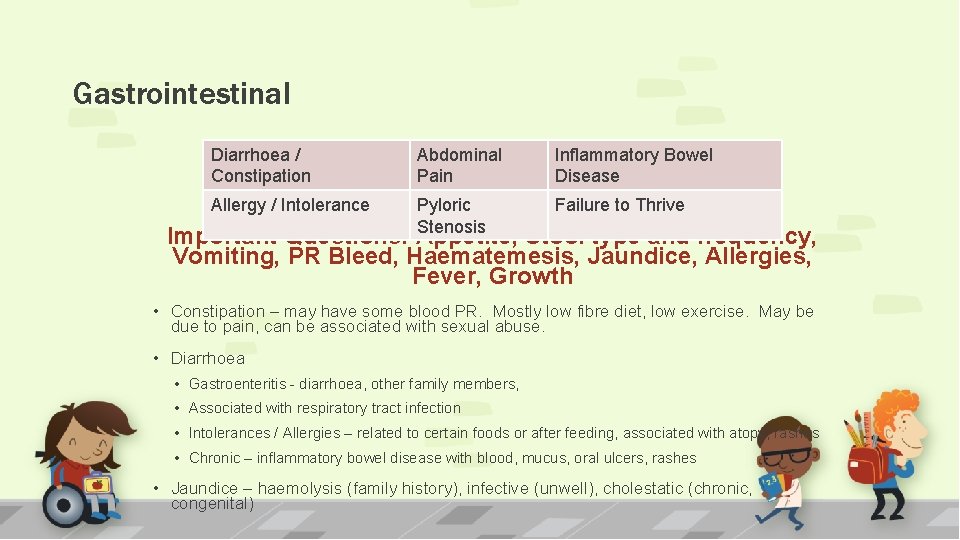
Gastrointestinal Diarrhoea / Constipation Abdominal Pain Inflammatory Bowel Disease Allergy / Intolerance Pyloric Stenosis Failure to Thrive Important Questions: Appetite, Stool type and frequency, Vomiting, PR Bleed, Haematemesis, Jaundice, Allergies, Fever, Growth • Constipation – may have some blood PR. Mostly low fibre diet, low exercise. May be due to pain, can be associated with sexual abuse. • Diarrhoea • Gastroenteritis - diarrhoea, other family members, • Associated with respiratory tract infection • Intolerances / Allergies – related to certain foods or after feeding, associated with atopy, rashes • Chronic – inflammatory bowel disease with blood, mucus, oral ulcers, rashes • Jaundice – haemolysis (family history), infective (unwell), cholestatic (chronic, congenital)
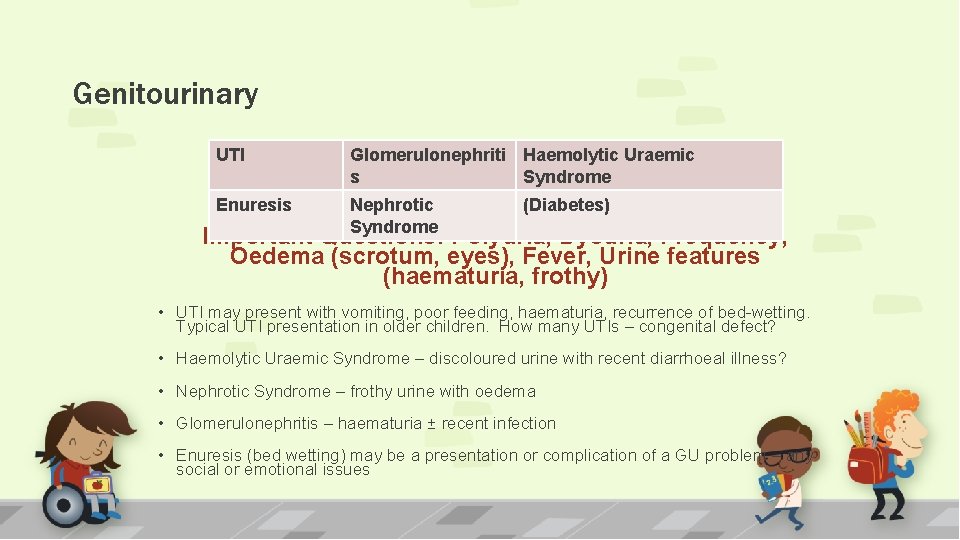
Genitourinary UTI Glomerulonephriti Haemolytic Uraemic s Syndrome Enuresis Nephrotic Syndrome (Diabetes) Important Questions: Polyuria, Dysuria, Frequency, Oedema (scrotum, eyes), Fever, Urine features (haematuria, frothy) • UTI may present with vomiting, poor feeding, haematuria, recurrence of bed-wetting. Typical UTI presentation in older children. How many UTIs – congenital defect? • Haemolytic Uraemic Syndrome – discoloured urine with recent diarrhoeal illness? • Nephrotic Syndrome – frothy urine with oedema • Glomerulonephritis – haematuria ± recent infection • Enuresis (bed wetting) may be a presentation or complication of a GU problem – any social or emotional issues
Musculoskeletal Limp Infection Arthritis HSP SUFE Perthes ’ Important Questions: Pain, Redness, Swelling, Fever, Rashes, Gait, Family History, Neonatal Screening, Normal Physical Activity • Septic Arthritis / Osteomyelitis– hot, red, swollen joint with fever, may have superficial skin infection or recently unwell. May have chronic illness (e. g. Sickle Cell Disease) • Limp could be Hip / Femur / Knee / Foot / Ankle • Consider haematological and oncological causes of bone pain • Neonatal hip screening results • Which joints affected and when
Neurological Headache Seizures Meningitis / Encephalitis Neuromuscular / Muscular Disorders Important Questions: Fever, Rashes, Photophobia, Meningism, Involuntary Movements, Unusual Behaviours, School Performance, Loss of Consciousness, Headache, Vomiting • Seizures / Epilepsy – triggers, antecedents, aura, nature of seizure, ictal period. Febrile? • Headache – worse in the morning? Loss of balance, altered behaviour consider space occupying lesion • Musuclar disorders – family history
Past Medical History • Prenatal history – gestation, maternal or foetal complications during pregnancy, medication during pregnancy • Birth history: birth weight, duration of labour, maternal fever, premature rupture of membranes, intervention at delivery • Neonatal period: any complications require ITU or SCBU, neonatal jaundice, cyanosis, respiratory distress, neonatal screening results • Childhood history: illnesses and infections, seeing any specialists for anything • Immunisation record – if anything is missed find out why • Check drug history – check reason for each; allergies – check reaction
Developmental History • Any parental concerns with hearing or vision • Any concerns with developmental milestones – any regression? • Bladder and bowel control? • Child’s behaviour • Sleeping problems • School concerns
Family History • Age of parents and siblings • Illnesses in the family – seizures, asthma, cancer, heart disease, TB • Check general health of siblings and household • Deaths of children in the family • Consider consanguinity
Social History • Who does the child live with? • Who looks after the child? • Parental occupation? • Any pets? • Smoking, alcohol, drugs? Family or child • Everything okay at home? • Involvement of a social worker?
Wrapping Up • Make sure you summarise • Check for any more ICE • Ask if the parent has any questions they would like to ask
Don’t forget… this is CCS! • Confirm problem list and screen for anything else • Signpost what you’re going to talk about • Summarise occasionally (at least once and at the end) • Pick up on cues (they may be obvious but more difficult in exam) • Open – closed questioning • Clarifies vague statements (tummy-pain, not themselves) • Avoid jargon • Empathy
Don’t forget… this is a Finals exam! • Summarise your findings (1 - 2 sentences) • Give a differential diagnosis • What are you most worried about? • How would you manage (investigation / treatment)?

Good Luck!
- Slides: 19