
HISTORY TAKING AND NEUROLOGICAL EXAMINATION DR M SOFI
- Slides: 8
HISTORY TAKING AND NEUROLOGICAL EXAMINATION DR. M. SOFI MD; FRCP (London); FRCPEdin; FRCSEdin 20/09/2016
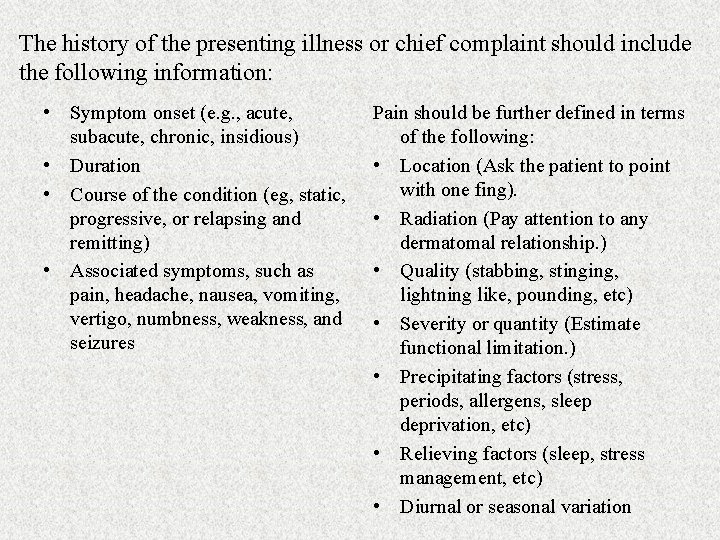
The history of the presenting illness or chief complaint should include the following information: • Symptom onset (e. g. , acute, subacute, chronic, insidious) • Duration • Course of the condition (eg, static, progressive, or relapsing and remitting) • Associated symptoms, such as pain, headache, nausea, vomiting, vertigo, numbness, weakness, and seizures Pain should be further defined in terms of the following: • Location (Ask the patient to point with one fing). • Radiation (Pay attention to any dermatomal relationship. ) • Quality (stabbing, stinging, lightning like, pounding, etc) • Severity or quantity (Estimate functional limitation. ) • Precipitating factors (stress, periods, allergens, sleep deprivation, etc) • Relieving factors (sleep, stress management, etc) • Diurnal or seasonal variation
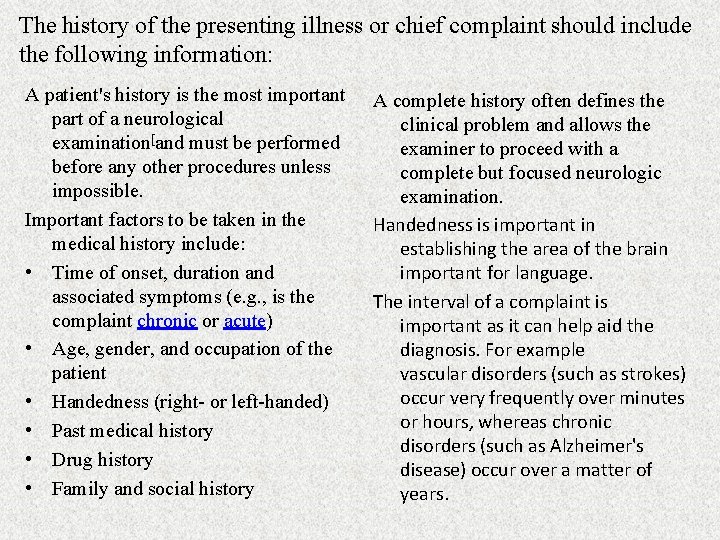
The history of the presenting illness or chief complaint should include the following information: A patient's history is the most important part of a neurological examination[and must be performed before any other procedures unless impossible. Important factors to be taken in the medical history include: • Time of onset, duration and associated symptoms (e. g. , is the complaint chronic or acute) • Age, gender, and occupation of the patient • Handedness (right- or left-handed) • Past medical history • Drug history • Family and social history A complete history often defines the clinical problem and allows the examiner to proceed with a complete but focused neurologic examination. Handedness is important in establishing the area of the brain important for language. The interval of a complaint is important as it can help aid the diagnosis. For example vascular disorders (such as strokes) occur very frequently over minutes or hours, whereas chronic disorders (such as Alzheimer's disease) occur over a matter of years.
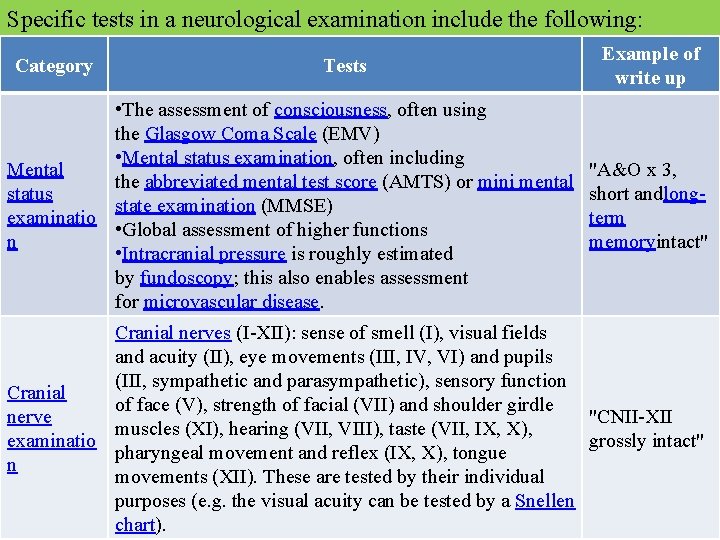
Specific tests in a neurological examination include the following: Category Tests • The assessment of consciousness, often using the Glasgow Coma Scale (EMV) • Mental status examination, often including Mental the abbreviated mental test score (AMTS) or mini mental status state examination (MMSE) examinatio • Global assessment of higher functions n • Intracranial pressure is roughly estimated by fundoscopy; this also enables assessment for microvascular disease. Example of write up "A&O x 3, short andlongterm memoryintact" Cranial nerves (I-XII): sense of smell (I), visual fields and acuity (II), eye movements (III, IV, VI) and pupils (III, sympathetic and parasympathetic), sensory function Cranial of face (V), strength of facial (VII) and shoulder girdle "CNII-XII nerve muscles (XI), hearing (VII, VIII), taste (VII, IX, X), examinatio grossly intact" pharyngeal movement and reflex (IX, X), tongue n movements (XII). These are tested by their individual purposes (e. g. the visual acuity can be tested by a Snellen chart).
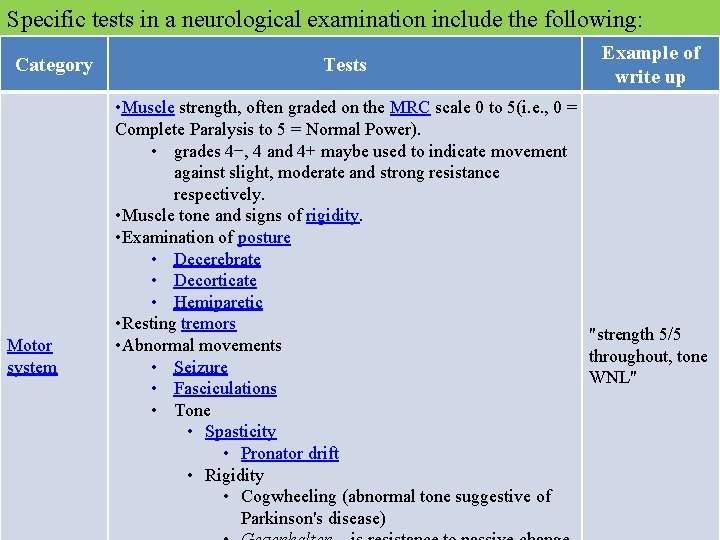
Specific tests in a neurological examination include the following: Category Motor system Tests Example of write up • Muscle strength, often graded on the MRC scale 0 to 5(i. e. , 0 = Complete Paralysis to 5 = Normal Power). • grades 4−, 4 and 4+ maybe used to indicate movement against slight, moderate and strong resistance respectively. • Muscle tone and signs of rigidity. • Examination of posture • Decerebrate • Decorticate • Hemiparetic • Resting tremors "strength 5/5 • Abnormal movements throughout, tone • Seizure WNL" • Fasciculations • Tone • Spasticity • Pronator drift • Rigidity • Cogwheeling (abnormal tone suggestive of Parkinson's disease)
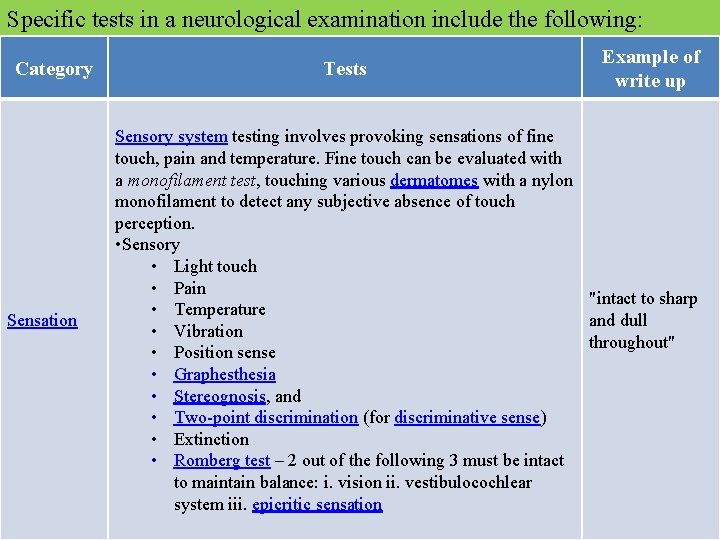
Specific tests in a neurological examination include the following: Category Sensation Tests Example of write up Sensory system testing involves provoking sensations of fine touch, pain and temperature. Fine touch can be evaluated with a monofilament test, touching various dermatomes with a nylon monofilament to detect any subjective absence of touch perception. • Sensory • Light touch • Pain "intact to sharp • Temperature and dull • Vibration throughout" • Position sense • Graphesthesia • Stereognosis, and • Two-point discrimination (for discriminative sense) • Extinction • Romberg test – 2 out of the following 3 must be intact to maintain balance: i. vision ii. vestibulocochlear system iii. epicritic sensation
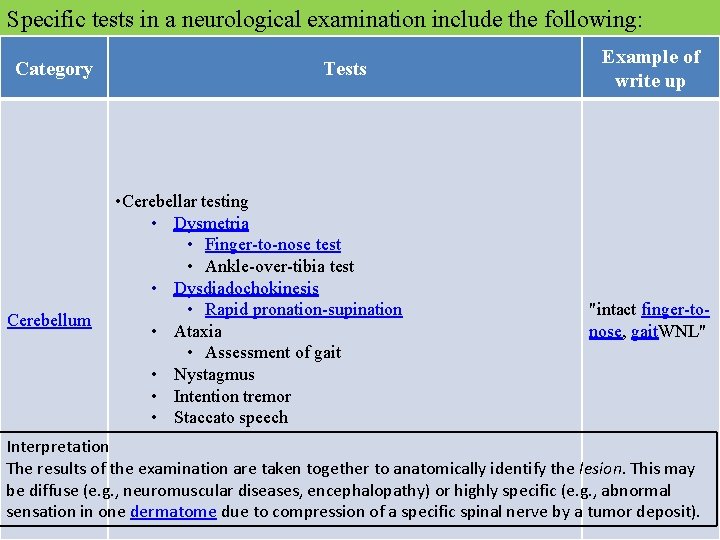
Specific tests in a neurological examination include the following: Category Cerebellum Tests • Cerebellar testing • Dysmetria • Finger-to-nose test • Ankle-over-tibia test • Dysdiadochokinesis • Rapid pronation-supination • Ataxia • Assessment of gait • Nystagmus • Intention tremor • Staccato speech Example of write up "intact finger-tonose, gait. WNL" Interpretation The results of the examination are taken together to anatomically identify the lesion. This may be diffuse (e. g. , neuromuscular diseases, encephalopathy) or highly specific (e. g. , abnormal sensation in one dermatome due to compression of a specific spinal nerve by a tumor deposit).
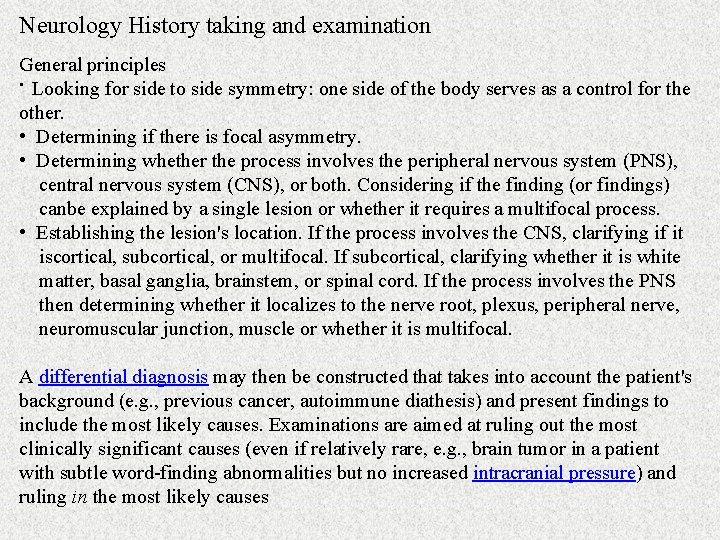
Neurology History taking and examination General principles • Looking for side to side symmetry: one side of the body serves as a control for the other. • Determining if there is focal asymmetry. • Determining whether the process involves the peripheral nervous system (PNS), central nervous system (CNS), or both. Considering if the finding (or findings) canbe explained by a single lesion or whether it requires a multifocal process. • Establishing the lesion's location. If the process involves the CNS, clarifying if it iscortical, subcortical, or multifocal. If subcortical, clarifying whether it is white matter, basal ganglia, brainstem, or spinal cord. If the process involves the PNS then determining whether it localizes to the nerve root, plexus, peripheral nerve, neuromuscular junction, muscle or whether it is multifocal. A differential diagnosis may then be constructed that takes into account the patient's background (e. g. , previous cancer, autoimmune diathesis) and present findings to include the most likely causes. Examinations are aimed at ruling out the most clinically significant causes (even if relatively rare, e. g. , brain tumor in a patient with subtle word-finding abnormalities but no increased intracranial pressure) and ruling in the most likely causes