
History taking and MSE Dr ABDULQADER ALJARAD Clinical

History taking and MSE Dr. ABDULQADER ALJARAD Clinical assistant professor and consultant of psychiatry and psychosomatic medicine College of medicine , KSU and KKUH
Aims of the interview � Obtain the necessary information to make a diagnosis. � Understand the person with the illness. � Understand the circumstances of the patient. � Form a relationship with the patient (rapport). � Provide the patient with information about the illness , recommendation and prognosis.
Opening (general advices ) Put patient at ease. ◦ ◦ Introduce yourself and Greet the patient by name Reassure privacy and confidentiality, separate room. L-shaped position and private comfortable setting. Suitable distance ( eg. with geriatric , with aggressive pt. ) ◦ Be supportive, attentive, non judgmental and encouraging. ◦ Explain about , yourself , the purpose of interview and expected time needed. ◦ Observe the patient’s nonverbal behavior and Avoid excessive note-taking
Opening (general advices ) � With whom you will start ( pt. or his relative ). � Why he come with a relative ? ( psychosis Vs. neurosis ) � Diagnose based on criteria and constellation of symptoms that affect functioning level (eg. Social phobia Vs. paranoid schiz. � Start with open ended questions.

Structure of history : � It is the chronological story of the patient’s life from birth to present. � It includes information about who the patient is, his problem (bio psycho-social aspects) and its possible causes and available support. � Information elicited both from the patient and from one or more informants.

Structure of history : Identification of the Patient: � Name, age, sex, marital status, occupation, education, nationality, residency. Referral Source: � Brief statement of how the patient came to the clinic and the expectations of the consultation. Chief complaint: � Exactly why the patient came to the psychiatrist, preferably in the patient’s own words.

Structure of history : HPI: ◦ Chronological background of the psychiatric problem: nature, onset, course, severity, duration, effects on the patient (social life, job, family…), ◦ review of the relevant problems, ◦ symptoms not mentioned by the patient (e. g. sleep, appetite, …), ◦ treatment taken so far (nature and effect). ◦ Important –ve (eg. history of mania in depressed patient ) ◦ Suicide , homicide, substance abuse and organic disease

Structure of history : � Past psychiatric history( admissions, depot injections , drug level. . etc ) � Past medical history. � Family history. � Social history. � Personal history (Birth and Early development, School, Occupations, Puberty & Adolescence) � Marital history. � Drug history � Tobacco and substance abuse. � legal (forensic) problems.
Structure of history : Personality Traits: ØAttitude to self (self-appraisal, performance, satisfaction, past achievements and failures, future. . ) ØMoral and religious attitudes and standards. ØPrevailing mood and emotions. ØReaction to stress (ability to tolerate frustration and disappointments, pattern of coping strategies). ØPersonal interests, habits, hobbies and leisure activities. ØInterpersonal relationships. Ø
� Transition . � Obstructive technique. � Facilitation technique : Doctors help patients continue in the interview by providing both verbal and nonverbal cues. � CLARIFICATION. In clarification, doctors attempt to get details from patients about what they have already said. � Empathy � Rapport. .

Mental status examination Ø MSE is a cross-sectional, systemic documentation of the quality of mental functioning at the time of interview. Ø The mental status examination patient’s feelings, thoughts, perception and behavior during the interview. Ø It serves as a baseline for future comparison and to follow the progress of the patient.
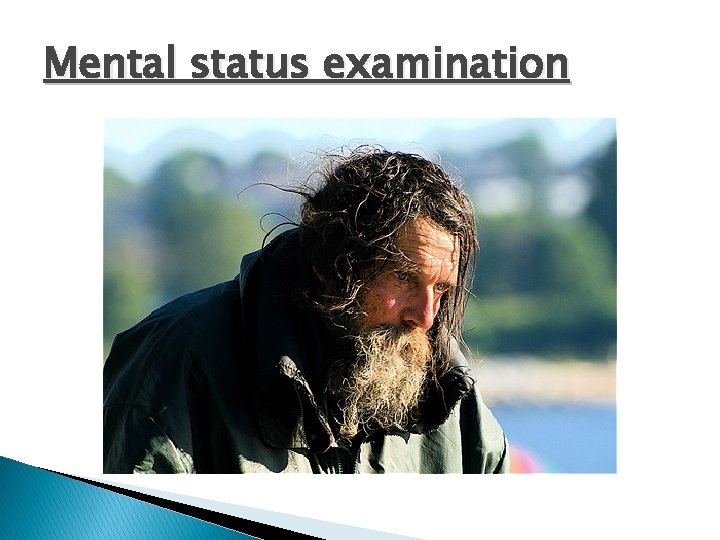
Mental status examination Appearance: include body build, self-care, clothes , grooming, hair , nails, facial expressions, and any unusual features (e. g. weight loss). q Behaviour: both the quantitative and qualitative aspects. Note level of activity, posture, eye contact and unusual movements (tics, grimacing, tremor, disinhibited behaviour, hallucinatory gestures, …etc) q Attitude: Note the patient’s attitude (verbal& non verbal) during the interview (interested, bored, cooperative, uncooperative, sarcastic, guarded or aggressive). q
Mental status examination



Mental status examination Speech: • Speech can be described in terms of its quantity, rate of production, and quality. • Listen to and describe how the patient speaks, noting: ØCoherence Øspontaneity ØVolume, flow & tone Øcontinuity Ø speech impairments (stuttering, dysarthria…)
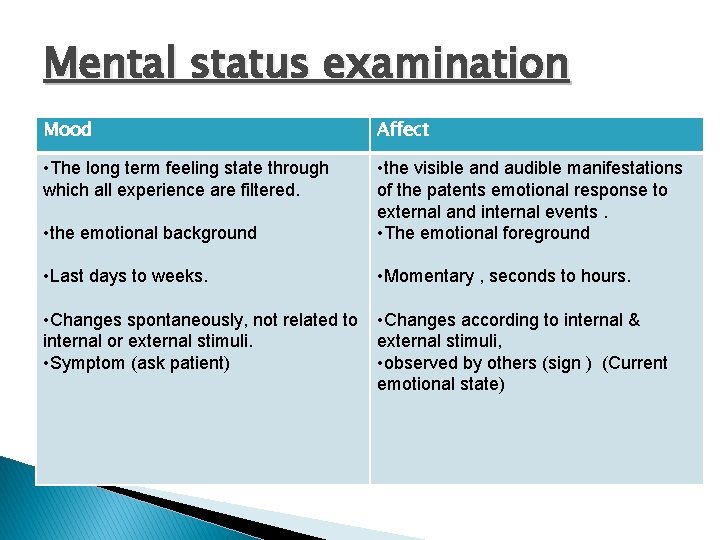
Mental status examination Mood Affect • The long term feeling state through which all experience are filtered. • the visible and audible manifestations of the patents emotional response to external and internal events. • The emotional foreground • Momentary , seconds to hours. • the emotional background • Last days to weeks. • Changes spontaneously, not related to • Changes according to internal & internal or external stimuli, • Symptom (ask patient) • observed by others (sign ) (Current emotional state)
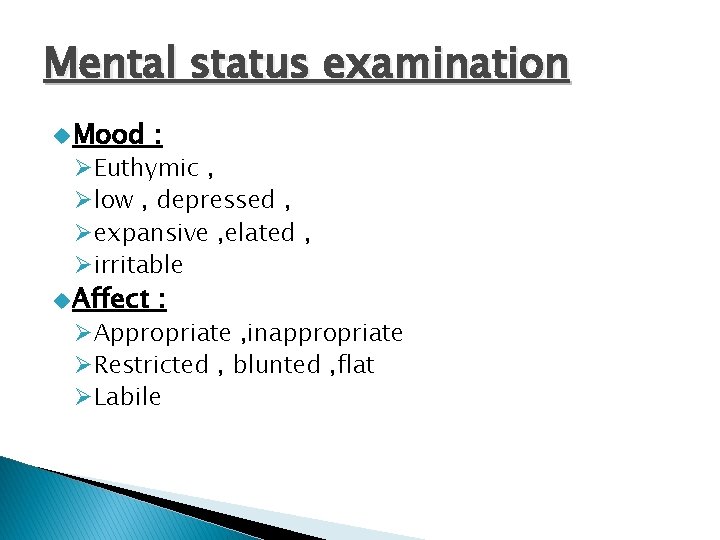
Mental status examination u Mood : u Affect : ØEuthymic , Ølow , depressed , Øexpansive , elated , Øirritable ØAppropriate , inappropriate ØRestricted , blunted , flat ØLabile
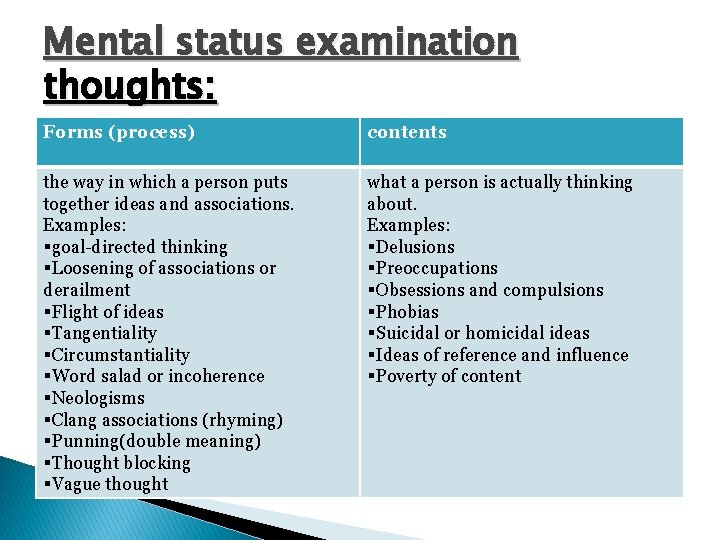
Mental status examination thoughts: Forms (process) contents the way in which a person puts together ideas and associations. Examples: §goal-directed thinking §Loosening of associations or derailment §Flight of ideas §Tangentiality §Circumstantiality §Word salad or incoherence §Neologisms §Clang associations (rhyming) §Punning(double meaning) §Thought blocking §Vague thought what a person is actually thinking about. Examples: §Delusions §Preoccupations §Obsessions and compulsions §Phobias §Suicidal or homicidal ideas §Ideas of reference and influence §Poverty of content
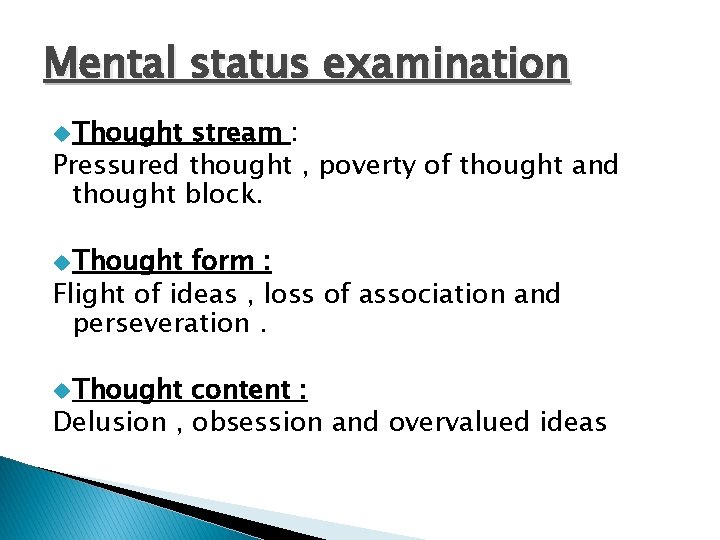
Mental status examination u Thought stream : Pressured thought , poverty of thought and thought block. u Thought form : Flight of ideas , loss of association and perseveration. u Thought content : Delusion , obsession and overvalued ideas
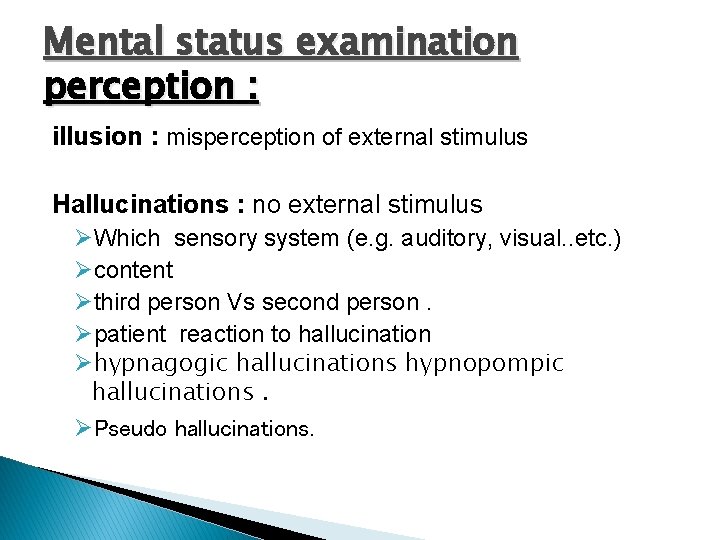
Mental status examination perception : illusion : misperception of external stimulus Hallucinations : no external stimulus ØWhich sensory system (e. g. auditory, visual. . etc. ) Øcontent Øthird person Vs second person. Øpatient reaction to hallucination Øhypnagogic hallucinations hypnopompic hallucinations. ØPseudo hallucinations.
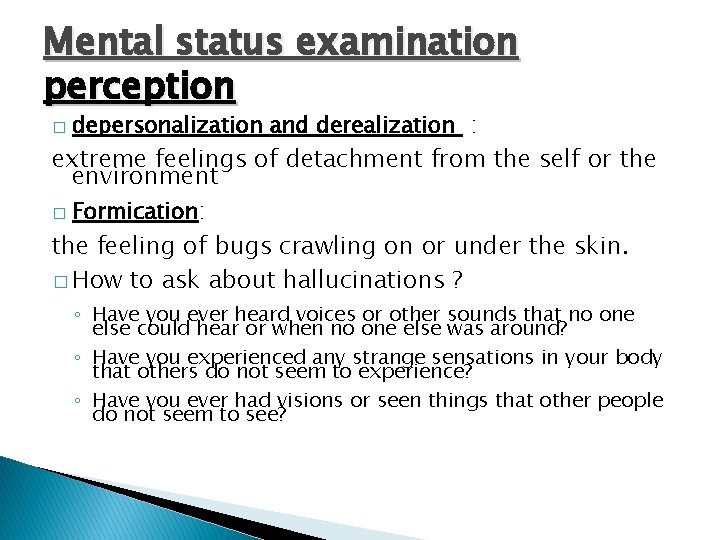
Mental status examination perception � depersonalization and derealization : extreme feelings of detachment from the self or the environment � Formication: the feeling of bugs crawling on or under the skin. � How to ask about hallucinations ? ◦ Have you ever heard voices or other sounds that no one else could hear or when no one else was around? ◦ Have you experienced any strange sensations in your body that others do not seem to experience? ◦ Have you ever had visions or seen things that other people do not seem to see?
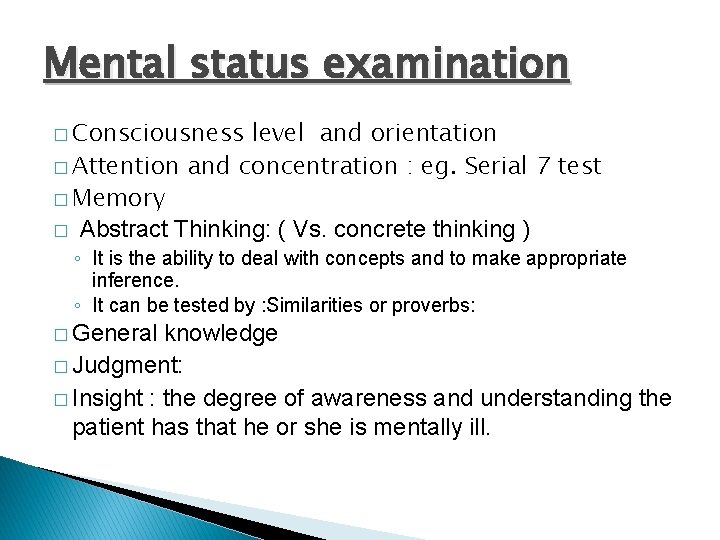
Mental status examination � Consciousness level and orientation � Attention and concentration : eg. Serial 7 test � Memory � Abstract Thinking: ( Vs. concrete thinking ) ◦ It is the ability to deal with concepts and to make appropriate inference. ◦ It can be tested by : Similarities or proverbs: � General knowledge � Judgment: � Insight : the degree of awareness and understanding the patient has that he or she is mentally ill.
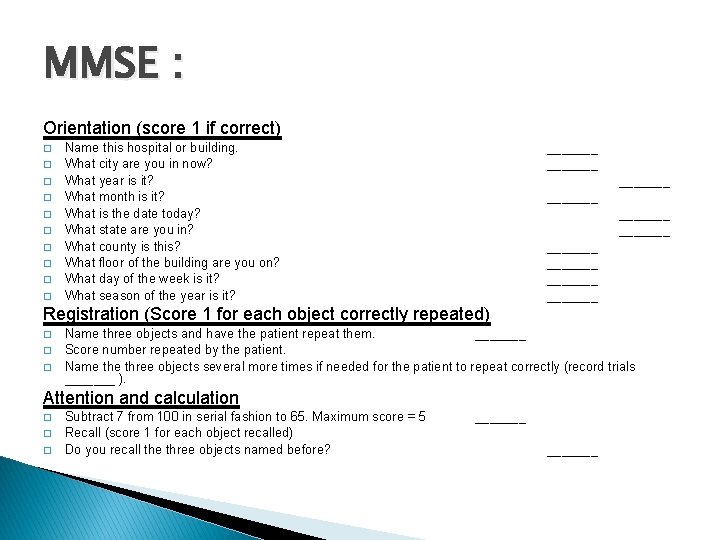
MMSE : Orientation (score 1 if correct) � � � � � Name this hospital or building. What city are you in now? What year is it? What month is it? What is the date today? What state are you in? What county is this? What floor of the building are you on? What day of the week is it? What season of the year is it? _______ _______ _______ Registration (Score 1 for each object correctly repeated) � � � Name three objects and have the patient repeat them. _______ Score number repeated by the patient. Name three objects several more times if needed for the patient to repeat correctly (record trials _______ ). Attention and calculation � � � Subtract 7 from 100 in serial fashion to 65. Maximum score = 5 Recall (score 1 for each object recalled) Do you recall the three objects named before? _______
MMSE : Language tests � � � Confrontation naming: watch, pen = 2 _______ Repetition: "No ifs, ands, or buts" = 1 _______ Comprehension: Pick up the paper in your right hand, in half, and set it on the floor = 3 Read and perform the command "close your eyes" = 1 _______ Write any sentence (subject, verb, object) = 1 _______ Construction � � � Copy the design below = 1 _______ Total MMSE questionnaire score (maximum = 30) fold it
Differential diagnoses. � Provisional (working ) diagnosis. � Investigations. � Management � ◦ (acute Vs. chronic ) ◦ Outpatient Vs. inpatient. ◦ Bio psychosocial treatment Full explanation about the plan (S/E. , efficacy , risk of addiction and any other questions from the patient. ) � Doctors explain treatment plans to patients in easily understandable language and allow patients to respond ask questions. � Prognosis. �
� Empathy To put oneself in another person's place. � Sympathy: Feeling sorry.
� Transference: The pt are transferring feelings toward others in their life onto the physician. � Counter-transference: Emotional reactions to the pt from the doc that often involve the doctor past experience.
Styles to deal with patient � The paternalistic style. � The shared decision making style.
� Professional � Difficult ◦ ◦ ◦ The The The Boundaries Doctor-Patient : Relationships Seductive Patient “Hateful” Patient With a Thousand Symptoms Patient in the Hospital Setting Mentally Disturbed Patient Dying Patient

Thank you
- Slides: 32