
History of Weaving FiberWhen did men came to
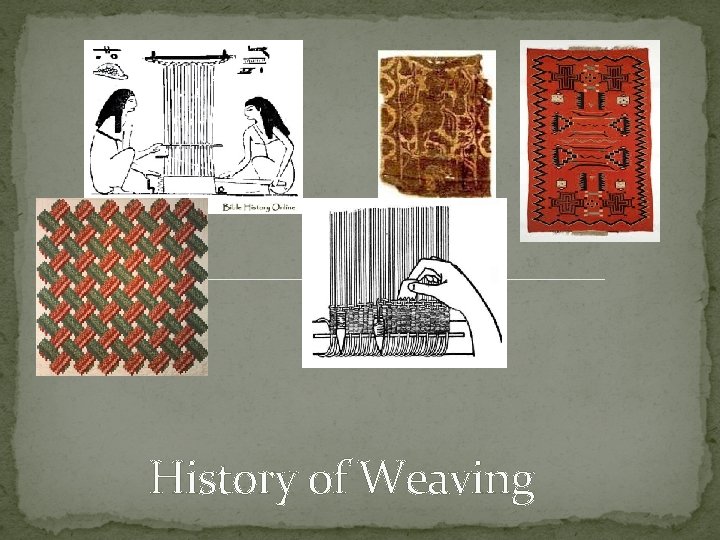
History of Weaving
Fiber…When did men came to know about it? ? ? �Sinew-a piece of tough fibrous tissue uniting muscle to bone �Flax-5000 BC, �Cotton-3000 BC, Worn by egyptian arlier than 2500 BC. �Wool-3000 BC, Used by people of the Late Stone Age �Silk-2600 BC, Began about 1725 BC
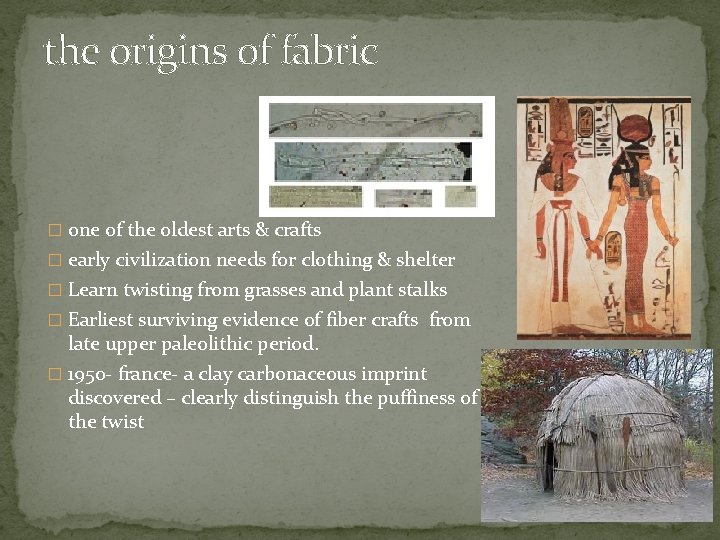
the origins of fabric � one of the oldest arts & crafts � early civilization needs for clothing & shelter � Learn twisting from grasses and plant stalks � Earliest surviving evidence of fiber crafts from late upper paleolithic period. � 1950 - france- a clay carbonaceous imprint discovered – clearly distinguish the puffiness of the twist

� The oldest example of textiles yet identified by archaeologists is at the Dzudzuana Cave in the former Soviet state of Georgia. There, a handful of flax fibers was discovered that had been twisted, cut and even dyed a range of colors. The fibers were radiocarbon-dated to between 30, 000 -36, 000 years ago. � Both sides of a fragment of a woven mat or basket container from Guitarrero
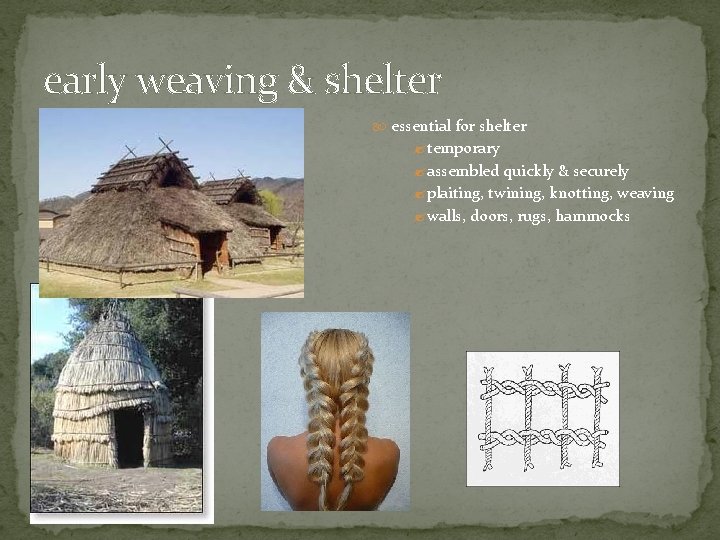
early weaving & shelter essential for shelter ? temporary ? assembled quickly & securely ? plaiting, twining, knotting, weaving ? walls, doors, rugs, hammocks
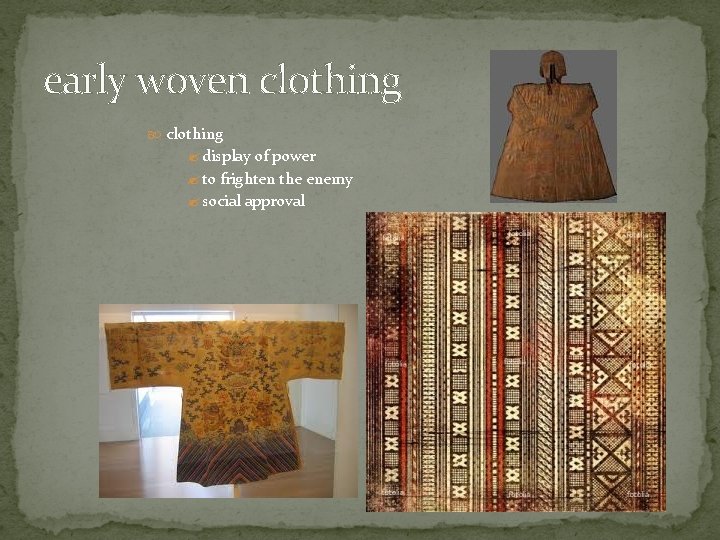
early woven clothing ? display of power ? to frighten the enemy ? social approval
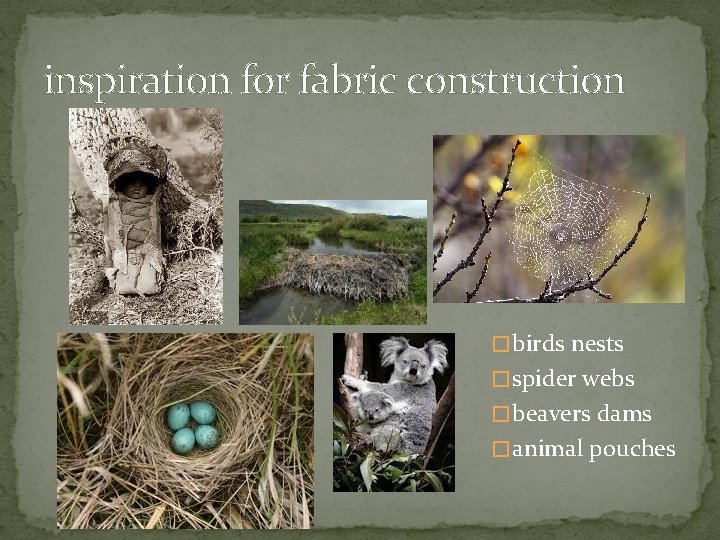
inspiration for fabric construction � birds nests � spider webs � beavers dams � animal pouches
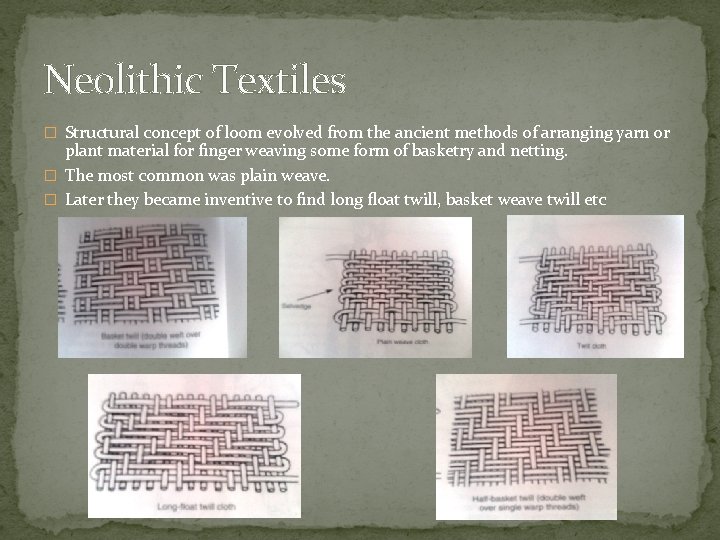
Neolithic Textiles � Structural concept of loom evolved from the ancient methods of arranging yarn or plant material for finger weaving some form of basketry and netting. � The most common was plain weave. � Later they became inventive to find long float twill, basket weave twill etc
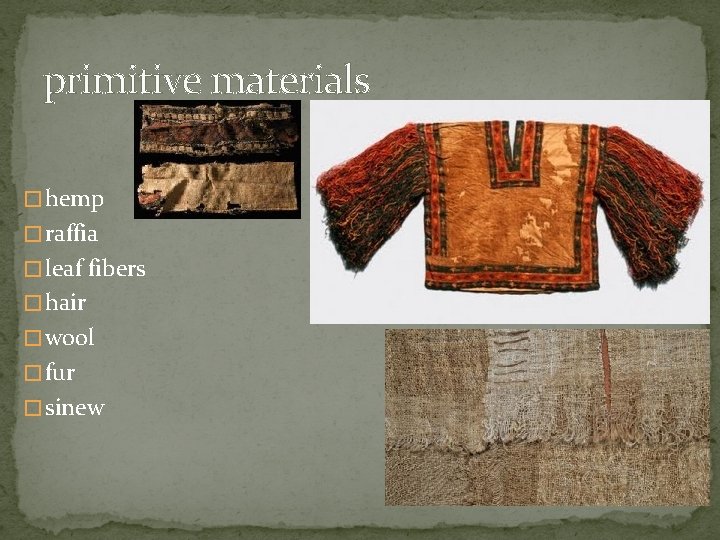
primitive materials � hemp � raffia � leaf fibers � hair � wool � fur � sinew
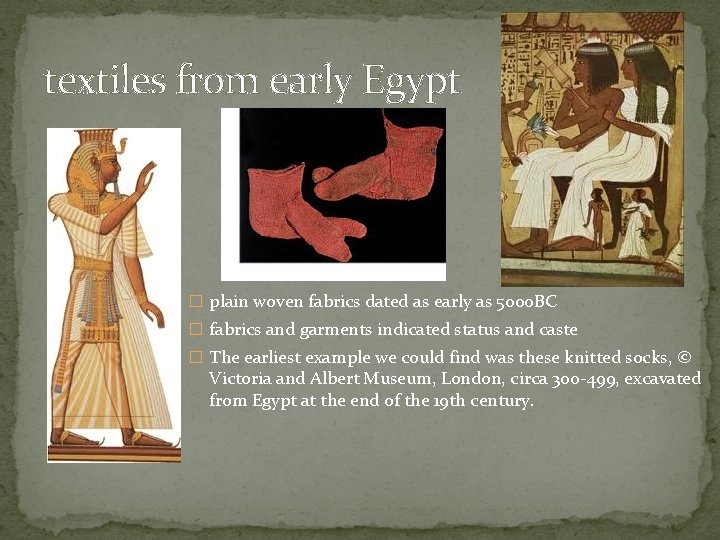
textiles from early Egypt � plain woven fabrics dated as early as 5000 BC � fabrics and garments indicated status and caste � The earliest example we could find was these knitted socks, © Victoria and Albert Museum, London, circa 300 -499, excavated from Egypt at the end of the 19 th century.
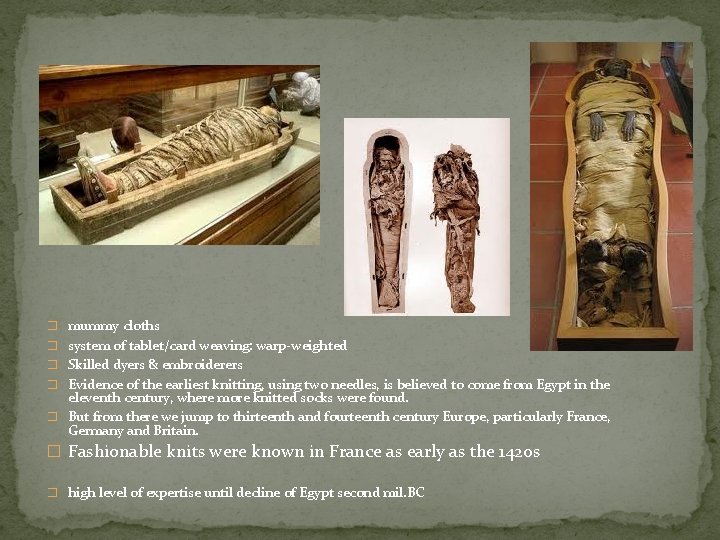
� mummy cloths � system of tablet/card weaving: warp-weighted � Skilled dyers & embroiderers � Evidence of the earliest knitting, using two needles, is believed to come from Egypt in the eleventh century, where more knitted socks were found. � But from there we jump to thirteenth and fourteenth century Europe, particularly France, Germany and Britain. � Fashionable knits were known in France as early as the 1420 s � high level of expertise until decline of Egypt second mil. BC
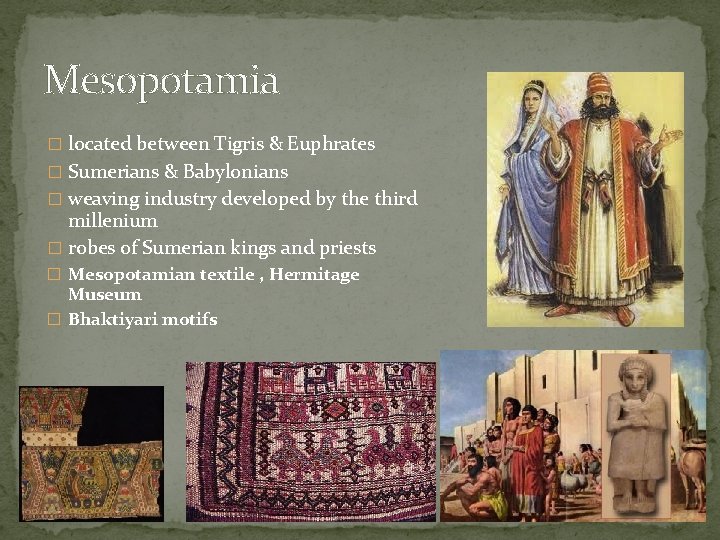
Mesopotamia � located between Tigris & Euphrates � Sumerians & Babylonians � weaving industry developed by the third millenium � robes of Sumerian kings and priests � Mesopotamian textile , Hermitage Museum � Bhaktiyari motifs
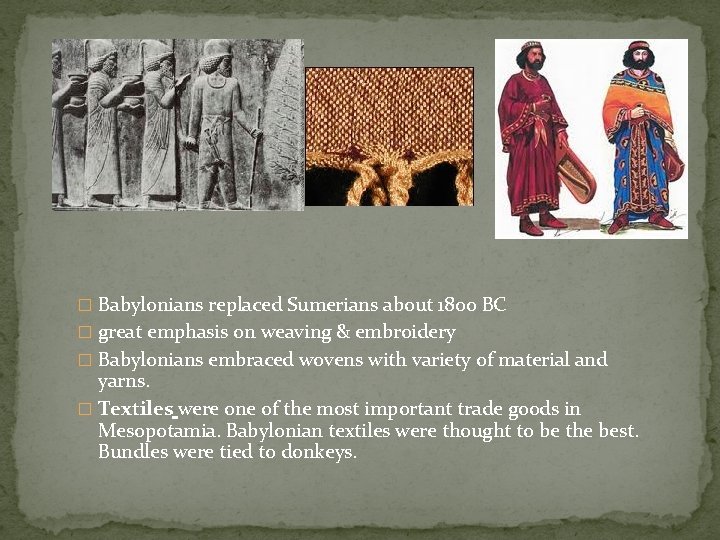
� Babylonians replaced Sumerians about 1800 BC � great emphasis on weaving & embroidery � Babylonians embraced wovens with variety of material and yarns. � Textiles were one of the most important trade goods in Mesopotamia. Babylonian textiles were thought to be the best. Bundles were tied to donkeys.
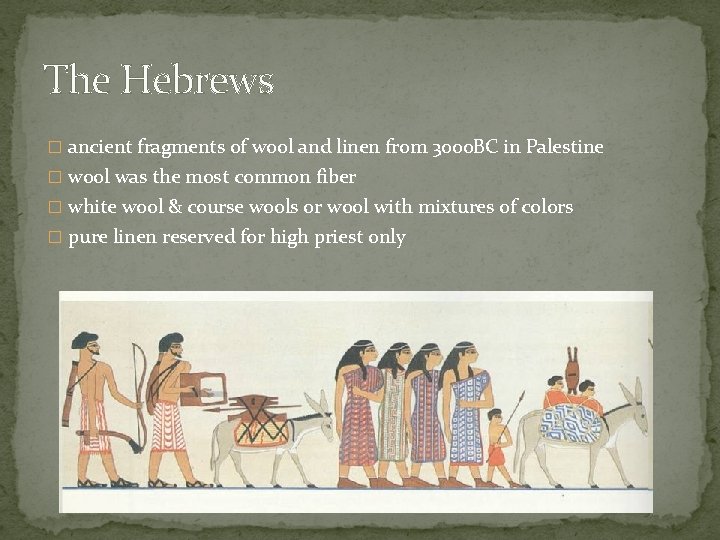
The Hebrews � ancient fragments of wool and linen from 3000 BC in Palestine � wool was the most common fiber � white wool & course wools or wool with mixtures of colors � pure linen reserved for high priest only
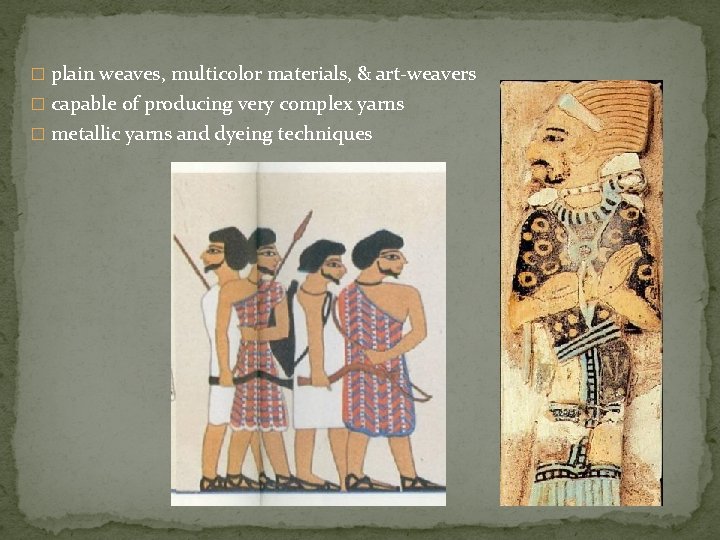
� plain weaves, multicolor materials, & art-weavers � capable of producing very complex yarns � metallic yarns and dyeing techniques
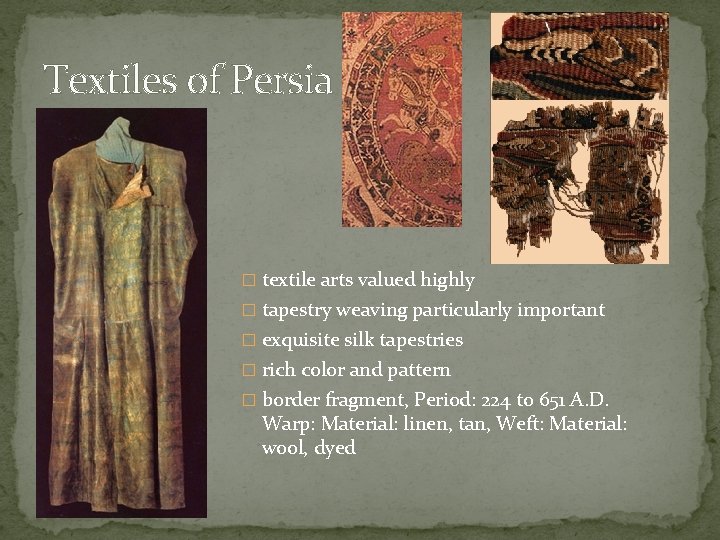
Textiles of Persia � textile arts valued highly � tapestry weaving particularly important � exquisite silk tapestries � rich color and pattern � border fragment, Period: 224 to 651 A. D. Warp: Material: linen, tan, Weft: Material: wool, dyed
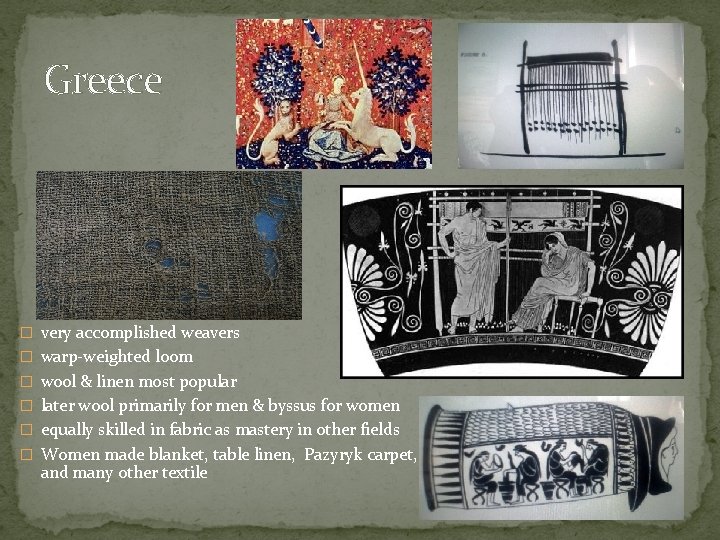
Greece � very accomplished weavers � warp-weighted loom � wool & linen most popular � later wool primarily for men & byssus for women � equally skilled in fabric as mastery in other fields � Women made blanket, table linen, Pazyryk carpet, and many other textile
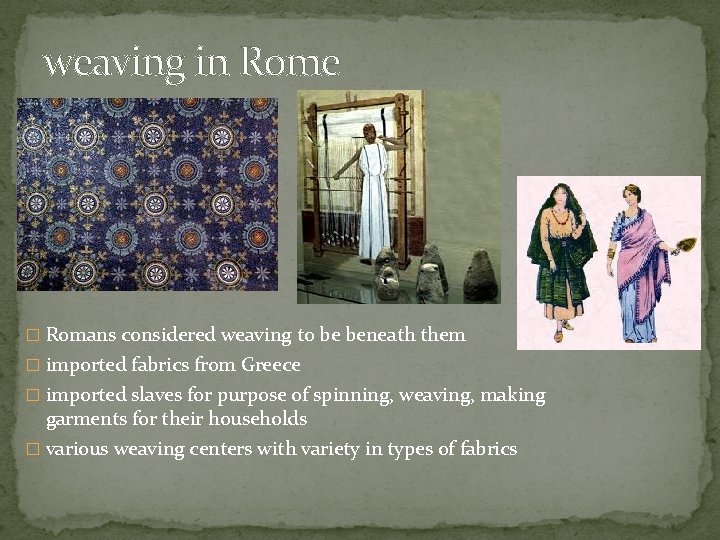
weaving in Rome � Romans considered weaving to be beneath them � imported fabrics from Greece � imported slaves for purpose of spinning, weaving, making garments for their households � various weaving centers with variety in types of fabrics
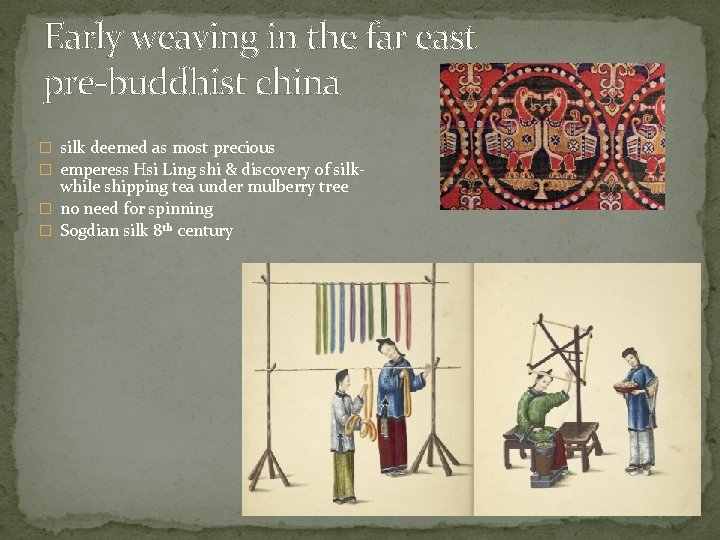
Early weaving in the far east pre-buddhist china � silk deemed as most precious � emperess Hsi Ling shi & discovery of silk- while shipping tea under mulberry tree � no need for spinning � Sogdian silk 8 th century
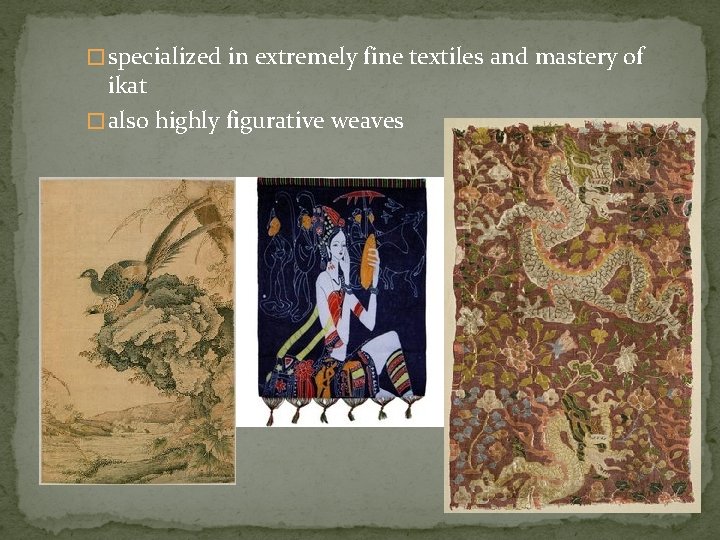
� specialized in extremely fine textiles and mastery of ikat � also highly figurative weaves
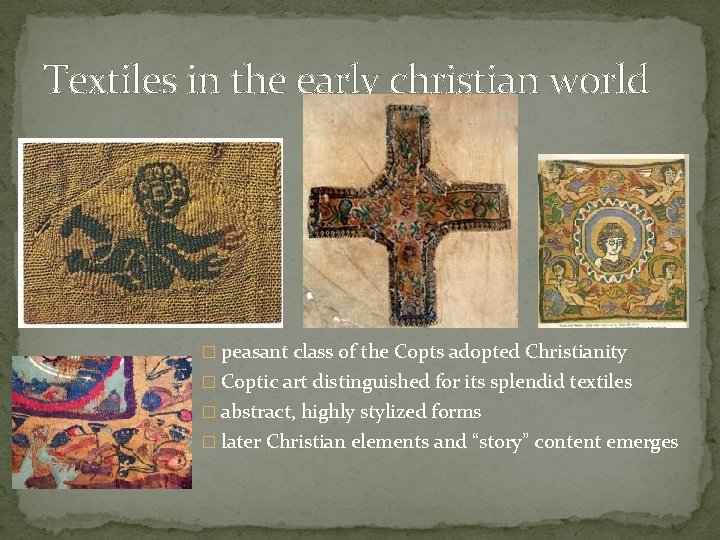
Textiles in the early christian world � peasant class of the Copts adopted Christianity � Coptic art distinguished for its splendid textiles � abstract, highly stylized forms � later Christian elements and “story” content emerges
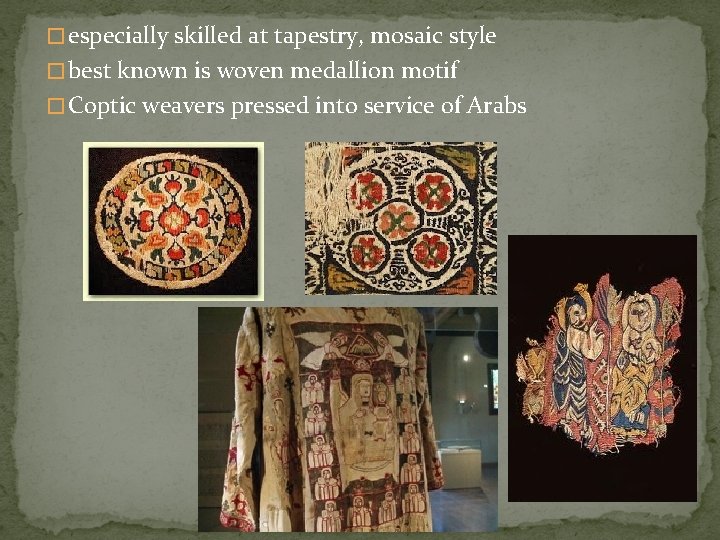
� especially skilled at tapestry, mosaic style � best known is woven medallion motif � Coptic weavers pressed into service of Arabs
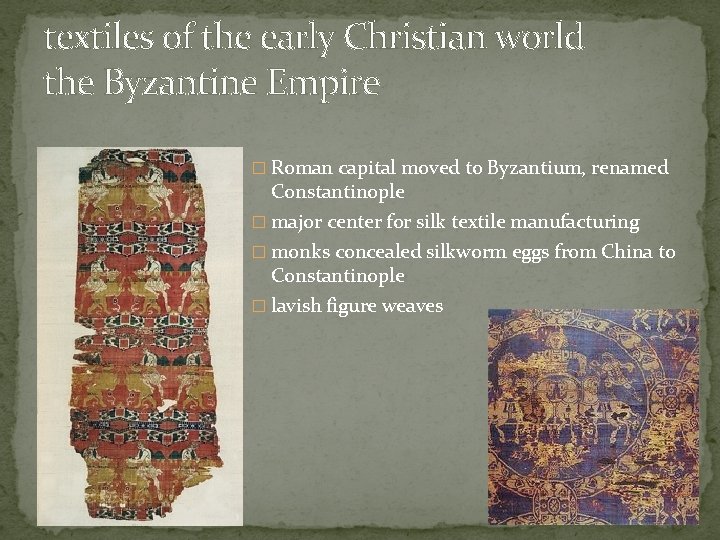
textiles of the early Christian world the Byzantine Empire � Roman capital moved to Byzantium, renamed Constantinople � major center for silk textile manufacturing � monks concealed silkworm eggs from China to Constantinople � lavish figure weaves
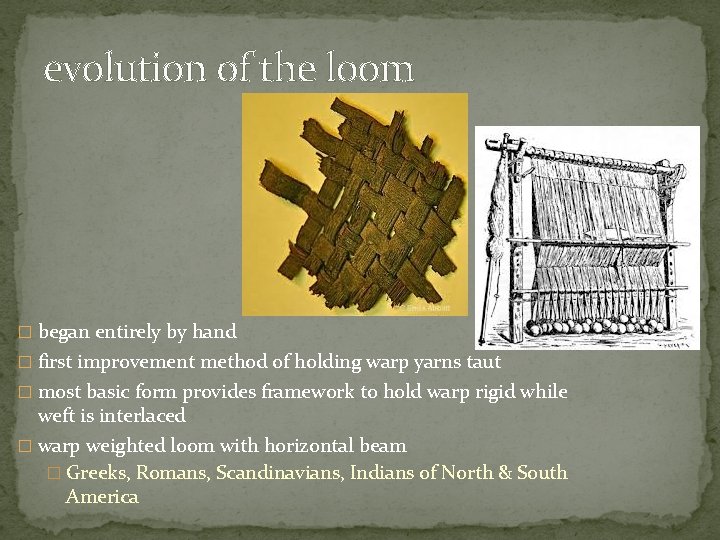
evolution of the loom � began entirely by hand � first improvement method of holding warp yarns taut � most basic form provides framework to hold warp rigid while weft is interlaced � warp weighted loom with horizontal beam � Greeks, Romans, Scandinavians, Indians of North & South America
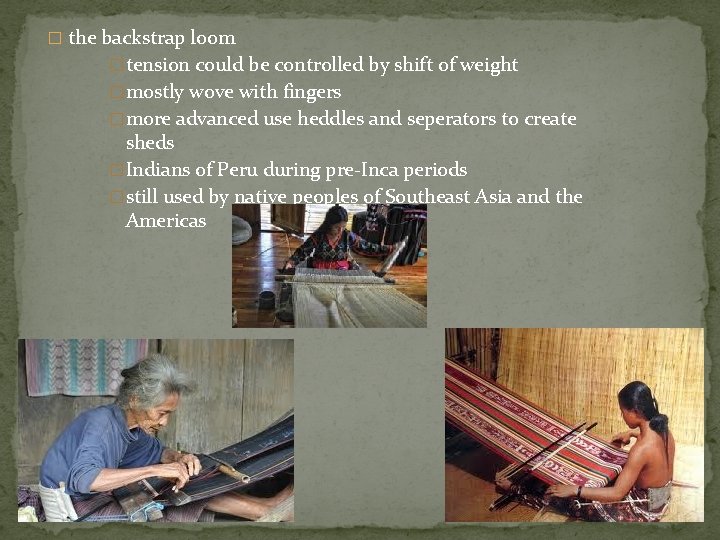
� the backstrap loom �tension could be controlled by shift of weight �mostly wove with fingers �more advanced use heddles and seperators to create sheds �Indians of Peru during pre-Inca periods �still used by native peoples of Southeast Asia and the Americas
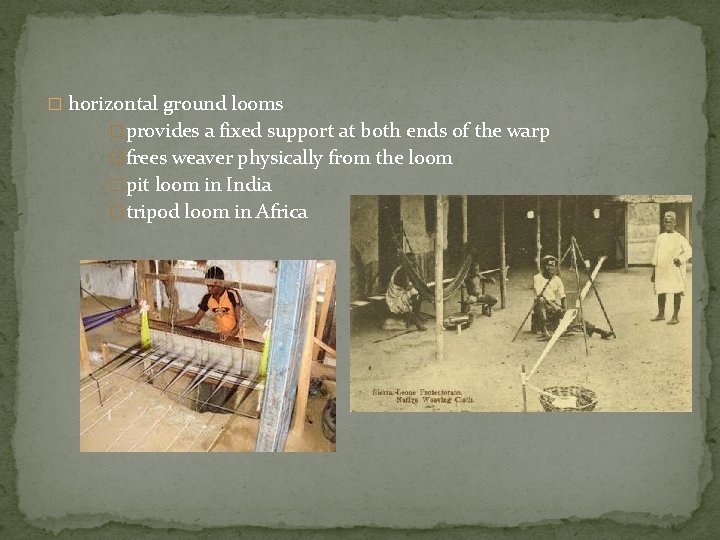
� horizontal ground looms �provides a fixed support at both ends of the warp �frees weaver physically from the loom �pit loom in India �tripod loom in Africa
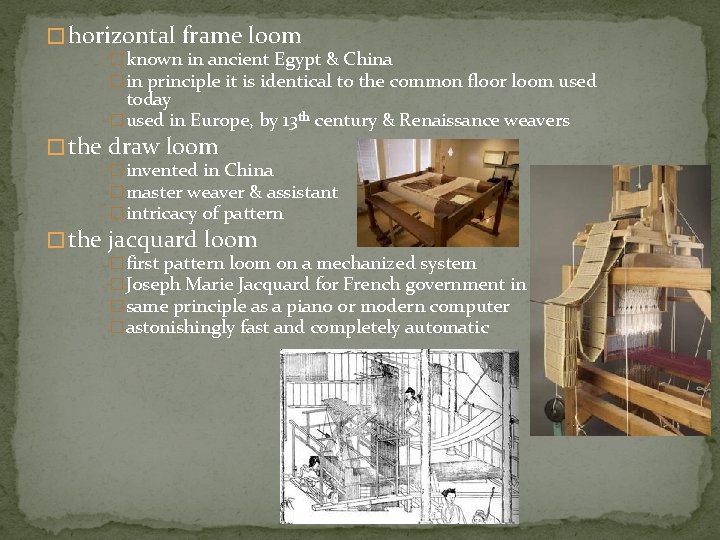
� horizontal frame loom � known in ancient Egypt & China � in principle it is identical to the common floor loom used today � used in Europe, by 13 th century & Renaissance weavers � the draw loom � invented in China � master weaver & assistant � intricacy of pattern � the jacquard loom � first pattern loom on a mechanized system � Joseph Marie Jacquard for French government in 1804 � same principle as a piano or modern computer � astonishingly fast and completely automatic
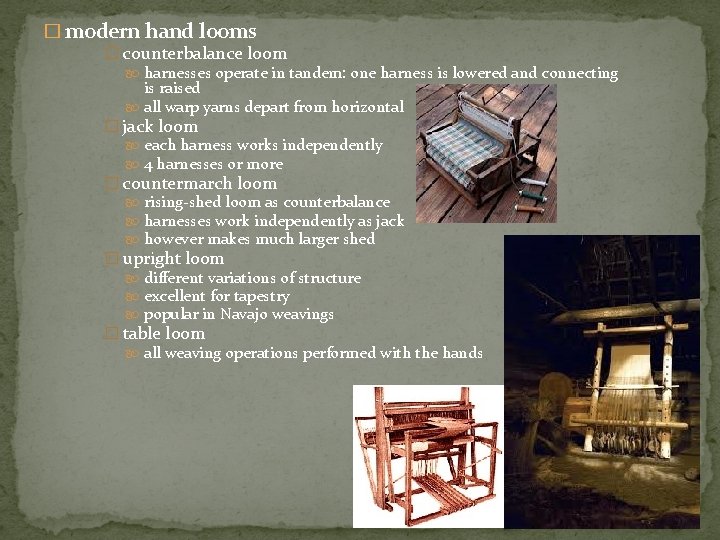
� modern hand looms � counterbalance loom harnesses operate in tandem: one harness is lowered and connecting is raised all warp yarns depart from horizontal � jack loom each harness works independently 4 harnesses or more � countermarch loom rising-shed loom as counterbalance harnesses work independently as jack however makes much larger shed � upright loom different variations of structure excellent for tapestry popular in Navajo weavings � table loom all weaving operations performed with the hands
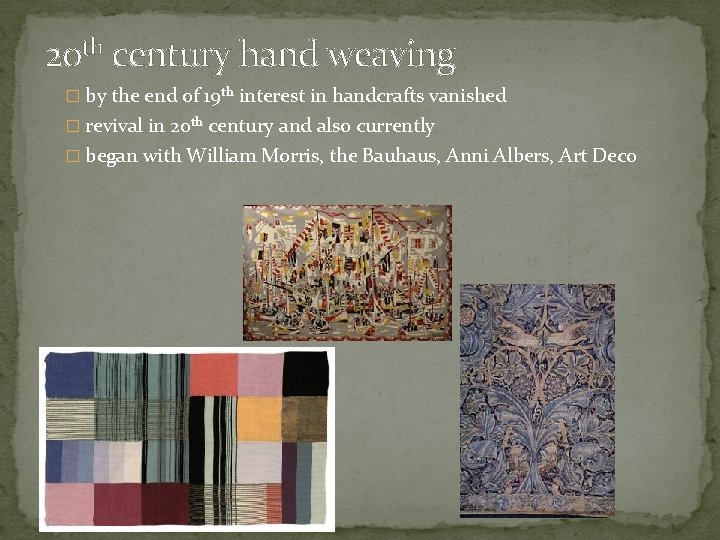
20 th century hand weaving � by the end of 19 th interest in handcrafts vanished � revival in 20 th century and also currently � began with William Morris, the Bauhaus, Anni Albers, Art Deco
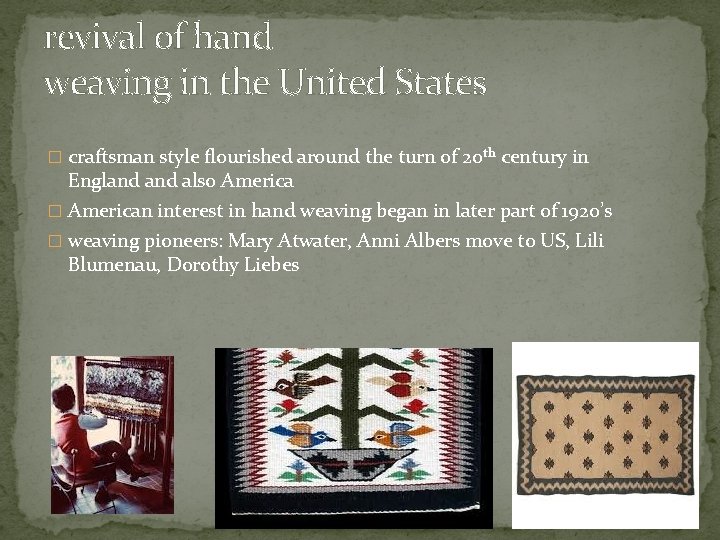
revival of hand weaving in the United States � craftsman style flourished around the turn of 20 th century in England also America � American interest in hand weaving began in later part of 1920’s � weaving pioneers: Mary Atwater, Anni Albers move to US, Lili Blumenau, Dorothy Liebes
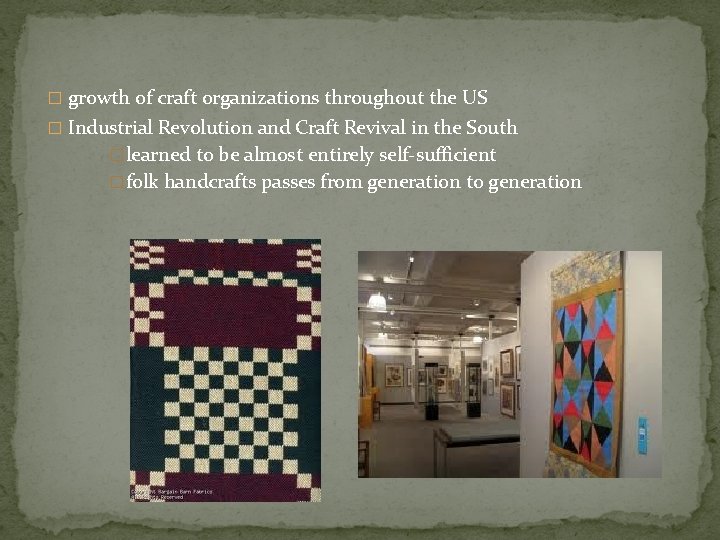
� growth of craft organizations throughout the US � Industrial Revolution and Craft Revival in the South �learned to be almost entirely self-sufficient �folk handcrafts passes from generation to generation
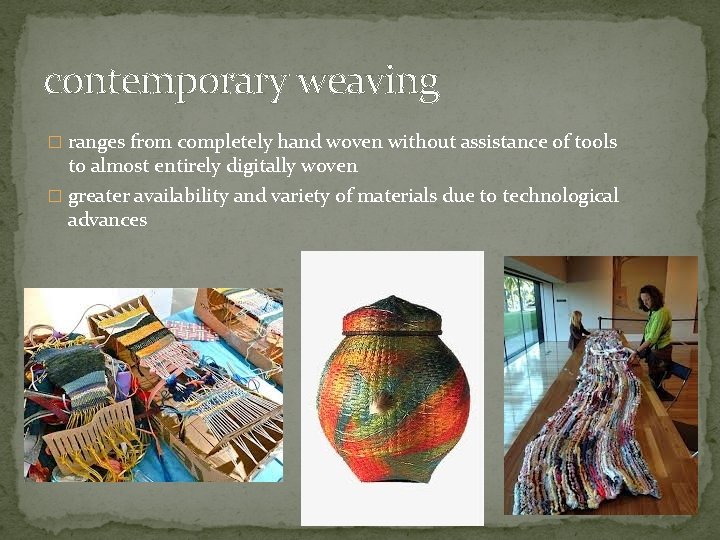
contemporary weaving � ranges from completely hand woven without assistance of tools to almost entirely digitally woven � greater availability and variety of materials due to technological advances
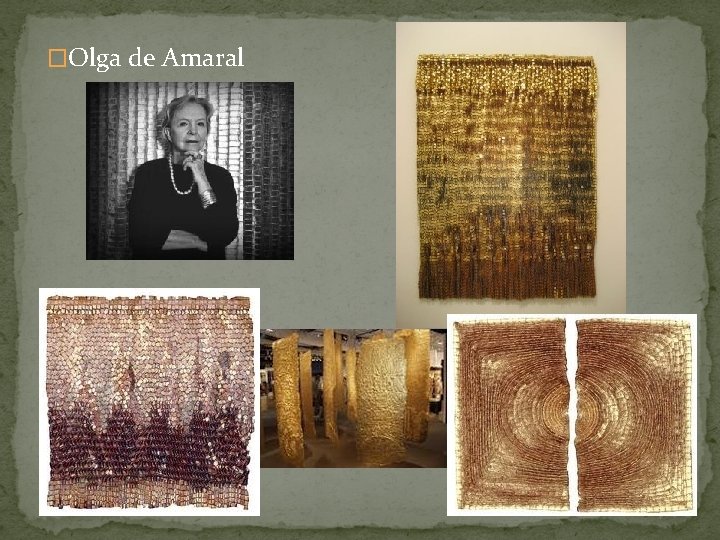
�Olga de Amaral
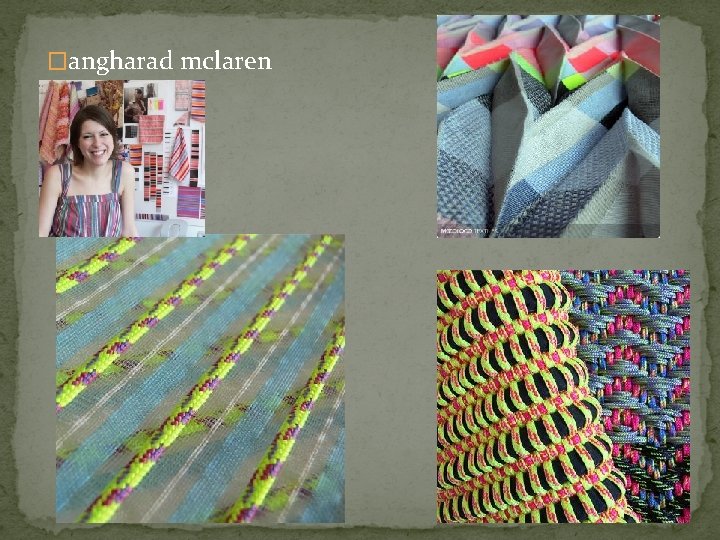
�angharad mclaren
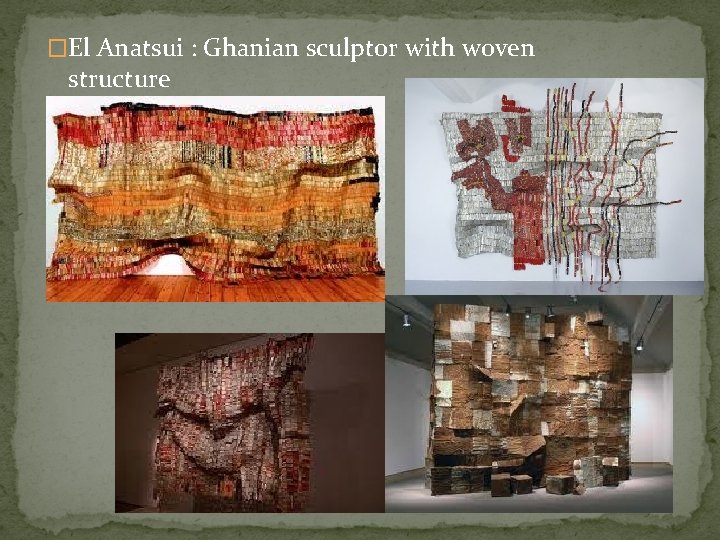
�El Anatsui : Ghanian sculptor with woven structure
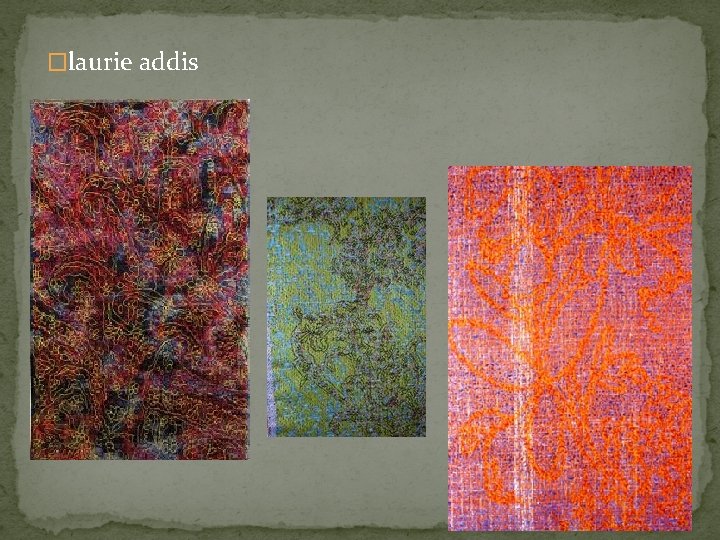
�laurie addis
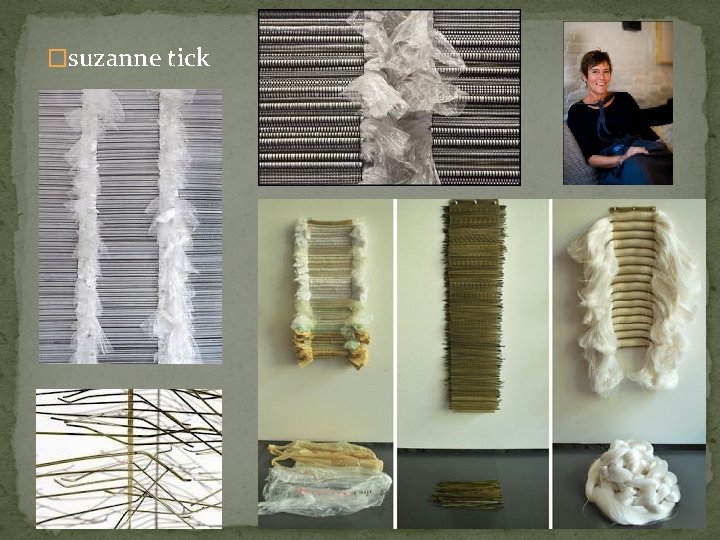
�suzanne tick
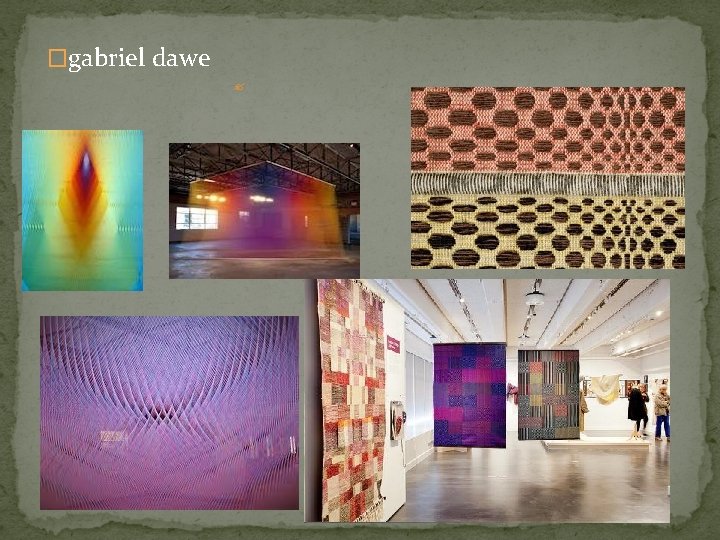
�gabriel dawe ?
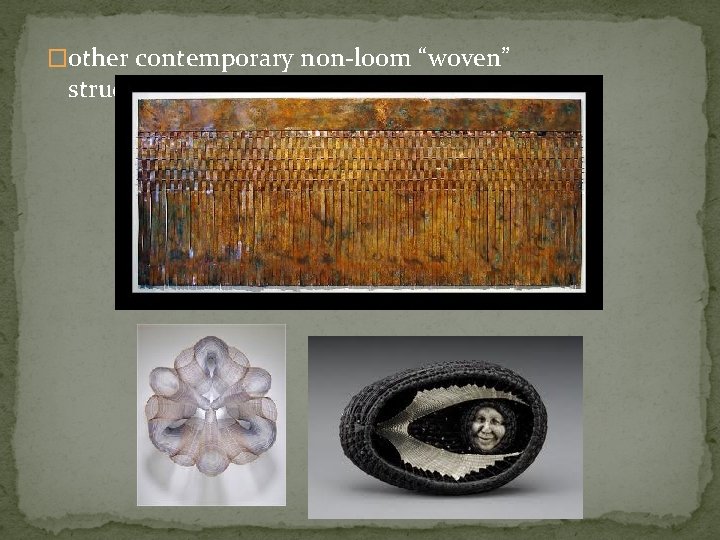
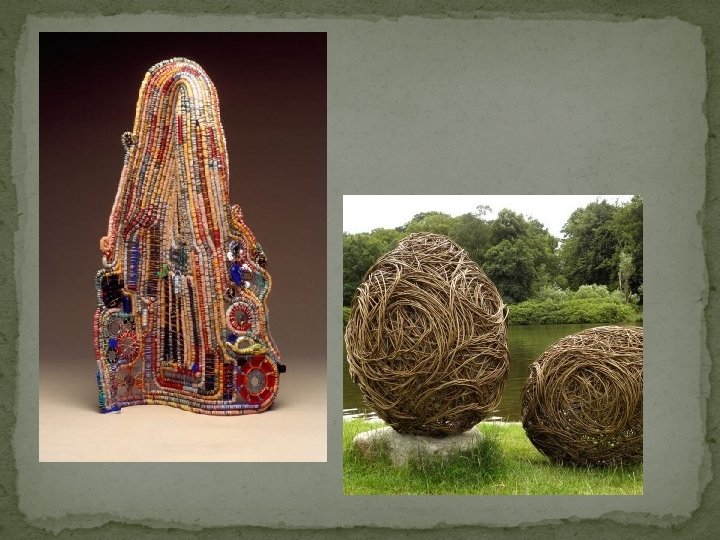
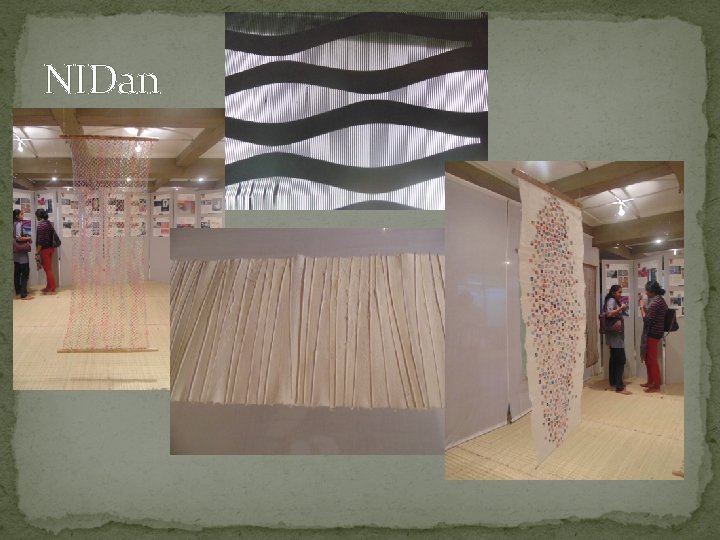
�other contemporary non-loom “woven” structures
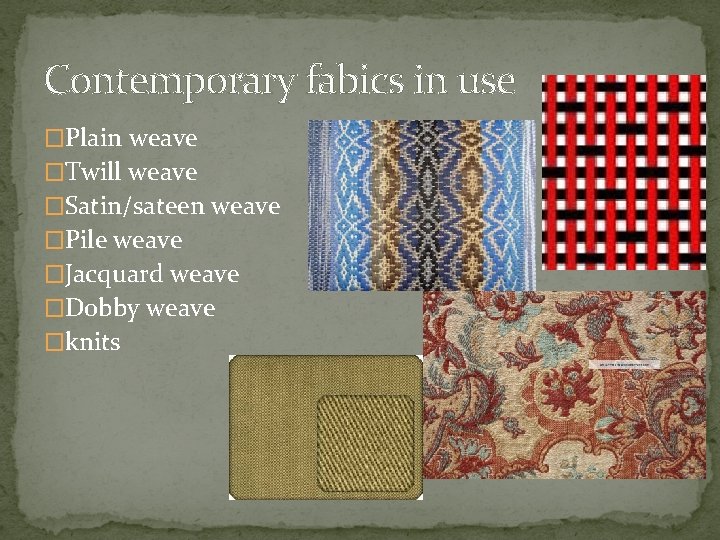
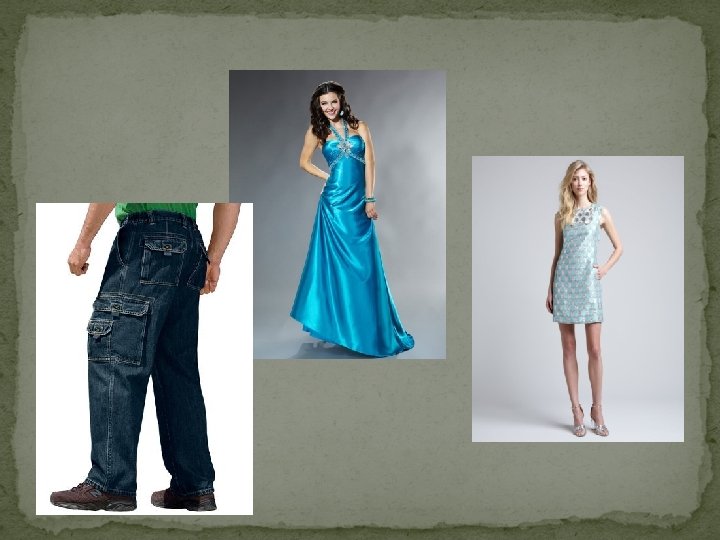
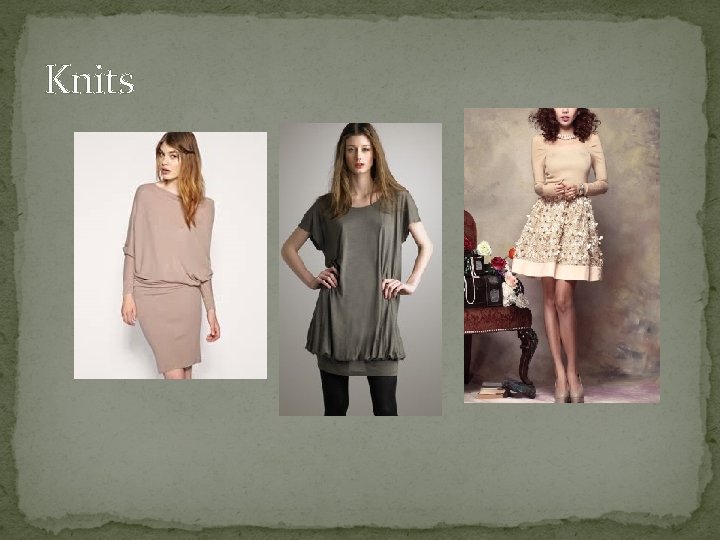
Contemporary fabics in use �Plain weave �Twill weave �Satin/sateen weave �Pile weave �Jacquard weave �Dobby weave �knits
NIDan
Knits
Bibliography �http: //textilelearner. blogspot. in/2012/06/history-of- weaving-in-according-with. html �http: //www. fofweb. com/History/Hist. Ref. Main. asp �http: //www. mariamilani. com/ancient_rome/roman_c lothing. htm �http: //www. crystalinks. com/egyptclothing. html �http: //www. olgadeamaral. com �http: //www. angharadmclaren. co. uk/ �http: //suzannetick. com/
Thank You
- Slides: 46