
History of Urbanization Quick Note about Rank Size

History of Urbanization
Quick Note about Rank Size Rule n n Primate Cities: The population of these cities is much larger than all other cities within the country q q q n London, England Paris, France Mexico City, Mexico This does not doom the country from providing or consuming the proper services
Basic Historical Components n Hearths of Urbanization: q Indus Valley q Nile Valley q Huang River Valley q Mesoamerica n Main components: q Agricultural surplus q Leadership Class q Social Stratification q Provision of Services (Trade, Government, Economic Centers etc. )
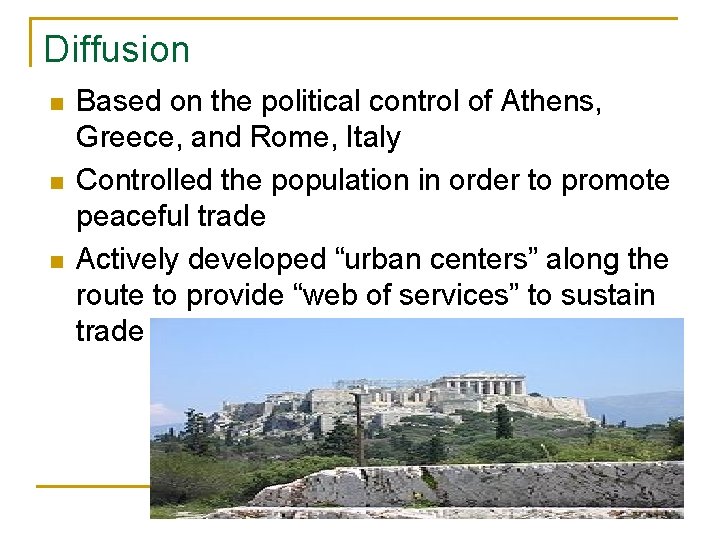
Diffusion n Based on the political control of Athens, Greece, and Rome, Italy Controlled the population in order to promote peaceful trade Actively developed “urban centers” along the route to provide “web of services” to sustain trade
Site and Situation in the Placement of Cities n n n Situation – relative location, its place in the region, and the world around it Site – the acual location of the urban center European Exploration: q n Site and Situation along the major trade routes of goods Second Urban Revolution: q Site and situation proximity to a power source
What Makes a Modern City? n n n Large Size High Density Social Heterogenity Legally Incorporated (Self Governing Unit) Urbanized Area (central city with contiguous suburbs)
Metropolitan Statistical Area q q q At least 50, 000 people, County containing city all adjacent counties with n n High density Large percentage of residents working in central city’s county MICROPOLITAN AREAS: n 10, 000 – 50, 000 people and all other characteristics

MEGALOPOLIS
- Slides: 8