
History of Transportation Before the year 1750 How
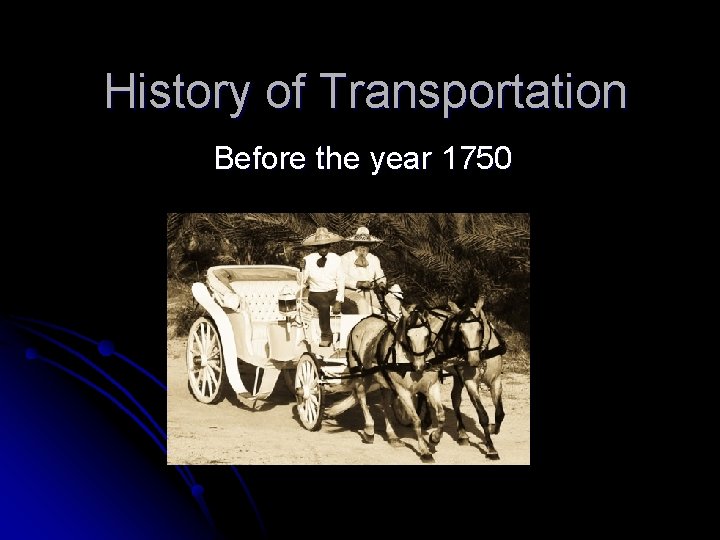
History of Transportation Before the year 1750

How it all began… - 3500 years before christ (BC): The invention of the wheel - 1662: Blaise Pascal invents the first public bus - horse- - 2000: BC Horses are domesticated drawn, regular route, and used for transportation schedule, and fare - 181 -234: The wheelbarrow is invented system - 770: Iron horseshoes improve - 1740 Jacques de transportation by horse Vaucanson demonstrates his clockwork powered carriage

Who used which transport? Rich people Poor people Carriage with horses Carriage with bullock Comfotable carriage with good seats Uncomfortable carriaga with hard seats and bad equipment Could used new inventions Often walk Imagine of the first wind-driven car
How did people go to work? - often lived in the near of the work - walk to work - very rich people get with the carriage to work

How did they travel? l Not everybody could afford to travel they travel with carriages, with very bad comfort carriages had no suspension l need much time, because of slowly transport very bad traffic-routes l
How often and why did they travel? l they travel rare, because of the high costs l They don´t travel for fun, but to search a job l some worked for a time for people with carriages, to travel with them
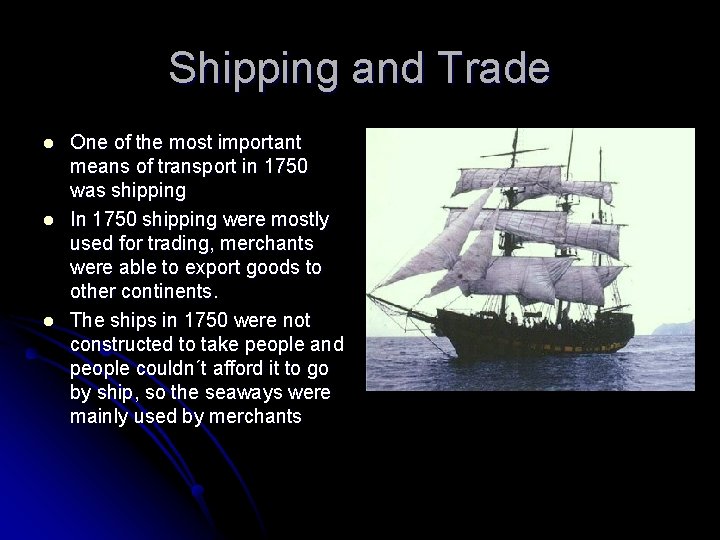
Shipping and Trade l l l One of the most important means of transport in 1750 was shipping In 1750 shipping were mostly used for trading, merchants were able to export goods to other continents. The ships in 1750 were not constructed to take people and people couldn´t afford it to go by ship, so the seaways were mainly used by merchants
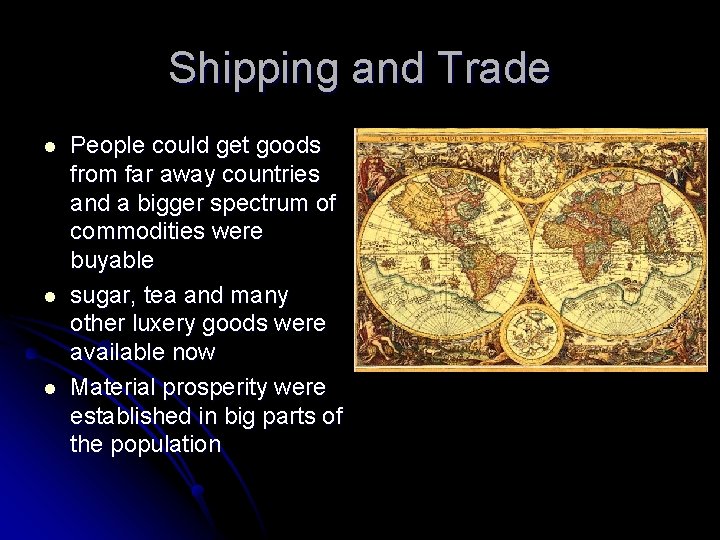
Shipping and Trade l l l People could get goods from far away countries and a bigger spectrum of commodities were buyable sugar, tea and many other luxery goods were available now Material prosperity were established in big parts of the population

Shipping and Trade l l l l An important way to trade was the „triangula trade“ Triangula trade ment the trade between three trade partners, in this example Africa, America and Europe. Manufactual goods from Europe were exported to Africa From Africa slaves were brought to the Caribbean (and from there to Nothern America) In the Caribbean merchants got for example sugar and rum for european consumers Every trade partner took advantage of the trade because every trader got goods which were not available on the local market In this time slaves were goods for western merchants, they used to do jobs which the local population didn´t like to do
The Steam Engine Thomas Savery (1650 -1715) English inventor& engineer had to solve a problem: When the miners digged very deep into the ground water flowed into the mine. l
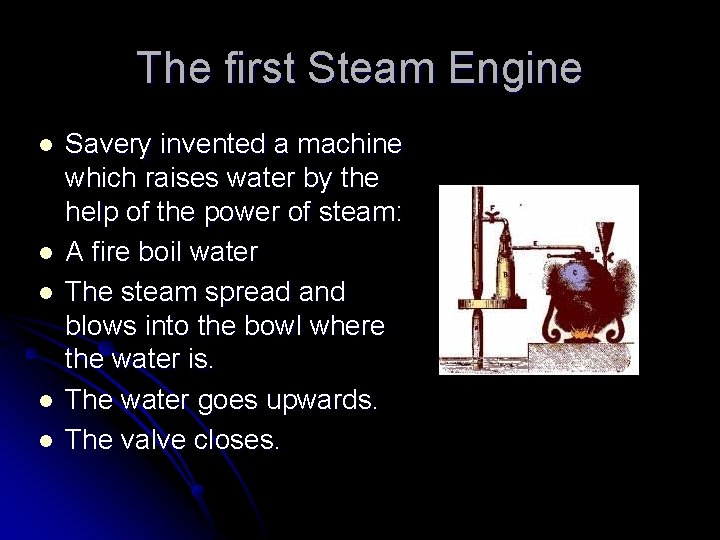
The first Steam Engine l l l Savery invented a machine which raises water by the help of the power of steam: A fire boil water The steam spread and blows into the bowl where the water is. The water goes upwards. The valve closes.
Miner‘s friend The steam condenses and creates a vacuum. l This vacuum sucks new water on which is pumped out of the coal mine like explained before. l Savery called his invention Miner‘s Friend and patented it 1698 for the next 14 years. l
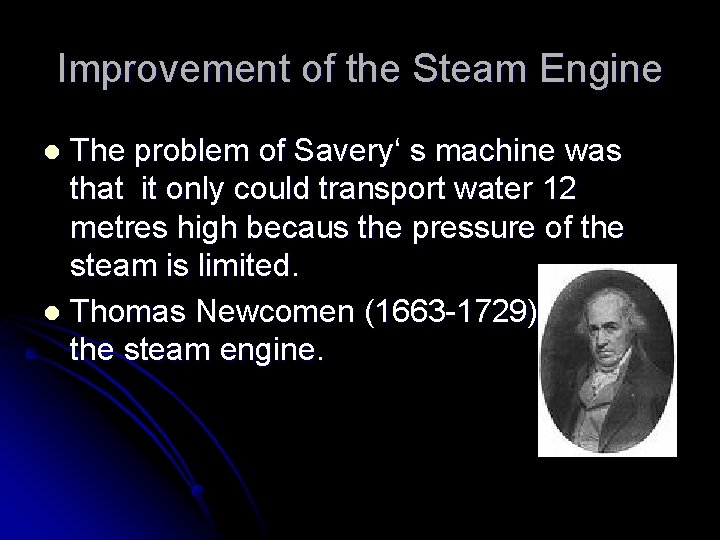
Improvement of the Steam Engine The problem of Savery‘ s machine was that it only could transport water 12 metres high becaus the pressure of the steam is limited. l Thomas Newcomen (1663 -1729) improved the steam engine. l
Newcomen Steam Engine This engine could transport water higher because it uses the power of atmospheric pressure and is so not limited. l 1712 Newcomen and John Calley built the first steam engine to pump water out of a water-filled coal mine. l This was a very interesting and useful invention for this time. l
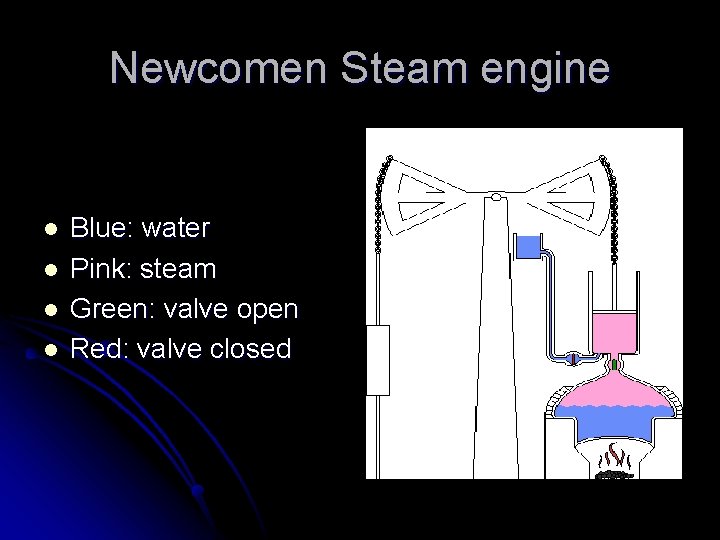
Newcomen Steam engine l l Blue: water Pink: steam Green: valve open Red: valve closed
You might ask yourself: What is the use of the steam engine… …for the history of transportation?
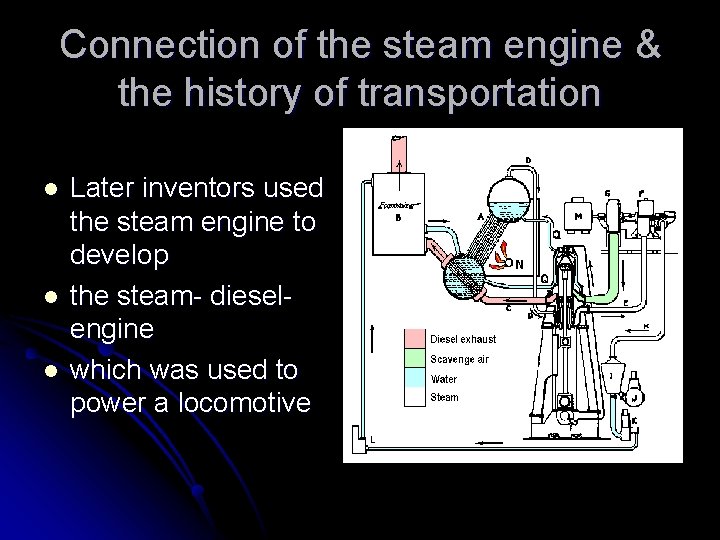
Connection of the steam engine & the history of transportation l l l Later inventors used the steam engine to develop the steam- diesel- engine which was used to power a locomotive
- Slides: 17