
History of the Philosophy of Science Part 1
- Slides: 8
History of the Philosophy of Science Part 1.
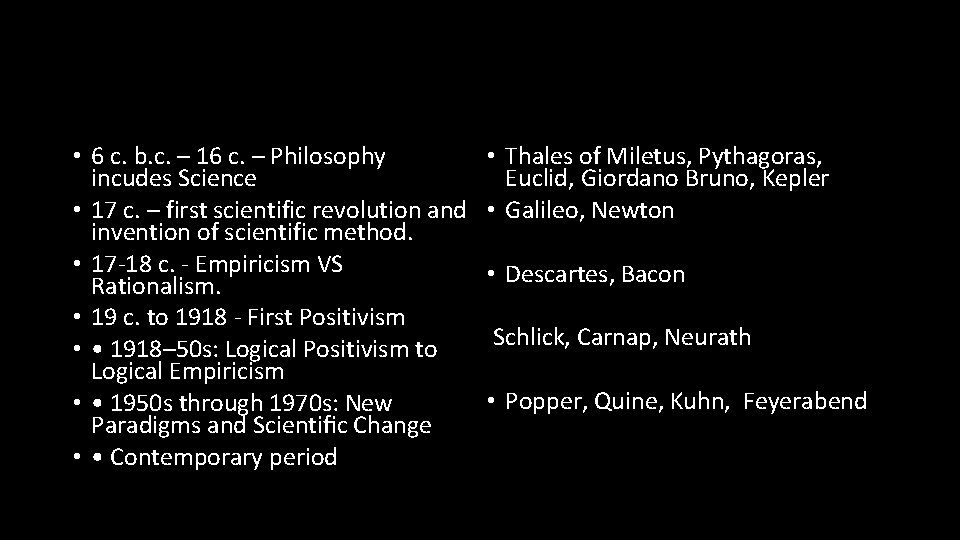
• 6 c. b. c. – 16 c. – Philosophy incudes Science • 17 c. – first scientific revolution and invention of scientific method. • 17 -18 c. - Empiricism VS Rationalism. • 19 c. to 1918 - First Positivism • • 1918– 50 s: Logical Positivism to Logical Empiricism • • 1950 s through 1970 s: New Paradigms and Scientific Change • • Contemporary period • Thales of Miletus, Pythagoras, Euclid, Giordano Bruno, Kepler • Galileo, Newton • Descartes, Bacon Schlick, Carnap, Neurath • Popper, Quine, Kuhn, Feyerabend
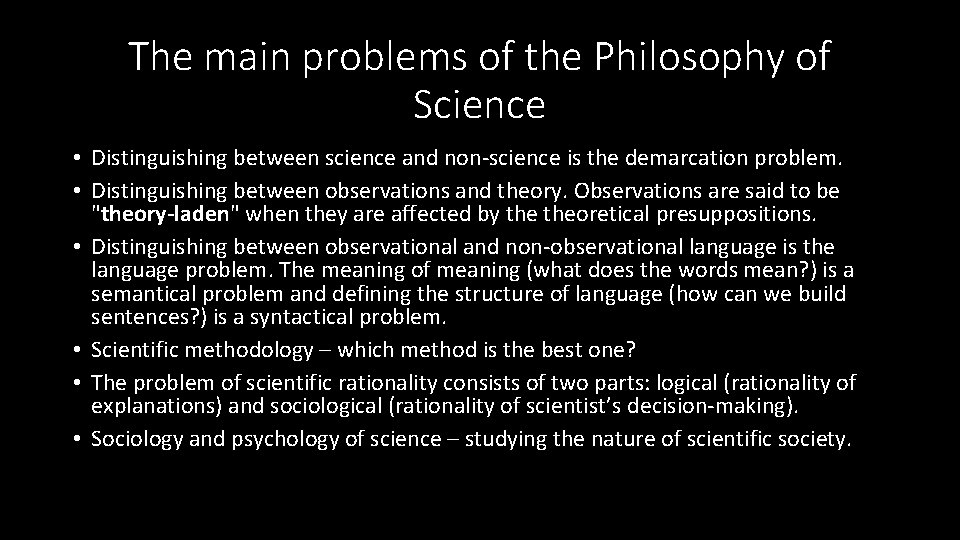
The main problems of the Philosophy of Science • Distinguishing between science and non-science is the demarcation problem. • Distinguishing between observations and theory. Observations are said to be "theory-laden" when they are affected by theoretical presuppositions. • Distinguishing between observational and non-observational language is the language problem. The meaning of meaning (what does the words mean? ) is a semantical problem and defining the structure of language (how can we build sentences? ) is a syntactical problem. • Scientific methodology – which method is the best one? • The problem of scientific rationality consists of two parts: logical (rationality of explanations) and sociological (rationality of scientist’s decision-making). • Sociology and psychology of science – studying the nature of scientific society.
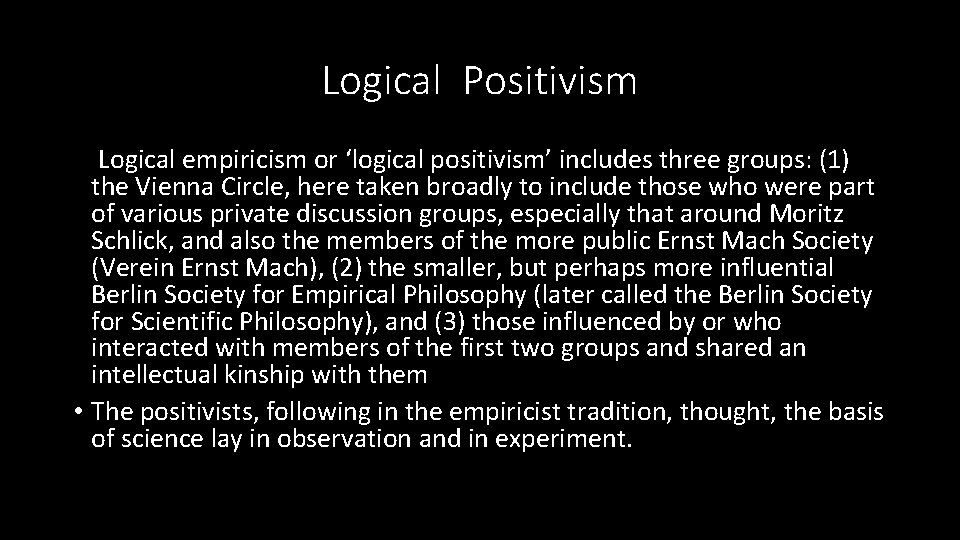
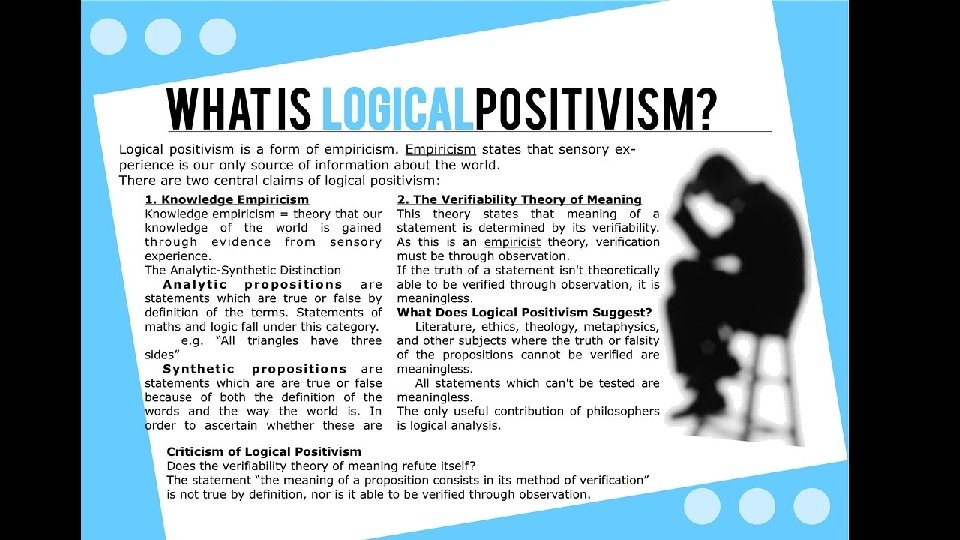
Logical Positivism • ‘Logical empiricism or ‘logical positivism’ includes three groups: (1) the Vienna Circle, here taken broadly to include those who were part of various private discussion groups, especially that around Moritz Schlick, and also the members of the more public Ernst Mach Society (Verein Ernst Mach), (2) the smaller, but perhaps more influential Berlin Society for Empirical Philosophy (later called the Berlin Society for Scientific Philosophy), and (3) those influenced by or who interacted with members of the first two groups and shared an intellectual kinship with them • The positivists, following in the empiricist tradition, thought, the basis of science lay in observation and in experiment.
• Hans Hahn, Moritz Schlick, Rudolf Carnap, and Otto Neurath were leaders of the Vienna Circle, and Kurt Gödel regularly attended its meetings. The list of its members, visitors, and interlocutors is staggering, including A. J. Ayer, Herbert Feigl, Philipp Frank, Hans Hahn, Carl Hempel, Karl Menger, Richard von Mises, Ernest Nagel, Karl Popper, W. V. Quine, Frank Ramsay, Hans Reichenbach, Alfred Tarski, Friedrich Waismann, and Ludwig Wittgenstein, among many others. Not all of these would admit to being part of the logical empiricist movement, of course, but a case can be made that all contributed to it.
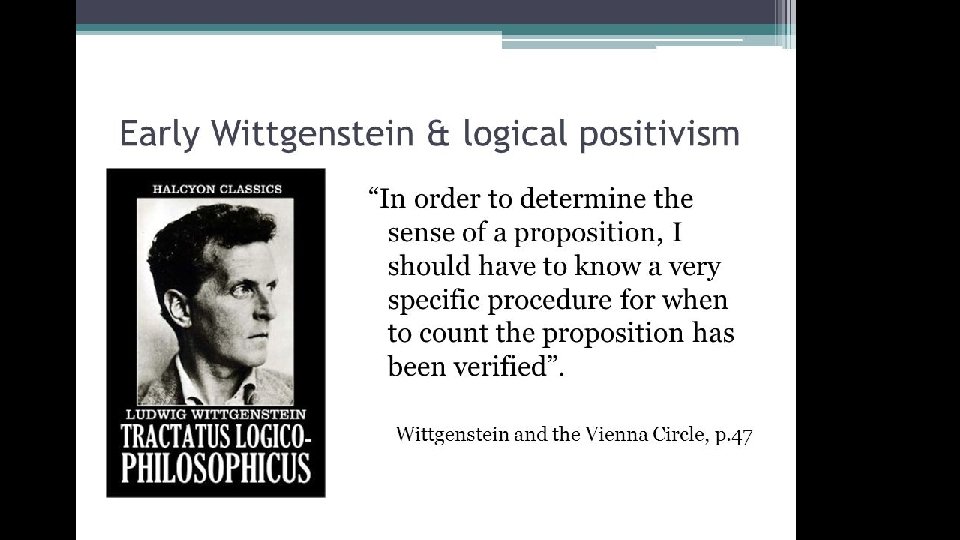
The verification principle • and by the time spent in Vienna with the Logical Positivists First formulation of a criterion of meaning, the principle of verification, was in the first edition of Wittgenstein’s Tractatus (1936), where he claimed that all propositions were analytic (true in virtue of their meaning) or else either strongly verifiable or weakly verifiable. Strong verification required that the truth of a proposition be conclusively ascertainable; weak verification required only that an observation statement be deducible from the proposition together with other, auxiliary, propositions, provided that the observation statement was not deducible from these auxiliaries alone. • The verification principle was thought to be a way of making precise the empirical observational, or experimental component of science.