
History of the Periodic Table Aristotle Circa 300
History of the Periodic Table
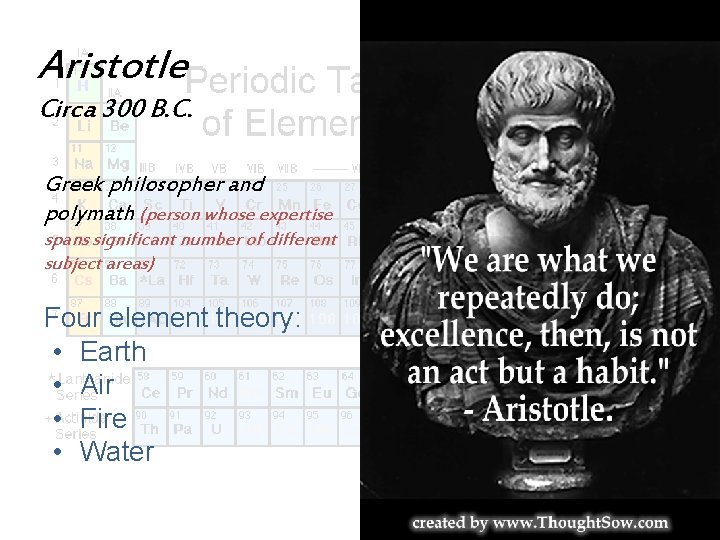
Aristotle Circa 300 B. C. Greek philosopher and polymath (person whose expertise spans significant number of different subject areas) Four element theory: • Earth • Air • Fire • Water
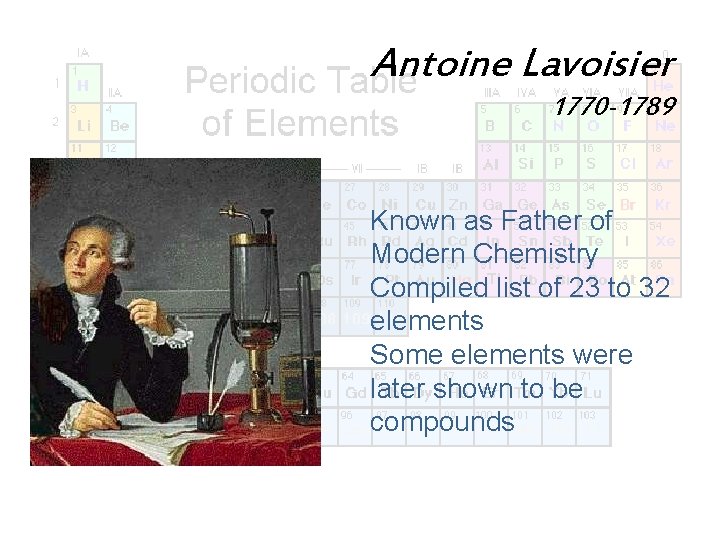
Antoine Lavoisier 1770 -1789 Known as Father of Modern Chemistry Compiled list of 23 to 32 elements Some elements were later shown to be compounds
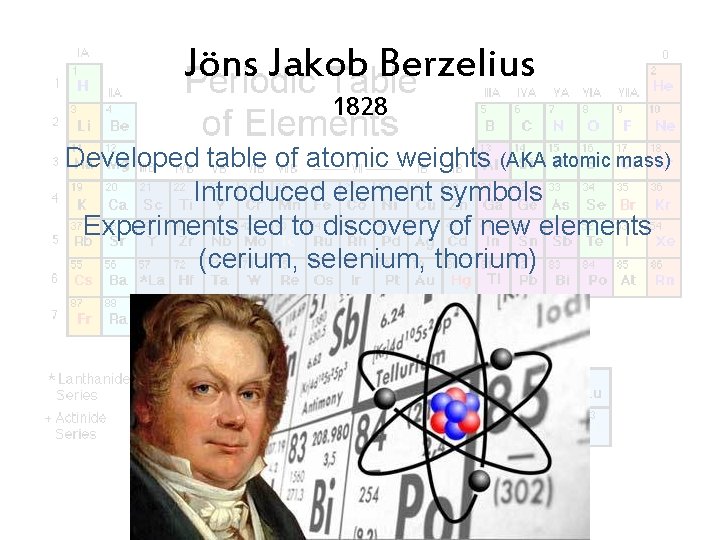
Jöns Jakob Berzelius 1828 Developed table of atomic weights (AKA atomic mass) Introduced element symbols Experiments led to discovery of new elements (cerium, selenium, thorium)
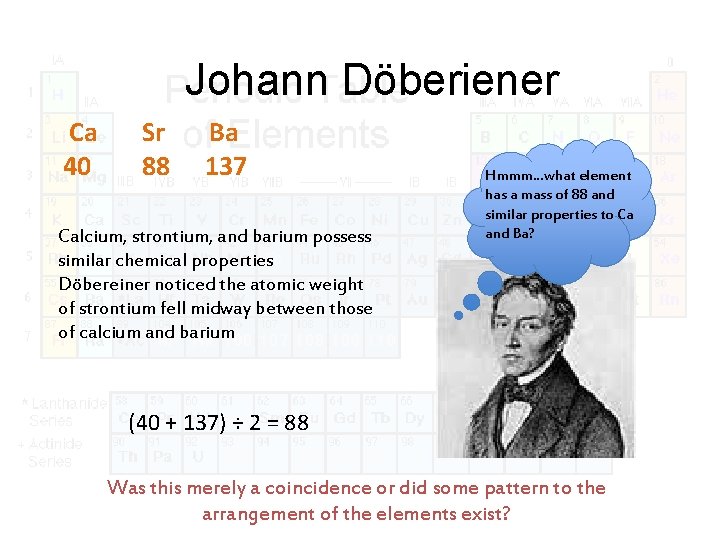
Johann Döberiener Ca 40 Sr 88 Ba 137 Calcium, strontium, and barium possess similar chemical properties Döbereiner noticed the atomic weight of strontium fell midway between those of calcium and barium Hmmm…what element has a mass of 88 and similar properties to Ca and Ba? (40 + 137) ÷ 2 = 88 Was this merely a coincidence or did some pattern to the arrangement of the elements exist?
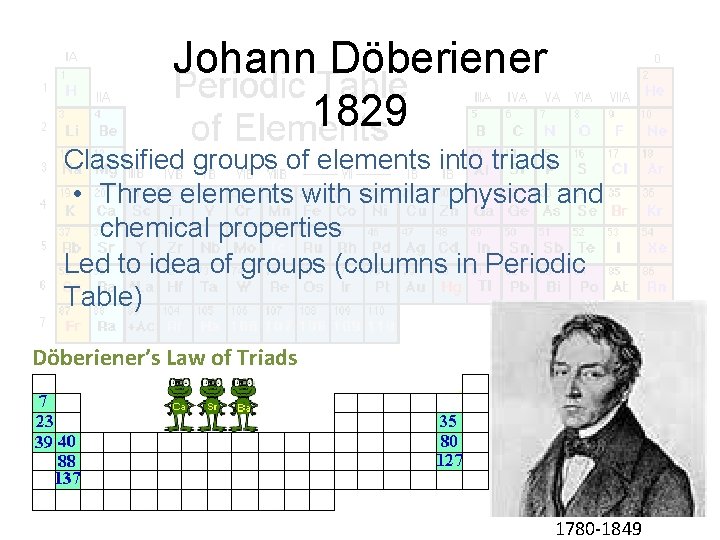
Johann Döberiener 1829 Classified groups of elements into triads • Three elements with similar physical and chemical properties Led to idea of groups (columns in Periodic Table) Döberiener’s Law of Triads 1780 -1849
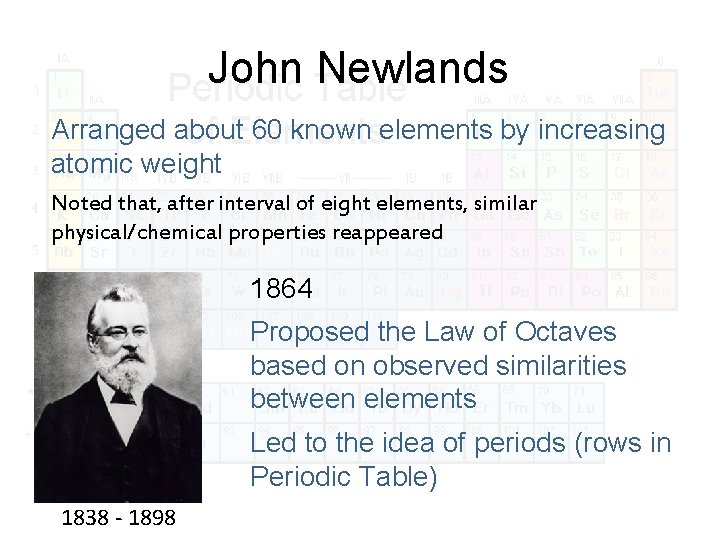
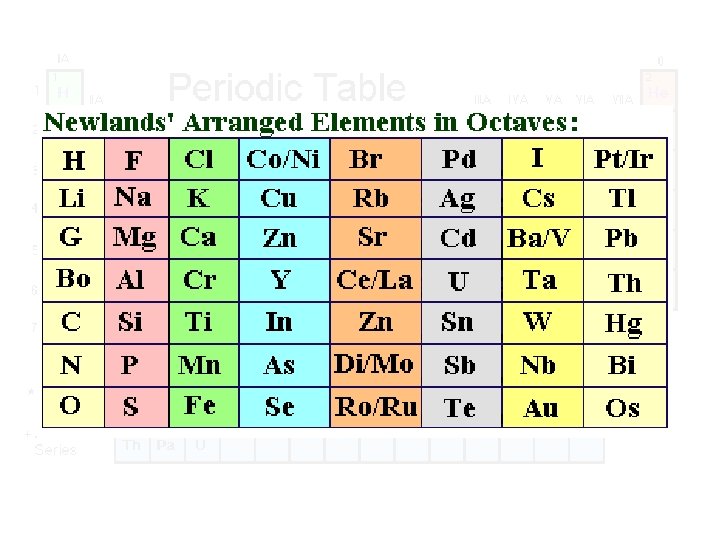
John Newlands Arranged about 60 known elements by increasing atomic weight Noted that, after interval of eight elements, similar physical/chemical properties reappeared 1864 Proposed the Law of Octaves based on observed similarities between elements Led to the idea of periods (rows in Periodic Table) 1838 - 1898
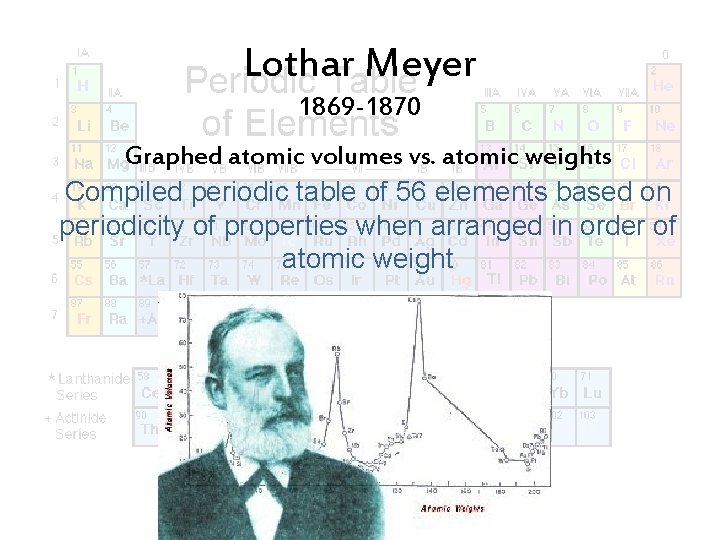
Lothar Meyer 1869 -1870 Graphed atomic volumes vs. atomic weights Compiled periodic table of 56 elements based on periodicity of properties when arranged in order of atomic weight
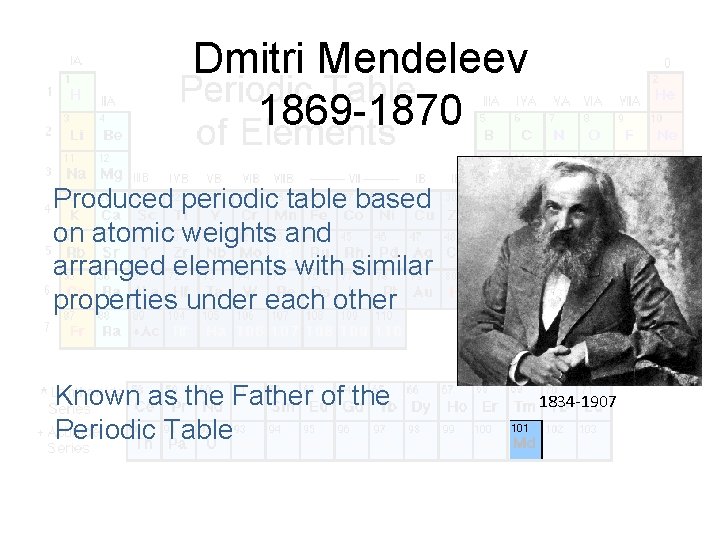
Dmitri Mendeleev 1869 -1870 Produced periodic table based on atomic weights and arranged elements with similar properties under each other Known as the Father of the Periodic Table 1834 -1907
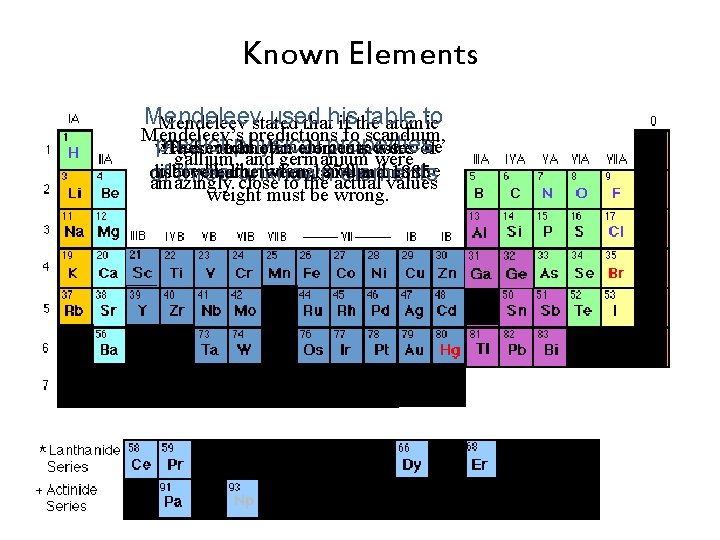
Known Elements Mendeleev used table to Mendeleev stated thathis if the atomic Mendeleev’s predictions fo scandium, predict physical properties weight of an element caused it to of be These unknown were He corrected the elements atomic masses gallium, and germanium were placed in the wrong 1874 group, then the discovered between and 1885 beryllium, indium, and uranium of three unknown elements amazingly close to the actual values weight must be wrong.
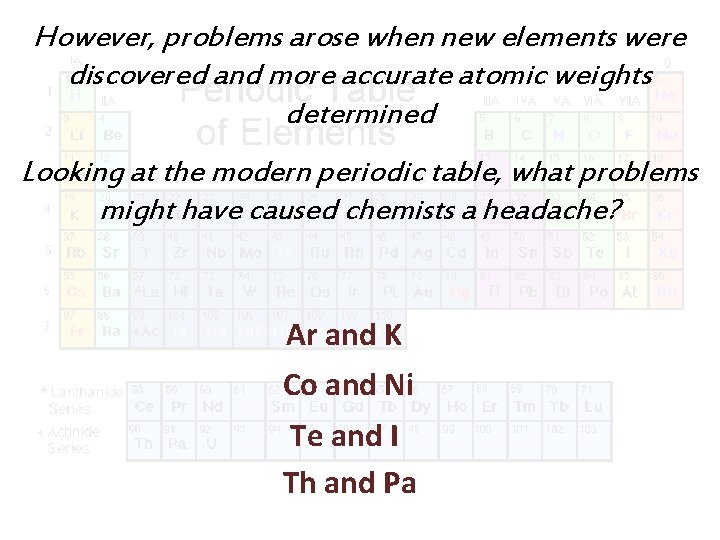
However, problems arose when new elements were discovered and more accurate atomic weights determined Looking at the modern periodic table, what problems might have caused chemists a headache? Ar and K Co and Ni Te and I Th and Pa
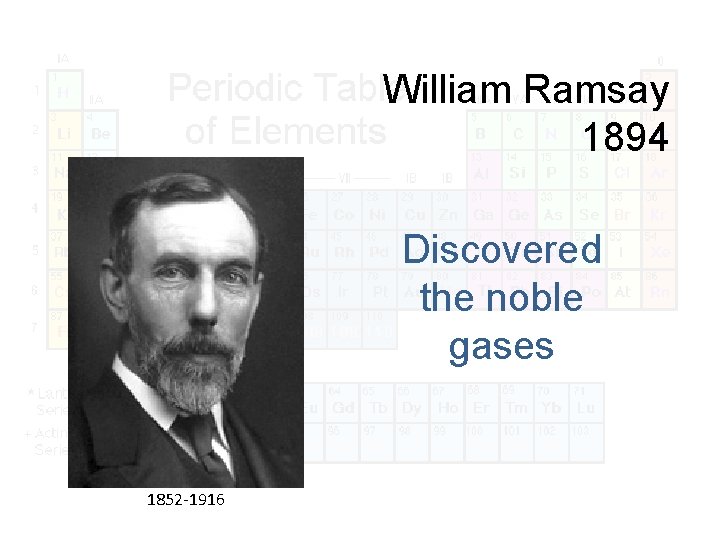
William Ramsay 1894 Discovered the noble gases 1852 -1916
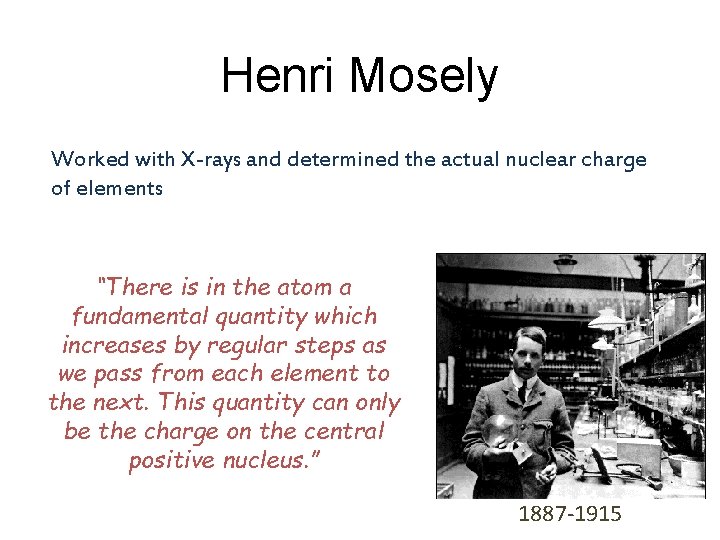
Henri Mosely Worked with X-rays and determined the actual nuclear charge of elements “There is in the atom a fundamental quantity which increases by regular steps as we pass from each element to the next. This quantity can only be the charge on the central positive nucleus. ” 1887 -1915
Henri Mosely 1913 Determined atomic numbers of elements Modified periodic law to read that properties of elements vary periodically with atomic number Concluded 92 elements existed, up to and including uranium 1887 -1915
Periodic Law There is a periodic repetition of chemical and physical properties of elements when they are arranged by increasing atomic number.
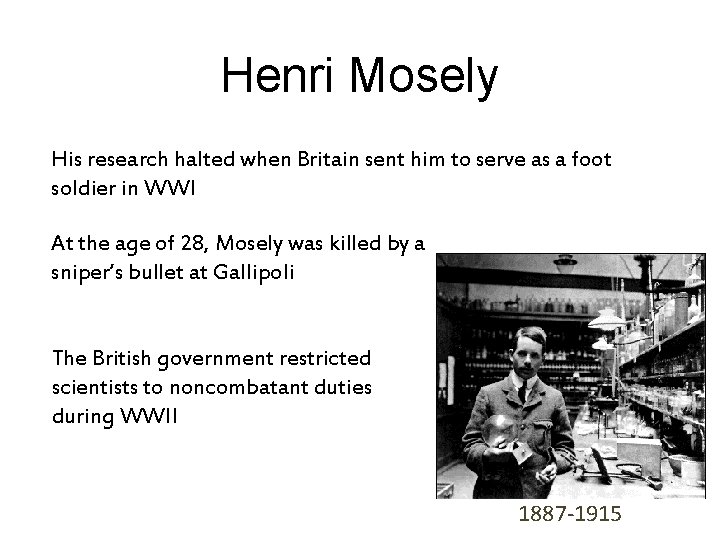
Henri Mosely His research halted when Britain sent him to serve as a foot soldier in WWI At the age of 28, Mosely was killed by a sniper’s bullet at Gallipoli The British government restricted scientists to noncombatant duties during WWII 1887 -1915
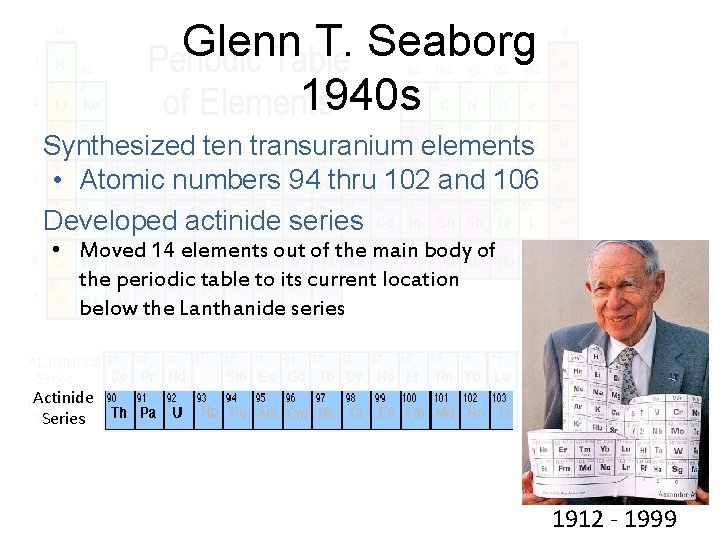
Glenn T. Seaborg 1940 s Synthesized ten transuranium elements • Atomic numbers 94 thru 102 and 106 Developed actinide series • Moved 14 elements out of the main body of the periodic table to its current location below the Lanthanide series Actinide Series 1912 - 1999

Glenn T. Seaborg Awarded the 1951 Nobel Prize in chemistry Element 106 was named Seaborgium (Sg) in his honor Only person to have an element named after him while still alive "This is the greatest honor ever bestowed upon me - even better, I think, than winning the Nobel Prize. "
Periodic Law There is a periodic repetition of chemical and physical properties of elements when they are arranged by increasing atomic number
- Slides: 21