
History of the Olympic Flag Created by Pierre

History of the Olympic Flag
Created by Pierre De Coubertin in 1914 l The Olympic Flag has a white background with five interlaced rings in the middle; blue yellow black green red
l This design is symbolic; it represents the five inhabited continents of the world, united by olympism, while the six colors are those that appear on all flags of the world at the present time

Field Events Throwing Events Jumping Events
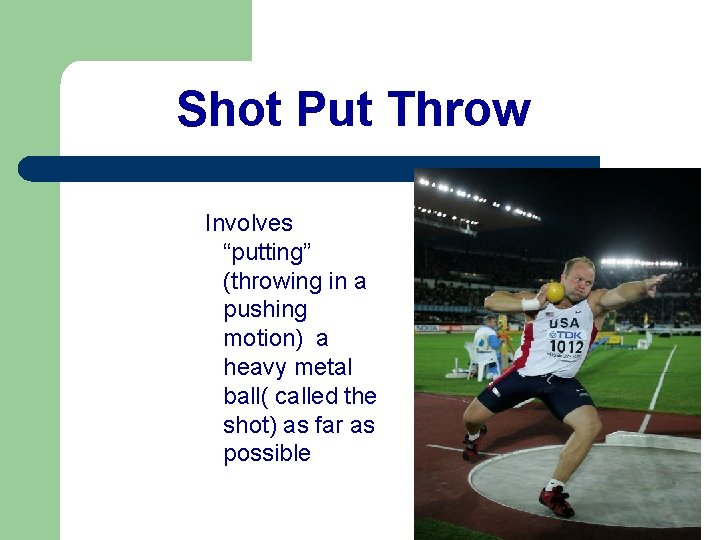
Shot Put Throw Involves “putting” (throwing in a pushing motion) a heavy metal ball( called the shot) as far as possible
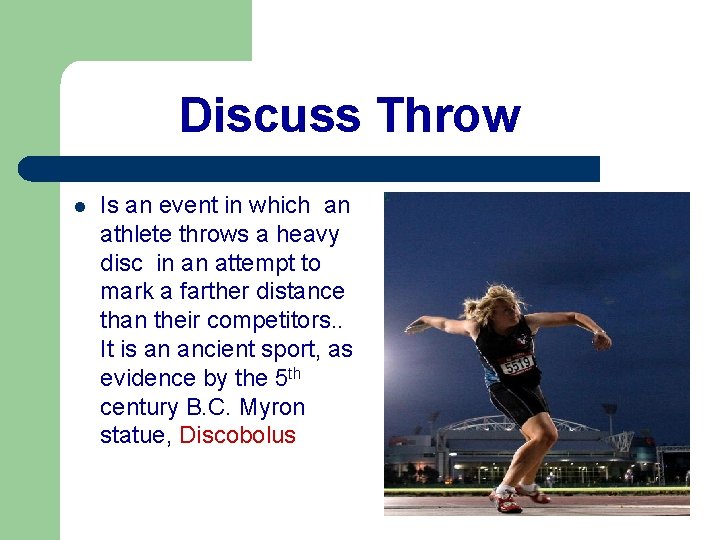
Discuss Throw l Is an event in which an athlete throws a heavy disc in an attempt to mark a farther distance than their competitors. . It is an ancient sport, as evidence by the 5 th century B. C. Myron statue, Discobolus
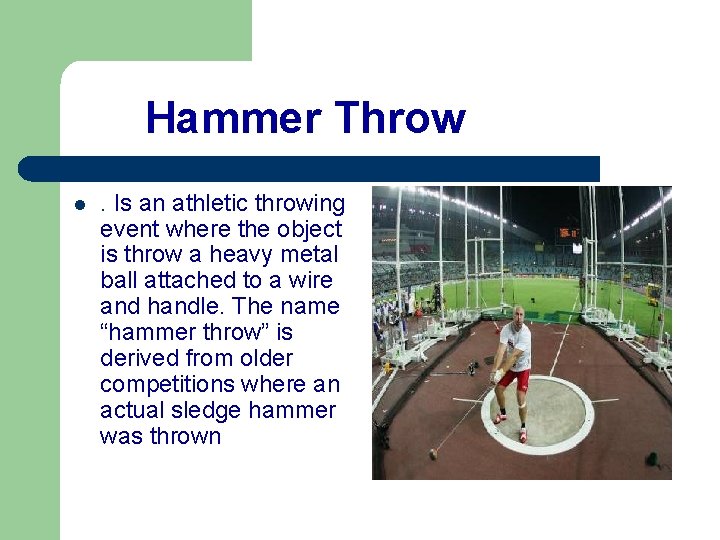
Hammer Throw l . Is an athletic throwing event where the object is throw a heavy metal ball attached to a wire and handle. The name “hammer throw” is derived from older competitions where an actual sledge hammer was thrown
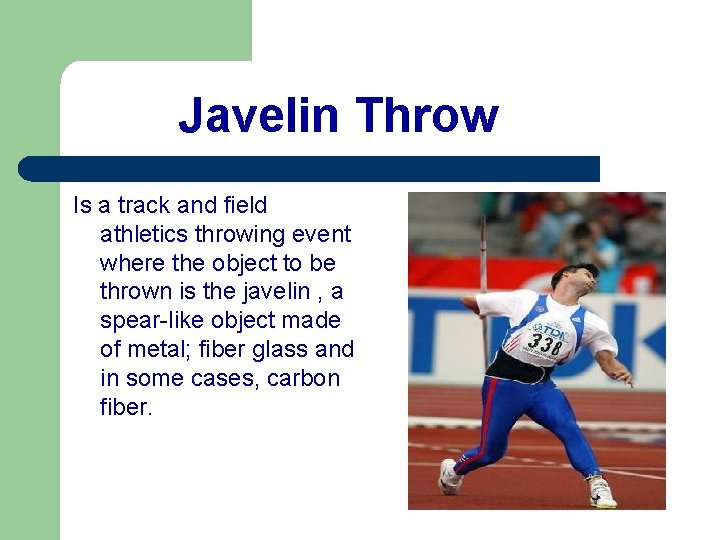
Javelin Throw Is a track and field athletics throwing event where the object to be thrown is the javelin , a spear-like object made of metal; fiber glass and in some cases, carbon fiber.
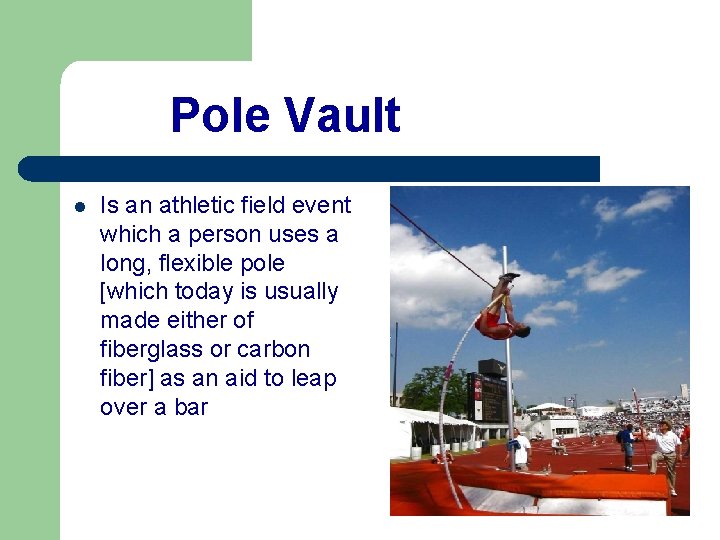
Pole Vault l Is an athletic field event which a person uses a long, flexible pole [which today is usually made either of fiberglass or carbon fiber] as an aid to leap over a bar
![Triple Jump l [sometimes referred to as the hop, skip and jump] similar to](http://slidetodoc.com/presentation_image_h2/04f4c3ff7b8d98b4151f263b3ed03780/image-10.jpg "Triple Jump l [sometimes referred to as the hop, skip and jump] similar to")
Triple Jump l [sometimes referred to as the hop, skip and jump] similar to the long jump, but involving a “hop, step and jump” routine, where by the competitors runs down the track and performs a hop a step and then a jump into the sand pit
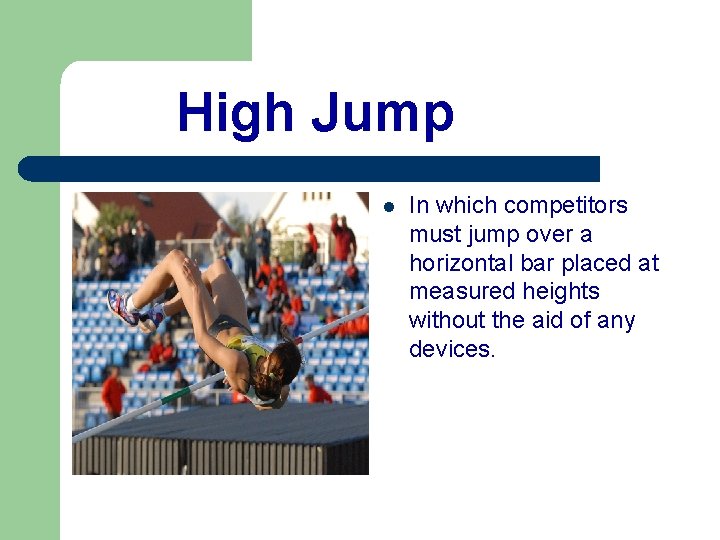
High Jump l In which competitors must jump over a horizontal bar placed at measured heights without the aid of any devices.
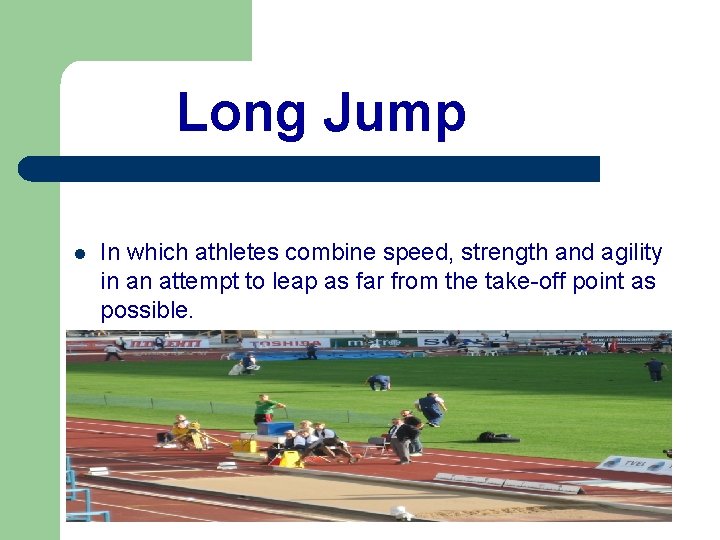
Long Jump l In which athletes combine speed, strength and agility in an attempt to leap as far from the take-off point as possible.
Track Events l Sprint l Middle Distance
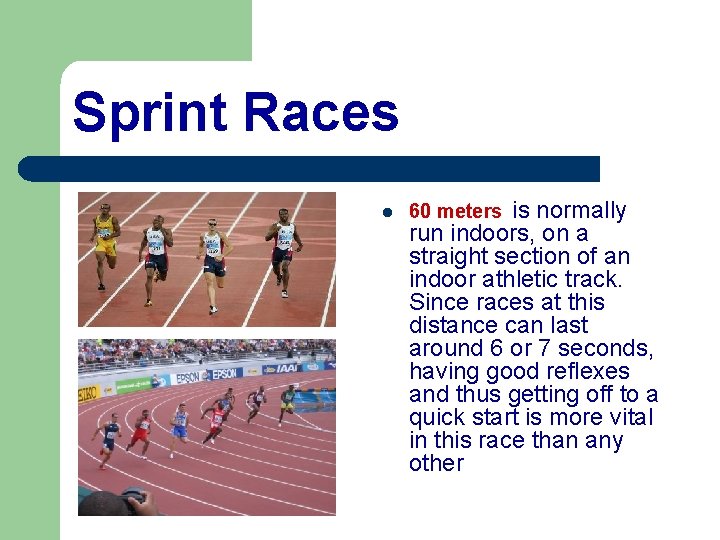
Sprint Races l is normally run indoors, on a straight section of an indoor athletic track. Since races at this distance can last around 6 or 7 seconds, having good reflexes and thus getting off to a quick start is more vital in this race than any other 60 meters
100 Meter Dash l 100 meters sprint takes place on one length of a standard outdoor 400 meter track. Often, the world-record holder in this race is considered “the world’s fastest man / woman” The current world record of 9. 69 seconds is held by Usain Bolt of Jamaica and was set 16 August 2008, at the Beijing Olympics. The women’s world record is 10. 49 seconds and was set by Florence Griffith Joyner.
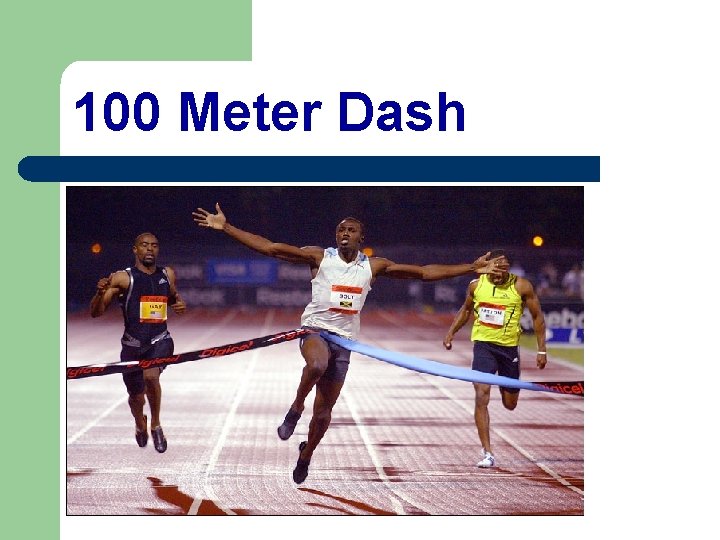
100 Meter Dash
200 Meter Dash l 200 meter begins on the curve of a standard track ( where the runners are staggered in their starting position, to ensure they all run the same distance), and ends on the home straight. The ability to”run a good bend” is key at this distance, as well conditioned runner will be able to run 200 meters in an average speed higher than their 100 meter speed.
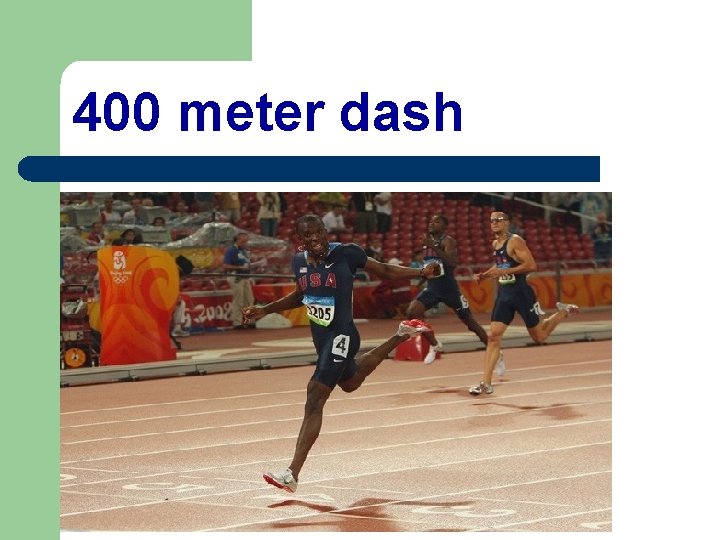
400 meter dash
400 meter Dash l 400 meters is on lap around the track on the inside lane. Runners are staggered in their starting positions to ensure that everyone run the same distance. While this event is a sprint { according to some }, there is more scope to use tactics in the race; the fact that 400 meter times are considerably more than 4 times a typical 100 meter time demonstrates this.
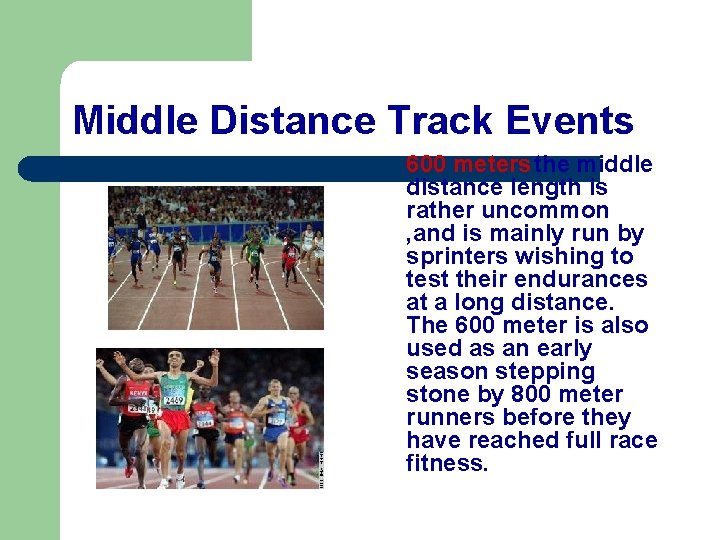
Middle Distance Track Events l 600 meters the middle distance length is rather uncommon , and is mainly run by sprinters wishing to test their endurances at a long distance. The 600 meter is also used as an early season stepping stone by 800 meter runners before they have reached full race fitness.
800 Meters l 800 meters consists of 2 laps around a standard 400 meter track, and has always been an Olympic event. It was included in the first women’s track programme in 1928, but suspended until 1960 because of shock and exhaustion it caused the competitors. Without the benefits of modern training, men of the era were, in contrast , expected to run themselves to complete exhaustion during competitions
1000 Meters l 1000 meters this distance is not commonly raced , though it is more common than the 500 meter event is for sprinters. This is commonly raced as an indoor men’s heptathlon event, or is an indoor high school event.
1200 Meters l 1200 meters a distance seldom raced on its own, but commonly raced as part of the distance medley relay.
1500 Meters l 1500 meters Along with the 800 meter, it is a premier middle distance race, covering 3 and three-quarter laps around a standard Olympic sized track. Speed is necessary and it seems that the more aerobic conditioning, the better. This is a difficult distance to complete at, mentally , in addition to being one of the more tactical middle distance track events. The distance is often witness to some of the most tactical physical races in the sport as many championship races are won in the final few meters
1600 Meters l 1600 meters exactly four laps of a normal 400 meter track, this distance race as the metric mile as a near replacement for the mile. The 500 meter, however, is the most popular distance ran at the college and international levels.
Mile l Mile This length of middle distance race, 1760 yards, [ 1609. 344 meters], is very common in countries that do not use the metric system, and is still often referred to as the “ Blue Riband ” of the track.
2000 Meters l 2000 Meters Another event that is rarely run a miler’s speed will generally allow him/her to prevail at the distance over the less balance challengers.
3000 Meters l 3000 Meters Truly on the borderline between middle and longer distances, the 3000 meter ( 7. 5 laps) is a standard race in the United Stares, Though it is not raced at the outdoor IAAF World Championships. This race requires decent speed , but a lack of a natural weakness can be made up for with superior aerobic conditioning and supporting race tactics
3000 Meters Steeple Chase
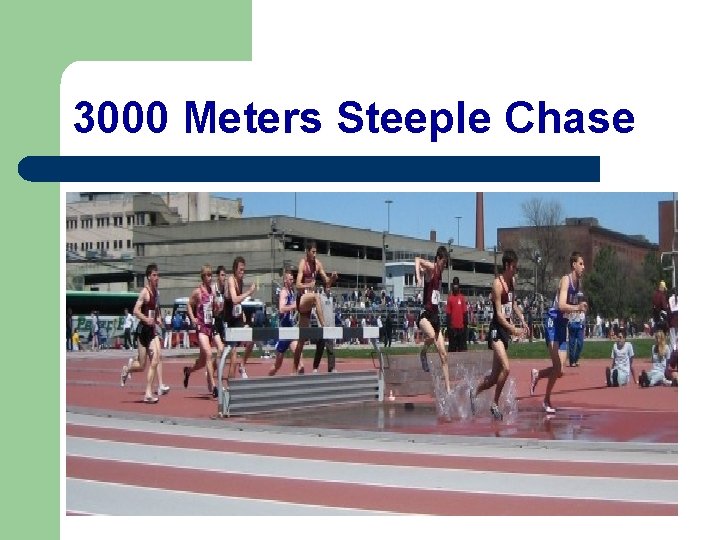
3000 Meters Steeple Chase l 3000 Meters steeple chase is a distance event requiring greater stamina and agility than the flat 3000 meter event. This is because athletes are required to jump over five barriers per lap, after a flat first 200 meter to allow for settling in. One barrier per lap is place in front of a water pit, meaning that runners are also forced to deal with the chaffing of wet shoes as they race.
Multi-Sport Events l Triathlon l Quadrathlon l Pentathlon l Decathlon
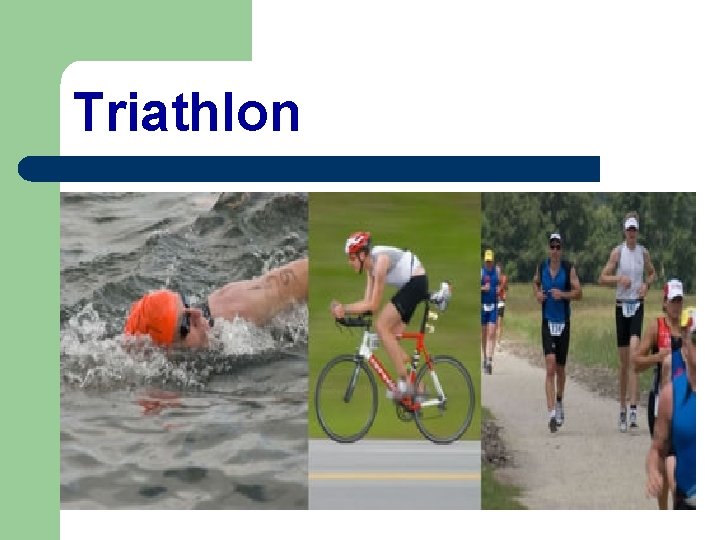
Triathlon
Triathlon l Endurance contest involving swimming, cycling and running. It originated in California in the 1970’s and became an Olympic event in 2000. Olympic and World championships consist of a 1. 5 kilometer open water swim, 40 km bicycle ride, and a 10 km run
Quadrathlon l l l Is an enduring sports event composed of four individual disciplines. All four disciplines are completed in succession and the lowest overall time decides the winner. The World Quadrathlon consists of: Swimming (2 miles / 3. 2 Kilometers) Kayaking (12. 4 miles / 20 kilometers) Cycling ( 100 miles / 161 kilometers) Running ( 26. 2 miles / 42 kilometers)
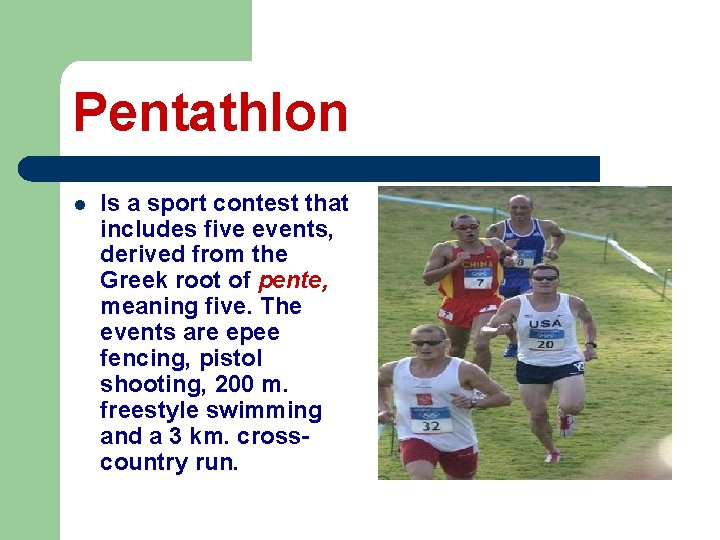
Pentathlon l Is a sport contest that includes five events, derived from the Greek root of pente, meaning five. The events are epee fencing, pistol shooting, 200 m. freestyle swimming and a 3 km. crosscountry run.
Decathlon l Is a combination of athletic disciplines, testing a individual’s speed, strength, skills, stamina, endurance and perseverance ; It includes five events on each of 2 successive days. The emphasis of the first day is on speed explosive power and jumping ability; the second emphasizes technique and endurance.
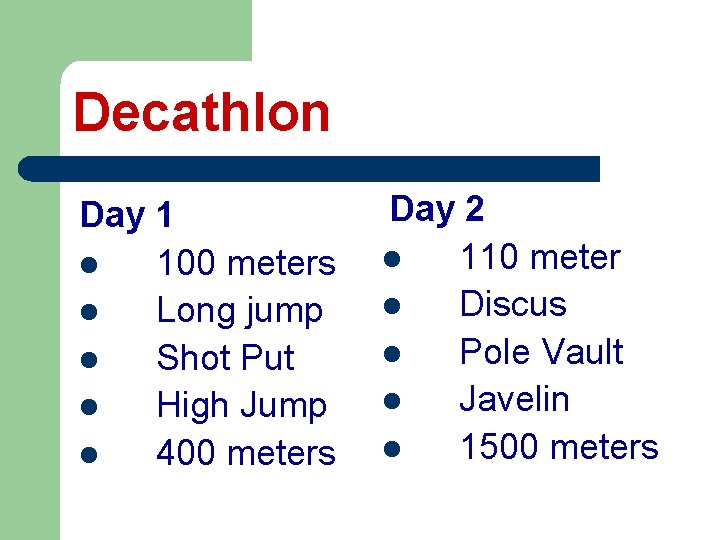
Decathlon Day 1 l 100 meters l Long jump l Shot Put l High Jump l 400 meters Day 2 l 110 meter l Discus l Pole Vault l Javelin l 1500 meters
The End This is the end of my report. Thank you for watching. ROBERT M. B. M. RICAFORT
- Slides: 38