
History of the Microscope and Microscopic Images Engaging
- Slides: 12
History of the Microscope and Microscopic Images: Engaging High School Biology Students Using Primary Sources (STEM) https: //www. waynesburg. edu/community/tps-eastern-region/project-activities-by-state/68 -eastern-region-partner/360 -eastern-region-lessonplans? showall=&start=4 Marietta F. Marrelli Wright, Ph. D. , M. S. , B. A. Sources Conference - UCF January 2019 Copyright 2007 by Saunders/Elsevier. All rights reserved.
Lesson Plan Overview • Modern histology, biology and medicine are based on pivotal innovations and observations of many individuals. In the 17 th century, the unknown world of cells was discovered, changing scientific views. As scientists learned about the “micro” world, society was uncertain of how cellular knowledge would affect them. • This lesson plan involves the exploration of various primary sources to understand the historical impacts of the microscope and microscopic images to modern biological and medical fields. Copyright 2007 by Saunders/Elsevier. All rights reserved.
Lesson Plan Objectives • Investigate the history of microscopy and its importance in the fields of histology, biology, and medicine. • Compile and analyze primary source materials written and drawn about the microscope and microscopic images. • Determine the impacts of primary source evidence on modern biological and medical fields. • Synthesize the influences of primary source information and current primary scientific literature into an oral presentation Copyright 2007 by Saunders/Elsevier. All rights reserved.
Library of Congress tools: • Analysis tool for books and images: • http: //www. loc. gov/teachers/primary-source-analysis-tool/ • Stripling model of inquiry: • http: //www. loc. gov/teachers/tps/quarterly/inquiry_learning/article. html Copyright 2007 by Saunders/Elsevier. All rights reserved.
Have students think about advancements in microscope technology • Examine the image of Robert Brown’s microscope (1665) in the next slide. (from the Library of Congress (Lo. C)): • https: //www. loc. gov/item/2006690465/ • How do the first and modern microscopes compare? • https: //www. loc. gov/preservation/scientists/instrumentation/compound_dig_micros copy. html • How has the technology of the microscope led to advancements in science? Copyright 2007 by Saunders/Elsevier. All rights reserved.
Students can examine the microscopic images from The Library of Congress (Lo. C) • What do you think were the type of organisms of the first microscopic images? Copyright 2007 by Saunders/Elsevier. All rights reserved.
Students can discuss: What do you think the public’s reaction was to these microscopic images? • Image: (Look before you eat) Opper, F • https: //www. loc. gov/item/2012645181/ • Based on the Opper image, would society welcome or believe in such an invention and/or the images obtained from these instruments? • Discuss the meanings of this image in the contexts of the time and for today. Has anything changed today? Copyright 2007 by Saunders/Elsevier. All rights reserved.
Thought questions for students to discuss: • Why would people be afraid to see the images from a microscope? • How did viewing the cellular world affect scientists’ thinking? Public views? • How did the invention of the microscope and microscopic observations contribute to the formulation of the Cell Theory? Copyright 2007 by Saunders/Elsevier. All rights reserved.
Student Exploration 7. Investigate: Divide the class into groups of 2. Have each of the groups select a section from each chapter of the book: The use of the Microscope: https: //archive. org/stream/useofmicroscopei 00 frie#page/n 7/mode/2 up 8. Have the students read analyze the section they chose from the chapter using the analysis tool Construct: Discuss findings with the whole class. 9. Create: Students will analyze the microscopic images in the book: • https: //archive. org/stream/illustratedsynop 00 pier#page/n 7/mode/2 up 10. Express: Have students discuss the similarities and differences that they see. Copyright 2007 by Saunders/Elsevier. All rights reserved.
Student Exploration (cont. ) 11. Reflect: Discuss the primary sources used. 12. Further investigation and Extensions: Students (on their own) should be able to connect the importance of primary historical sources to modern histology, biology, and medicine Using specific search terms from the previous exercises, students will search the Library of Congress website to find additional historical microscopic images and/or books. Copyright 2007 by Saunders/Elsevier. All rights reserved.
Library of Congress Sources • Book (The Use of the Microscope in Clinical and Pathological • Examinations): https: //archive. org/stream/useofmicroscopei 00 frie#page/n 7/mode/2 up • Book (An Illustrated Synopsis of Normal Histology): • https: //archive. org/stream/illustratedsynop 00 pier#page/n 7/mode/2 up • Book (A Manual of Pathological Histology): • https: //archive. org/stream/manualofpatholog 00 corn#page/n 7/mode/2 up • Modern microscopic images: • https: //www. youtube. com/watch? v=Om. HGw. Dy 51 PQ&index=5&list=PLDEQ MJ 4 WTc. Wq 1 Ahf. YMzem 7 Noireq. JUDo 6 • Database searches for historical primary sources: Library of Congress • https: //www. loc. gov/ Copyright 2007 by Saunders/Elsevier. All rights reserved.
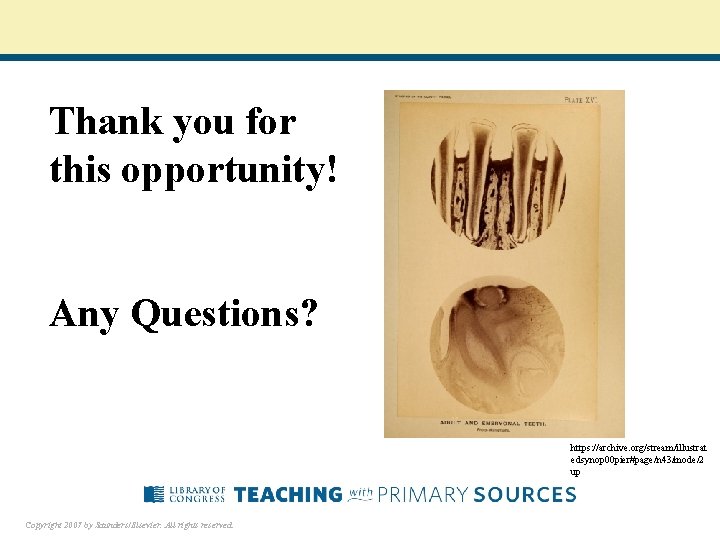
Thank you for this opportunity! Any Questions? https: //archive. org/stream/illustrat edsynop 00 pier#page/n 43/mode/2 up Copyright 2007 by Saunders/Elsevier. All rights reserved.