
HISTORY OF THE ATOM Why study the history





- Slides: 19
HISTORY OF THE ATOM
Why study the history of the atom? ◦"If I have seen further, it is by standing on the shoulders of giants. “ – Isaac Newton, 1676
Aristotle ◦We are what we repeatedly do. Excellence, then, is not an act, but a habit. ◦Happiness depends upon ourselves. ◦The educated differ from the uneducated as much as the living from the dead.
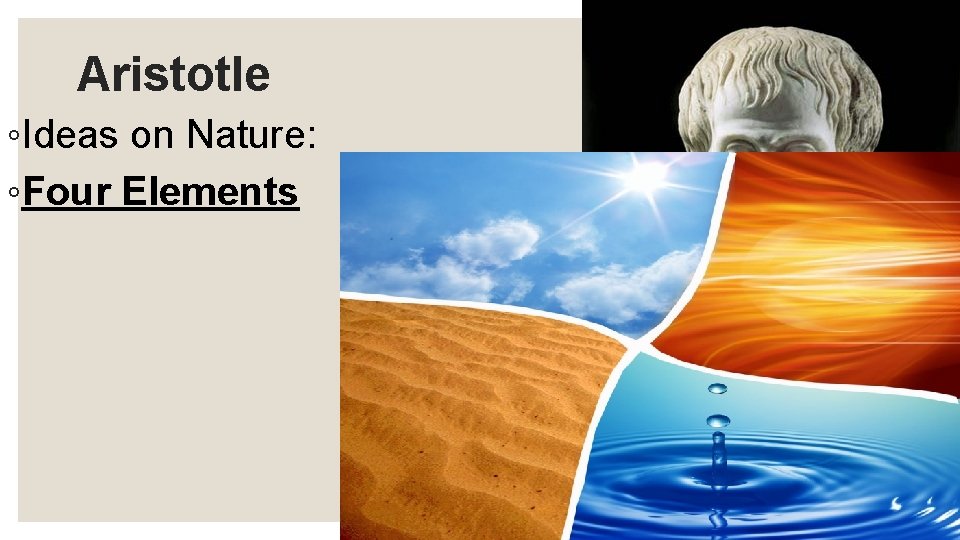
Aristotle ◦Ideas on Nature: ◦Four Elements
Democritus ◦He asked: Could matter be divided into smaller and smaller pieces forever, or was there a limit to the number of times a piece of matter could be divided?
Democritus ◦ His theory: ◦ Matter could not be divided into smaller and smaller pieces forever; eventually the smallest possible piece would be obtained. ◦ This piece would be indivisible. ◦ He named the smallest piece of matter “atomos, ” meaning “not to be cut. ”
Democritus ◦ His theory: ◦ Matter is composed of “atoms” which move through empty space. ◦ Atoms are solid, homogeneous, indestructible and indivisible. ◦ Different kinds of atoms have different shapes and sizes. ◦ The properties of matter are determined by the sizes, shapes, and movement of atoms.
Dalton ◦ His theory: ◦ He deduced that all matter is composed of atoms. ◦ Atoms are indivisible and indestructible particles. ◦ Atoms of the same element are exactly alike. ◦ Atoms of different elements are different. ◦ Compounds are formed by the joining of atoms of two or more elements.
Thomson ◦ He found that there were even smaller particles inside atoms.
Thomson ◦ His theory: ◦ When he passed an electric current through an almost empty glass tube, he saw a green flash. ◦ This radiation was called a cathode ray. ◦ It was negatively charged. ◦ Now called electrons.
Thomson ◦ His theory: ◦ Since all matter is neutral, it has no electric charge. ◦ If there are negatively charged particles in side atoms, there must be a positive charge too. ◦ Plum Pudding Model of the Atom ◦ Spherical atom of uniform positive charge, with negative electrons studded in it.
Rutherford ◦ Rutherford’s experiment Involved firing a stream of tiny positively charged particles at a thin sheet of gold foil (2000 atoms thick)
Rutherford
Rutherford ◦ Most of the positively charged “bullets” passed right through the gold atoms in the sheet of gold foil without changing course at all. ◦ Some of the positively charged “bullets, ” however, did bounce away from the gold sheet as if they had hit something solid. He knew that positive charges repel positive charges.
Rutherford ◦ His Theory: ◦ Most of the space of an atom must be empty. ◦ There must be a small, positively charged area in the center of the atom. called the nucleus. ◦ The nucleus is tiny compared to the atom as a whole.
Bohr ◦ His Theory: ◦ The electrons “live” in specific energy levels around the nucleus. ◦ The energy levels were like “orbits” ◦
Wave Model ◦ Today’s atomic model is based on the principles of wave mechanics. ◦ According to theory of wave mechanics, electrons do not move about an atom in a definite path, like the planets around the sun. ◦ In fact, it is impossible to determine the exact location of an electron. The probable location of an electron is based on how much energy the electron has. ◦ A space in which electrons are likely to be found is called the electron cloud. ◦
Wave Model: The Electron Cloud ◦ Electrons whirl about the nucleus billions of times in one second ◦ They are not moving around in random patterns. ◦ Location of electrons depends upon how much energy the electron has. ◦ Depending on their energy they are locked into a certain area in the cloud. ◦ Electrons with the lowest energy are found in the energy level closest to the nucleus ◦ Electrons with the highest energy are found in the outermost energy levels, farther from the nucleus. ◦