
History of the Atom Democritus 400 300 B

History of the Atom

Democritus ~ 400 -300 B. C. Produced the concept of the atom (“atomos”) Stated that the atoms could not be divided Indefinite number, various shapes and sizes Linked in clusters and connected in a physical manner (ball in joint or hooked with barbs) “Father of modern science”
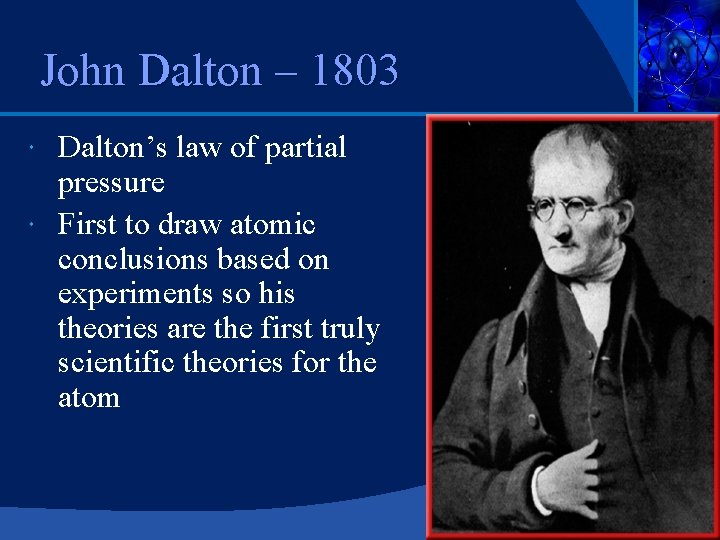
John Dalton – 1803 Dalton’s law of partial pressure First to draw atomic conclusions based on experiments so his theories are the first truly scientific theories for the atom
John Dalton – 1803 Contribution: 1) All elements are made of tiny atoms that cannot be created, divided, or destroyed. 2) Atoms of the same element are identical. Atoms of different elements are different from each other. 3) Atoms of different elements can physically mix or chemically combine to form chemical compounds in whole # ratios. 4) During chemical rxns, atoms are rearranged, and atoms of one element cannot be changed into atoms of a different element.
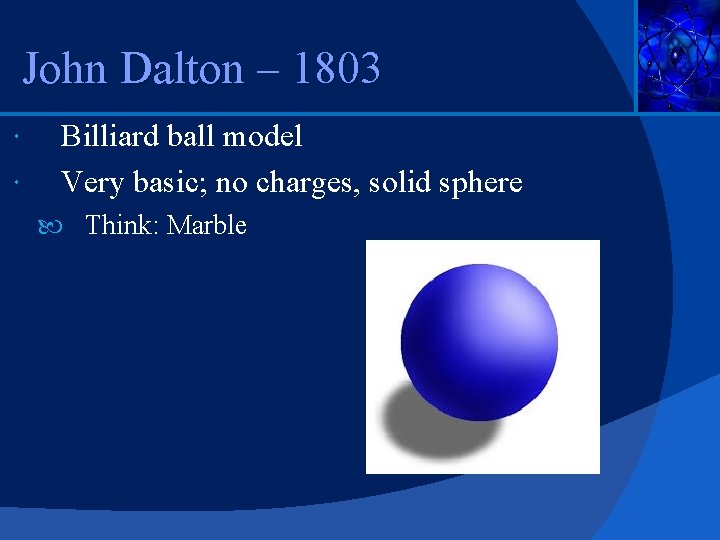
John Dalton – 1803 Billiard ball model Very basic; no charges, solid sphere Think: Marble
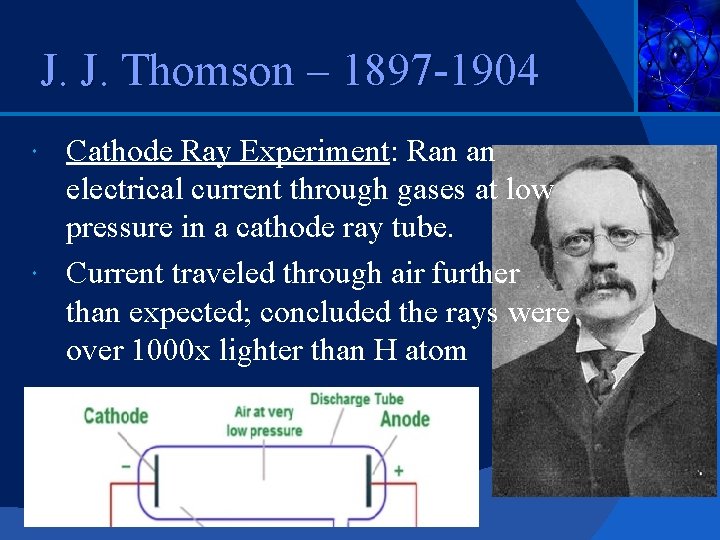
J. J. Thomson – 1897 -1904 Cathode Ray Experiment: Ran an electrical current through gases at low pressure in a cathode ray tube. Current traveled through air further than expected; concluded the rays were over 1000 x lighter than H atom
J. J. Thomson – 1897 -1904 Noticed the mass to charge ratio remained the same no matter which type of gas. Concluded atoms have (-) charges; named these “corpuscles” However, atoms are overall neutral, so there must be (+) charges as well https: //www. youtube. com/watch? v=UUp. D 62 r 2 wq 8
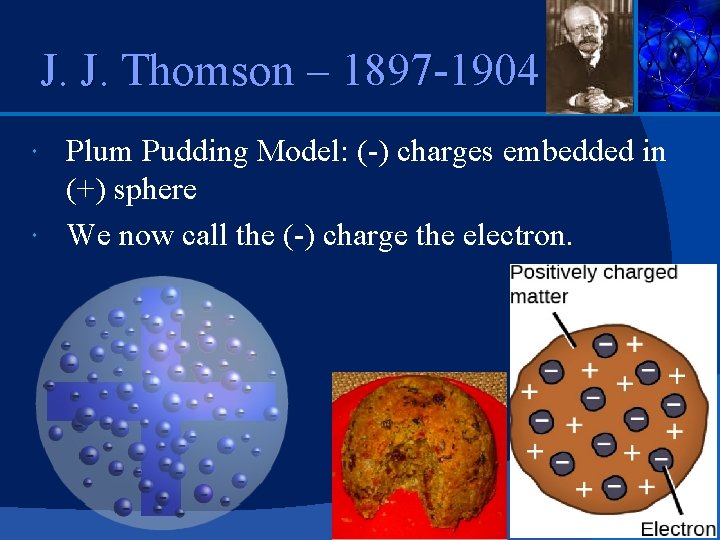
J. J. Thomson – 1897 -1904 Plum Pudding Model: (-) charges embedded in (+) sphere We now call the (-) charge the electron.
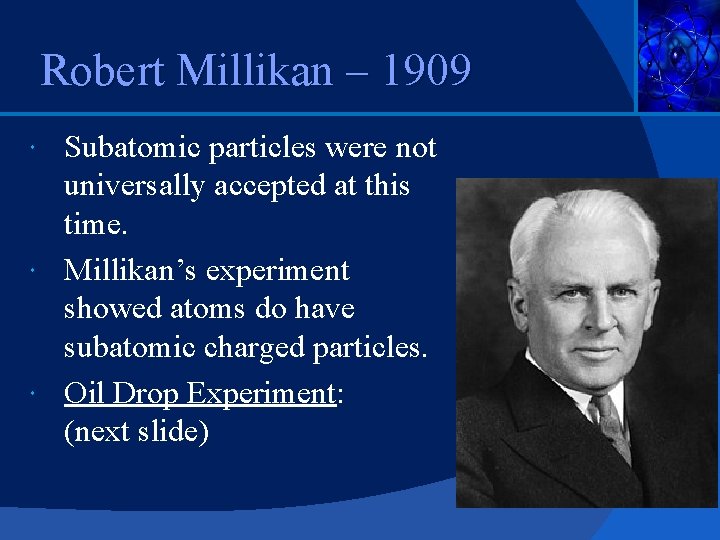
Robert Millikan – 1909 Subatomic particles were not universally accepted at this time. Millikan’s experiment showed atoms do have subatomic charged particles. Oil Drop Experiment: (next slide)
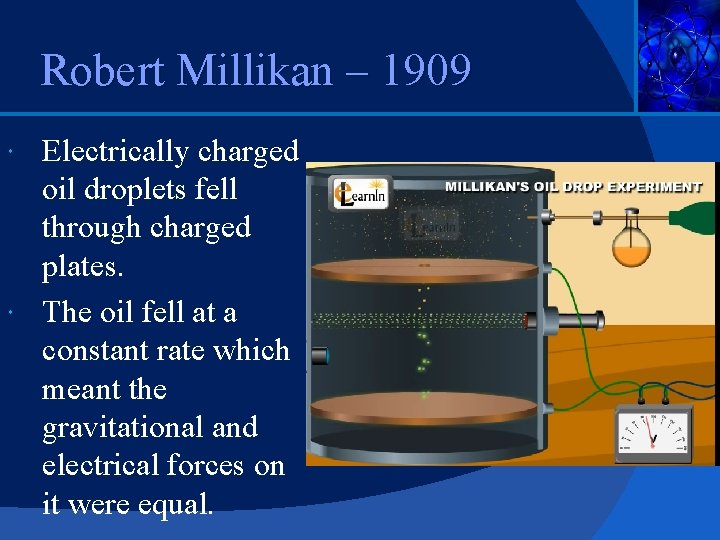
Robert Millikan – 1909 Electrically charged oil droplets fell through charged plates. The oil fell at a constant rate which meant the gravitational and electrical forces on it were equal.
Robert Millikan – 1909 Determined the charge of the e-. https: //www. youtube. com/watch? v=UFi. PWv 03 f 6 g
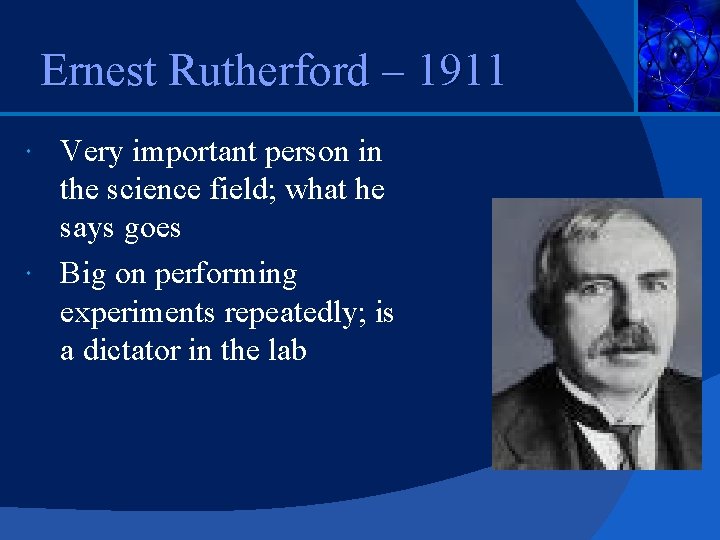
Ernest Rutherford – 1911 Very important person in the science field; what he says goes Big on performing experiments repeatedly; is a dictator in the lab
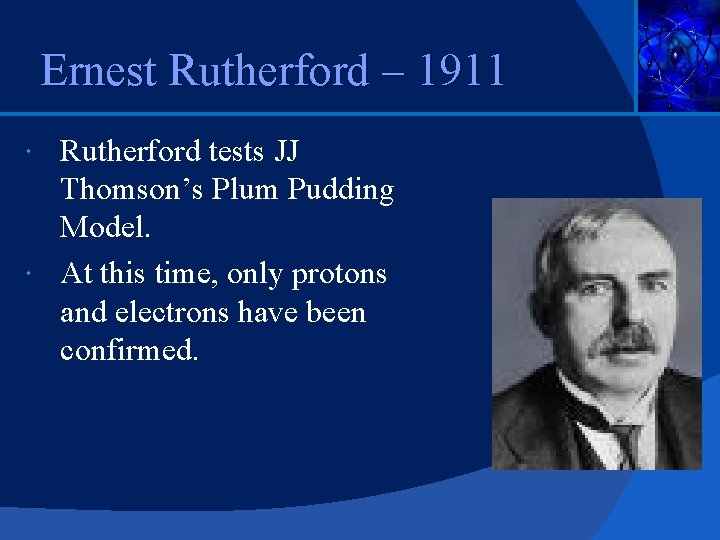
Ernest Rutherford – 1911 Rutherford tests JJ Thomson’s Plum Pudding Model. At this time, only protons and electrons have been confirmed.
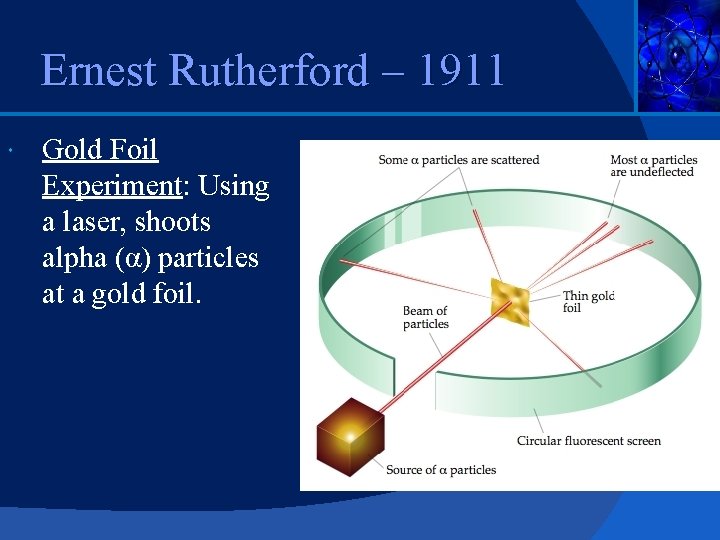
Ernest Rutherford – 1911 Gold Foil Experiment: Using a laser, shoots alpha (α) particles at a gold foil.
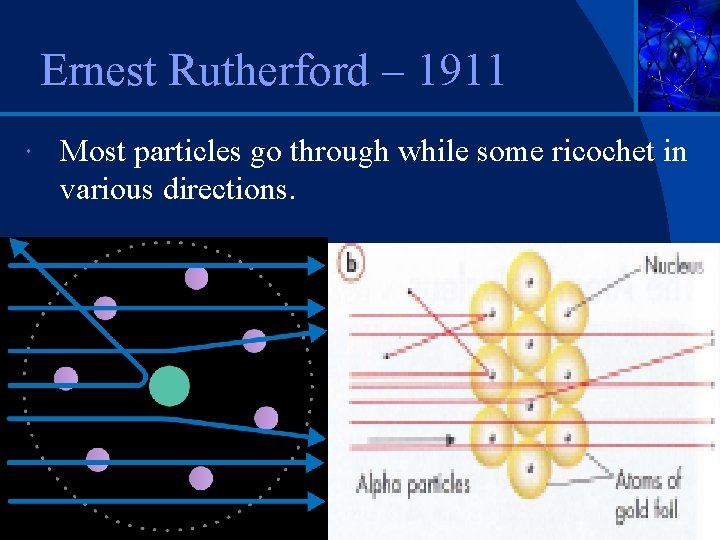
Ernest Rutherford – 1911 Most particles go through while some ricochet in various directions.
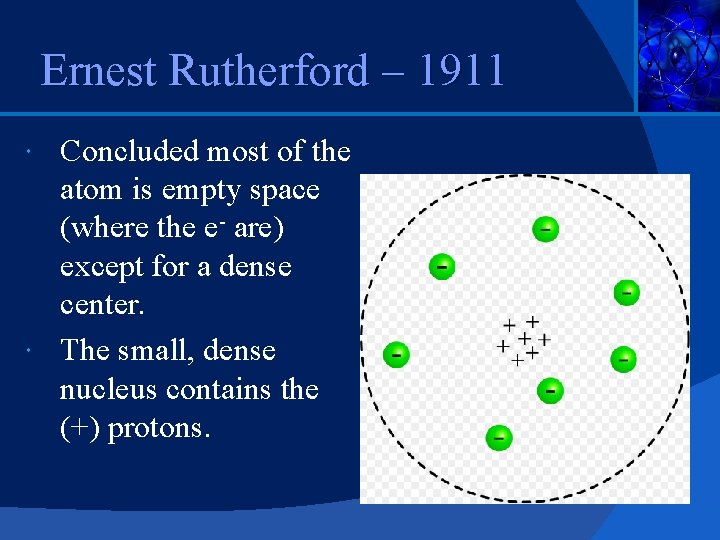
Ernest Rutherford – 1911 Concluded most of the atom is empty space (where the e- are) except for a dense center. The small, dense nucleus contains the (+) protons.
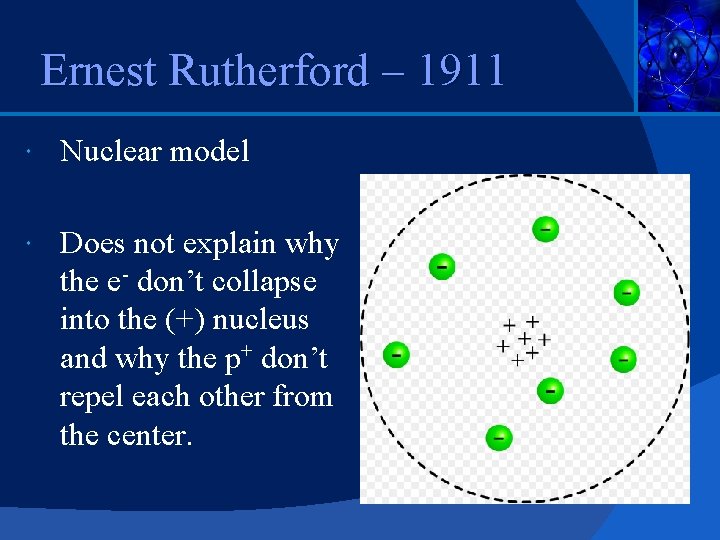
Ernest Rutherford – 1911 Nuclear model Does not explain why the e- don’t collapse into the (+) nucleus and why the p+ don’t repel each other from the center.
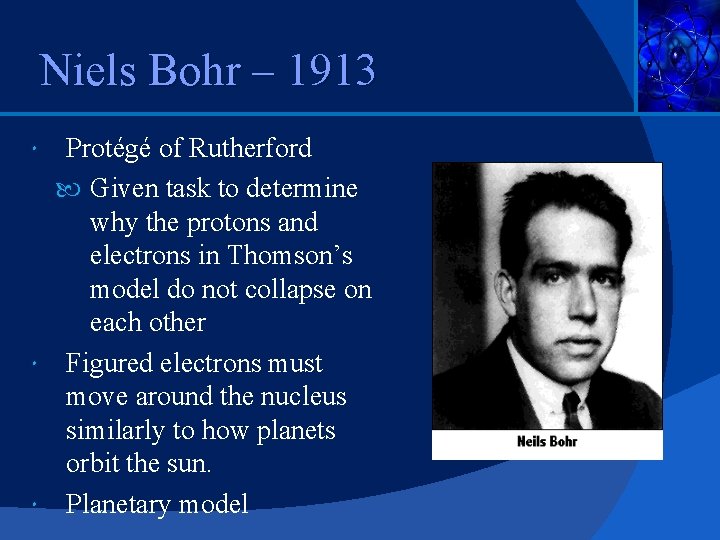
Niels Bohr – 1913 Protégé of Rutherford Given task to determine why the protons and electrons in Thomson’s model do not collapse on each other Figured electrons must move around the nucleus similarly to how planets orbit the sun. Planetary model
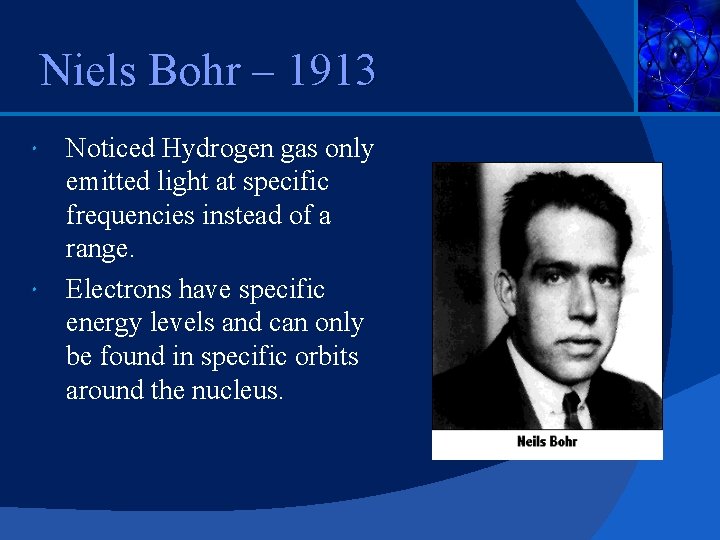
Niels Bohr – 1913 Noticed Hydrogen gas only emitted light at specific frequencies instead of a range. Electrons have specific energy levels and can only be found in specific orbits around the nucleus.
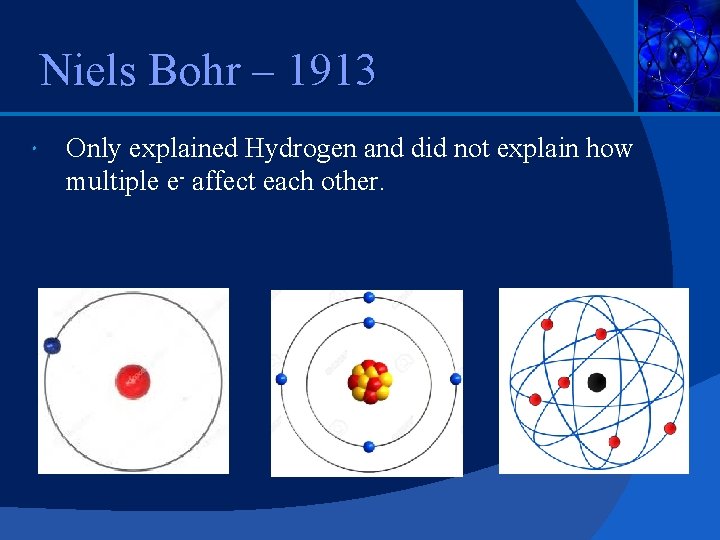
Niels Bohr – 1913 Only explained Hydrogen and did not explain how multiple e- affect each other.
Quantum Mechanical Model – 1926 today Today’s current model Initial theory proposed by Einstein himself (who later argued against it) Further produced by various scientists such as Schrödinger, Heisenberg, and de Broglie.
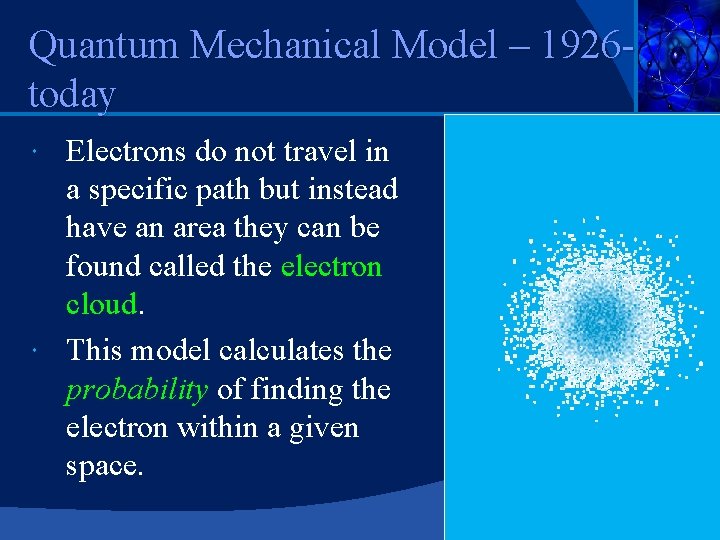
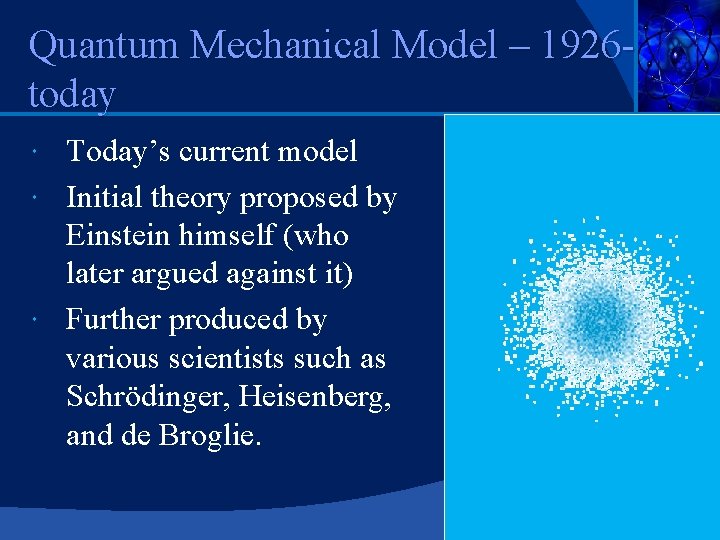
Quantum Mechanical Model – 1926 today Electrons do not travel in a specific path but instead have an area they can be found called the electron cloud. This model calculates the probability of finding the electron within a given space.
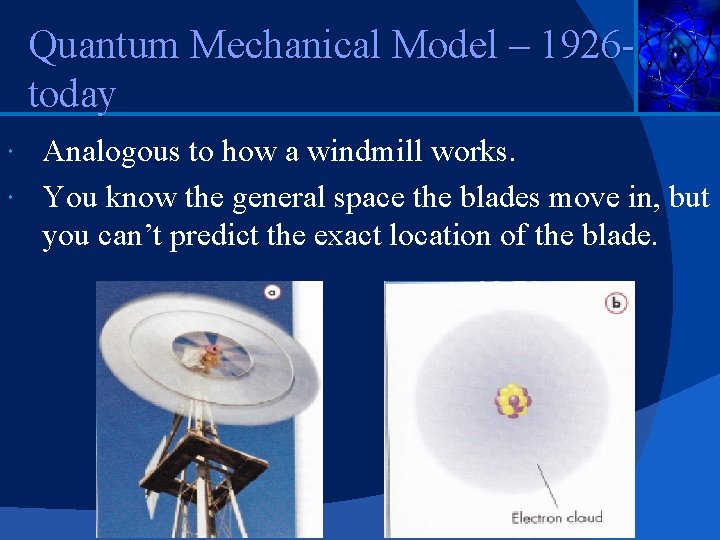
Quantum Mechanical Model – 1926 today Analogous to how a windmill works. You know the general space the blades move in, but you can’t predict the exact location of the blade.
Quantum Mechanical Model – 1926 today Heisenberg’s Uncertainty Principle: You can know the velocity of an electron or the location of the electron, but not both at the same time. We will go over further details tomorrow.
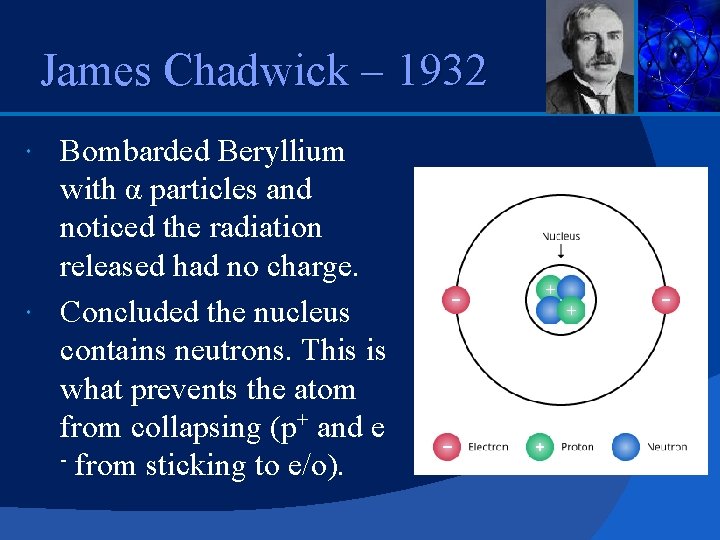
James Chadwick – 1932 Bombarded Beryllium with α particles and noticed the radiation released had no charge. Concluded the nucleus contains neutrons. This is what prevents the atom from collapsing (p+ and e - from sticking to e/o).
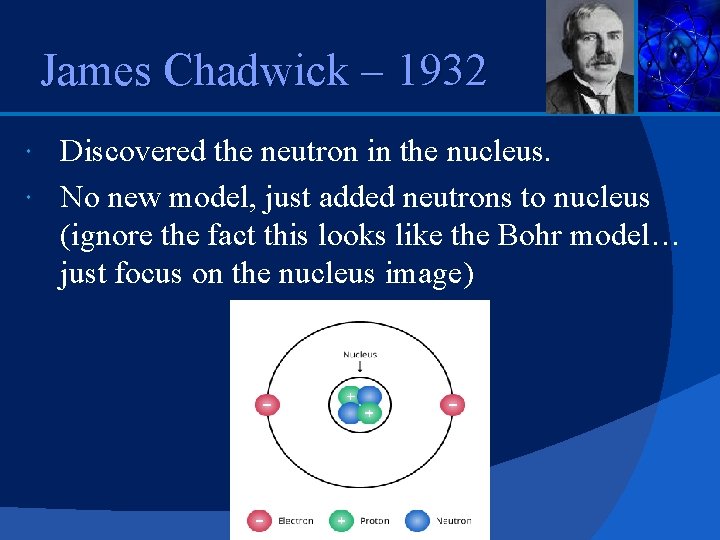
James Chadwick – 1932 Discovered the neutron in the nucleus. No new model, just added neutrons to nucleus (ignore the fact this looks like the Bohr model… just focus on the nucleus image)
- Slides: 26