
History of Software Insecurity CSE 545 Software Security
![The Worm • First Step: Remote privileged access – finger buffer overflow char line[512];](https://slidetodoc.com/presentation_image_h/b63955fe880908feb299d5532b25b5dd/image-22.jpg "The Worm • First Step: Remote privileged access – finger buffer overflow char line[512];")
- Slides: 37
History of Software Insecurity CSE 545 – Software Security Spring 2017 Adam Doupé Arizona State University http: //adamdoupe. com Content of some slides provided by Giovanni Vigna of UCSB, with approval
The Internet • A "network of networks" • Composed of a set of autonomous subnetworks • Open architecture • Different administrative domains with different (and sometimes conflicting) goals • The Internet is critical to our lives Adam Doupé, Software Security 2
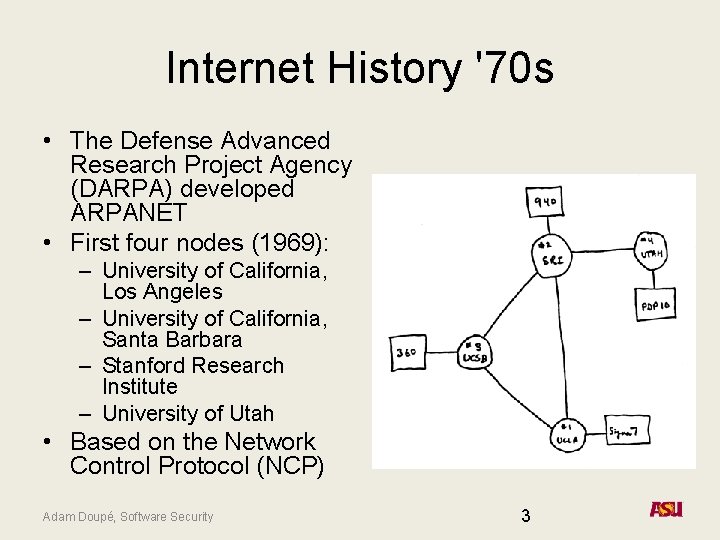
Internet History '70 s • The Defense Advanced Research Project Agency (DARPA) developed ARPANET • First four nodes (1969): – University of California, Los Angeles – University of California, Santa Barbara – Stanford Research Institute – University of Utah • Based on the Network Control Protocol (NCP) Adam Doupé, Software Security 3
Internet History '80 s • ARPANET moves to TCP/IP (January 1 st, 1983) • DARPA funds the development of Berkeley UNIX (TCP/IP implementation that introduces the socket programming abstraction) • APRANET becomes a subset of the Internet (and MILNET detaches) • The National Science Foundation (NSF) creates a supercomputer network, NFSNET, supported by a "backbone" (56 Kbps link in 1986) Adam Doupé, Software Security 4
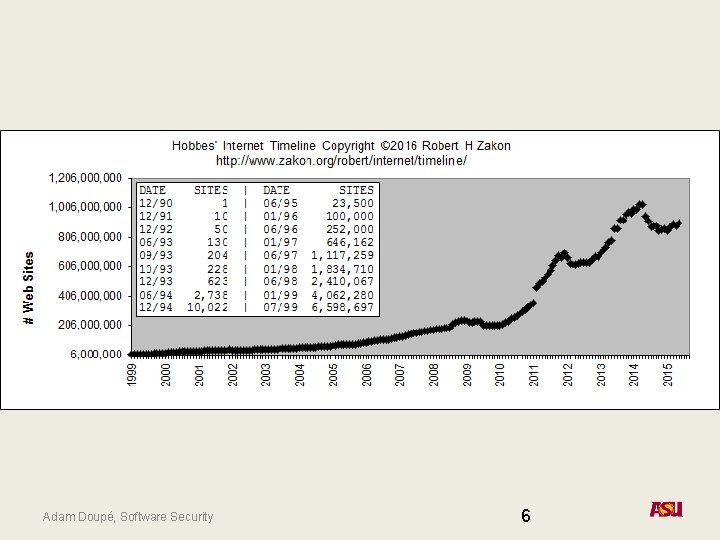
Internet History '90 s and '00 • Fast growth (size and volume) • 1991: Tim Berners-Lee at CERN creates the World Wide Web • The Internet explodes Adam Doupé, Software Security 5
Adam Doupé, Software Security 6
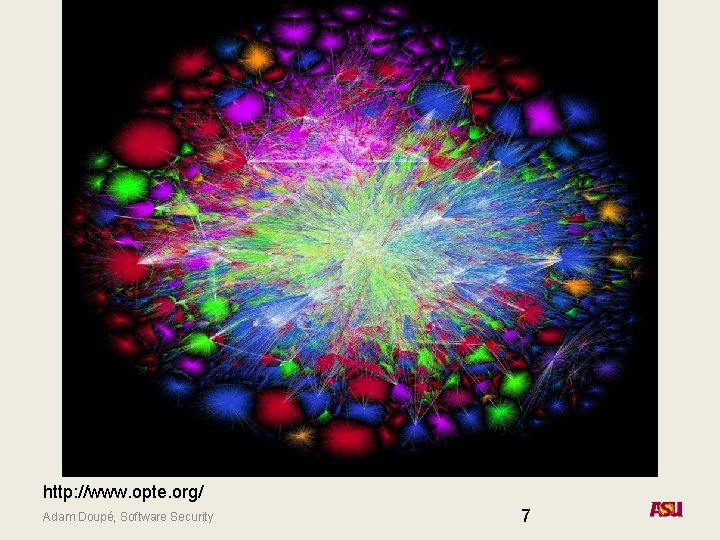
http: //www. opte. org/ Adam Doupé, Software Security 7
A Brief History of Notable Hacking • 1972 phone phreaking • December 1972, Bob Metcalfe "The Stockings Were Hung by the Chimney with Care, " RFC #602 • August 1986, German hackers try to obtain secrets to be sold to the KGB • November 1988, The Internet worm • December 1994, Kevin Mitnick attacks Supercomputer Center • March 2010, Albert Gonzales receives 20 -year sentence for hacking • … Adam Doupé, Software Security 8
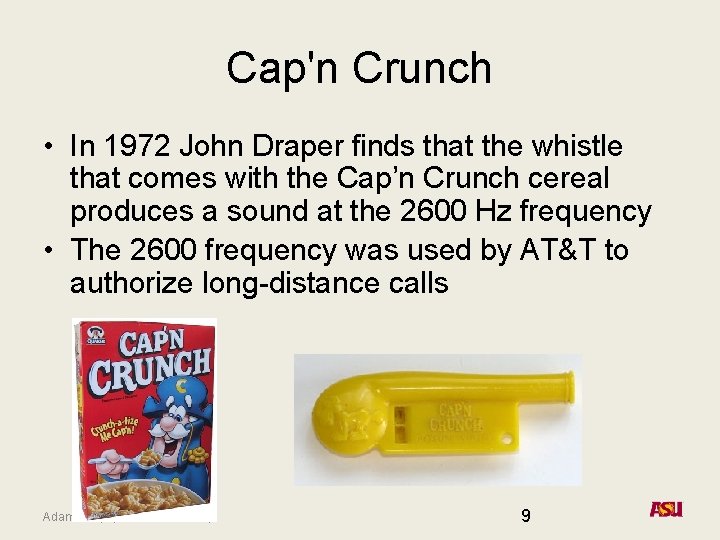
Cap'n Crunch • In 1972 John Draper finds that the whistle that comes with the Cap’n Crunch cereal produces a sound at the 2600 Hz frequency • The 2600 frequency was used by AT&T to authorize long-distance calls Adam Doupé, Software Security 9
Phone Phreaking • John Draper became known as "Captain Crunch" and built a "blue box" – Blue box produced a number of different tones that could be used for in-band signaling • Draper was eventually sentenced to five years' probation for phone fraud • Why do we care? Adam Doupé, Software Security 10
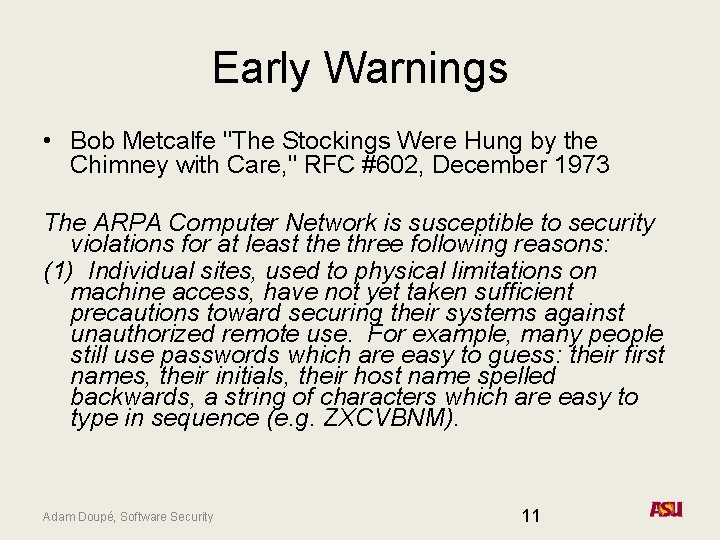
Early Warnings • Bob Metcalfe "The Stockings Were Hung by the Chimney with Care, " RFC #602, December 1973 The ARPA Computer Network is susceptible to security violations for at least the three following reasons: (1) Individual sites, used to physical limitations on machine access, have not yet taken sufficient precautions toward securing their systems against unauthorized remote use. For example, many people still use passwords which are easy to guess: their first names, their initials, their host name spelled backwards, a string of characters which are easy to type in sequence (e. g. ZXCVBNM). Adam Doupé, Software Security 11
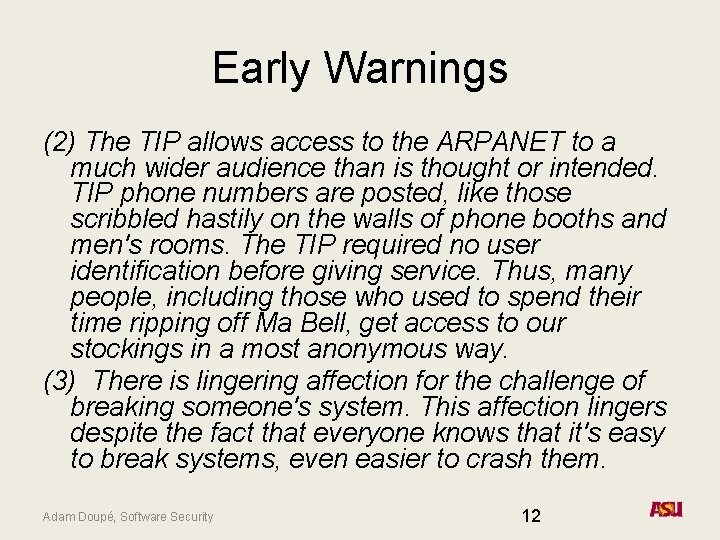
Early Warnings (2) The TIP allows access to the ARPANET to a much wider audience than is thought or intended. TIP phone numbers are posted, like those scribbled hastily on the walls of phone booths and men's rooms. The TIP required no user identification before giving service. Thus, many people, including those who used to spend their time ripping off Ma Bell, get access to our stockings in a most anonymous way. (3) There is lingering affection for the challenge of breaking someone's system. This affection lingers despite the fact that everyone knows that it's easy to break systems, even easier to crash them. Adam Doupé, Software Security 12
Early Warnings All of this would be quite humorous and cause for raucous eye winking and elbow nudging, if it weren't for the fact that in recent weeks at least two major serving hosts were crashed under suspicious circumstances by people who knew what they were risking; on yet a third system, the system wheel password was compromised -- by two high school students in Los Angeles no less. We suspect that the number of dangerous security violations is larger than any of us know is growing. You are advised not to sit "in hope that Saint Nicholas would soon be there". Adam Doupé, Software Security 13
The German Hacker Incident • Cliff Stoll was a system administrator at LBL in August 1986 – He was a physics student • On his first day, he started investigating a 75 cent accounting discrepancy for CPU time • He found out that an account had been created with no billing address • More investigation identified the presence of an intruder • Stoll (with encouragement by the FBI) monitored the intruder to find out who they were and how they gained access Adam Doupé, Software Security 14
The German Hacker Incident • Configuration problem in Emacs • Emacs can work as a mailer and it used the "movemail" program to move a user's email from /var/spool/mail to their home diretory • LBL configuration needed "movemail" to have root (advanced) privileges Adam Doupé, Software Security 15
The German Hacker Incident • In this configuration, movemail allowed anybody to move files to any directory of the system • Hacker exploited the bug to substitute his own copy of the "atrun" program • After execution, the legitimate atrun program was copied back Adam Doupé, Software Security 16
The German Hacker Incident • Hacker gained administrative access and created accounts and backdoor programs • Used the LBL to connect to military systems in the MILNET • Military sites and databases were searched for keywords such as “SDI” (Strategic Defense Initiative), “stealth”, “SAC” (Strategic Air Command), “nuclear”, “NORAD” • Stoll called the FBI Adam Doupé, Software Security 17
The German Hacker Incident • With the help of the FBI and of the Bundeskriminalamt (BKA) he was able to trace the intruder to Hanover • 1989: the investigation ends with the arrest of Markus Hess in Germany, who apparently worked for the Eastern Bloc • Markus was sentenced to a year and eight months and a 10, 000 DM fine – He was put on probation • Other “hackers” were involved in the break-in and received similar sentences Adam Doupé, Software Security 18
The Cuckoo's Egg • Cliff Stoll's own account of the incident – Highly recommended reading • http: //www. amazon. com/The-Cuckoos-Egg -Tracking-Espionage/dp/1416507787 Adam Doupé, Software Security 19
The Internet Worm • November 2 nd, 1988: The "Internet worm, " developed by Robert T. Morris (hacker alias RTM) was released • Mistake in the replication procedure led to unexpected proliferation • The Internet had to be "turned off" • Damages were estimated on the order of several hundred thousand dollars • RTM was sentenced to three years' probation, a $10, 000 fine, and 400 hours community service • CERT (Computer Emergency Response Team) was created in reaction Adam Doupé, Software Security 20
The Worm • A worm is a self-replicating program that spreads across a network of computers • The worm worked only on Sun 3 systems and VAX computers running BSD UNIX • The worm consisted of two parts: – A main program – A bootstrap program Adam Doupé, Software Security 21
The Worm • First Step: Remote privileged access – finger buffer overflow char line[512]; line[0] = ''; gets(line); – sendmail • DEBUG option allows one to specify a number of commands to execute • The bootstrap program (99 lines of C) was transferred to the machine • The bootstrap program was compiled and run, causing the transfer of a precompiled version of the main program to the infected host Adam Doupé, Software Security 22
The Worm • The main program – Gathered information about the network interfaces and open connections – Tried to break into hosts using rsh, finger, or sendmail – Gathers information on "trusted hosts" • /etc/hosts. equiv • /. rhosts • ~/. forward – Tries to rsh to the referenced hosts – Performs a password cracking attack • On each successful break-in the bootstrap was transferred Adam Doupé, Software Security 23
The Worm • http: //blog. wfmu. org/freeform/2008/05/abrief-history. html Adam Doupé, Software Security 24
Kevin Mitnick • One of the most well-known "hackers" • 1982: One-year probation for breaking into Pac. Bell’s offices • 1982: Enrolls at University of Southern California and uses campus machines to perform illegal activities: 6 months of juvenile prison in Stockton, California • 1987: Mitnick breaks into SCO. Sentence: three-year probation • 1988: Enrolls at Pierce and misuses campus systems. Expelled, appealed unsuccessfully • 1988: Mitnick breaks into DEC and steals software. Caught by FBI. One-year sentence at Lompoc, California Adam Doupé, Software Security 25
Kevin Mitnick • 1992: Mitnik violates probation and goes into hiding • 1994: California Department of Motor Vehicles issues $1 M warrant for Mitnick's arrest • Christmas 1994: Mitnick accused of invading San Diego Supercomputer Center Adam Doupé, Software Security 26
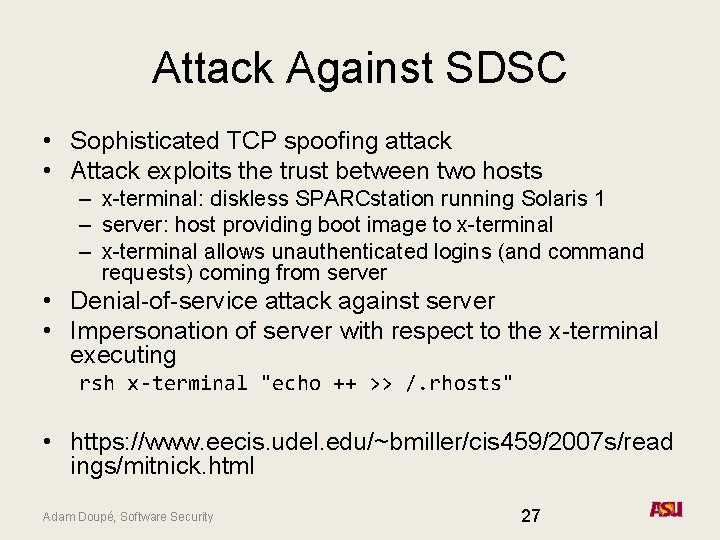
Attack Against SDSC • Sophisticated TCP spoofing attack • Attack exploits the trust between two hosts – x-terminal: diskless SPARCstation running Solaris 1 – server: host providing boot image to x-terminal – x-terminal allows unauthenticated logins (and command requests) coming from server • Denial-of-service attack against server • Impersonation of server with respect to the x-terminal executing rsh x-terminal "echo ++ >> /. rhosts" • https: //www. eecis. udel. edu/~bmiller/cis 459/2007 s/read ings/mitnick. html Adam Doupé, Software Security 27
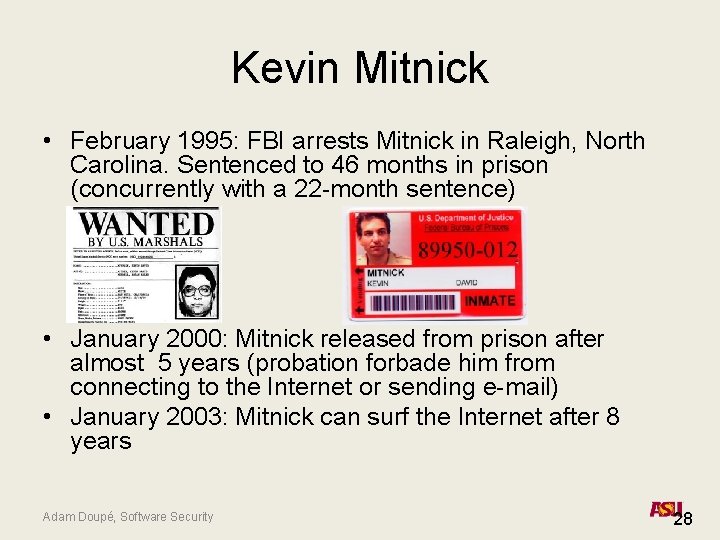
Kevin Mitnick • February 1995: FBI arrests Mitnick in Raleigh, North Carolina. Sentenced to 46 months in prison (concurrently with a 22 -month sentence) • January 2000: Mitnick released from prison after almost 5 years (probation forbade him from connecting to the Internet or sending e-mail) • January 2003: Mitnick can surf the Internet after 8 years Adam Doupé, Software Security 28
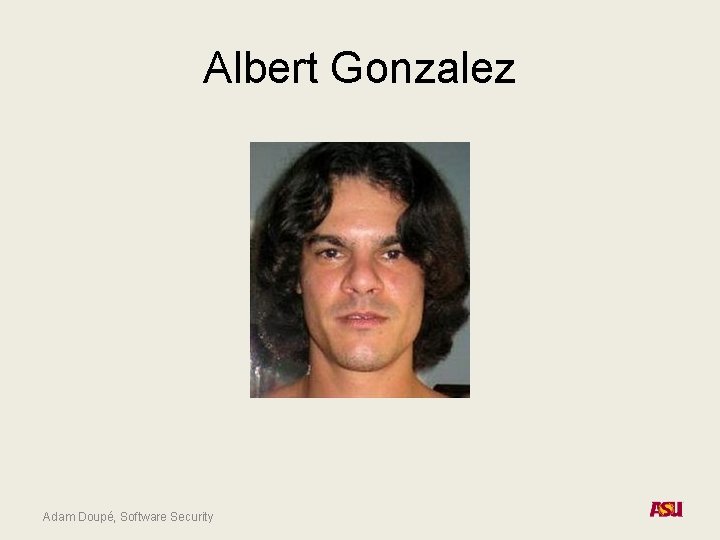
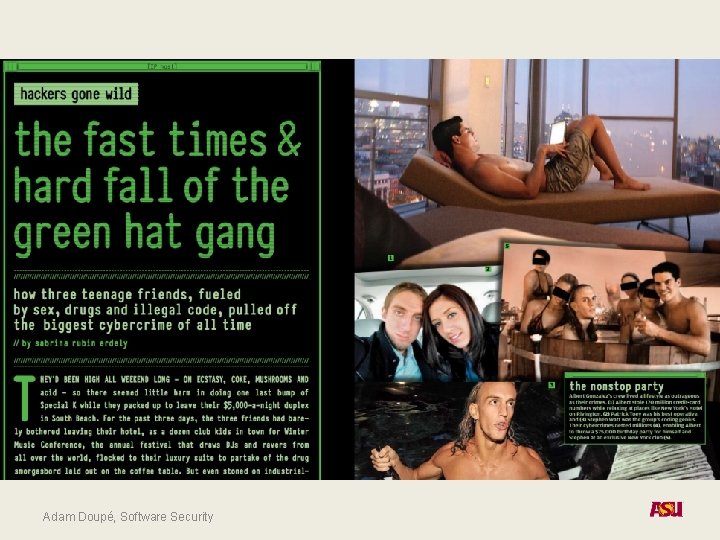
Albert Gonzalez Adam Doupé, Software Security
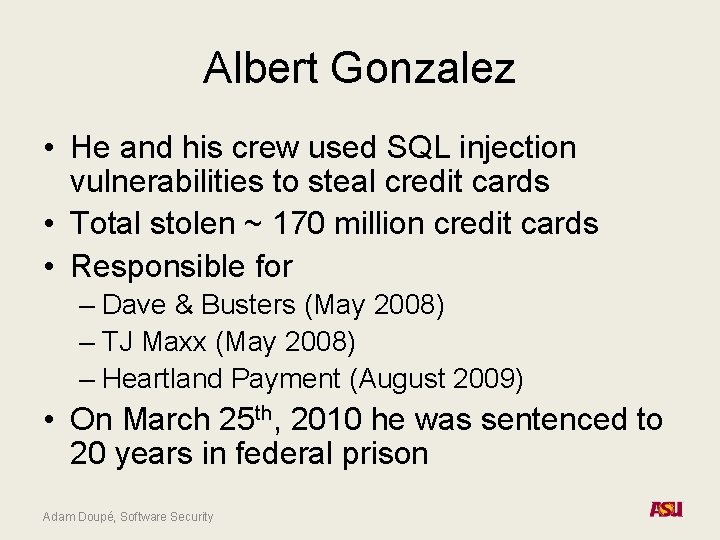
Albert Gonzalez • He and his crew used SQL injection vulnerabilities to steal credit cards • Total stolen ~ 170 million credit cards • Responsible for – Dave & Busters (May 2008) – TJ Maxx (May 2008) – Heartland Payment (August 2009) • On March 25 th, 2010 he was sentenced to 20 years in federal prison Adam Doupé, Software Security
Adam Doupé, Software Security
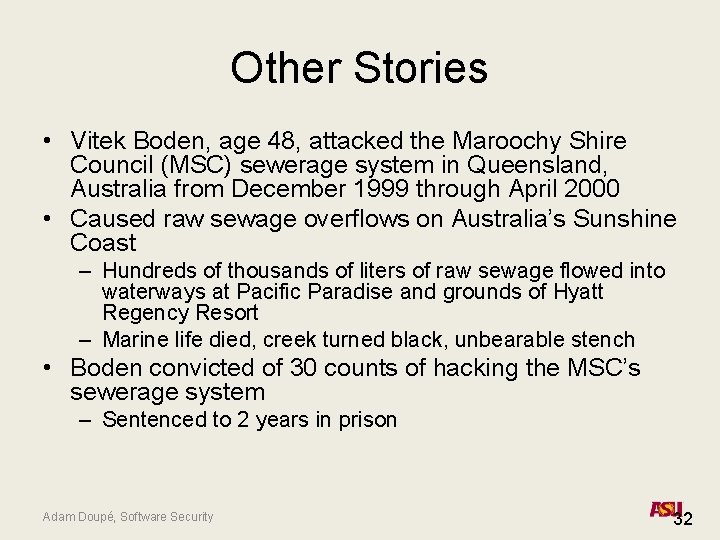
Other Stories • Vitek Boden, age 48, attacked the Maroochy Shire Council (MSC) sewerage system in Queensland, Australia from December 1999 through April 2000 • Caused raw sewage overflows on Australia’s Sunshine Coast – Hundreds of thousands of liters of raw sewage flowed into waterways at Pacific Paradise and grounds of Hyatt Regency Resort – Marine life died, creek turned black, unbearable stench • Boden convicted of 30 counts of hacking the MSC’s sewerage system – Sentenced to 2 years in prison Adam Doupé, Software Security 32
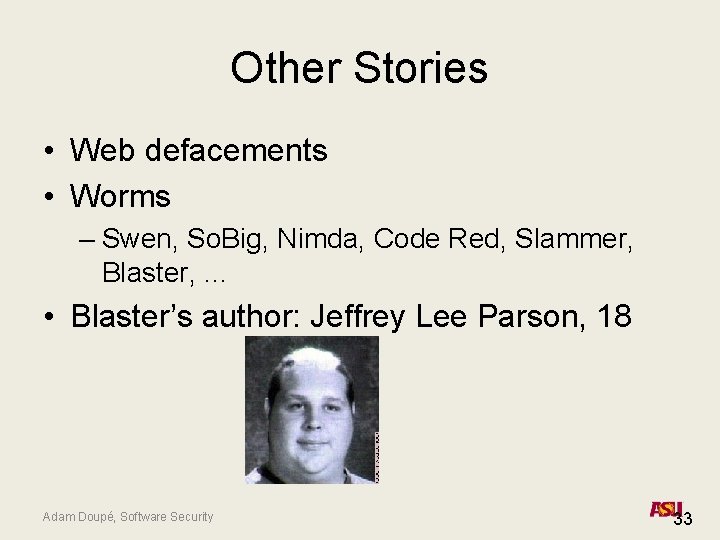
Other Stories • Web defacements • Worms – Swen, So. Big, Nimda, Code Red, Slammer, Blaster, . . . • Blaster’s author: Jeffrey Lee Parson, 18 Adam Doupé, Software Security 33
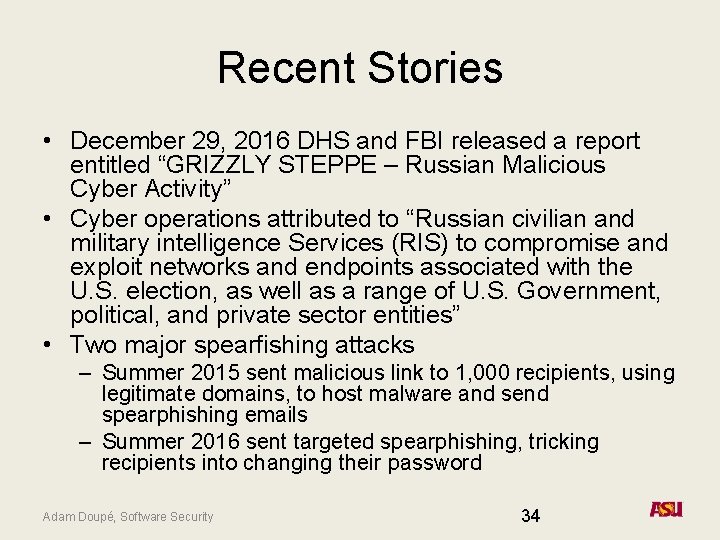
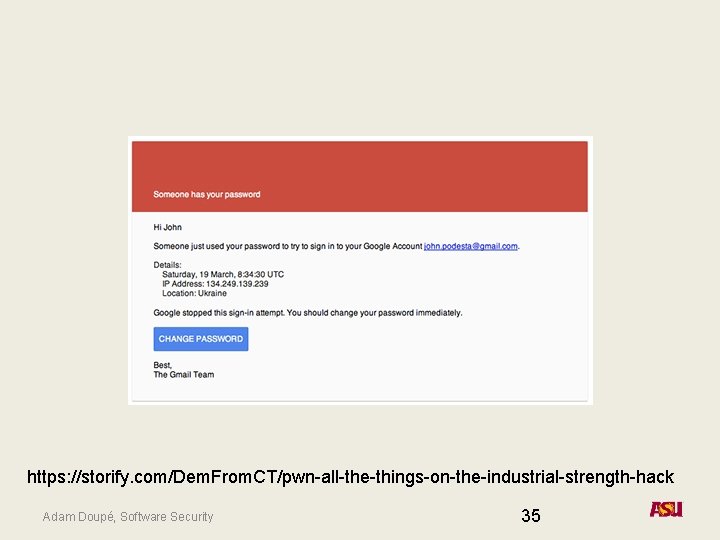
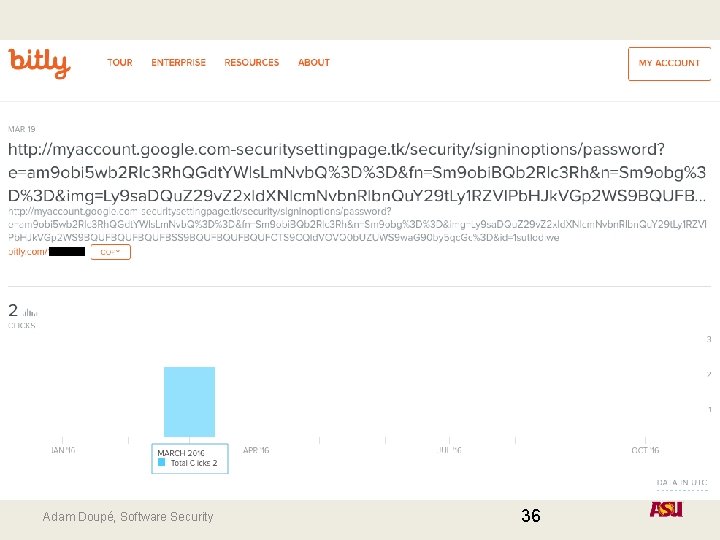
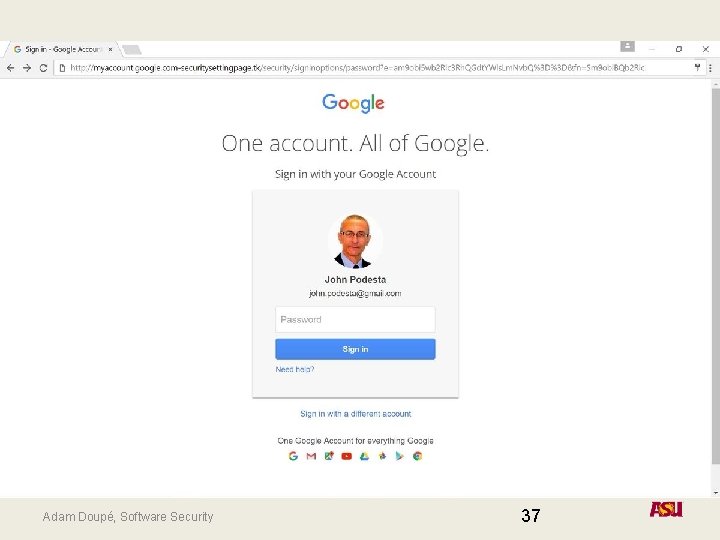
Recent Stories • December 29, 2016 DHS and FBI released a report entitled “GRIZZLY STEPPE – Russian Malicious Cyber Activity” • Cyber operations attributed to “Russian civilian and military intelligence Services (RIS) to compromise and exploit networks and endpoints associated with the U. S. election, as well as a range of U. S. Government, political, and private sector entities” • Two major spearfishing attacks – Summer 2015 sent malicious link to 1, 000 recipients, using legitimate domains, to host malware and send spearphishing emails – Summer 2016 sent targeted spearphishing, tricking recipients into changing their password Adam Doupé, Software Security 34
https: //storify. com/Dem. From. CT/pwn-all-the-things-on-the-industrial-strength-hack Adam Doupé, Software Security 35
Adam Doupé, Software Security 36
Adam Doupé, Software Security 37