
HISTORY OF PSYC Chapter 1 WHAT IS PSYCHOLOGY





- Slides: 26
HISTORY OF PSYC! Chapter 1
WHAT IS PSYCHOLOGY? • = Is the SCIENTIFIC study of behavior and mental processes. Psychologists rely on scientific research methods in their attempts to unravel answers to questions such as “why do some people offer help when others don’t? ” • Psychologists systematically collect research data and use mathematical formulas to analyze the results of their findings. • The key to unlocking the human mind / behaviors / feelings is using the scientific method.
HANK GREEN • https: //www. youtube. com/watch? v=vo 4 p. MVb 0 R 6 M • While watching this video write down at least 5 facts into your notebook!! • It will be graded!
BACK IN THE DAY! • American Psychological Association (APA): • Was founded in 1892 it is the primary publisher of scholarly journals in the field and promotes research and practice through founding initiatives and conference.
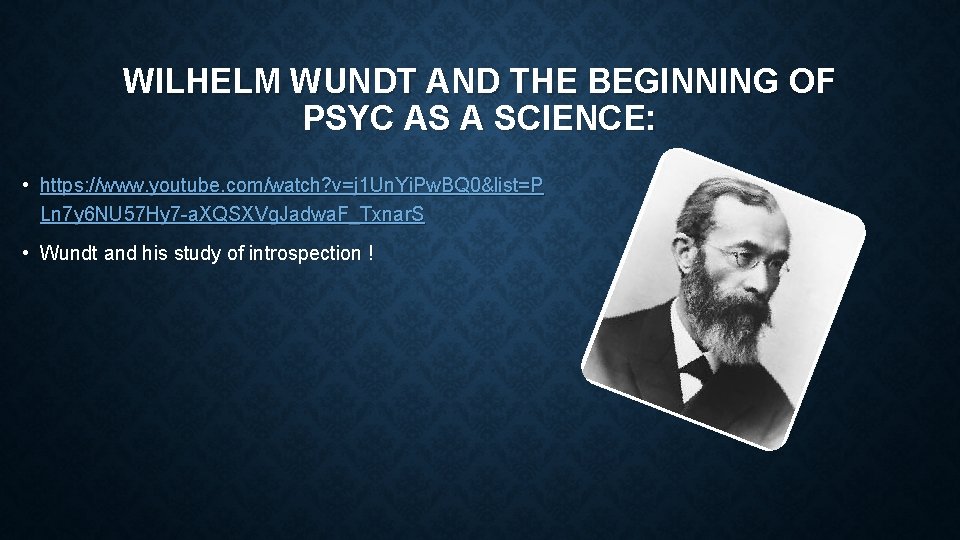
WILHELM WUNDT AND THE BEGINNING OF PSYC AS A SCIENCE: • https: //www. youtube. com/watch? v=j 1 Un. Yi. Pw. BQ 0&list=P Ln 7 y 6 NU 57 Hy 7 -a. XQSXVg. Jadwa. F_Txnar. S • Wundt and his study of introspection !
WILHELM WUNDT AND THE BEGINNING OF PSYC AS A SCIENCE: • Wilhelm Wundt = Father of modern day psychology • The son of a Lutheran minister Wundt had trouble staying focused in school he was known to get bad grades and even had to repeat a year of school. • Once he made his way into go university and decided he did not want to practice medicine (his father’s wishes) he decided to conduct experiments that tested how perception, sensation, and feeling related to human behavior. • Wundt was given space in a laboratory at the university of Leipzig to run his tests in 1879 which has now become known as the “birth year of psychology. ”
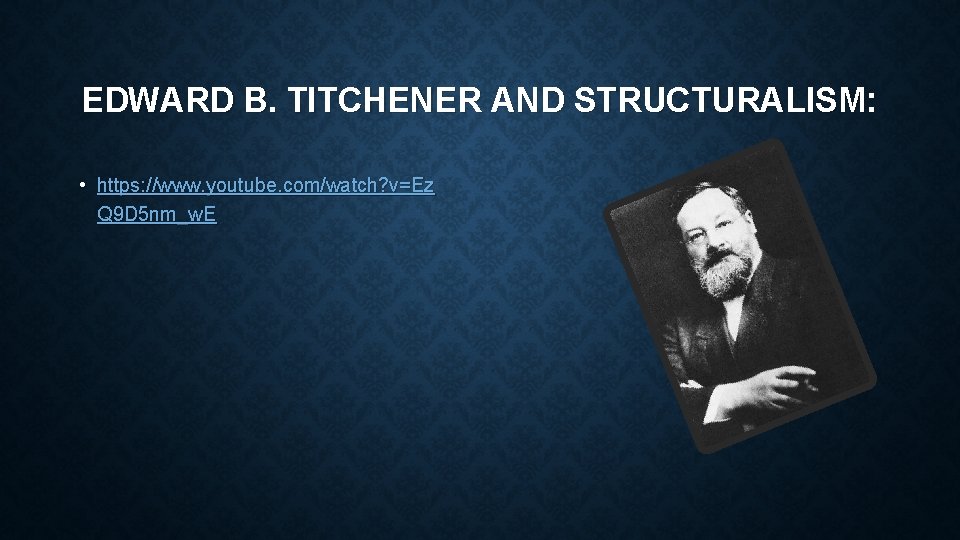
EDWARD B. TITCHENER AND STRUCTURALISM: • https: //www. youtube. com/watch? v=Ez Q 9 D 5 nm_w. E
EDWARD B. TITCHENER AND STRUCTURALISM: • Titchener introduced structuralism • Structuralism = the 1 st major school of psyc. Just as a chemist tries to understand the different elements in chemical compounds, structuralisms tried to understand the structure of conscious experiences by analyzing the intensity, clarity and quality of its basic parts. • Example: picture a blade of grass. A structuralist might have lingered over the intensity of the green color, the clarity of its texture, and the roughly rectangular shape of the blade.
EDWARD B. TITCHENER AND STRUCTURALISM: • For Titchener and his students, successful descriptions of such basic elements were the building blocks of consciousness. • Like Wundt, Titchener studied the structural elements of consciousness. Unlike Wundt, Titchener did not want to use hypothetical mental processes to explain consciousness. • Instead, Titchener steered psychology toward a descriptive science he could see.
GESTALT PSYCHOLOGY: • https: //www. youtube. com/watch? v=Fp. Ib. M 8 Nd. Rv. Q • Just watch you do not have to take notes
GESTALT PSYCHOLOGY: • Structuralism did not produce many followers, and so it died out. One reason for this was that in practice it did not prove to be very reliable. After many experiments on the same subject it kept giving different results . • Gestalt psychology = German word meaning configuration was a psychological perspective that emphasized our tendency to integrate pieces of information into meaningful wholes. • Gestalt psychologists suggested that adding the individual elements of an experiment together creates something new and different. “The whole is different from the sum of its parts. ”
GESTALT PSYCHOLOGY: • Examples: think of the notes to your favorite song. Individually each notes means little but put them together and you have a great tune. • Examples: think of an attack combo (for you gamers out there) if you separate each piece (action / move) they are sort of meaningless but put all the pieces (actions / moves) together and you just KILLED a wizard, murdered a drug dealer, stole a car, destroyed a planet etc…
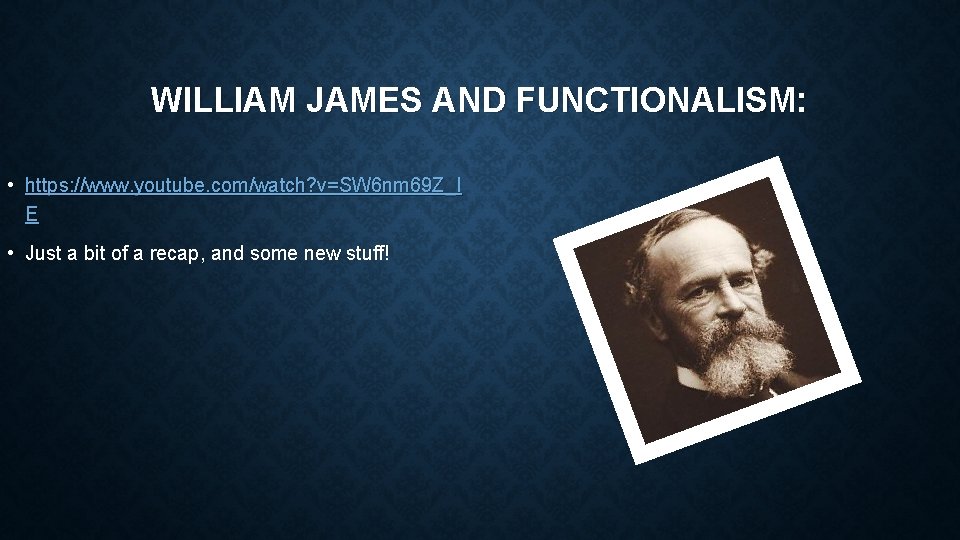
WILLIAM JAMES AND FUNCTIONALISM: • https: //www. youtube. com/watch? v=SW 6 nm 69 Z_I E • Just a bit of a recap, and some new stuff!
WILLIAM JAMES AND FUNCTIONALISM: • James = 1 st American psychologist, once noted that the 1 st psychology lecture he ever heard was his own… (JERK) • He went on to writ the 1 st psyc text book published in 1890. • James said psychology needed to be a study of the functions of consciousness or the ways consciousness helps people adapt to their environment. • James was influenced by Charles Darwin’s theory of evolution and believed that mental processes evolved over time. James thought we developed useful habits such as washing our hands before eating and brushing our teeth after a meal because they help us function more effectively in our daily lives.
PSYCHOLOGY IN THE 20 TH CENTURY: • As the 1900 s began and science developed more so did psychology, it was heading in a new direction and the man who was leading this change was Sigmund Freud.
SIGMUND FREUD AND PSYCHOANALYSIS: • https: //www. youtube. com/watch? v=m. Qaq. XK 7 z 9 LM • WARNING this video has some nudity pleas be adults… • Freud was a strange man and had some strange ideas so lets be polite while watching this.
SIGMUND FREUD AND PSYCHOANALYSIS: • In 1900, Freud introduced the world to psychoanalysis a theory of personality and therapeutic technique that attributes our thoughts and actions to unconscious motives and conflict. • Freud’s approach to psychology differed from Titchner’s structuralism and James's functionalism in two key ways: • 1. Psychoanalysis focused on abnormal behavior which Freud attributed to unconscious drives and conflicts, often stemming from childhood. • 2. Psychoanalysis relied on personal observation and reflection instead of controlled laboratory experimentation as its means of discovery. While Freud claimed his work was scientific it really was not because he relied on self reported reflections rather than scientific methods to gather information.
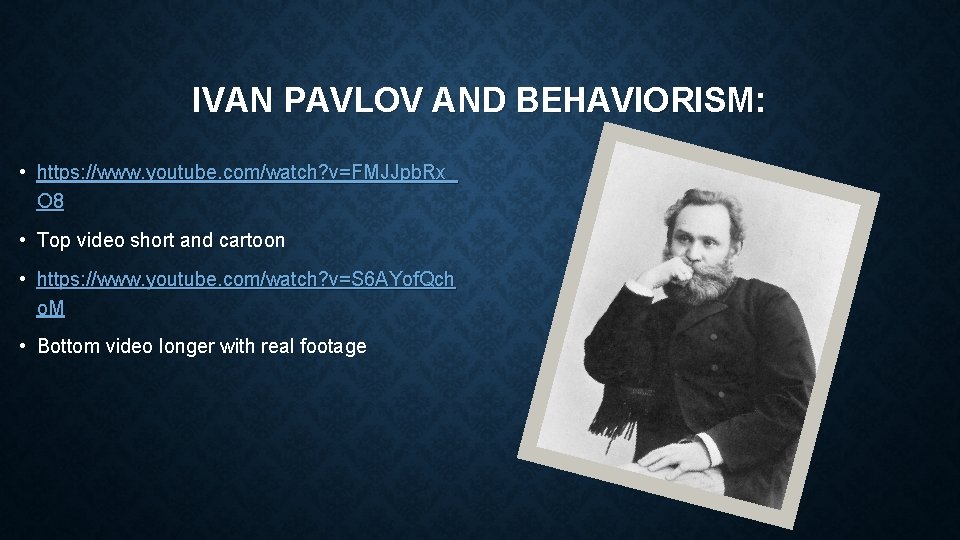
IVAN PAVLOV AND BEHAVIORISM: • https: //www. youtube. com/watch? v=FMJJpb. Rx_ O 8 • Top video short and cartoon • https: //www. youtube. com/watch? v=S 6 AYof. Qch o. M • Bottom video longer with real footage
IVAN PAVLOV AND BEHAVIORISM: • During the 1890 s Russian physiologist Ivan Pavlov was looking at salivation in dogs in response to being fed, when he noticed that his dogs would begin to salivate whenever he entered the room, even when he was not bringing them food. At first this was something of a nuisance (not to mention messy!). • Pavlov (1902) started from the idea that there are some things that a dog does not need to learn. For example, dogs don’t learn to salivate whenever they see food. This reflex is ‘hard wired’ into the dog. In behaviorist terms, it is an unconditioned response (i. e. a stimulus-response connection that required no learning). In behaviorist terms, we write:
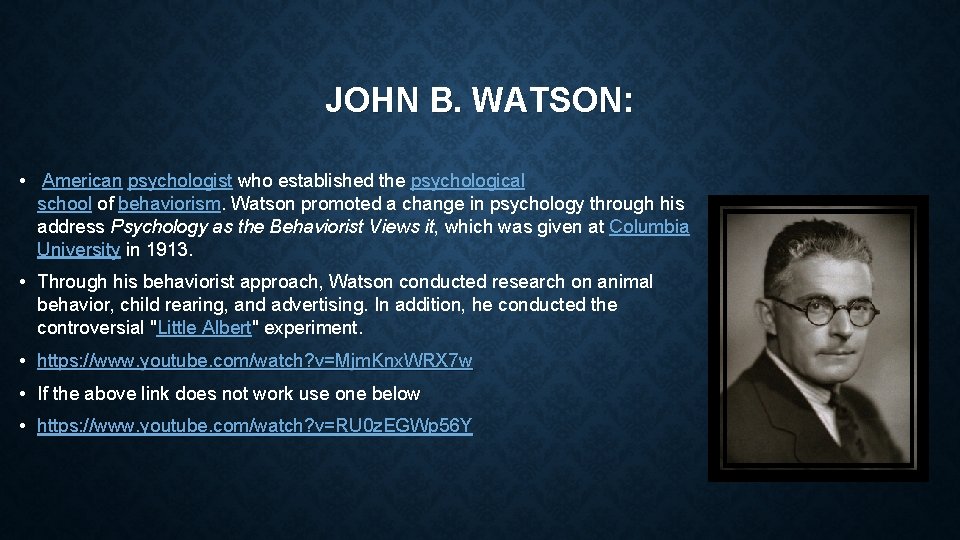
JOHN B. WATSON: • American psychologist who established the psychological school of behaviorism. Watson promoted a change in psychology through his address Psychology as the Behaviorist Views it, which was given at Columbia University in 1913. • Through his behaviorist approach, Watson conducted research on animal behavior, child rearing, and advertising. In addition, he conducted the controversial "Little Albert" experiment. • https: //www. youtube. com/watch? v=Mjm. Knx. WRX 7 w • If the above link does not work use one below • https: //www. youtube. com/watch? v=RU 0 z. EGWp 56 Y
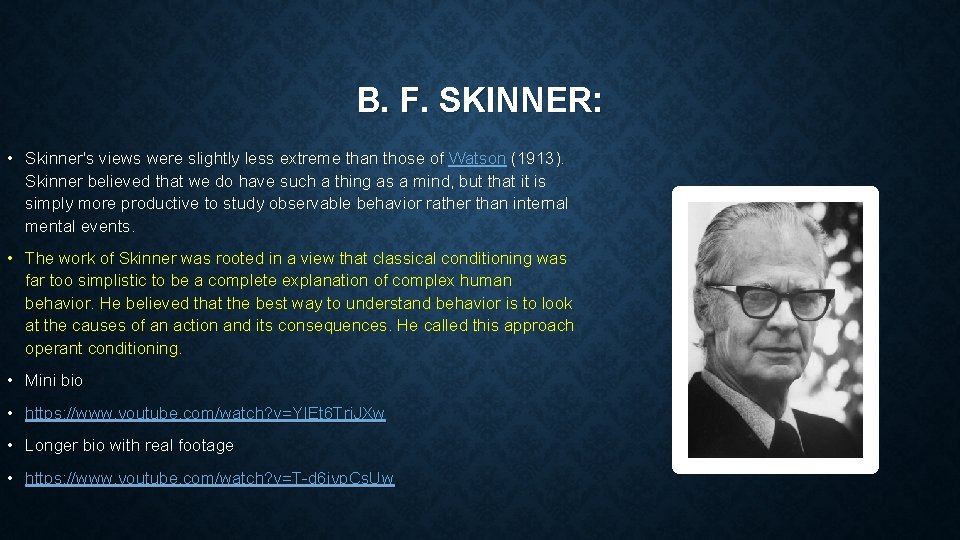
B. F. SKINNER: • Skinner's views were slightly less extreme than those of Watson (1913). Skinner believed that we do have such a thing as a mind, but that it is simply more productive to study observable behavior rather than internal mental events. • The work of Skinner was rooted in a view that classical conditioning was far too simplistic to be a complete explanation of complex human behavior. He believed that the best way to understand behavior is to look at the causes of an action and its consequences. He called this approach operant conditioning. • Mini bio • https: //www. youtube. com/watch? v=YIEt 6 Trj. JXw • Longer bio with real footage • https: //www. youtube. com/watch? v=T-d 6 jyp. Cs. Uw
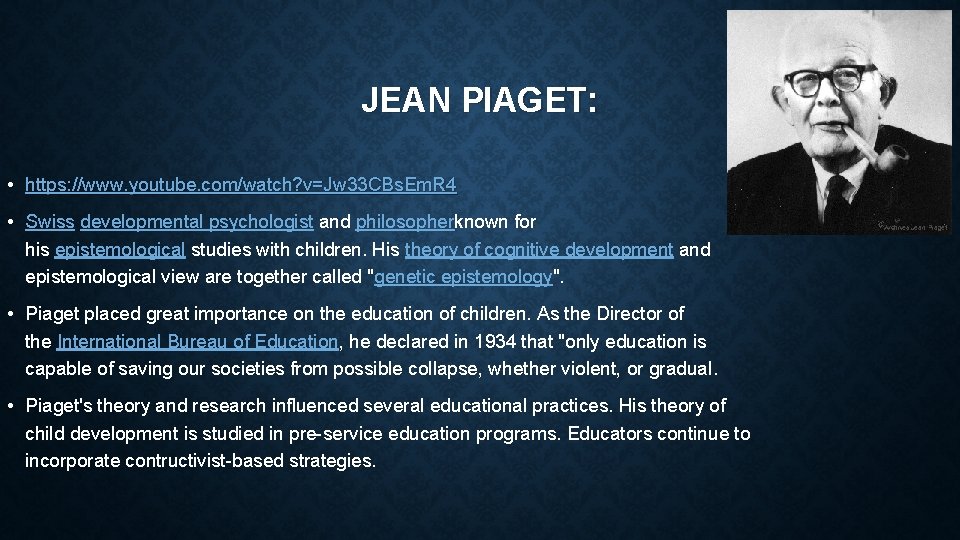
JEAN PIAGET: • https: //www. youtube. com/watch? v=Jw 33 CBs. Em. R 4 • Swiss developmental psychologist and philosopherknown for his epistemological studies with children. His theory of cognitive development and epistemological view are together called "genetic epistemology". • Piaget placed great importance on the education of children. As the Director of the International Bureau of Education, he declared in 1934 that "only education is capable of saving our societies from possible collapse, whether violent, or gradual. • Piaget's theory and research influenced several educational practices. His theory of child development is studied in pre-service education programs. Educators continue to incorporate contructivist-based strategies.
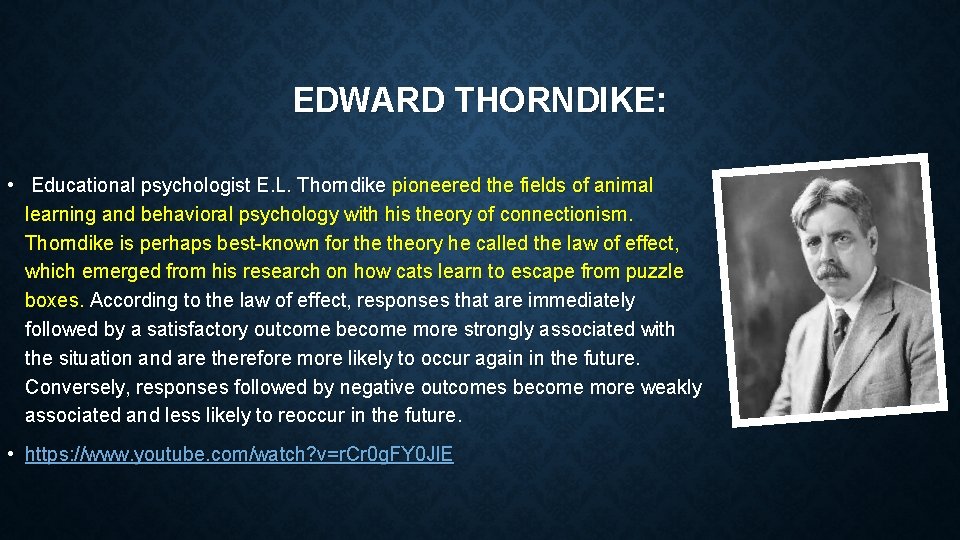
EDWARD THORNDIKE: • Educational psychologist E. L. Thorndike pioneered the fields of animal learning and behavioral psychology with his theory of connectionism. Thorndike is perhaps best-known for theory he called the law of effect, which emerged from his research on how cats learn to escape from puzzle boxes. According to the law of effect, responses that are immediately followed by a satisfactory outcome become more strongly associated with the situation and are therefore more likely to occur again in the future. Conversely, responses followed by negative outcomes become more weakly associated and less likely to reoccur in the future. • https: //www. youtube. com/watch? v=r. Cr 0 g. FY 0 Jl. E
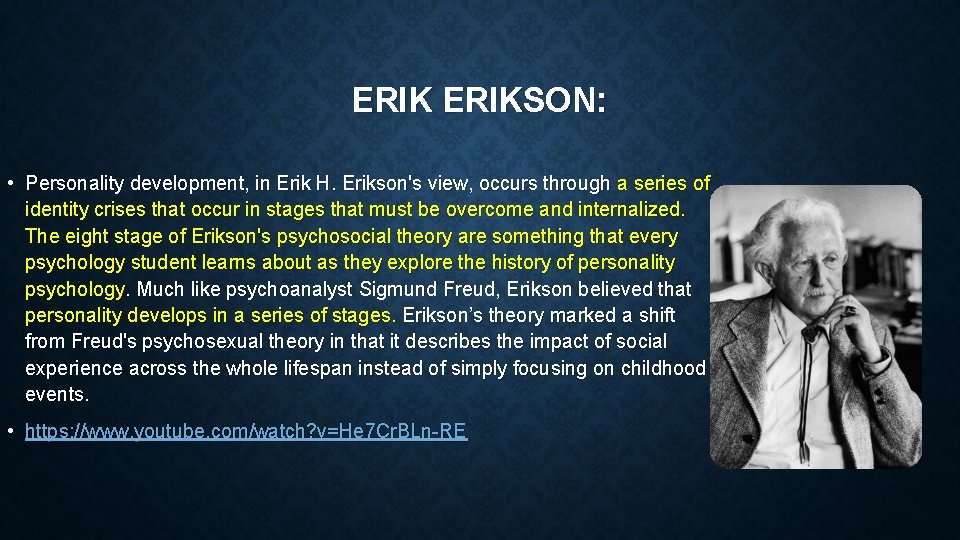
ERIKSON: • Personality development, in Erik H. Erikson's view, occurs through a series of identity crises that occur in stages that must be overcome and internalized. The eight stage of Erikson's psychosocial theory are something that every psychology student learns about as they explore the history of personality psychology. Much like psychoanalyst Sigmund Freud, Erikson believed that personality develops in a series of stages. Erikson’s theory marked a shift from Freud's psychosexual theory in that it describes the impact of social experience across the whole lifespan instead of simply focusing on childhood events. • https: //www. youtube. com/watch? v=He 7 Cr. BLn-RE
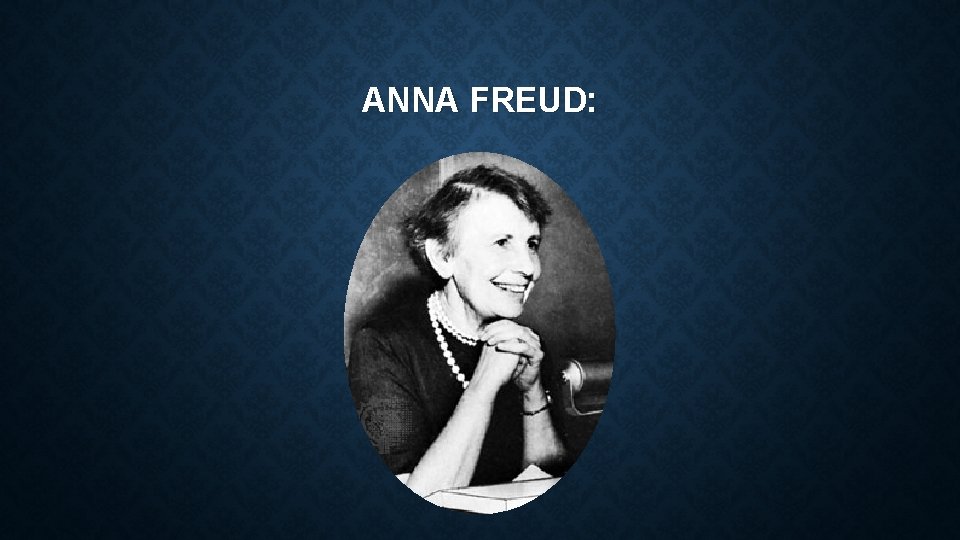
ANNA FREUD: • Anna Freud is considered the co-founder of psychoanalytic child psychology along with Melanie Klein. Her formal education did not play a significant role in her learning instead, she gained a lot of knowledge and learned from her father Sigmund Freud and the guests he hosted at home. She learnt and became fluent in many languages including German, Hebrew and French by serving them as a host. Born as the sixth and last child to Sigmund Freud and Martha Barneys she worked extensively on psychoanalysis with his father. • She spent an unhappy childhood which instigated a yearning in her to study child psychology. Anna was more focused on studying about children and adolescents, unlike, her father who was more into adult psychoanalysis. She made a profound impact on development of ego psychology; she always followed her father’s theories and proposition regarding the subject. • https: //www. youtube. com/watch? v=v 80 Nd 8 w 1 uts
ANNA FREUD: