
HISTORY OF PROJECTIVE GEOMETRY Presented by Mr CARMEL

HISTORY OF PROJECTIVE GEOMETRY Presented by Mr. CARMEL PUSHPA RAJ J Assistant Professor Department of Mathematics SJC
CONTENTS Projective geometry Subfields Examples History Conclusion

PROJECTIVE GEOMETRY In mathematics, projective geometry is the study of geometric properties that are invariant under projective transformations. This means that, compared to elementary geometry, projective geometry has a different setting, projective space, and a selective set of basic geometric concepts.
SUBFIELDS Projective algebraic geometry The study of projective varieties Projective differential geometry The study of differential invariants of the projective transformations
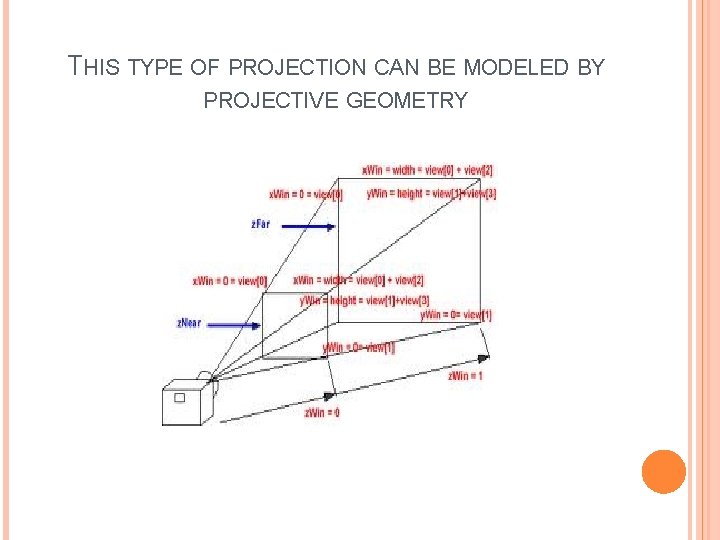
THIS TYPE OF PROJECTION CAN BE MODELED BY PROJECTIVE GEOMETRY
THE SIMPLEST ILLUSTRATION OF DUALITY IS IN THE PROJECTIVE PLANE “Two distinct points determine a unique line" (i. e. the line through them) “Two distinct lines determine a unique point" (i. e. their point of intersection)
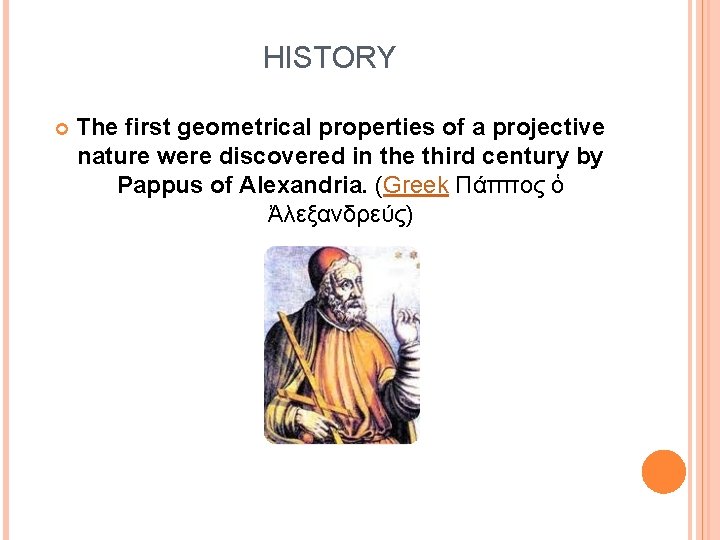
HISTORY The first geometrical properties of a projective nature were discovered in the third century by Pappus of Alexandria. (Greek Πάππος ὁ Ἀλεξανδρεύς)
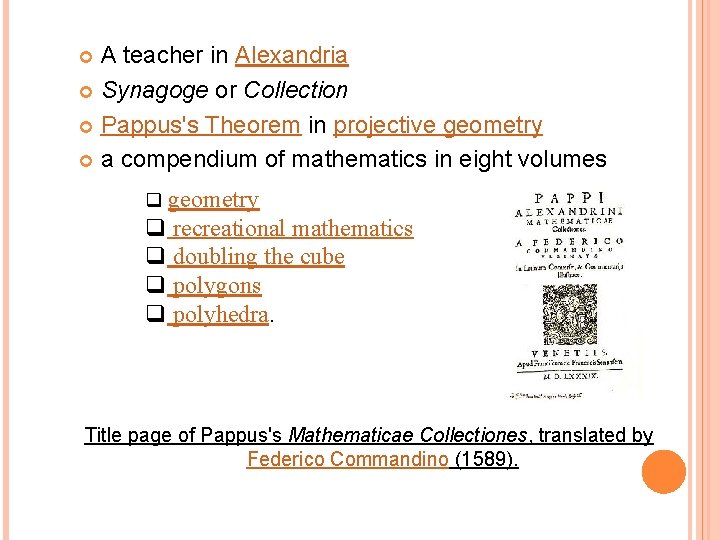
A teacher in Alexandria Synagoge or Collection Pappus's Theorem in projective geometry a compendium of mathematics in eight volumes q geometry q recreational mathematics q doubling the cube q polygons q polyhedra. Title page of Pappus's Mathematicae Collectiones, translated by Federico Commandino (1589).
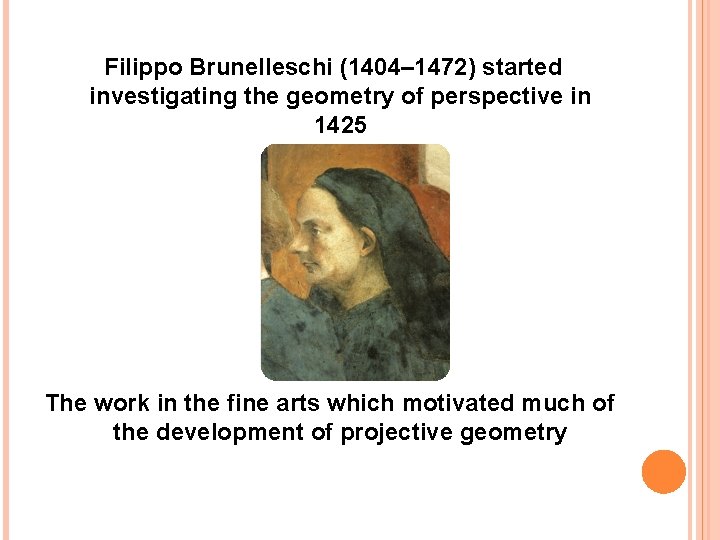
Filippo Brunelleschi (1404– 1472) started investigating the geometry of perspective in 1425 The work in the fine arts which motivated much of the development of projective geometry
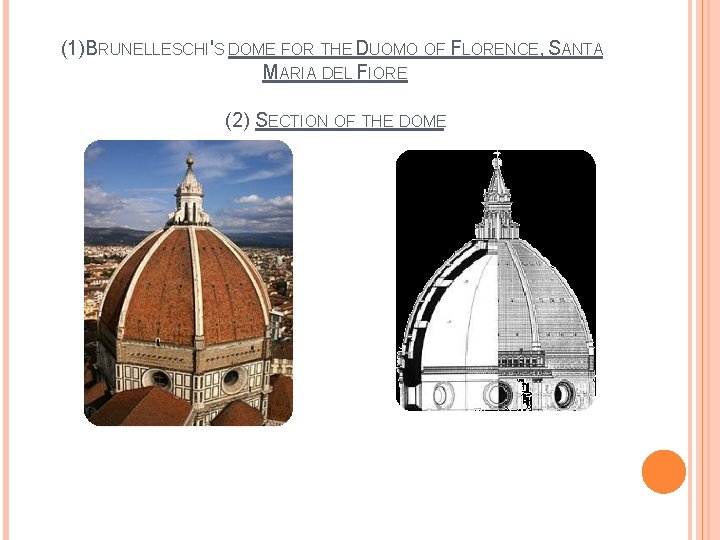
(1)BRUNELLESCHI'S DOME FOR THE DUOMO OF FLORENCE, SANTA MARIA DEL FIORE (2) SECTION OF THE DOME

Gérard Desargues (1591– 1661) developed an alternative way of constructing perspective drawings by generalizing the use of vanishing points to include the case when these are infinitely far away.
worked as an architect an engineer and technical consultant -entourage of Richelieu Desargues' theorem, the Desargues graph the crater Desargues on the Moon
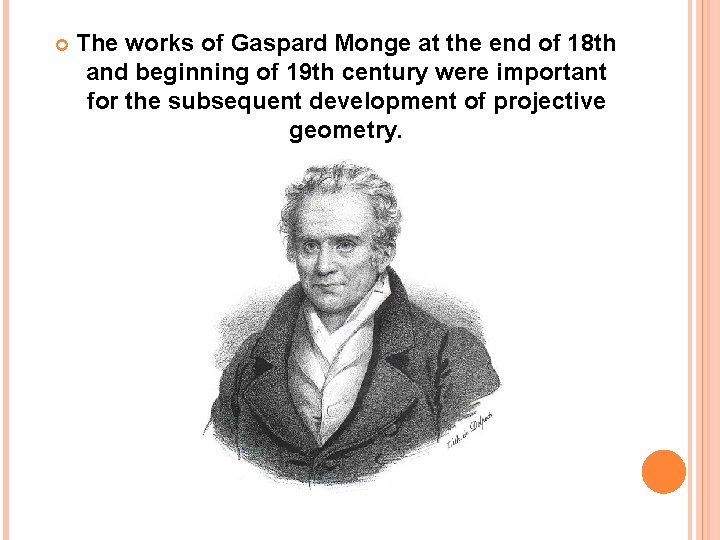
The works of Gaspard Monge at the end of 18 th and beginning of 19 th century were important for the subsequent development of projective geometry.
Jean-Victor Poncelet had published the foundational treatise on projective geometry in 1822. Poncelet separated the projective properties of objects in individual class and establishing a relationship between metric and projective properties.
This early 19 th century projective geometry was a stepping stone from analytic geometry to algebraic geometry. When treated in terms of homogeneous coordinates, projective geometry looks like an extension or technical improvement of the use of coordinates to reduce geometric problems to algebra, an extension reducing the number of special cases.
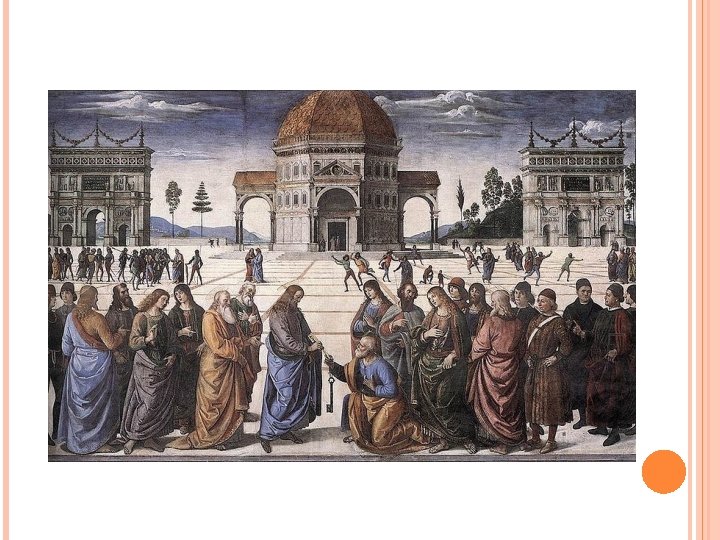
Projective geometry formalizes one of the central principles of perspective art In essence, a projective geometry may be thought of as an extension of Euclidean geometry.
Projective geometry also includes a full theory of conic sections, a subject already very well developed in Euclidean geometry.

Thank you…
- Slides: 20