
History of Pressure Balancing Valves LEED Accreditation Course
History of Pressure Balancing Valves & LEED Accreditation Course #: 122014 P
Best Practice • Symmons is an approved AIA provider • The educational section of this presentation will not be used to promote Symmons products or services • Credit for this course is 1 AIA/CES Learning Unit for HSW/SD This program is registered with the AIA/CES for continuing professional education. As such, it does not include content that may be deemed or construed to be an approval or endorsement by the AIA or of any material of construction or any method or manner of handling, using, distributing, or dealing in any material or product. Questions related to specific materials, methods, and services will be addressed at the conclusion of this presentation. 2 © 2018 SYMMONS, INC.
Agenda 3 History of Pressure Balancing Valves Innovation & Safety Water Conservation Finishes © 2018 SYMMONS, INC.
History of Pressure Balancing Valves • Problem − Unsafe shower conditions • Drastic water temperature fluctuations − Causes: Fluctuations in water pressure • Toilets • Dishwashers • Sinks • Solution − Design valve which will address pressure fluctuations − Keep temperature constant 4 © 2018 SYMMONS, INC.
History of Pressure Balancing Valves • Pressure Balancing Shower Valve − Designed in 1939 by Paul C. Symmons − Valve provided greater reliability in mixed water applications • Other pressure balancing valves have since been manufactured • ASSE 1016 − 1996 • +/- 3. 0 degrees F temperature variation − 2005 • +/- 3. 6 degrees F temperature variation 5 © 2018 SYMMONS, INC.
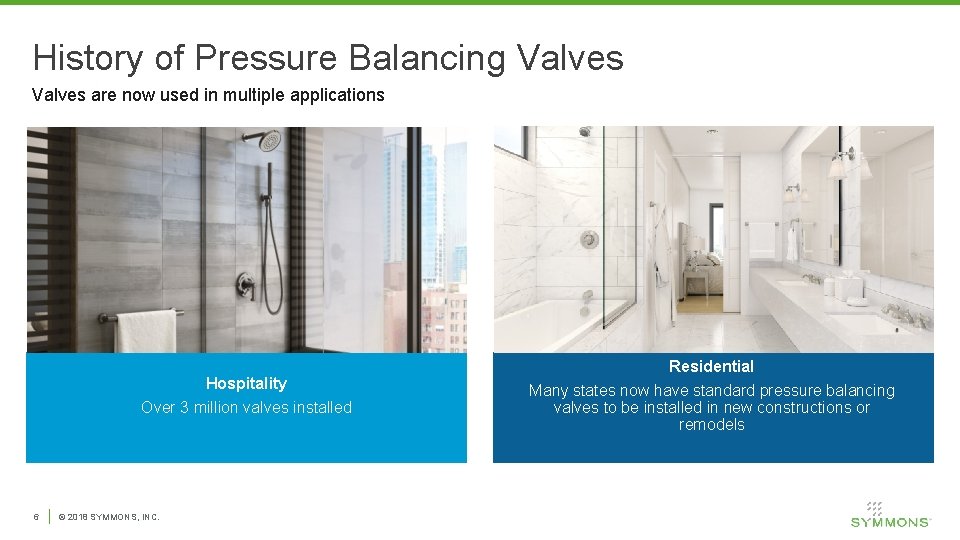
History of Pressure Balancing Valves are now used in multiple applications Hospitality Over 3 million valves installed 6 © 2018 SYMMONS, INC. Residential Many states now have standard pressure balancing valves to be installed in new constructions or remodels
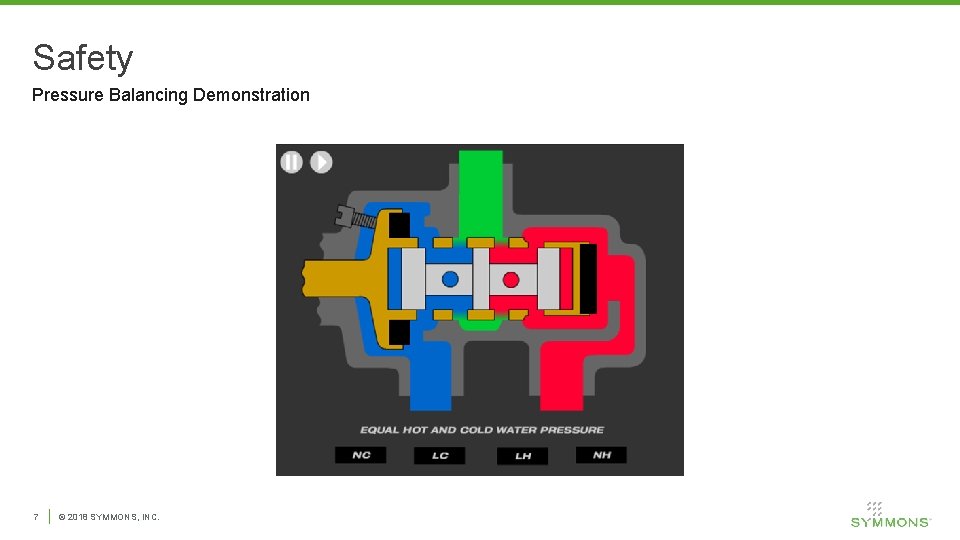
Safety Pressure Balancing Demonstration 7 © 2018 SYMMONS, INC.
Safety • Temperature regulated within +/- 3 degrees of set temperature − Anti-scald − Shower shock • Limit stop mechanism − Prevents handle from being turned past desired handle position • Useful in applications where Children or Elderly are end users • Low potential for cross over 8 © 2018 SYMMONS, INC.
Water Conservation & LEED • LEED − What is LEED? − Why get LEED certified? • Water Efficiency (WE) Credit 3 − What is LEED WE Credit 3? − How to get LEED credits for WE 3 • Water Reduction Considerations • Benefits of Green Hospitality 9 © 2018 SYMMONS, INC.
What is LEED? • LEED, or Leadership in Energy and Environmental Design, is an internationally recognized green building certification system. • Developed by the U. S. Green Building Council (USGBC) in March 2000, LEED provides building owners and operators with a framework for identifying and implementing practical and measurable green building design, construction, operations and maintenance solutions. 10 © 2018 SYMMONS, INC.
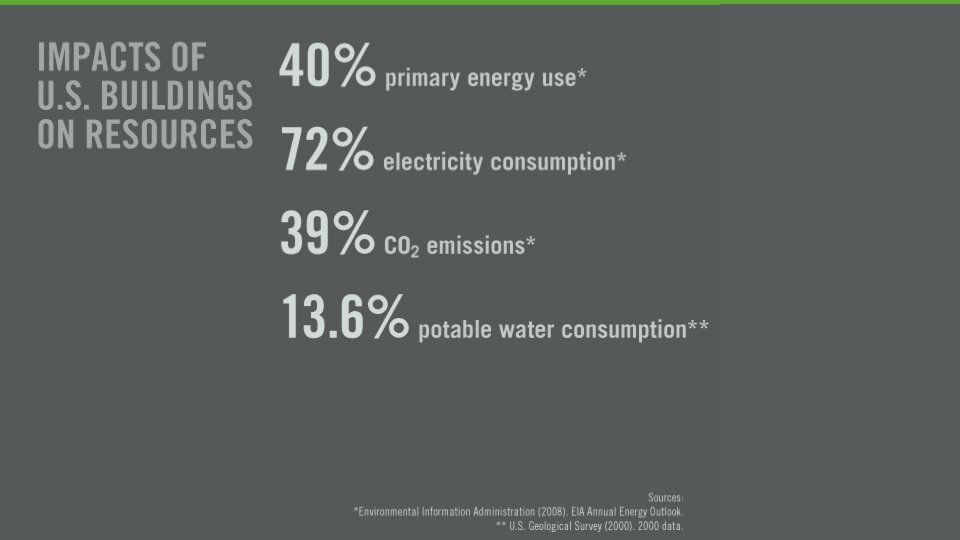
11 © 2018 SYMMONS, INC.
USGBC and LEED • U. S. Green Building Council (USGBC) • Non-profit, membership organization founded in 1993 • Objective − Incorporate environmental considerations into the building process • Developed the Leadership in Energy and Environmental Design (LEED) rating system 12 © 2018 SYMMONS, INC.
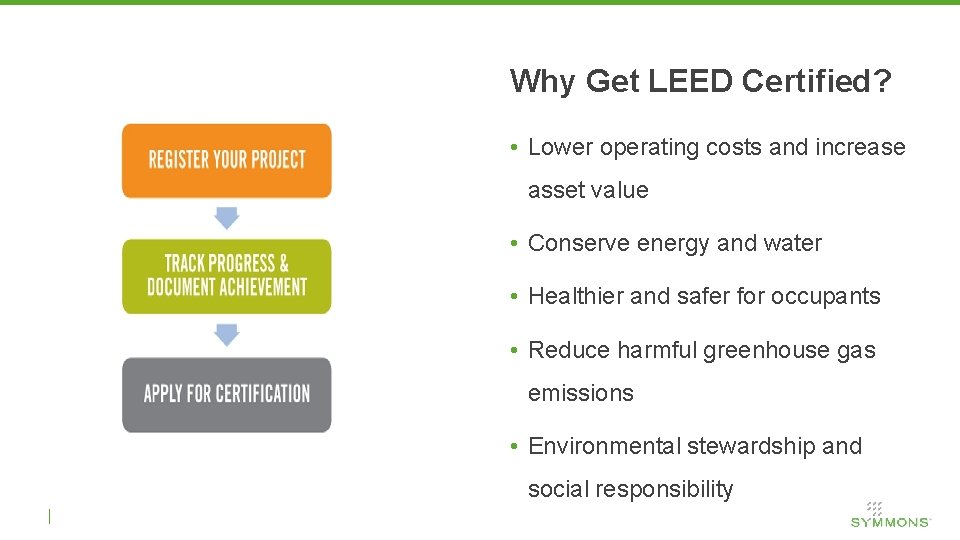
Why Get LEED Certified? • Lower operating costs and increase asset value • Conserve energy and water • Healthier and safer for occupants • Reduce harmful greenhouse gas emissions • Environmental stewardship and social responsibility 13 © 2018 SYMMONS, INC.
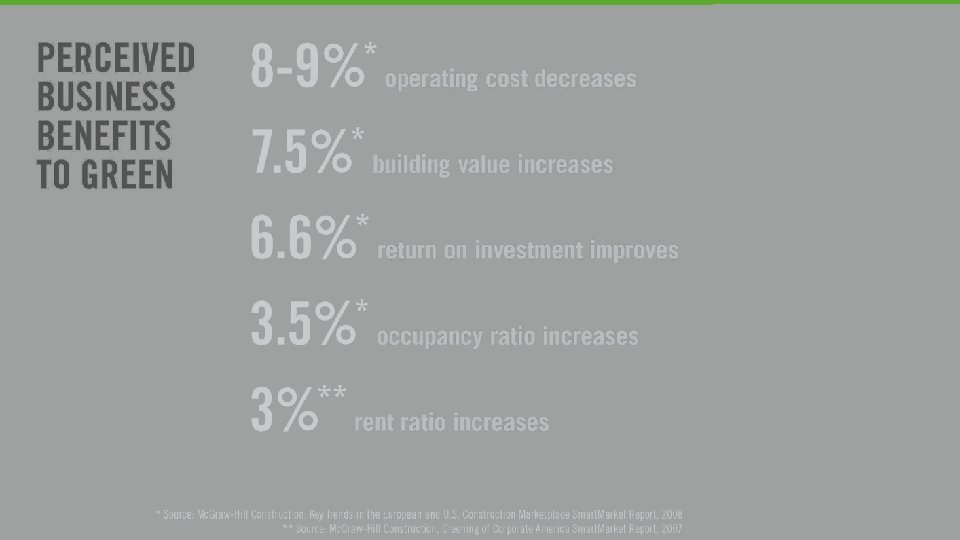
14 © 2018 SYMMONS, INC.
LEED WE Credit 3 Requirements • Use 20% less water than the water use baseline calculated for the building (not including irrigation) after meeting the Energy Policy Act of 1992 fixture performance requirements. • Calculations are based on estimated occupant usage and shall include the following fixtures (as applicable to the building): water closets, urinals, lavatory faucets, showers and kitchen sinks. 15 © 2018 SYMMONS, INC.
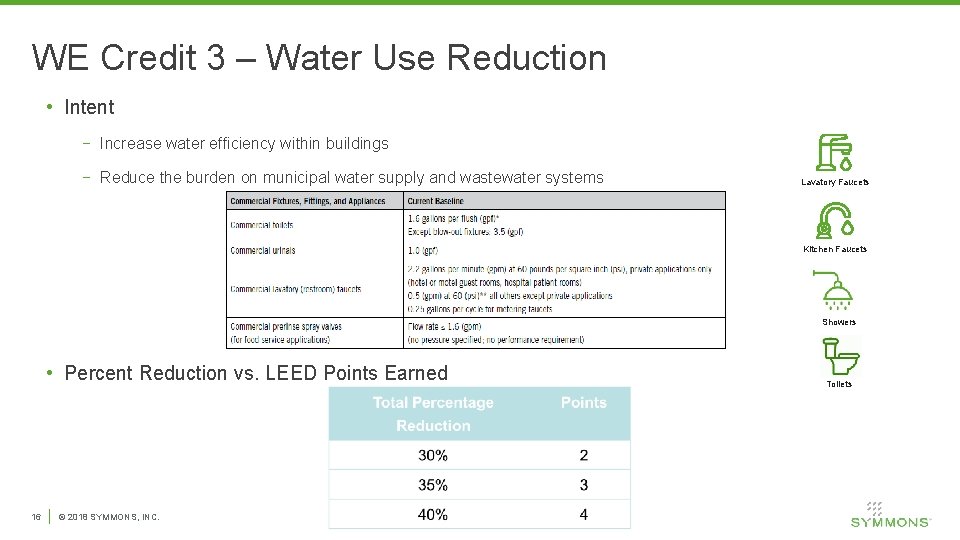
WE Credit 3 – Water Use Reduction • Intent − Increase water efficiency within buildings − Reduce the burden on municipal water supply and wastewater systems Lavatory Faucets Kitchen Faucets Showers • Percent Reduction vs. LEED Points Earned 16 © 2018 SYMMONS, INC. Toilets
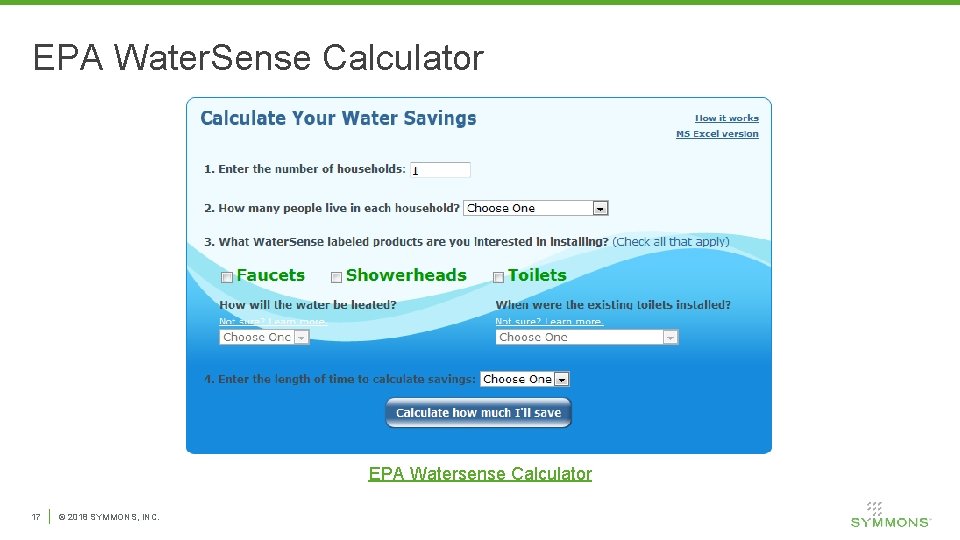
EPA Water. Sense Calculator EPA Watersense Calculator 17 © 2018 SYMMONS, INC.
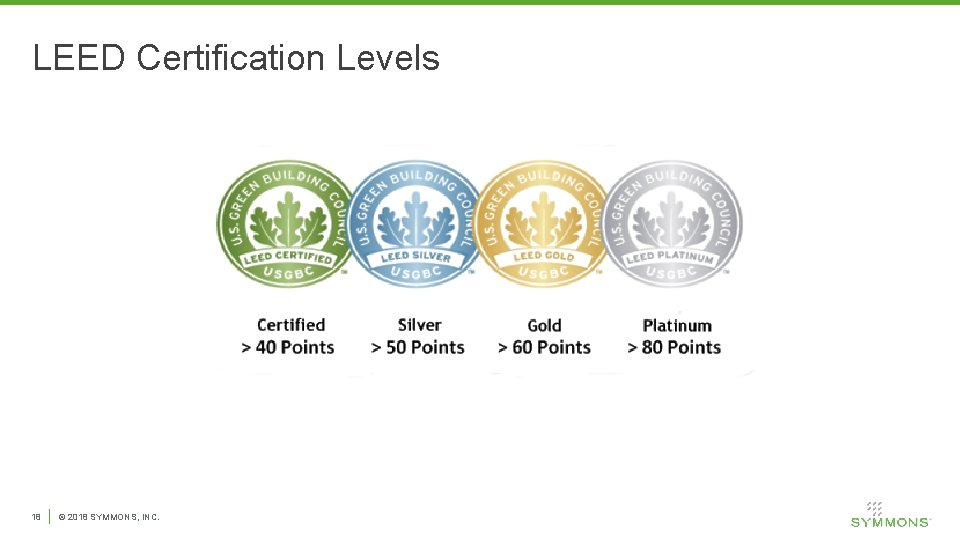
LEED Certification Levels 18 © 2018 SYMMONS, INC.
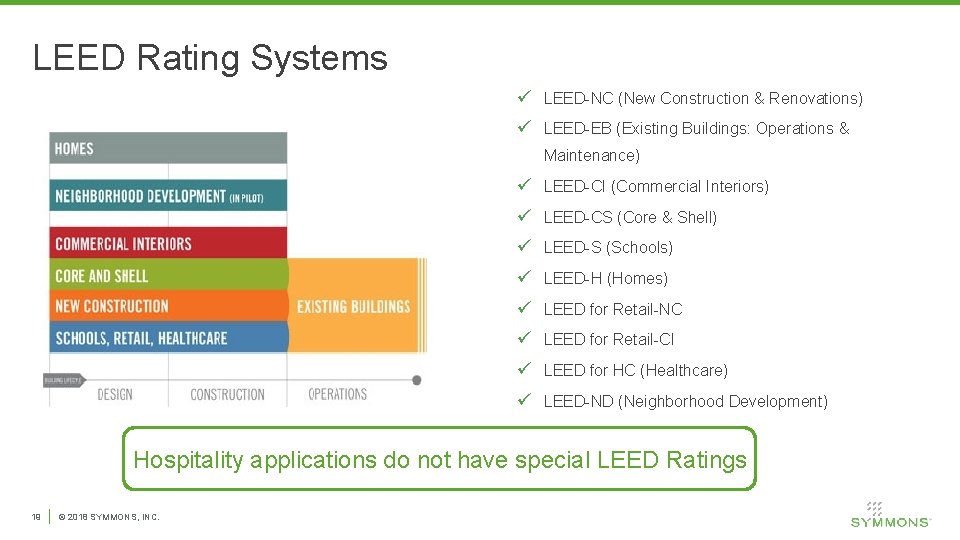
LEED Rating Systems ü LEED-NC (New Construction & Renovations) ü LEED-EB (Existing Buildings: Operations & Maintenance) ü LEED-CI (Commercial Interiors) ü LEED-CS (Core & Shell) ü LEED-S (Schools) ü LEED-H (Homes) ü LEED for Retail-NC ü LEED for Retail-CI ü LEED for HC (Healthcare) ü LEED-ND (Neighborhood Development) Hospitality applications do not have special LEED Ratings 19 © 2018 SYMMONS, INC.
Water Reduction Considerations • Changes to supply lines − Changes to inlet piping size • Compensate for PSI • Possibility of Legionnaires’ Disease • Impact of lower volumes of water on waste lines • Potential impacts of reduced flow − Increase shower time • Potential for increased energy consumption − Consumer complaints • Will persons with ailments that can be relieved by the medicinal value of a therapeutic shower be ignored in the name of green? 20 © 2018 SYMMONS, INC.
Valves & Low Flow Showerheads • Concern − Replacing a standard (2. 5 gpm) with a low flow showerhead (2 gpm or lower) to gain LEED Water Efficiency (WE) points could bring about the potential for bathing injuries • Fact − ASSE 1016 standard requires all ATC (automatic temperature compensating) shower valves be designed to work with 2. 5 gpm showerhead • Issue − No current standard in place for qualifying low flow showerheads with valves • Valve may not be able to accommodate lower flow rate − Safe bathing temperatures may not be maintained 21 © 2018 SYMMONS, INC.
Design Considerations with Low Flow Showerheads • Size and layout of the showering design • Amount of heat being delivered from lower flow head • Droplet size and aeration also impact heat retention • Bather may need to increase the water temperature to compensate − Increase in energy consumption • Possible solutions for problems listed above: − Showerhead placement • Closer to user − Specify height adjustable shower fixture 22 © 2018 SYMMONS, INC.
Benefits of Green • Energy Savings • Reduced Operational Costs • Healthy Guest Environment • Improved Air Quality • Promotes Green Culture in Employees & Guests • Creates Media PR & Outreach 23 © 2018 SYMMONS, INC.
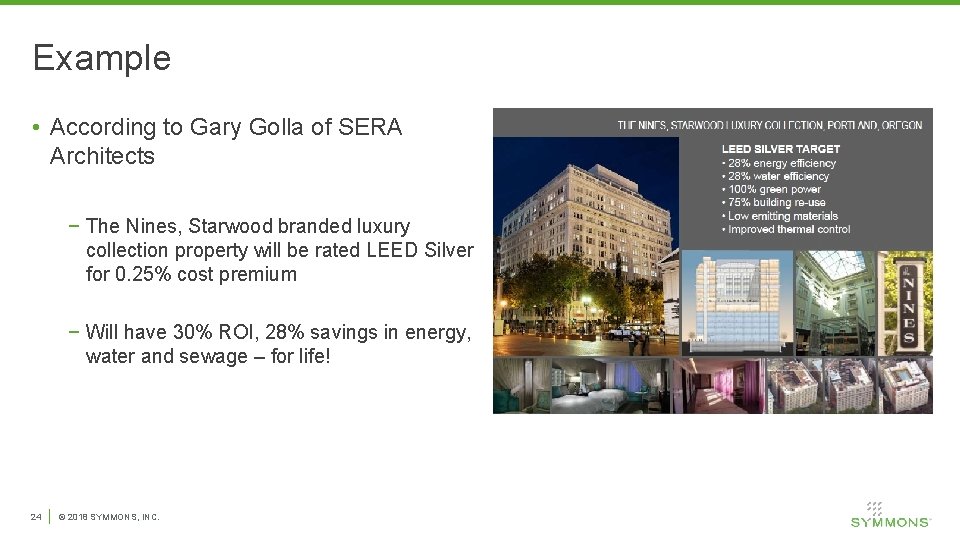
Example • According to Gary Golla of SERA Architects − The Nines, Starwood branded luxury collection property will be rated LEED Silver for 0. 25% cost premium − Will have 30% ROI, 28% savings in energy, water and sewage – for life! 24 © 2018 SYMMONS, INC.
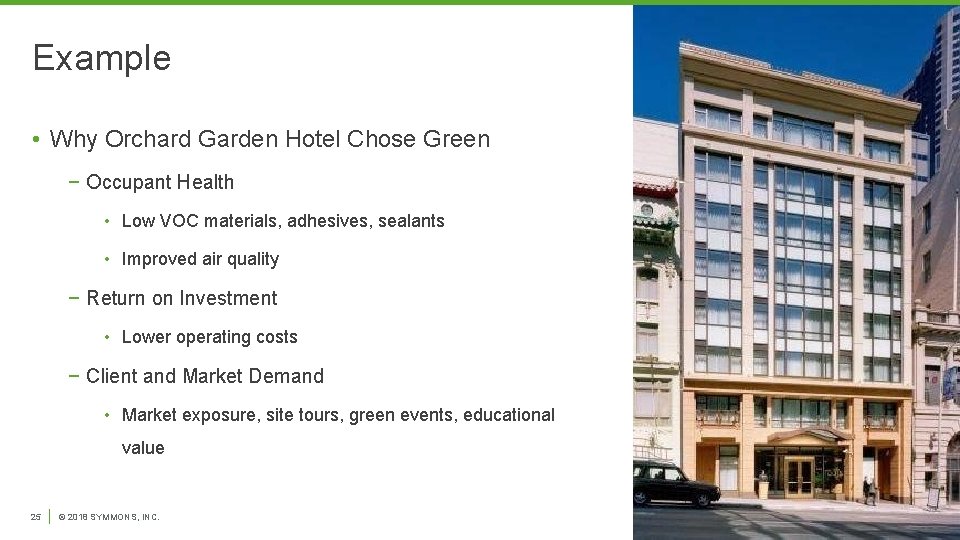
Example • Why Orchard Garden Hotel Chose Green − Occupant Health • Low VOC materials, adhesives, sealants • Improved air quality − Return on Investment • Lower operating costs − Client and Market Demand • Market exposure, site tours, green events, educational value 25 © 2018 SYMMONS, INC.
Finishes • Background of finishes • Chrome plating • Need for environmentally friendly finishes • PVD process • Alternate deco finishes 26 © 2018 SYMMONS, INC.
Background of Finishes • Chrome plating − Used for electroplating as early as 1848 − Improved process introduced in 1924 • Process mostly unchanged sinception • Used for aesthetics and to protect metal • Multiple finishes evolved from original chrome process − PVD − Powder coating 27 © 2018 SYMMONS, INC.
Sustainability & Environmental Impact • Finish needs to adhere to metal − Often requires a build up or multi-step process • Each step involves labor and potentially dangerous chemicals • Final coating is typically inert • Problems − Chemical waste disposal − Environmental hazards − Potential risks to workers 28 © 2018 SYMMONS, INC.

EPA Regulated Plating Facilities • Works in conjunction with EPA on state and federal level − Recycling − Water remediation process • New process incurs higher costs • Eliminated use of cyanide − Less risk to workers 29 © 2018 SYMMONS, INC.
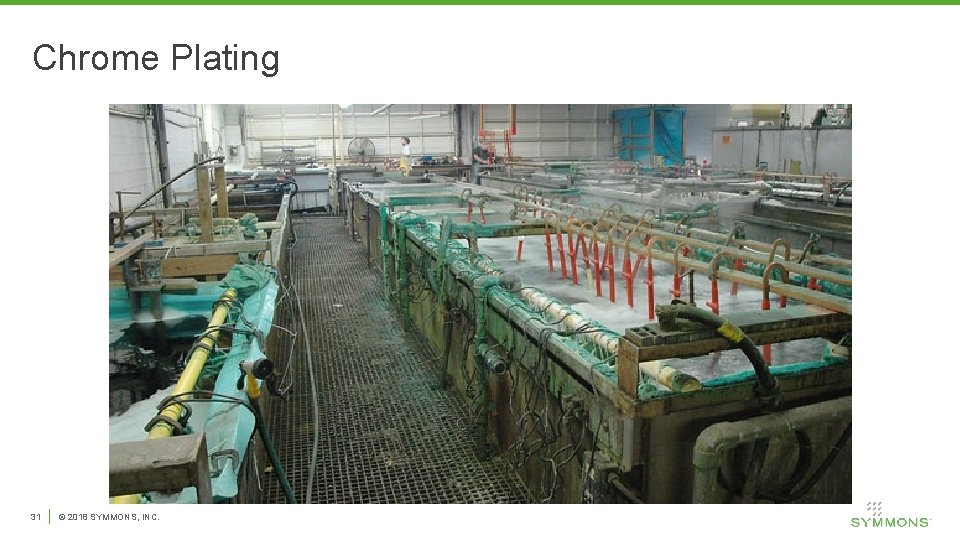
Chrome Plating • Four step process to achieve final product − Strip parts − Copper plating − Nickel/chrome plating − Buffing • Chrome plating represents 97% of the hospitality market choice • Labor intensive: buffing is required to create a mirror surface • EPA heavily regulates facilities that use this process • Cyanide has been used for decades in the process • Waste disposal 30 © 2018 SYMMONS, INC.
Chrome Plating 31 © 2018 SYMMONS, INC.
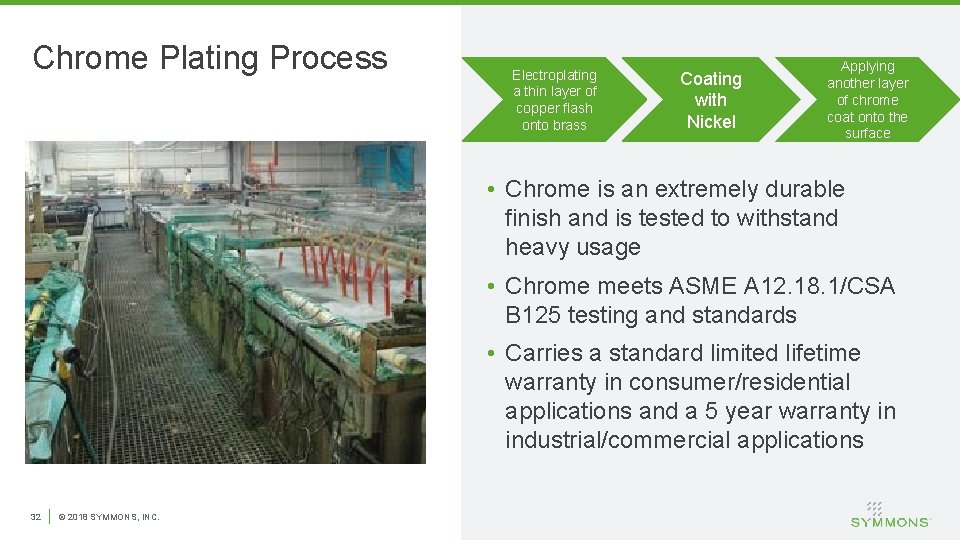
Chrome Plating Process Electroplating a thin layer of copper flash onto brass Coating with Nickel Applying another layer of chrome coat onto the surface • Chrome is an extremely durable finish and is tested to withstand heavy usage • Chrome meets ASME A 12. 18. 1/CSA B 125 testing and standards • Carries a standard limited lifetime warranty in consumer/residential applications and a 5 year warranty in industrial/commercial applications 32 © 2018 SYMMONS, INC.
PVD Process • Physical Vapor Deposition − Invented by NASA − Faster process − Non-chemical based finish technology − A sealed, highly durable deco finish − Requires less labor − Eliminated water usage − Consistent end result 33 © 2018 SYMMONS, INC.
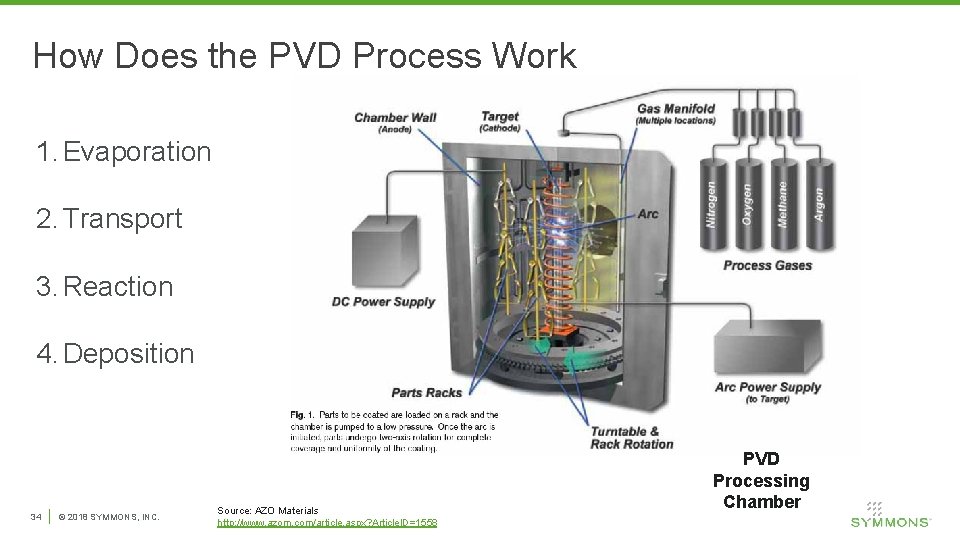
How Does the PVD Process Work 1. Evaporation 2. Transport 3. Reaction 4. Deposition 34 © 2018 SYMMONS, INC. Source: AZO Materials http: //www. azom. com/article. aspx? Article. ID=1558 PVD Processing Chamber
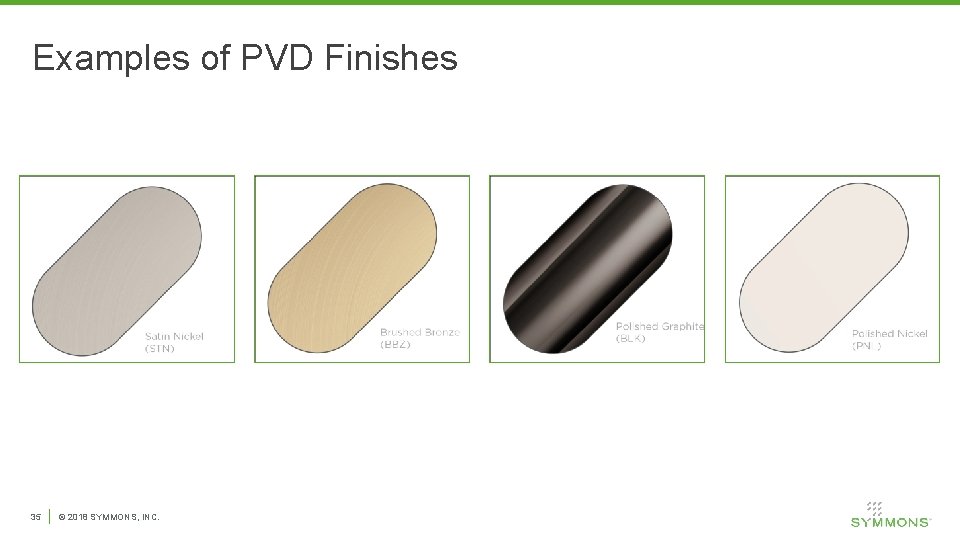
Examples of PVD Finishes 35 © 2018 SYMMONS, INC.
Alternate Deco Finishes • Powder coating • Applicable on both plastic and metal • Infrared used to cure finish • Provides seal over metal • Durability • Consistent color • Colors can be mixed to achieve look of living finishes • Non-living finish unlike other hand applied methods 36 © 2018 SYMMONS, INC.
Questions? 37 © 2018 SYMMONS, INC.
References Cited • Kilbane, Timothy. “Water works. ” Kitchen and Bath Design: Nov. 2009. • Martin, Shawn. “Do’s and Don’ts of Super Low-Flow Showerheads”. Building Design and Construction: August 2008. • USGBC. www. usgbc. org − "USGBC' and related logo is a trademark owned by the U. S. Green Building Council. “ • Golla, Gary. SERA Architects. “LEED Hospitality Properties: Techniques and Costs”. • Lapointe, Melanie. Swinerton Builders. “Orchard Garden Hotel”: July 2006 • Aqua Pro Solutions. <www. aquaprosolutions. com> 38 © 2018 SYMMONS, INC.
Thank You 39 © 2018 SYMMONS, INC.
- Slides: 39