
History of Photography Part 1 Ancient Times1900 Mr
- Slides: 27
History of Photography Part 1 -Ancient Times-1900 Mr. Zeko: Digital Photography A
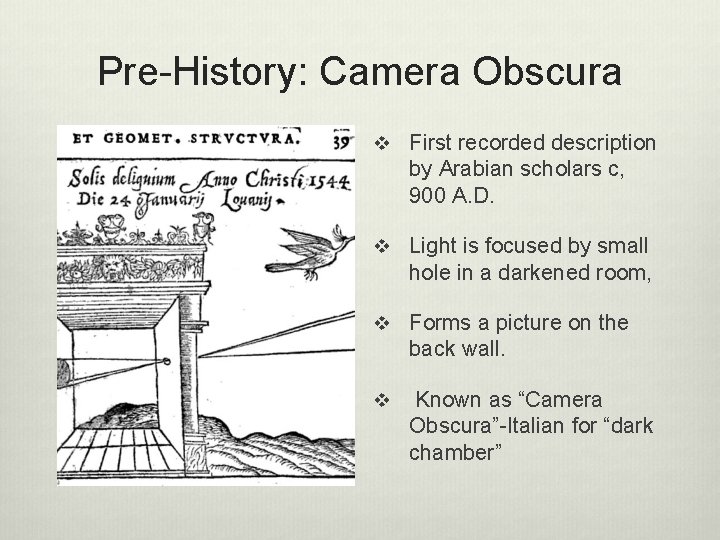
Pre-History: Camera Obscura v First recorded description by Arabian scholars c, 900 A. D. v Light is focused by small hole in a darkened room, v Forms a picture on the back wall. v Known as “Camera Obscura”-Italian for “dark chamber”
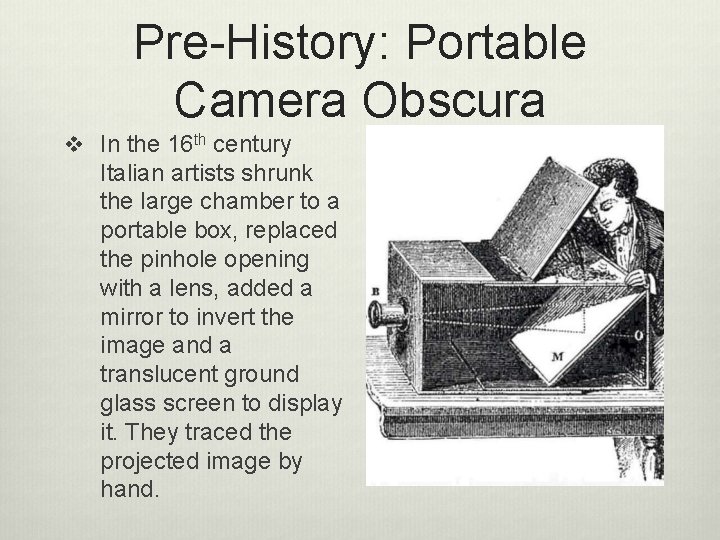
Pre-History: Portable Camera Obscura v In the 16 th century Italian artists shrunk the large chamber to a portable box, replaced the pinhole opening with a lens, added a mirror to invert the image and a translucent ground glass screen to display it. They traced the projected image by hand.
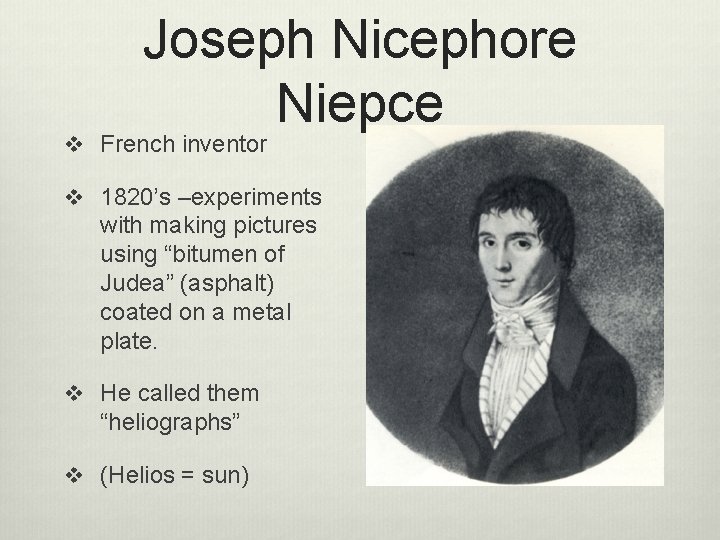
Joseph Nicephore Niepce v French inventor v 1820’s –experiments with making pictures using “bitumen of Judea” (asphalt) coated on a metal plate. v He called them “heliographs” v (Helios = sun)
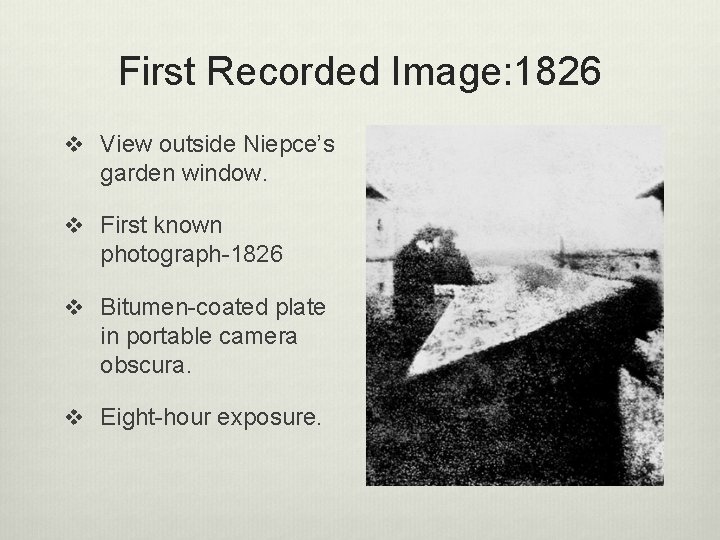
First Recorded Image: 1826 v View outside Niepce’s garden window. v First known photograph-1826 v Bitumen-coated plate in portable camera obscura. v Eight-hour exposure.
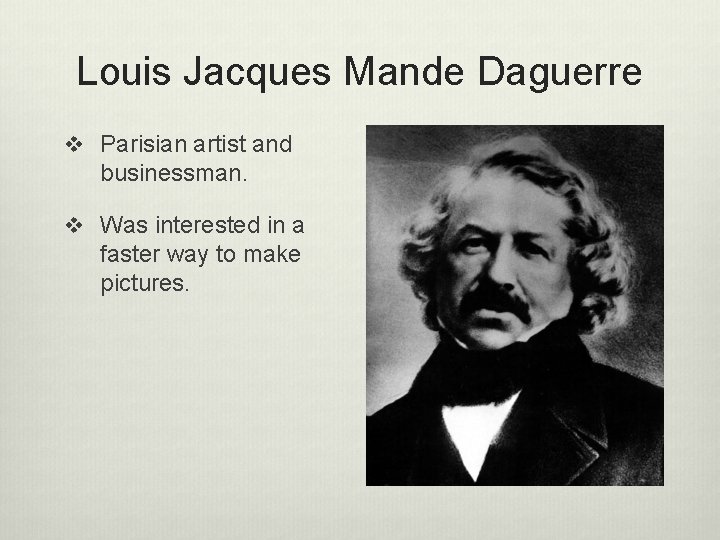
Louis Jacques Mande Daguerre v Parisian artist and businessman. v Was interested in a faster way to make pictures.
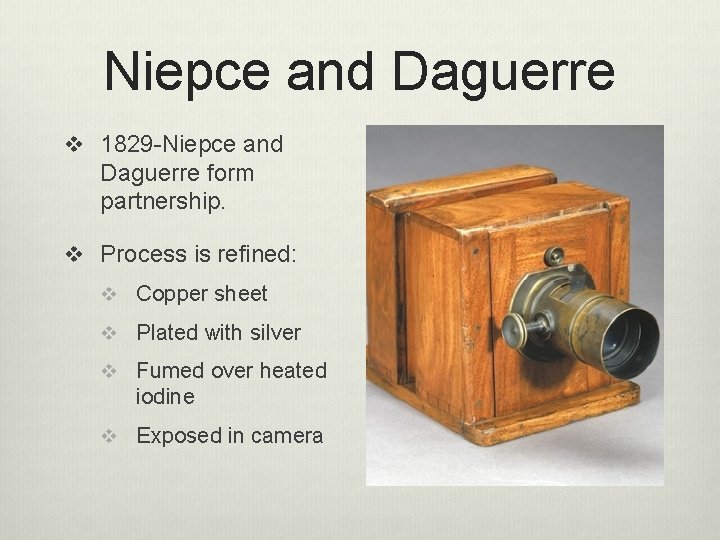
Niepce and Daguerre v 1829 -Niepce and Daguerre form partnership. v Process is refined: v Copper sheet v Plated with silver v Fumed over heated iodine v Exposed in camera
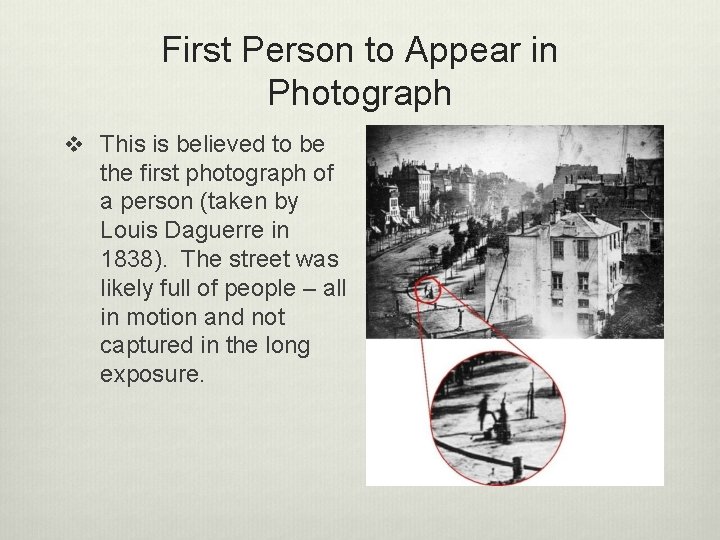
First Person to Appear in Photograph v This is believed to be the first photograph of a person (taken by Louis Daguerre in 1838). The street was likely full of people – all in motion and not captured in the long exposure.
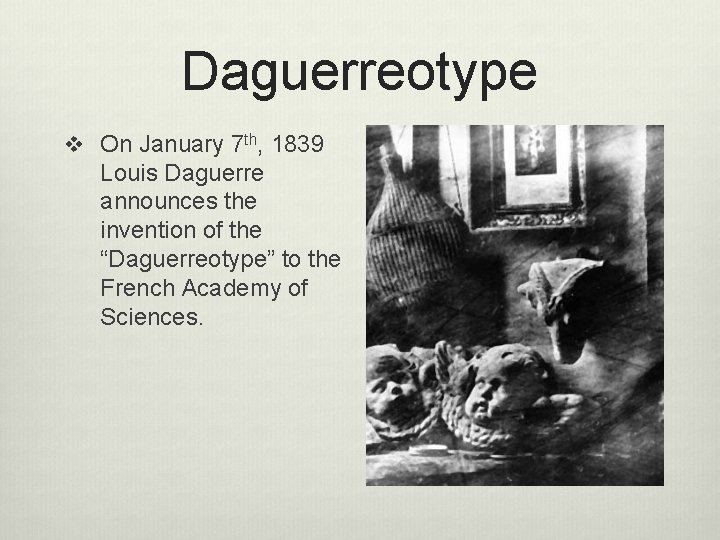
Daguerreotype v On January 7 th, 1839 Louis Daguerre announces the invention of the “Daguerreotype” to the French Academy of Sciences.
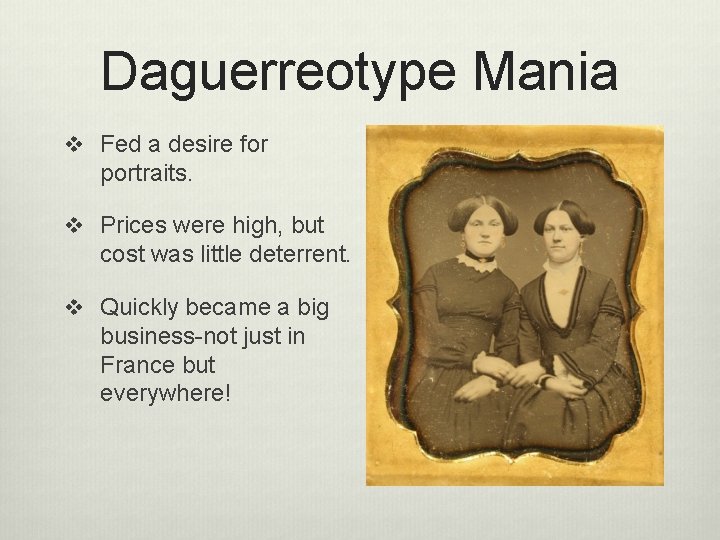
Daguerreotype Mania v Fed a desire for portraits. v Prices were high, but cost was little deterrent. v Quickly became a big business-not just in France but everywhere!
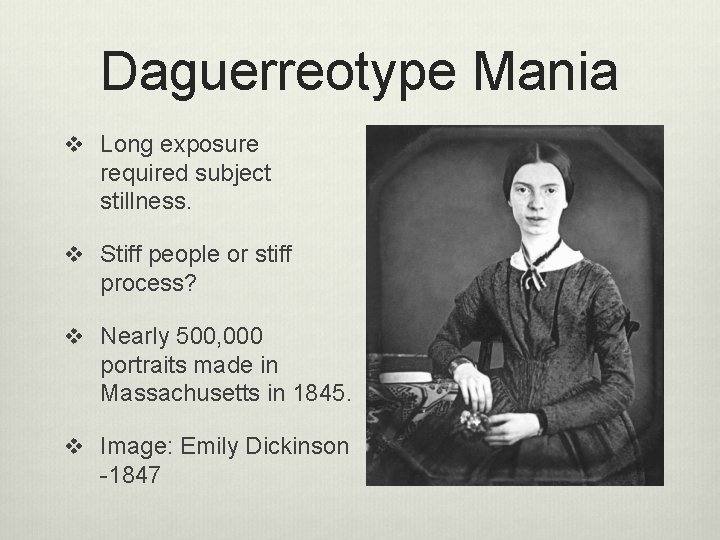
Daguerreotype Mania v Long exposure required subject stillness. v Stiff people or stiff process? v Nearly 500, 000 portraits made in Massachusetts in 1845. v Image: Emily Dickinson -1847
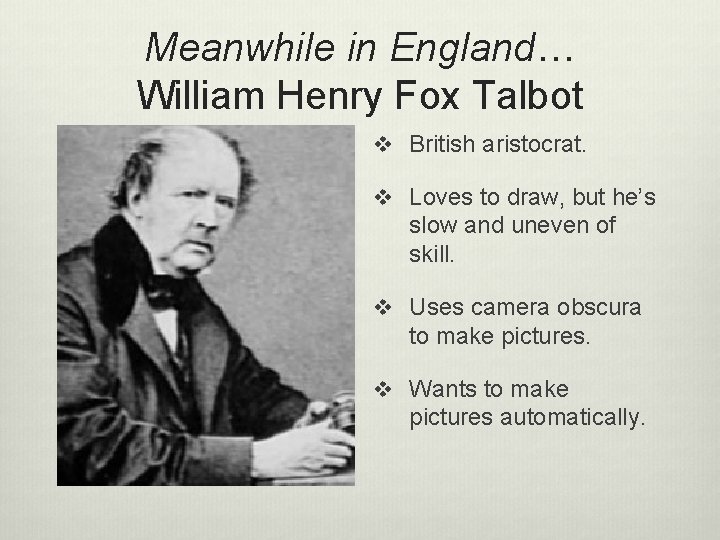
Meanwhile in England… William Henry Fox Talbot v British aristocrat. v Loves to draw, but he’s slow and uneven of skill. v Uses camera obscura to make pictures. v Wants to make pictures automatically.
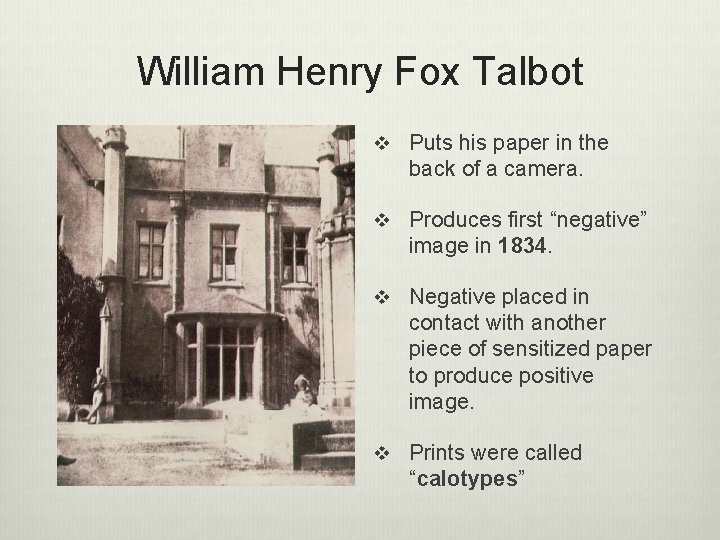
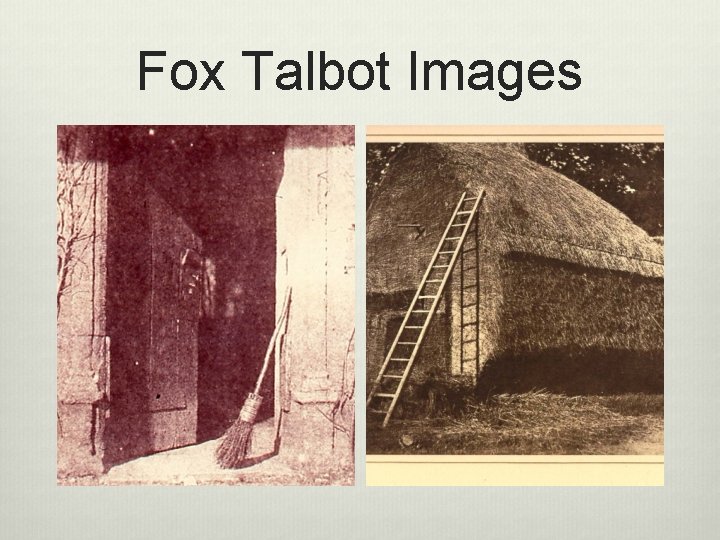
William Henry Fox Talbot v Puts his paper in the back of a camera. v Produces first “negative” image in 1834. v Negative placed in contact with another piece of sensitized paper to produce positive image. v Prints were called “calotypes”
Fox Talbot Images
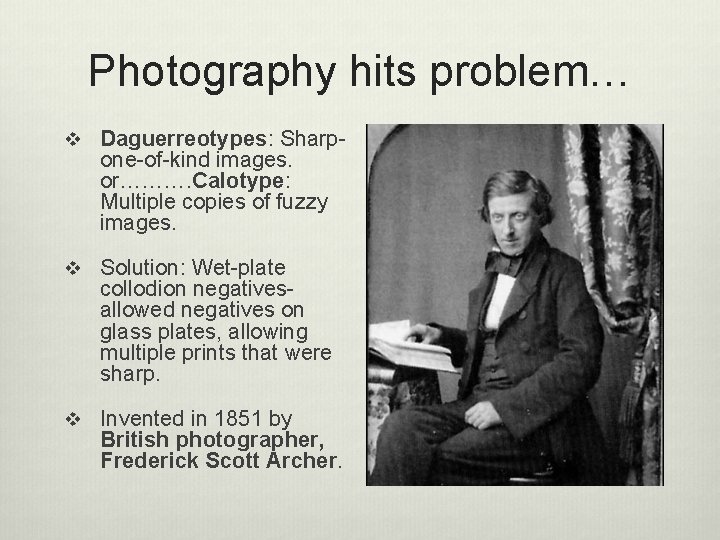
Photography hits problem… v Daguerreotypes: Sharp- one-of-kind images. or………. Calotype: Multiple copies of fuzzy images. v Solution: Wet-plate collodion negativesallowed negatives on glass plates, allowing multiple prints that were sharp. v Invented in 1851 by British photographer, Frederick Scott Archer.
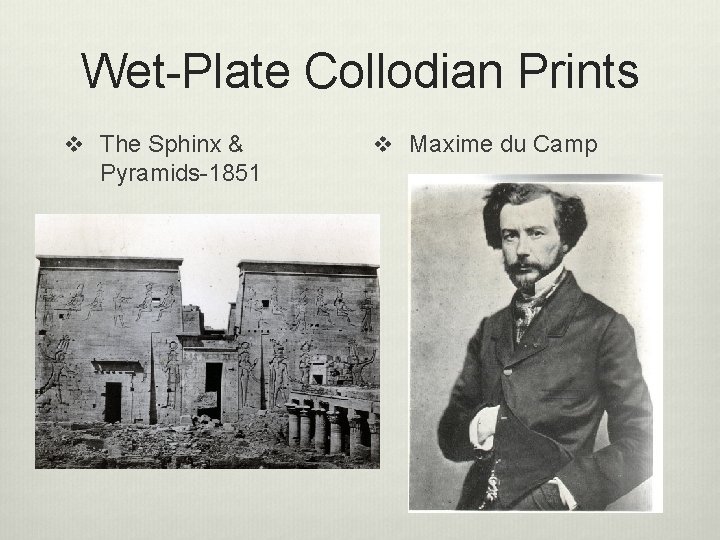
Wet-Plate Collodian Prints v The Sphinx & Pyramids-1851 v Maxime du Camp
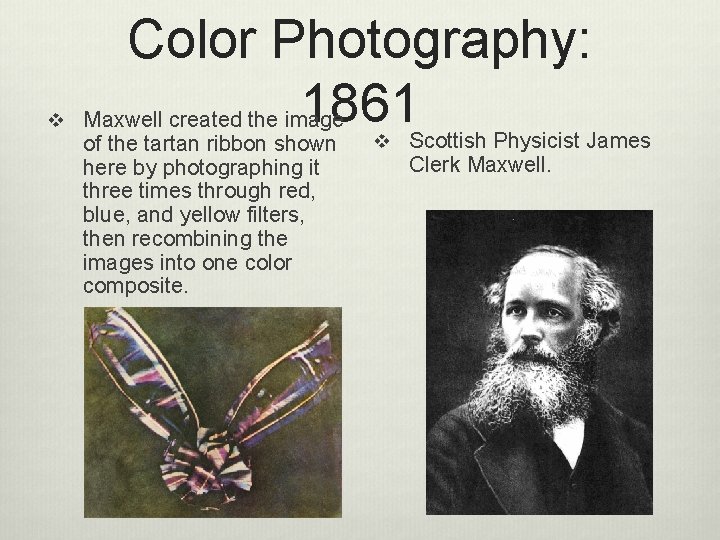
v Color Photography: 1861 Scottish Physicist James Maxwell created the image of the tartan ribbon shown here by photographing it three times through red, blue, and yellow filters, then recombining the images into one color composite. v Clerk Maxwell.
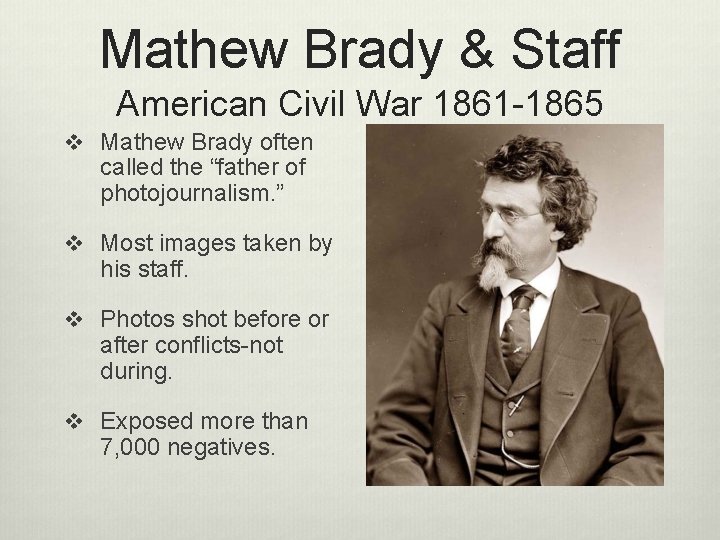
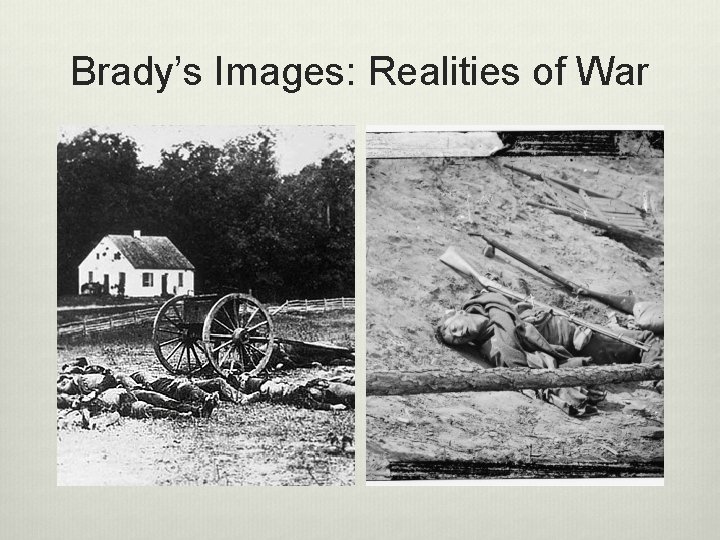
Mathew Brady & Staff American Civil War 1861 -1865 v Mathew Brady often called the “father of photojournalism. ” v Most images taken by his staff. v Photos shot before or after conflicts-not during. v Exposed more than 7, 000 negatives.
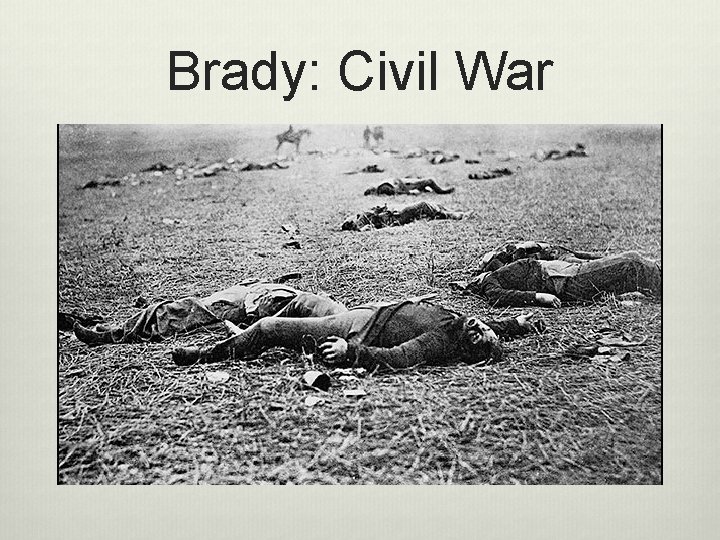
Brady: Civil War
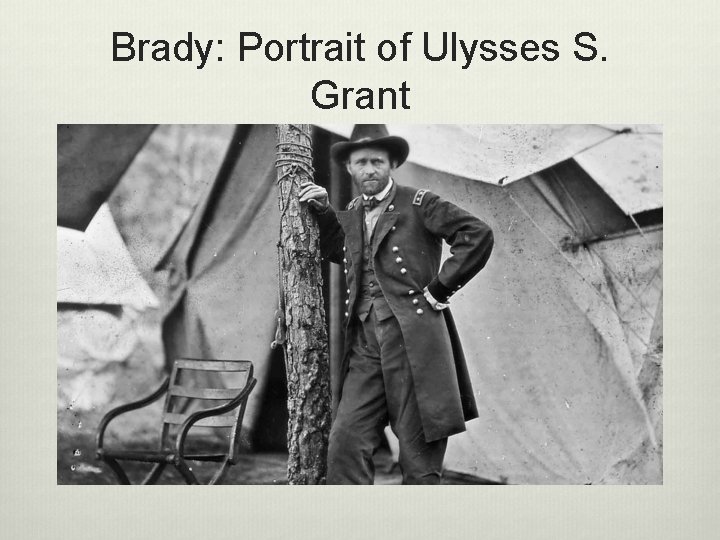
Brady: Portrait of Ulysses S. Grant
Brady’s Images: Realities of War
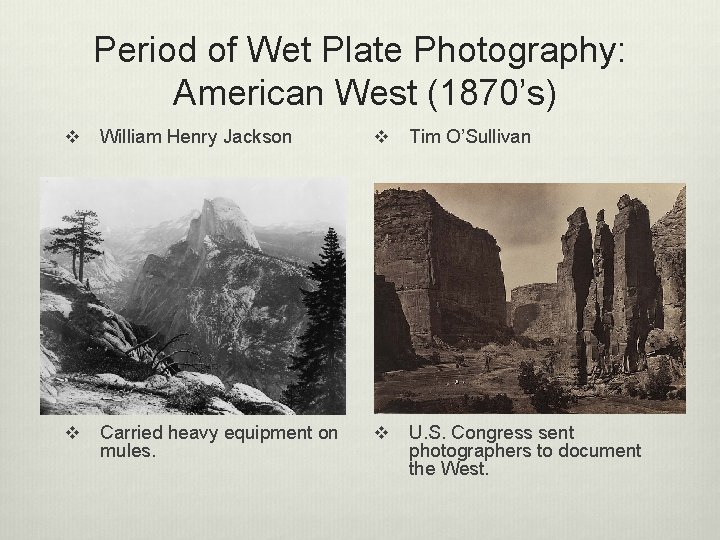
Period of Wet Plate Photography: American West (1870’s) v William Henry Jackson v Tim O’Sullivan v Carried heavy equipment on mules. v U. S. Congress sent photographers to document the West.
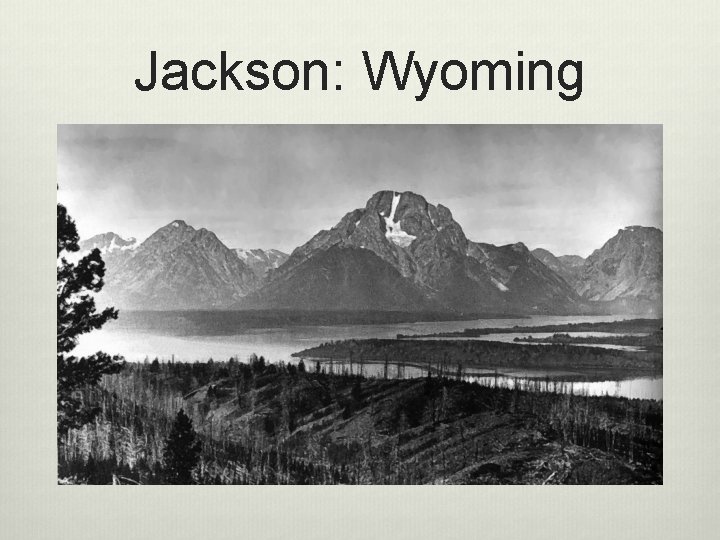
Jackson: Wyoming
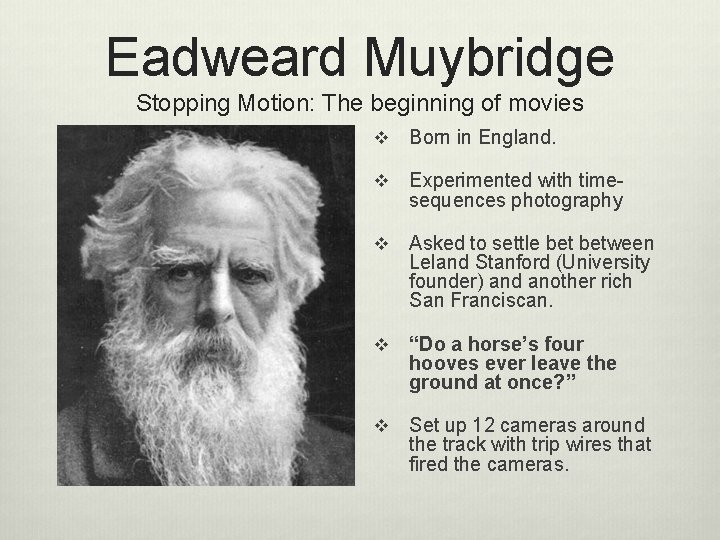
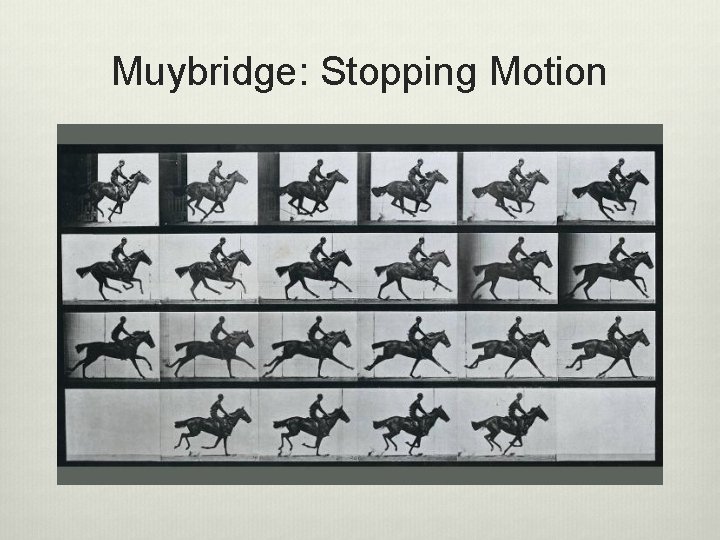
Eadweard Muybridge Stopping Motion: The beginning of movies v Born in England. v Experimented with timesequences photography v Asked to settle between Leland Stanford (University founder) and another rich San Franciscan. v “Do a horse’s four hooves ever leave the ground at once? ” v Set up 12 cameras around the track with trip wires that fired the cameras.
Muybridge: Stopping Motion
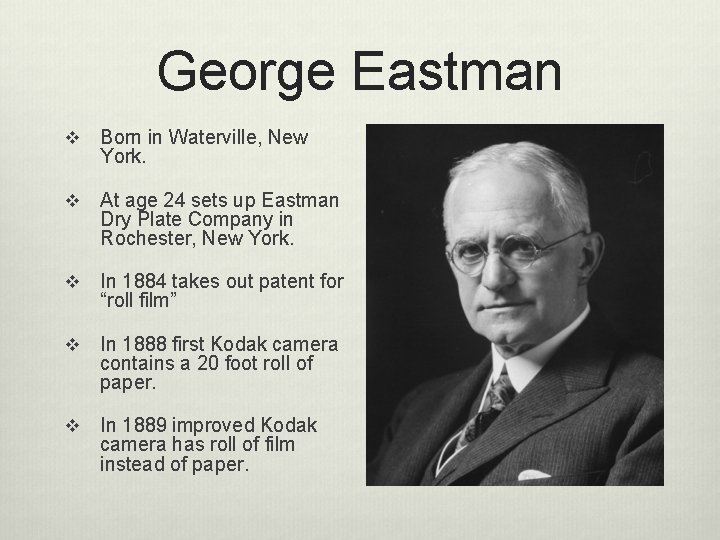
George Eastman v Born in Waterville, New York. v At age 24 sets up Eastman Dry Plate Company in Rochester, New York. v In 1884 takes out patent for “roll film” v In 1888 first Kodak camera contains a 20 foot roll of paper. v In 1889 improved Kodak camera has roll of film instead of paper.
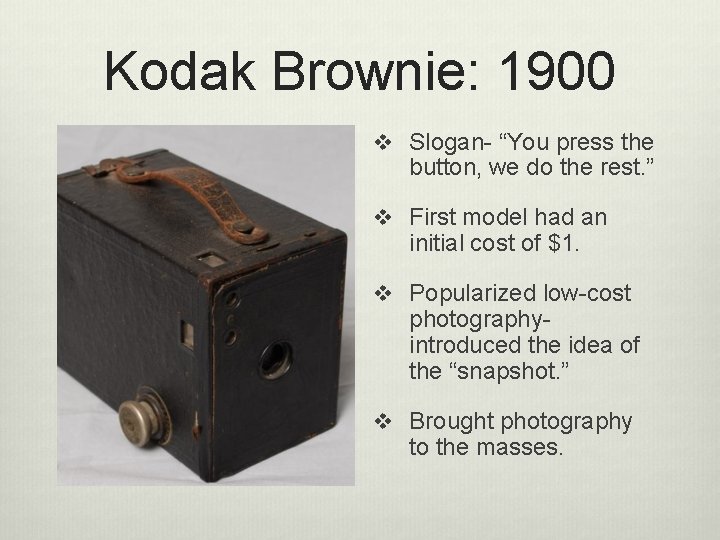
Kodak Brownie: 1900 v Slogan- “You press the button, we do the rest. ” v First model had an initial cost of $1. v Popularized low-cost photographyintroduced the idea of the “snapshot. ” v Brought photography to the masses.