
HISTORY OF PERSONAL COMPUTERS BY KRYSTAL ABERMAN LISA
HISTORY OF PERSONAL COMPUTERS BY: KRYSTAL ABERMAN LISA SALDINO
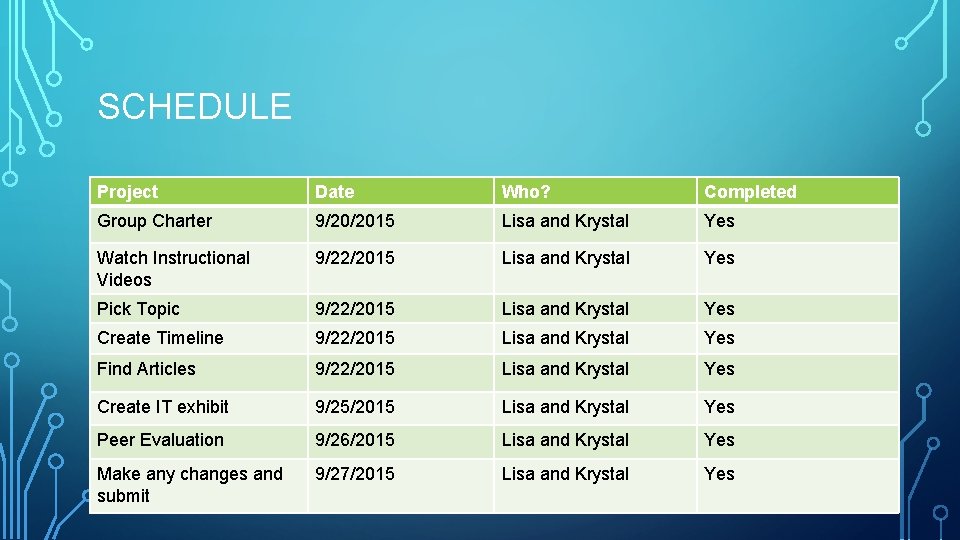
SCHEDULE Project Date Who? Completed Group Charter 9/20/2015 Lisa and Krystal Yes Watch Instructional Videos 9/22/2015 Lisa and Krystal Yes Pick Topic 9/22/2015 Lisa and Krystal Yes Create Timeline 9/22/2015 Lisa and Krystal Yes Find Articles 9/22/2015 Lisa and Krystal Yes Create IT exhibit 9/25/2015 Lisa and Krystal Yes Peer Evaluation 9/26/2015 Lisa and Krystal Yes Make any changes and submit 9/27/2015 Lisa and Krystal Yes
DEFINITION OF PERSONAL COMPUTERS • Noun • A compact computer that uses a microprocessor and is designed for individual use, as by a person in an office or at home or school, for such applications as word processing, data management, financial analysis, or computer games. • Abbreviation: PC. Citation

WHO CREATED THE FIRST PC AND WHEN? • In 1972, Intel created the first 8 t-bit microcomputer • But it wasn’t until 1981 when the first microcomputer was marketed as a personal computer by IBM. • Citation
PERSONAL COMPUTERS • Started in 1972 as a desktop computer • A luxury item back then • Personal computers come in various forms • Phone with internet access, tablet, laptop, or desktop setup • Most people have access to internet daily.
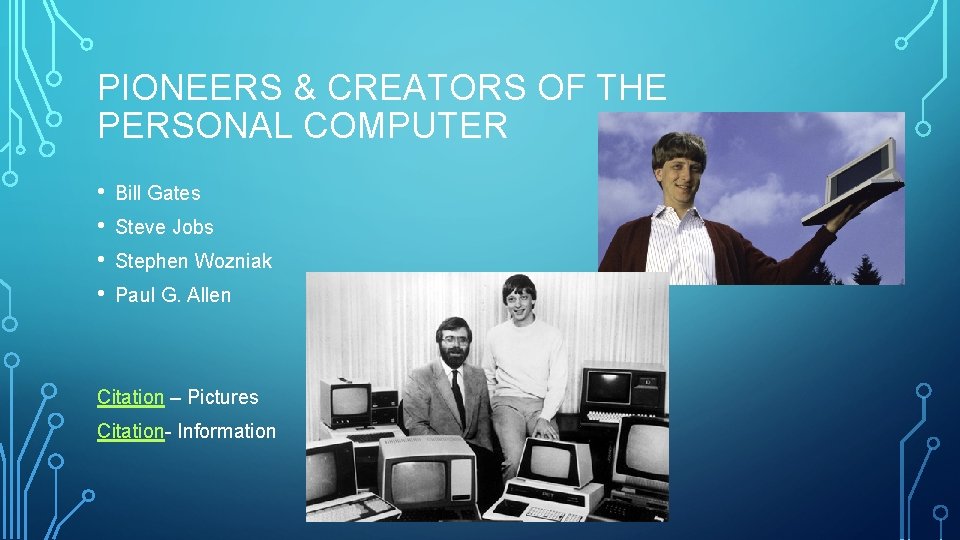
PIONEERS & CREATORS OF THE PERSONAL COMPUTER • • Bill Gates Steve Jobs Stephen Wozniak Paul G. Allen Citation – Pictures Citation- Information
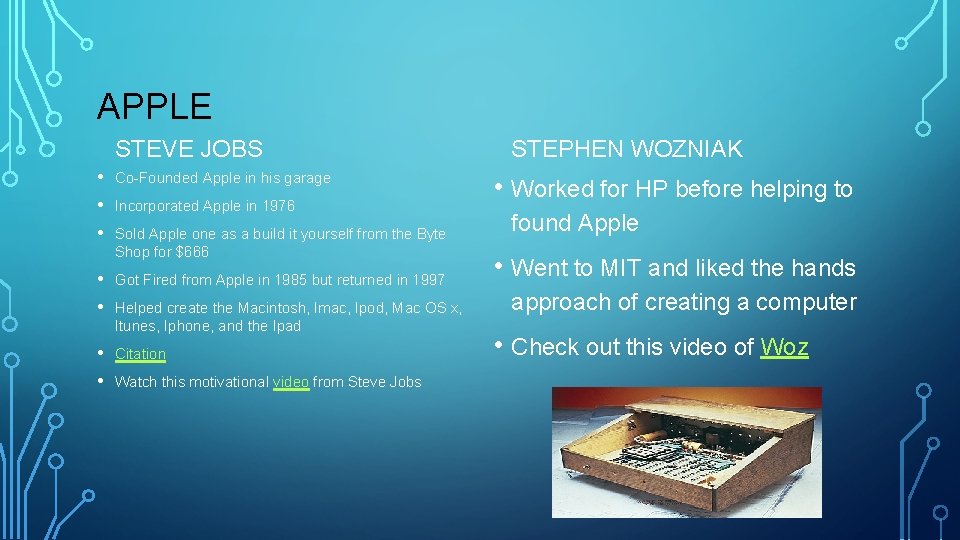
APPLE STEVE JOBS • • • Co-Founded Apple in his garage • • Got Fired from Apple in 1985 but returned in 1997 • • Citation Incorporated Apple in 1976 Sold Apple one as a build it yourself from the Byte Shop for $666 Helped create the Macintosh, Imac, Ipod, Mac OS x, Itunes, Iphone, and the Ipad Watch this motivational video from Steve Jobs STEPHEN WOZNIAK • Worked for HP before helping to found Apple • Went to MIT and liked the hands approach of creating a computer • Check out this video of Woz
MICROSOFT BILL GATES • • • Hired to write code for Altair • • Created Windows Operating System • • Citation Used the money to create Microsoft PAUL G. ALLEN in 1975 Creates an operating system which is licensed to IBM- IBM made Microsoft what it is today • Hired to write code for Altair • Cofound Microsoft • Left Microsoft in 1983 Retired from Microsoft’s day to day operations in 2008 as one of the richest people on the planet Video of Bill Gates • Video of Bill and Paul
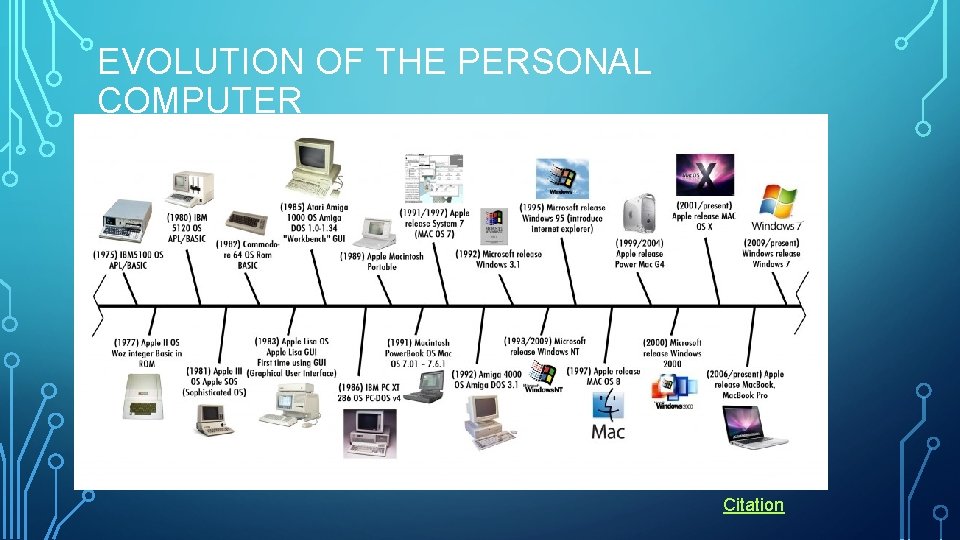
EVOLUTION OF THE PERSONAL COMPUTER Citation
STORY BOARD
EDUCATIONAL TECHNOLOGY • Without the invention of the personal computer, education might not be where it is today. • Today students need computers for their homework. They use it for creating presentations, researching information, staying connected. • This could not have been so without Steve Jobs, Bill Gates etc.
LEARNING THEORISTS • John B. Watson- • • Behaviorist • • B. F. Skinner- • • Behaviorist Wrote The Behaviorist Manifesto which outlined his theory on behaviorism • He theorized that both positive and negative reinforcement can strengthen a behavior • Behaviorism is a Psychological theory of learning where behavior is learned through rewards and punishments. • Skinner’s theory is often used in the classroom where students are given positive reinforcement (i. e. stickers, prizes) for the good behavior that the teacher is looking for • Citation Little Albert Experiment- conditioned a child to have phobias Skinner box- conditioned rats to do a system of tasks to receive food
LEARNING THEORISTS • Ivan Pavlov • • • Behaviorist • Not only students but anyone who uses a personal computer is conditioned, they know certain sounds mean to check email or notifications. They are conditioned to behave a certain way. • Citation Pavlov’s Dogs- conditioned dogs to salivate when they heard a bell by always producing food after the sound. This classical conditioning is a theory that can also be applied for students. Students are conditioned with the school bells to pack up their things to leave. They are conditioned in school to respond a certain way when a neutral stimulus is present (ex. If the teacher turns off the lights, they learned to be quite).
EDUCATIONAL TECHNOLOGY • People learn differently which technology helps greatly. • Visual learners can see with presentations, diagrams, and charts. • Auditory learners can still listen to presentations.
RESOURCES • • http: //www. history. com/topics/invention-of-the-pc • • http: //dictionary. reference. com/browse/personal+computer • http: //content. time. com/time/specials/packages/article/0, 28804, 1873486_1873491_1873520, 00. html Crawford, W. (2005). P Is for Personal, C Is for Computer. Online, 29(6), 58 -60. Andrews, P. (2001). How IBM's PC made Microsoft. U. S. News & World Report, 131(7), 20. Munro, R. A. , & Rice-Munro, E. J. (2004). Learning Styles, Teaching Approaches, and Technology. Journal For Quality & Participation, 27(1), 26 -32. https: //www. google. com/search? q=important+people+in+creating+the+first+personal+computer&biw=1280&bih= 923&source=lnms&tbm=isch&sa=X&ved=0 CAc. Q_AUo. Amo. VCh. MIh 5 Hss 9 WSy. AIVxx 0 e. Ch 0 Ezg. O_#imgrc=f 3 PH BHEz. CFTAEM%3 A
- Slides: 15