
History of Particle Nuclear Physics Power points slides
- Slides: 36
History of Particle Nuclear Physics!
Power points slides… thanks to David Krofcheck Canterbury Teachers Workshop And Stefania Ricciardi (sourced off the internet via Google)
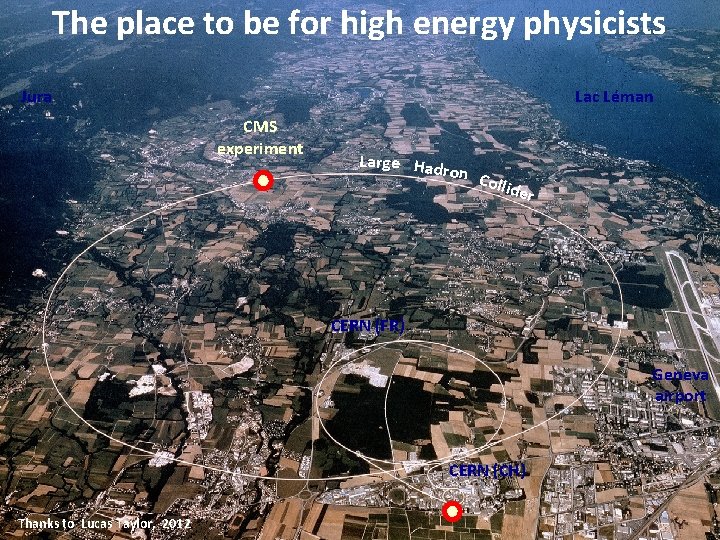
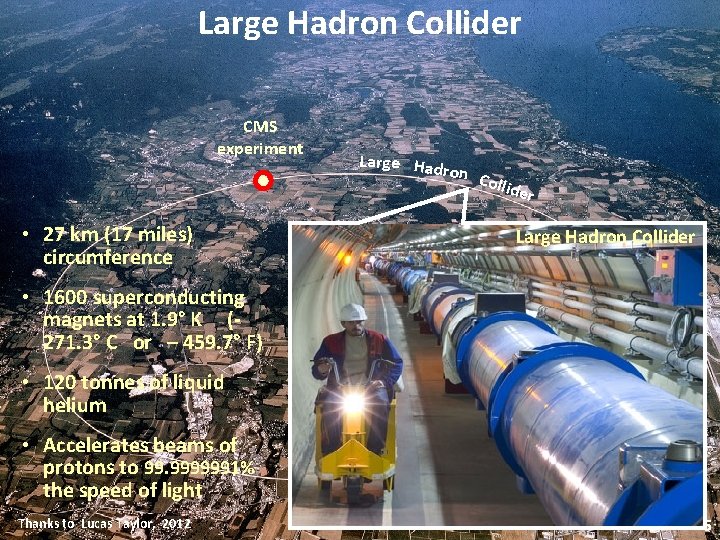
The place to be for high energy physicists Lac Léman Jura CMS experiment Large Had ron C ollid er CERN (FR) Geneva airport CERN (CH) Thanks to Lucas Taylor, 2012
Large Hadron Collider CMS experiment • 27 km (17 miles) circumference Large Had ron C ollid er Large Hadron Collider • 1600 superconducting magnets at 1. 9° K (271. 3° C or – 459. 7° F) • 120 tonnes of liquid helium • Accelerates beams of protons to 99. 9999991% the speed of light Thanks to Lucas Taylor, 2012 5
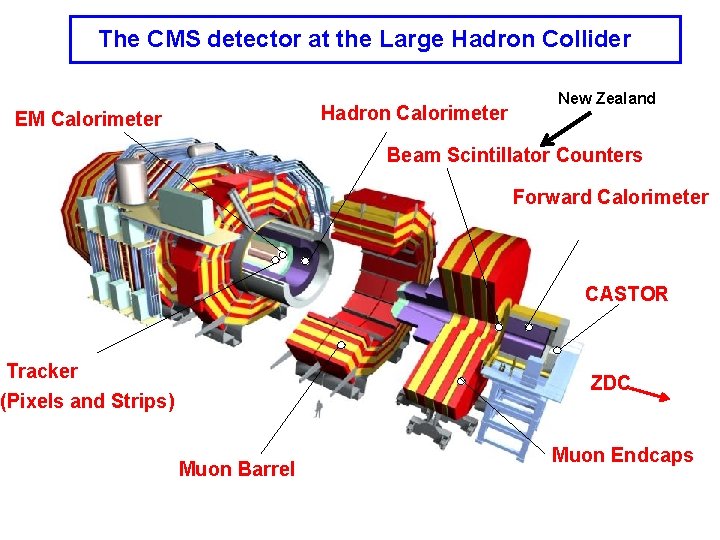
The CMS detector at the Large Hadron Collider Hadron Calorimeter EM Calorimeter New Zealand Beam Scintillator Counters Forward Calorimeter CASTOR Tracker (Pixels and Strips) ZDC Muon Barrel Muon Endcaps
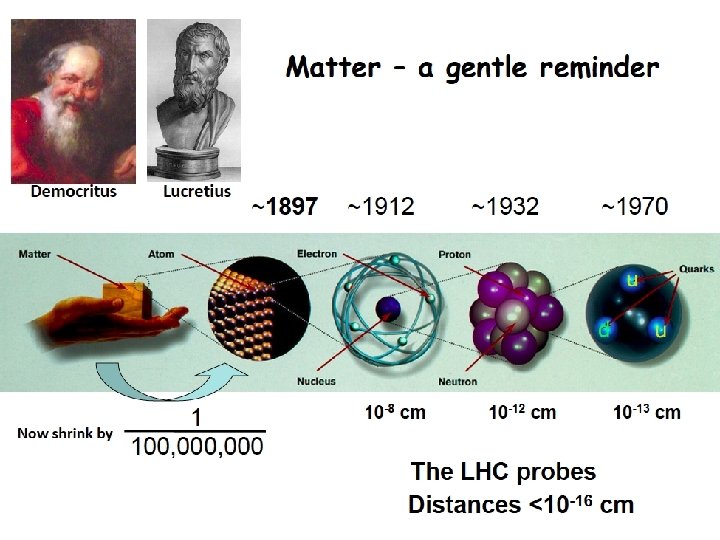
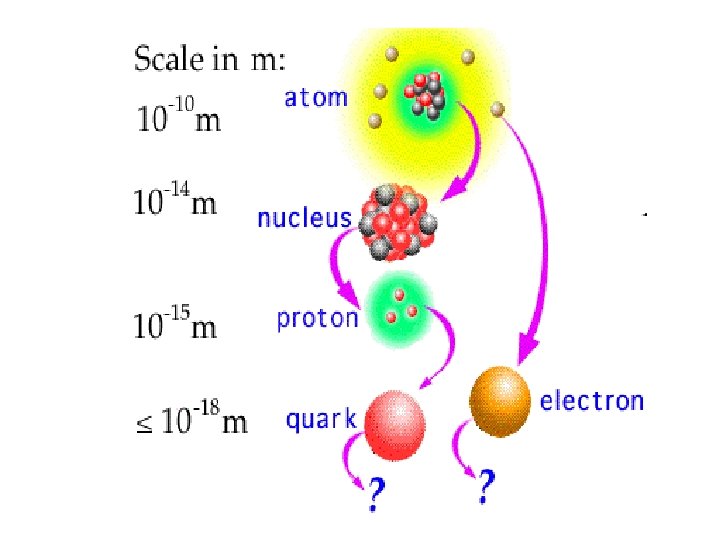
PARTICLE PHYSICS Particle physics is a separate branch of physics which studies the fundamental particles and the fundamental forces of nature. Even before 1950 it was clear that there was more to the Universe than protons, neutrons and electrons.
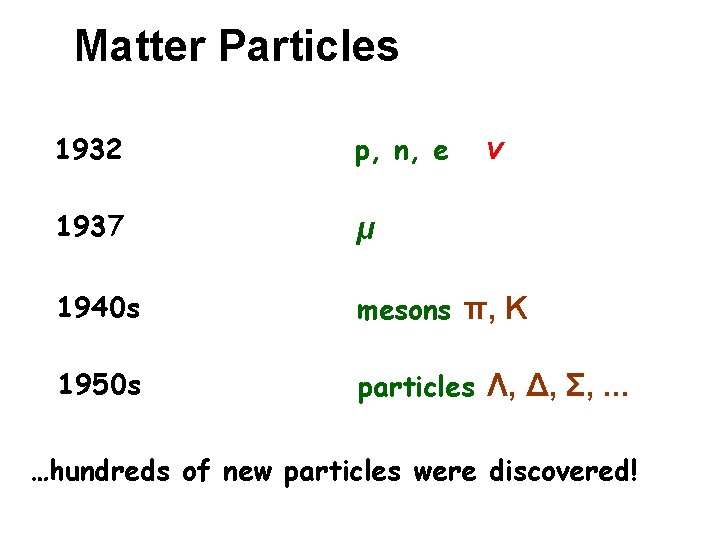
Matter Particles 1932 p, n, e 1937 μ 1940 s mesons π, K 1950 s particles Λ, Δ, Σ, . . . ν …hundreds of new particles were discovered!
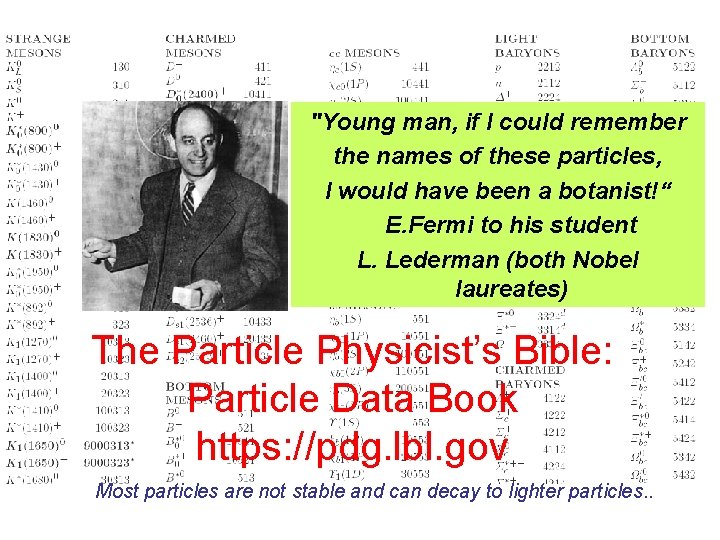
"Young man, if I could remember the names of these particles, I would have been a botanist!“ E. Fermi to his student L. Lederman (both Nobel laureates) The Particle Physicist’s Bible: Particle Data Book https: //pdg. lbl. gov Most particles are not stable and can decay to lighter particles. .
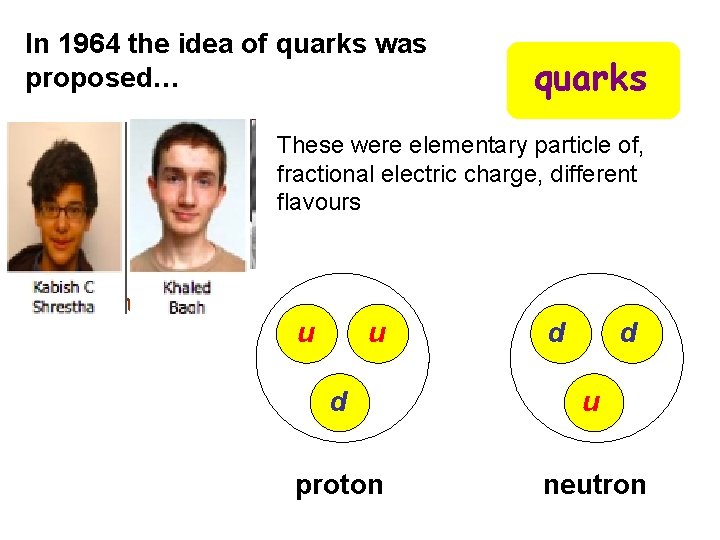
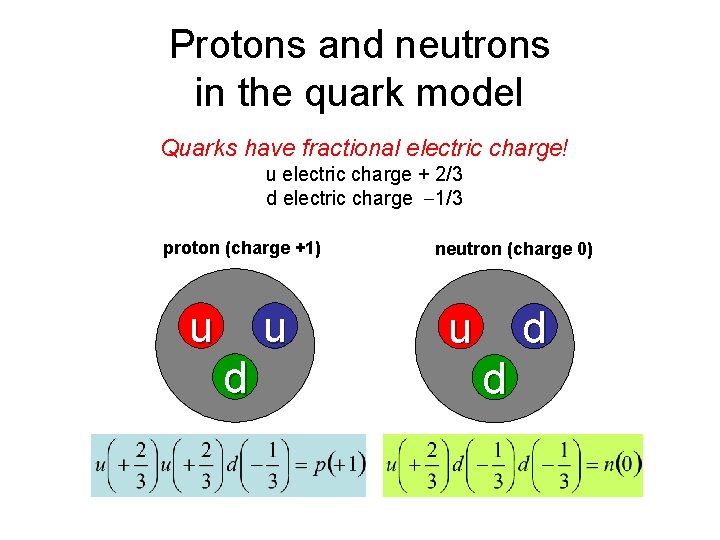
In 1964 the idea of quarks was proposed… quarks These were elementary particle of, fractional electric charge, different flavours Gell-Mann Zweig u u d d d u proton neutron
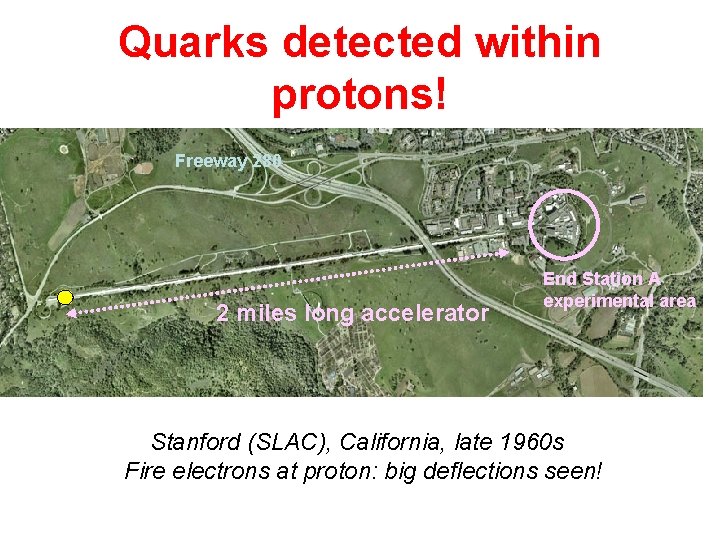
Quarks detected within protons! Freeway 280 2 miles long accelerator End Station A experimental area Stanford (SLAC), California, late 1960 s Fire electrons at proton: big deflections seen!
Protons and neutrons in the quark model Quarks have fractional electric charge! u electric charge + 2/3 d electric charge -1/3 proton (charge +1) u u d neutron (charge 0) u d d
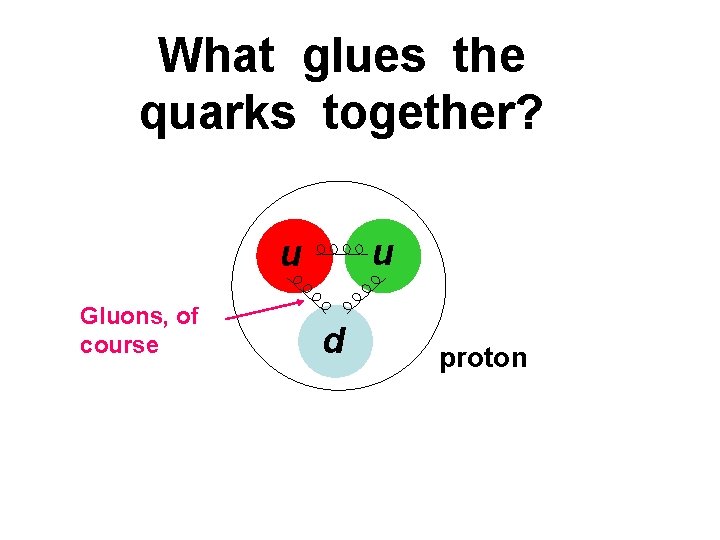
What glues the quarks together? u u Gluons, of course d proton
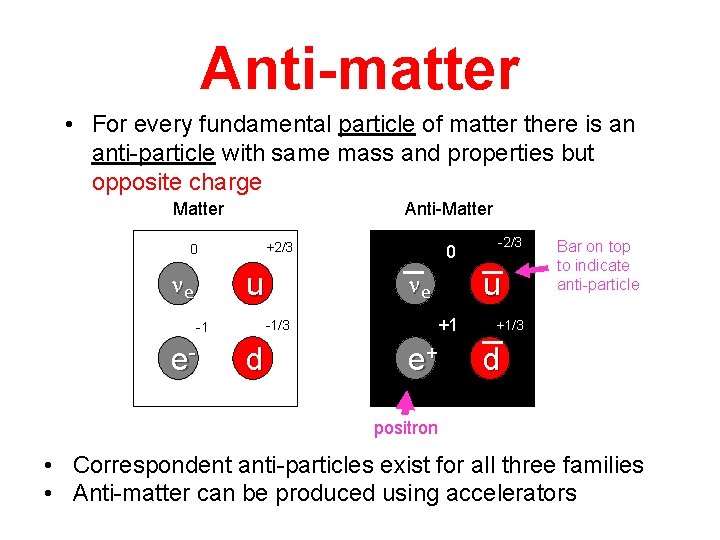
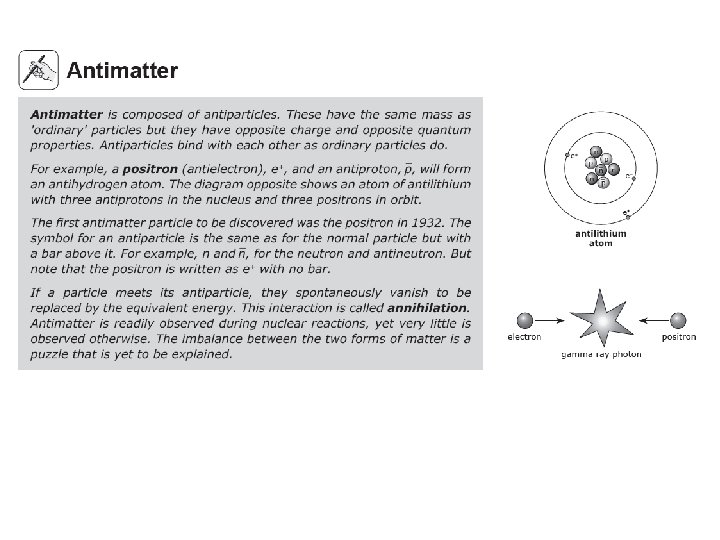
Anti-matter • For every fundamental particle of matter there is an anti-particle with same mass and properties but opposite charge Matter Anti-Matter +2/3 0 u ne d -2/3 u ne +1 -1/3 -1 e- 0 e+ Bar on top to indicate anti-particle +1/3 d positron • Correspondent anti-particles exist for all three families • Anti-matter can be produced using accelerators
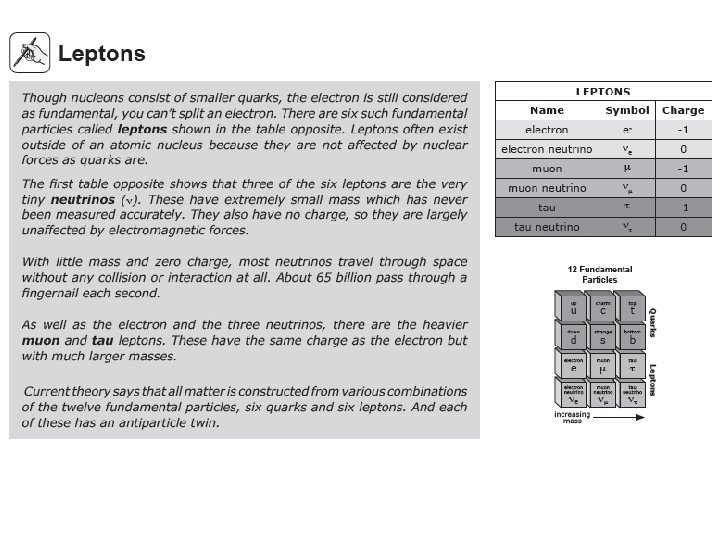
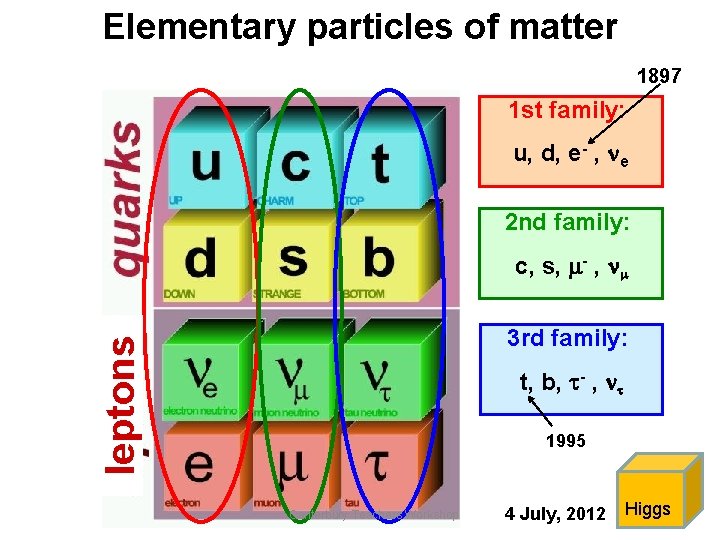
Elementary particles of matter 1897 1 st family: u, d, e- , e 2 nd family: c, s, - , leptons 3 rd family: t, b, - , 1995 Canterbury Teachers Workshop 4 July, 2012 Higgs
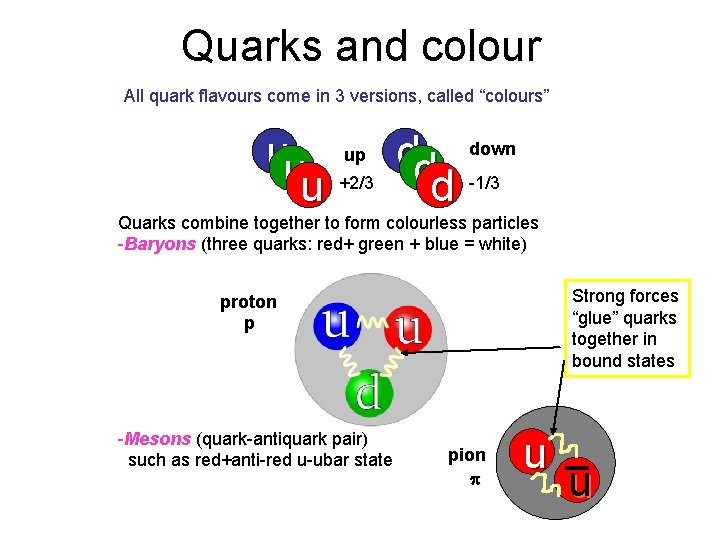
Quarks and colour All quark flavours come in 3 versions, called “colours” up uu +2/3 dd down u d -1/3 Quarks combine together to form colourless particles -Baryons (three quarks: red+ green + blue = white) Strong forces “glue” quarks together in bound states proton p -Mesons (quark-antiquark pair) such as red+anti-red u-ubar state pion p u u
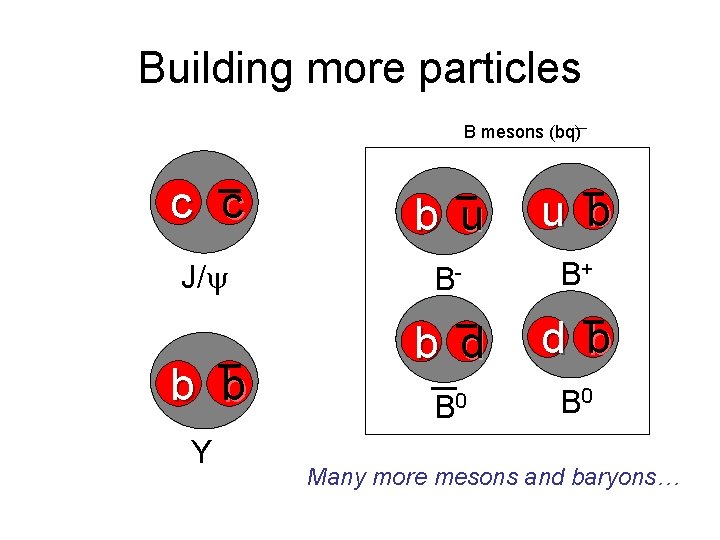
Building more particles B mesons (bq) c c b u u b J/y B- B+ b d d b B 0 b b Y Many more mesons and baryons…
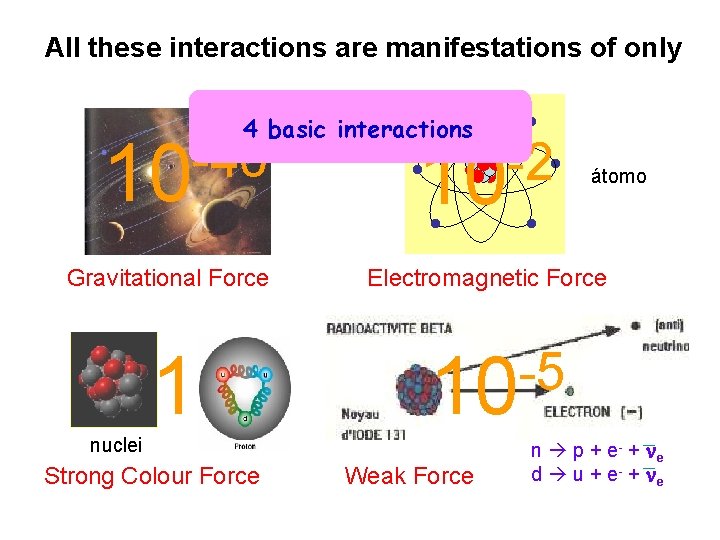
All these interactions are manifestations of only . . . 10 -2. . . 4 basic interactions -40 10 Gravitational Force 1 Electromagnetic Force -5 10 nuclei Strong Colour Force átomo Weak Force n p + e - + e d u + e - + e
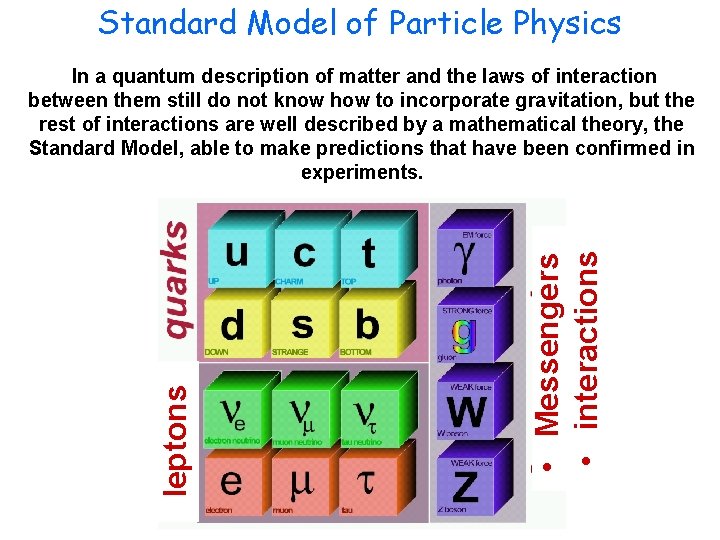
Standard Model of Particle Physics • Messengers • interactions leptons In a quantum description of matter and the laws of interaction between them still do not know how to incorporate gravitation, but the rest of interactions are well described by a mathematical theory, the Standard Model, able to make predictions that have been confirmed in experiments.
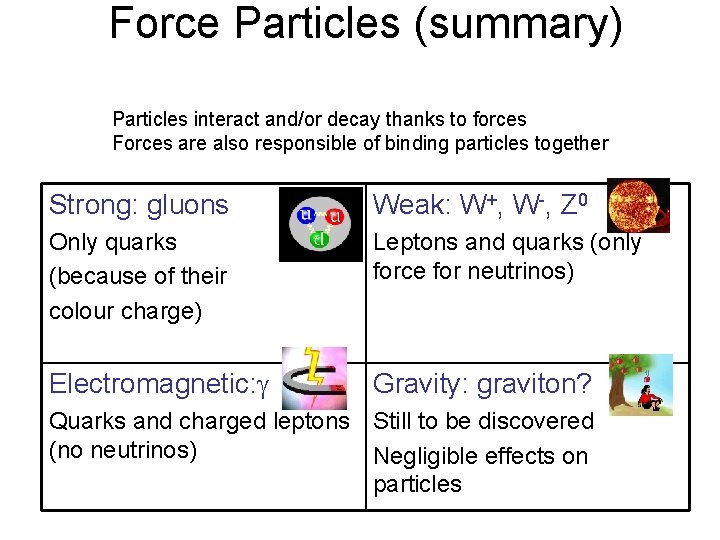
Force Particles (summary) Particles interact and/or decay thanks to forces Forces are also responsible of binding particles together Strong: gluons Weak: W+, W-, Z 0 Only quarks (because of their colour charge) Leptons and quarks (only force for neutrinos) Electromagnetic: g Gravity: graviton? Quarks and charged leptons Still to be discovered (no neutrinos) Negligible effects on particles
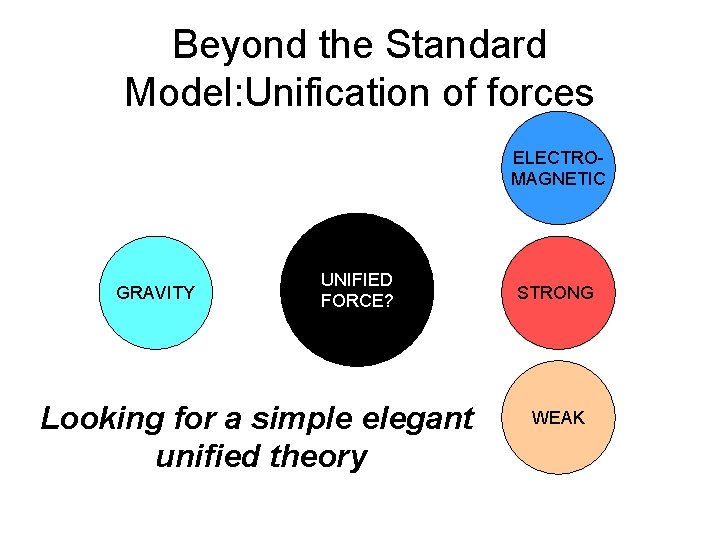
Beyond the Standard Model: Unification of forces ELECTROMAGNETIC GRAVITY UNIFIED FORCE? Looking for a simple elegant unified theory STRONG WEAK