
History of Nuclear Weapons Lupei Zhu Topics Important
- Slides: 13
History of Nuclear Weapons Lupei Zhu
Topics � Important discoveries before WWII that led to nuclear weapons. � The Manhattan Project. � Nuclear weapon attacks on Japan in WWII. � Current states with nuclear weapons. History of Nuclear Weapons 2
Important discoveries pre-WWII the end of 19 th century, people knew the all matter is made of basic substances called elements. Each element consists of a particular type of particle atom. But they believed that atom is the smallest particle that can not be divided further. � In 1896 French physicist Antoine Henri Becquerel's experiments led to the discovery of radioactivity: atomic nucleus of certain elements emit energetic particles (rays). He shared the 1903 Nobel Prize with Pierre and Marie Curie. � By History of Nuclear Weapons 3
Important discoveries pre-WWII � In 1899 Ernest Rutherford discovered two kinds of rays emitting from radium. The first is positively charged and he called alpha rays (turned out late to be the helium nucleus, which consists of two protons and two neutrons); the more penetrating negative charged rays he called beta rays (electrons). � The third one, the gamma ray, has no charge and late found to be photon (light). History of Nuclear Weapons 4
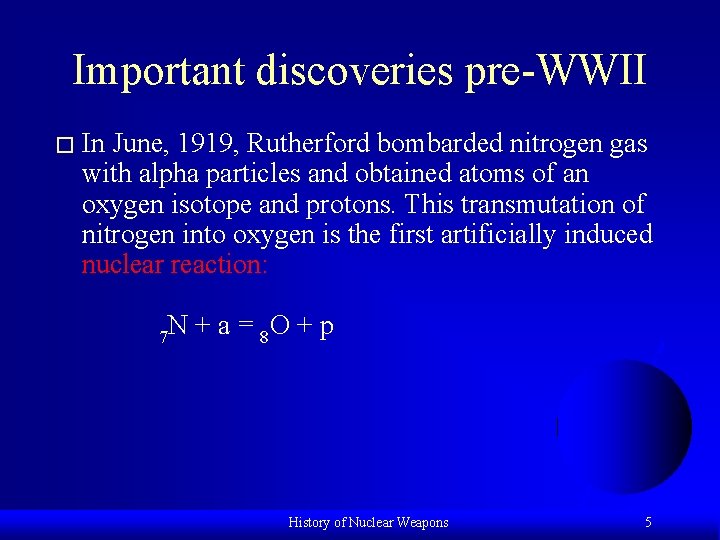
Important discoveries pre-WWII � In June, 1919, Rutherford bombarded nitrogen gas with alpha particles and obtained atoms of an oxygen isotope and protons. This transmutation of nitrogen into oxygen is the first artificially induced nuclear reaction: N + a = 8 O + p 7 History of Nuclear Weapons 5
Important discoveries pre-WWII � 1932 February - James Chadwick discovered the neutron. It has the same mass as proton but without charge. � 1934 Frédéric and Irène Joliot-Curie discovered artificial radioactivity. Enrico Fermi irradiated uranium with neutrons, unknowingly achieved the world's first nuclear fission. � 1938 -1939 - Otto Hahn sent a paper to Lise Meitner containing experimental results that were interpreted by Meitner and nephew Otto Frisch as nuclear fission. History of Nuclear Weapons 6
Manhattan Project � As World War II broke out it became clear that the Germans understood fission as well and were interested in making a bomb. � At the urging of prominent scientists, including Albert Einstein, the US government was persuaded to start a program to develop weapons. � American scientists were skeptic of fission however and didn’t start a concentrated effort until Dec. 6, 1941. � By August 1942 things had gotten serious and the Manhattan Project was officially born. History of Nuclear Weapons 7
Manhattan Project Movie (6 m) History of Nuclear Weapons 8
4 Components in the Project � � Achieve a chain reaction/ produce plutonium. This was carried out at the University of Chicago, called the Met Lab, and led by Compton and Fermi. Mass production of U 235, the fissionable isotope of uranium, carried out at the Oak Ridge Laboratories in Tennessee. Mass production of plutonium, a better fissionable material than U 235, carried out at Hanford, Washington. Design and testing of actual nuclear bombs. This was carried out at Los Alamos, New Mexico under the direction of Oppenheimer. History of Nuclear Weapons 9
Testing in Manhattan Project � � By the July of 1945 enough fissionable material had been developed (and the bomb design had advanced enough) that a test was planned. Everyone was confident the U 235 bomb would work, but the plutonium bomb was a different story - so it needed a test. On July 4 th a test shot of 100 tons of high explosive was done. The explosive was purposely contaminated with radioactive elements so that scientists could track the contamination. On July 16, the real test was performed and was actually bigger than expected (21 kt). It was code-named Trinity. History of Nuclear Weapons 10
Use of atomic bombs in WII � The first atomic bomb, Little Boy, was dropped in Hiroshima on Aug. 6, 1945. The yield is 15 kt. 70, 000 people killed. � Three days later, the 2 nd bomb, the Fat Man, was dropped in Nakasaki with a yield of 20 kt. 52, 000 people died. History of Nuclear Weapons 11
Use of atomic bombs in WII History of Nuclear Weapons 12
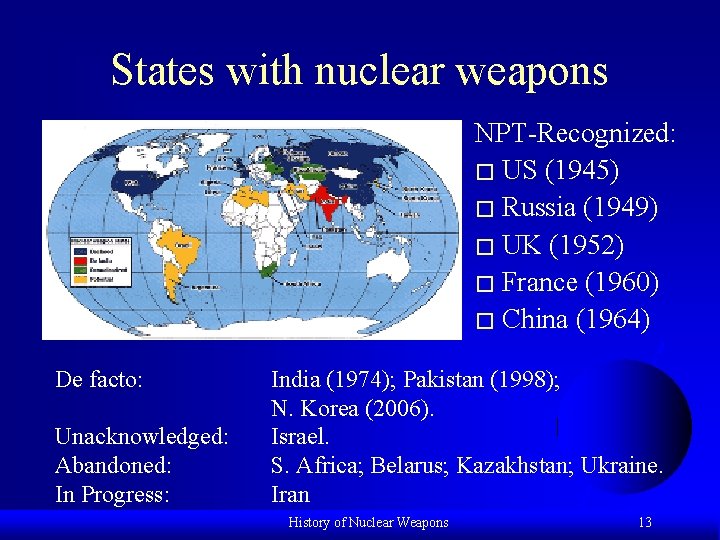
States with nuclear weapons NPT-Recognized: � US (1945) � Russia (1949) � UK (1952) � France (1960) � China (1964) De facto: Unacknowledged: Abandoned: In Progress: India (1974); Pakistan (1998); N. Korea (2006). Israel. S. Africa; Belarus; Kazakhstan; Ukraine. Iran History of Nuclear Weapons 13