
History of Moving Image Drama By Jerry Castillo

History of Moving Image Drama By: Jerry Castillo
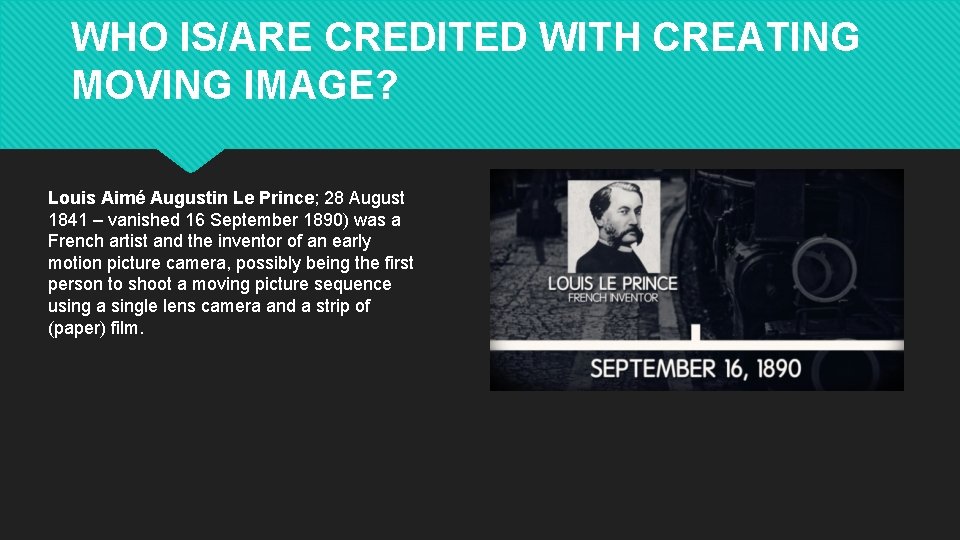
WHO IS/ARE CREDITED WITH CREATING MOVING IMAGE? Louis Aimé Augustin Le Prince; 28 August 1841 – vanished 16 September 1890) was a French artist and the inventor of an early motion picture camera, possibly being the first person to shoot a moving picture sequence using a single lens camera and a strip of (paper) film.
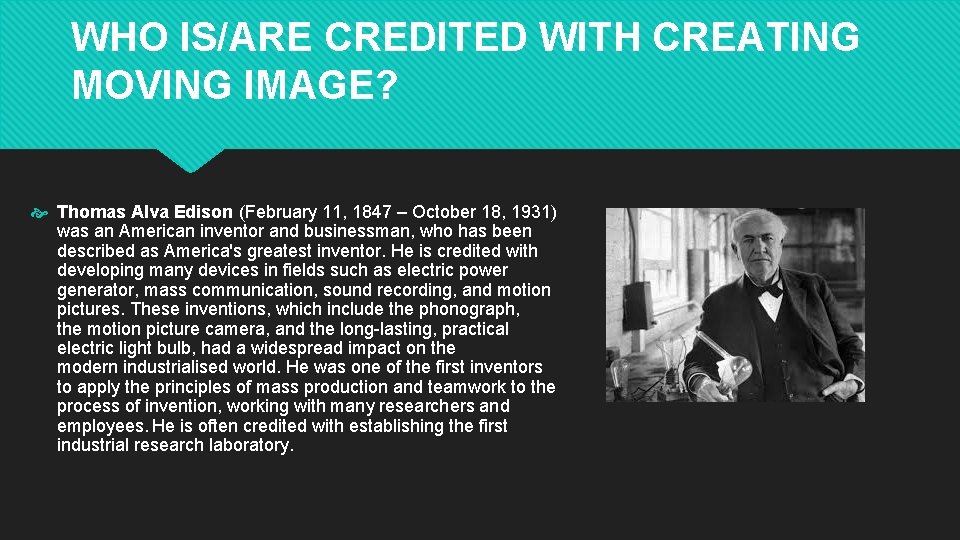
WHO IS/ARE CREDITED WITH CREATING MOVING IMAGE? Thomas Alva Edison (February 11, 1847 – October 18, 1931) was an American inventor and businessman, who has been described as America's greatest inventor. He is credited with developing many devices in fields such as electric power generator, mass communication, sound recording, and motion pictures. These inventions, which include the phonograph, the motion picture camera, and the long-lasting, practical electric light bulb, had a widespread impact on the modern industrialised world. He was one of the first inventors to apply the principles of mass production and teamwork to the process of invention, working with many researchers and employees. He is often credited with establishing the first industrial research laboratory.
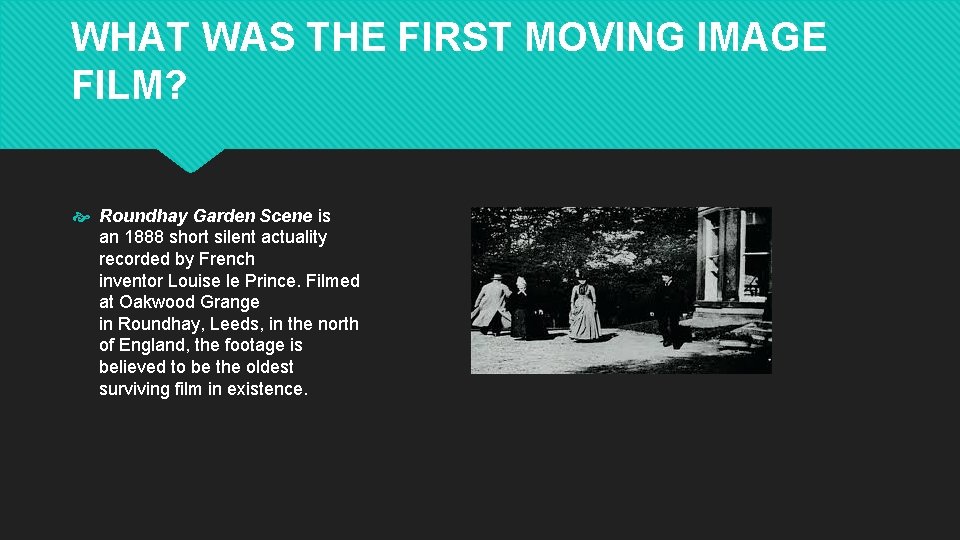
WHAT WAS THE FIRST MOVING IMAGE FILM? Roundhay Garden Scene is an 1888 short silent actuality recorded by French inventor Louise le Prince. Filmed at Oakwood Grange in Roundhay, Leeds, in the north of England, the footage is believed to be the oldest surviving film in existence.
WHAT WAS THE FIRST MOVING IMAGE FILM? According to Le Prince's son, Adolphe, the film was made at Oakwood Grange, the home of Joseph and Sarah Whitley, in Roundhay, Leeds, West Riding of Yorkshire, England on 14 October 1888. The footage features Louis' son Adolphe Le Prince, his mother-in law Sarah Whitley (née Robinson, 1816 – 24 October 1888), his father-in-law Joseph Whitley (1817 – 12 January 1891) and Annie Hartley in the garden of Oakwood Grange. The film features: Leisurely walking around the garden of the premises. Sarah is seen walking - or dancing backwards as she turns around, and Joseph's coat tails are seen flying as he also is turning. Joseph and Sarah Whitley were the parents of Le Prince‘s wife, Elizabeth. Annie Hartley is believed to be a friend of Le Prince and his wife. Sarah Whitley died ten days after the scene was filmed.
WHAT YEAR WAS THE MOVING IMAGE CREATED? Roundhay Garden Scene is an 1888 short silent actuality recorded by French inventor Louise le Prince. Filmed at Oakwood Grange in Roundhay, Leeds, in the north of England, the footage is believed to be the oldest surviving film in existence.
WHAT IS MOVING IMAGE? Moving Images A generic term for a visual work that has the appearance of movement. (from Society of American Archivists Glossary of Archival and Records Terminology) Examples include motion pictures, videos, and other theatrical releases, shorts, news footage (including television newscasts and theatrical newsreels), trailers, out-takes, screen tests, training films, educational material, commercials, spot announcements, home movies, amateur footage, television broadcasts, and unedited footage. These may be in electronic form.
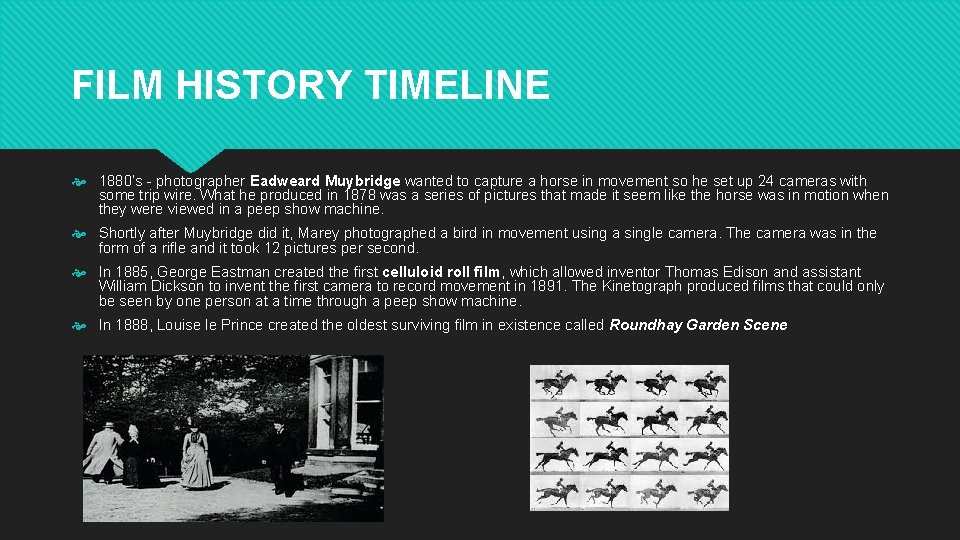
FILM HISTORY TIMELINE 1880’s - photographer Eadweard Muybridge wanted to capture a horse in movement so he set up 24 cameras with some trip wire. What he produced in 1878 was a series of pictures that made it seem like the horse was in motion when they were viewed in a peep show machine. Shortly after Muybridge did it, Marey photographed a bird in movement using a single camera. The camera was in the form of a rifle and it took 12 pictures per second. In 1885, George Eastman created the first celluloid roll film, which allowed inventor Thomas Edison and assistant William Dickson to invent the first camera to record movement in 1891. The Kinetograph produced films that could only be seen by one person at a time through a peep show machine. In 1888, Louise le Prince created the oldest surviving film in existence called Roundhay Garden Scene
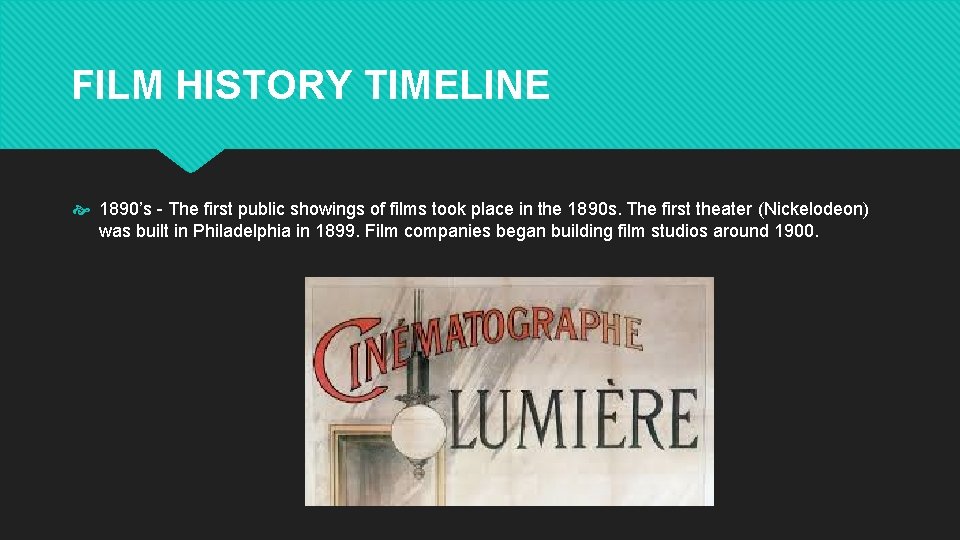
FILM HISTORY TIMELINE 1890’s - The first public showings of films took place in the 1890 s. The first theater (Nickelodeon) was built in Philadelphia in 1899. Film companies began building film studios around 1900.
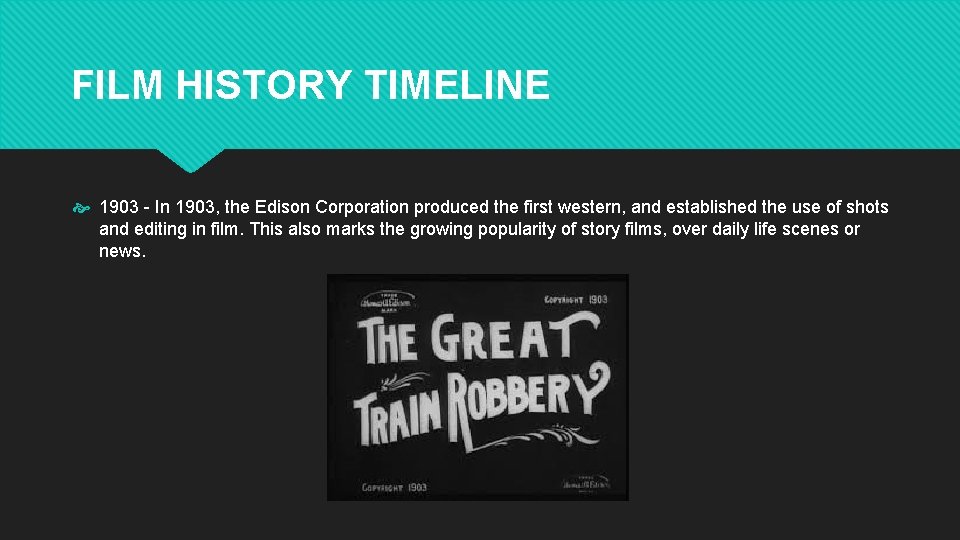
FILM HISTORY TIMELINE 1903 - In 1903, the Edison Corporation produced the first western, and established the use of shots and editing in film. This also marks the growing popularity of story films, over daily life scenes or news.
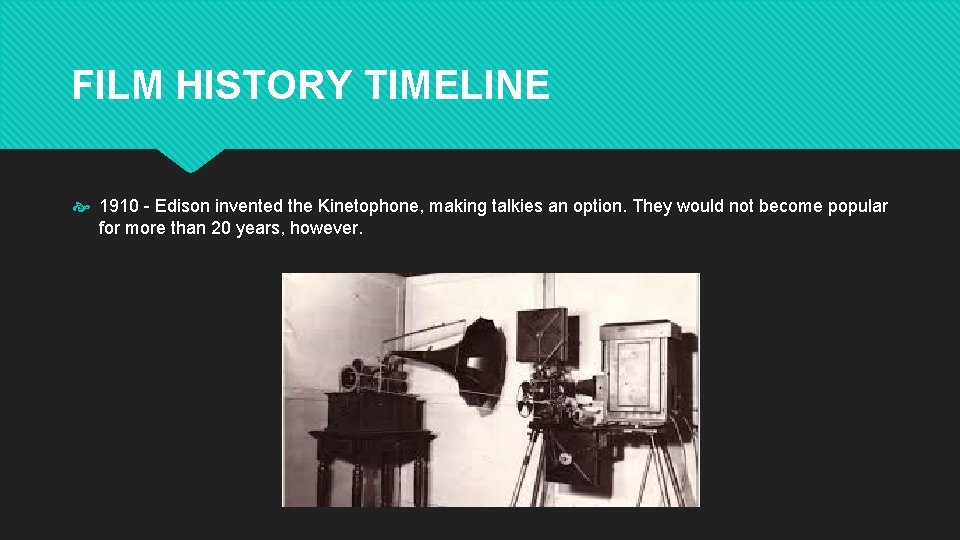
FILM HISTORY TIMELINE 1910 - Edison invented the Kinetophone, making talkies an option. They would not become popular for more than 20 years, however.
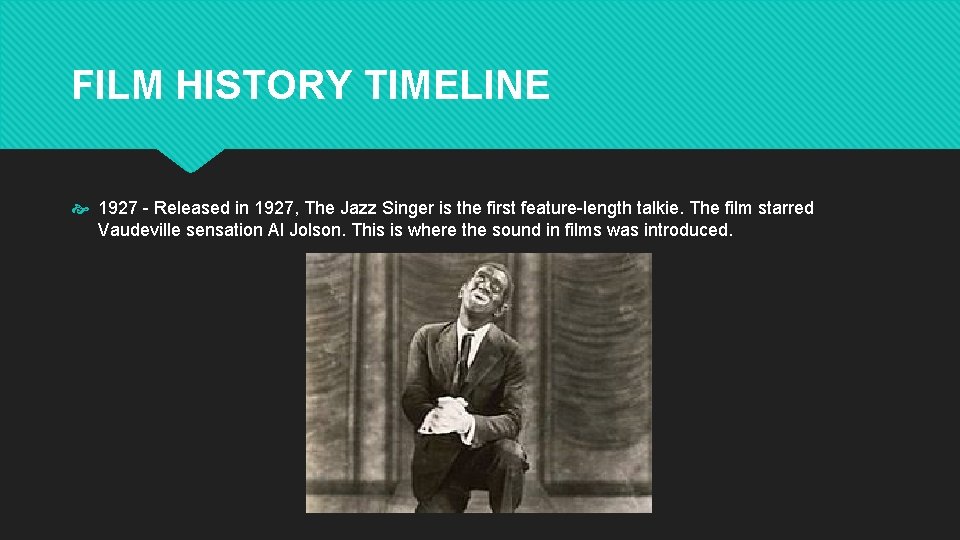
FILM HISTORY TIMELINE 1927 - Released in 1927, The Jazz Singer is the first feature-length talkie. The film starred Vaudeville sensation Al Jolson. This is where the sound in films was introduced.
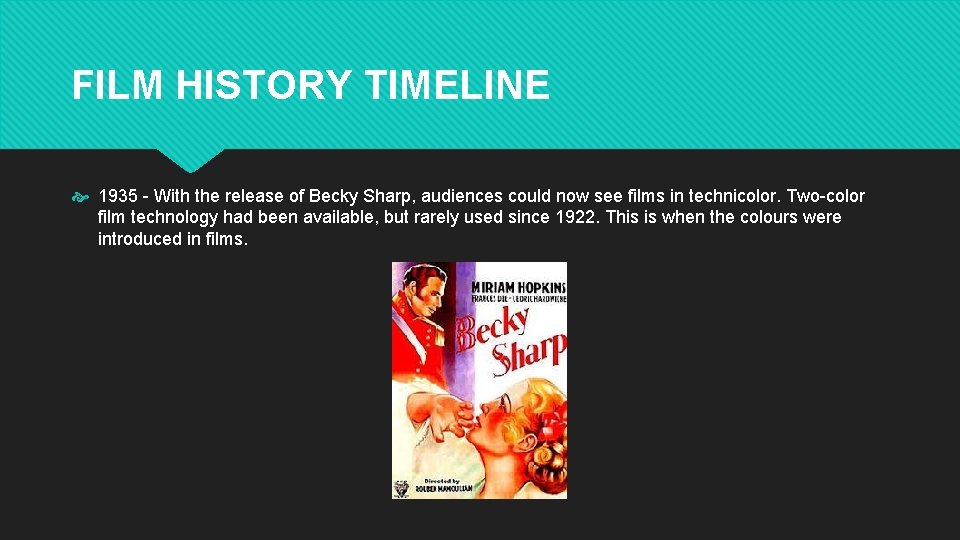
FILM HISTORY TIMELINE 1935 - With the release of Becky Sharp, audiences could now see films in technicolor. Two-color film technology had been available, but rarely used since 1922. This is when the colours were introduced in films.
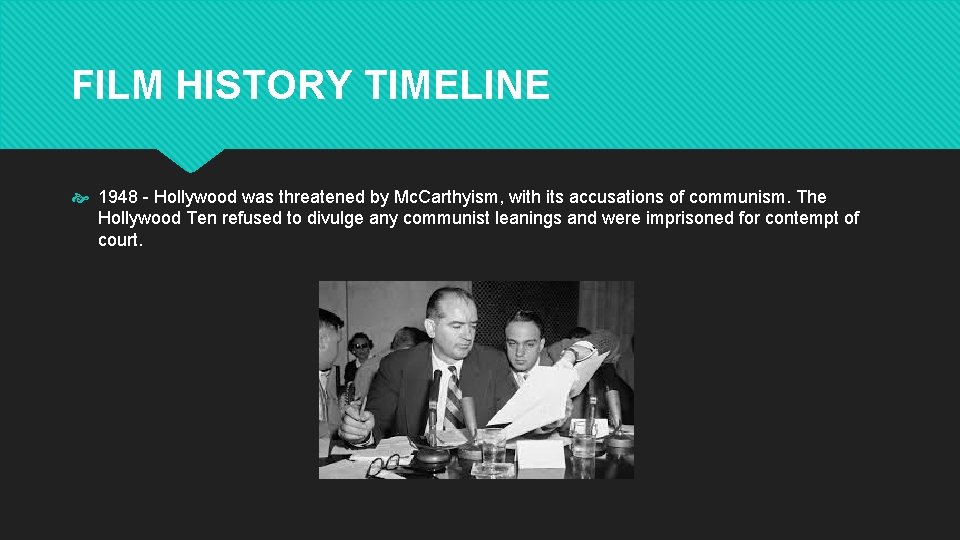
FILM HISTORY TIMELINE 1948 - Hollywood was threatened by Mc. Carthyism, with its accusations of communism. The Hollywood Ten refused to divulge any communist leanings and were imprisoned for contempt of court.
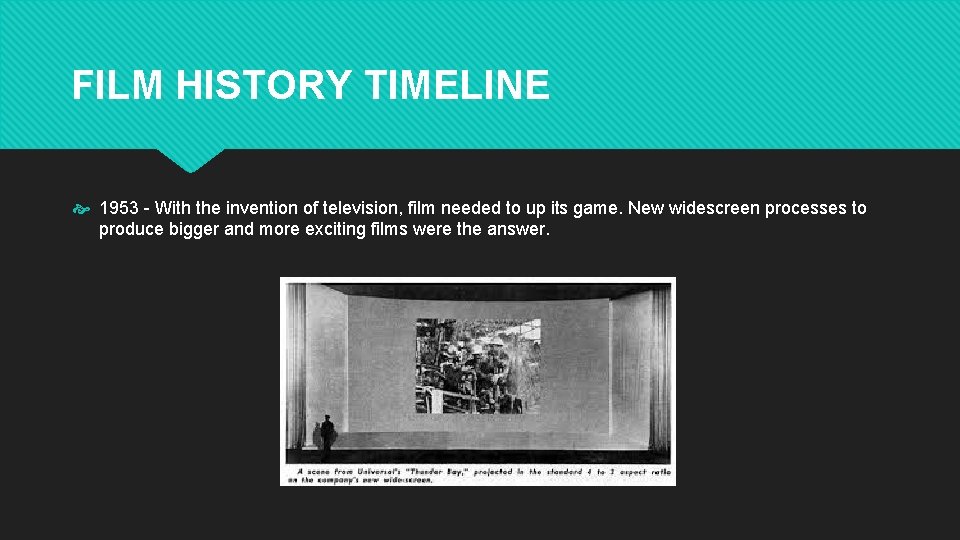
FILM HISTORY TIMELINE 1953 - With the invention of television, film needed to up its game. New widescreen processes to produce bigger and more exciting films were the answer.
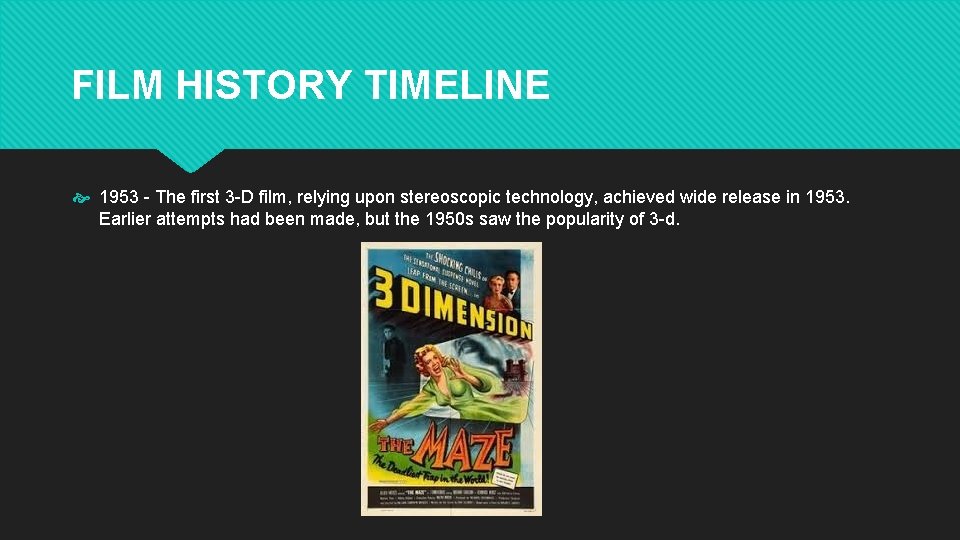
FILM HISTORY TIMELINE 1953 - The first 3 -D film, relying upon stereoscopic technology, achieved wide release in 1953. Earlier attempts had been made, but the 1950 s saw the popularity of 3 -d.
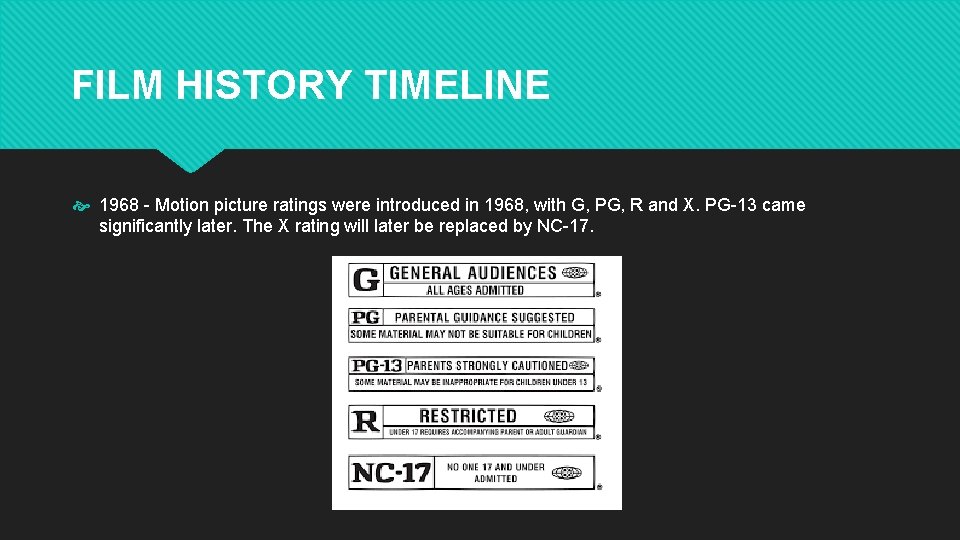
FILM HISTORY TIMELINE 1968 - Motion picture ratings were introduced in 1968, with G, PG, R and X. PG-13 came significantly later. The X rating will later be replaced by NC-17.
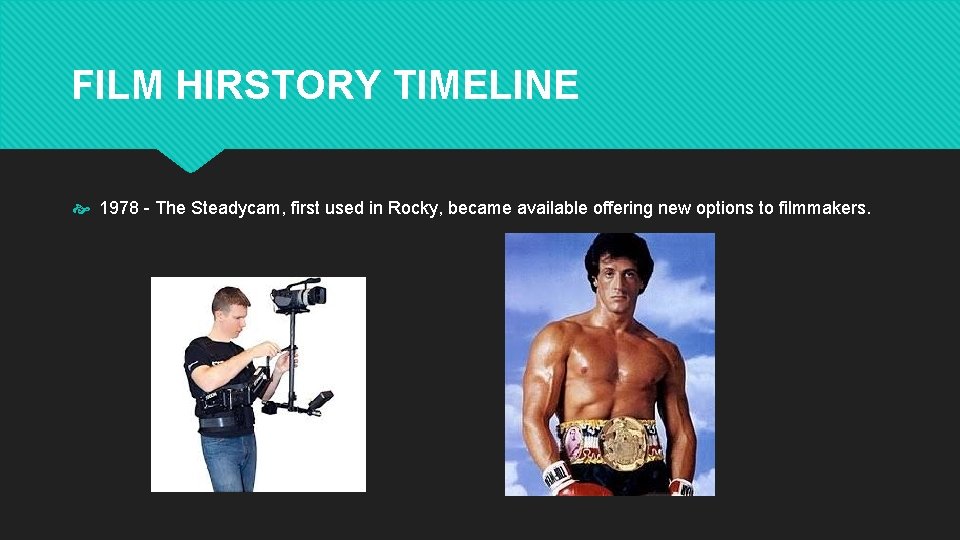
FILM HIRSTORY TIMELINE 1978 - The Steadycam, first used in Rocky, became available offering new options to filmmakers.
FILM HISTORY TIMELINE 2003 - In 2003, for the first time, home entertainment revenues exceeded the box office. The DVD took over for the video cassette in 2003 as well.
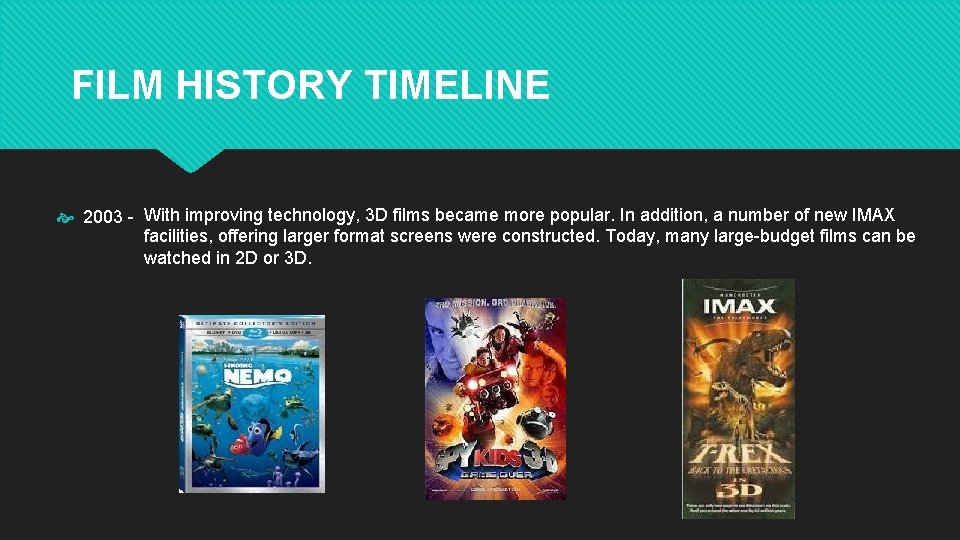
FILM HISTORY TIMELINE 2003 - With improving technology, 3 D films became more popular. In addition, a number of new IMAX facilities, offering larger format screens were constructed. Today, many large-budget films can be watched in 2 D or 3 D.
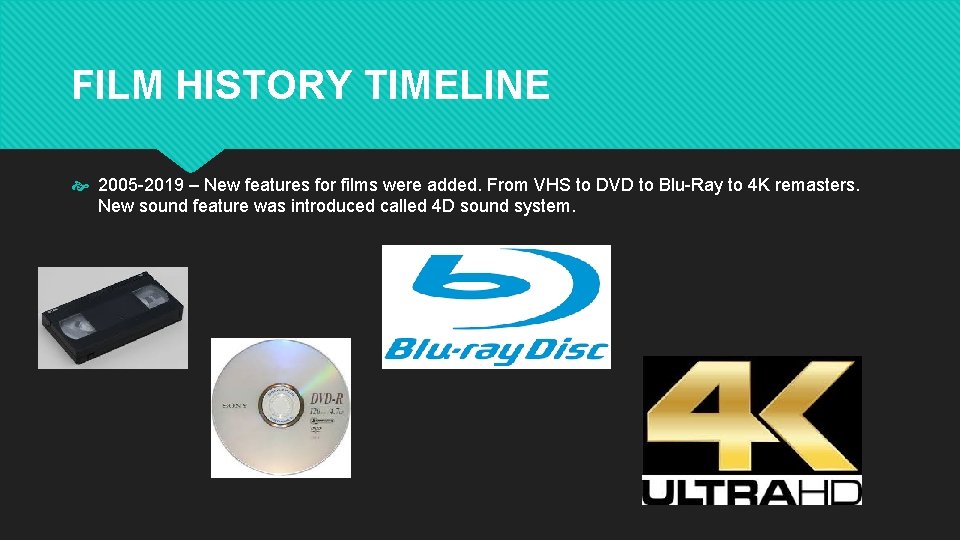
FILM HISTORY TIMELINE 2005 -2019 – New features for films were added. From VHS to DVD to Blu-Ray to 4 K remasters. New sound feature was introduced called 4 D sound system.
- Slides: 21