
History of Modern Macroeconomics Lecture 8 The Managed
- Slides: 40
History of Modern Macroeconomics Lecture 8. The Managed Economy (1945 -1975) : The Problem of Inflation Kevin D. Hoover Department of Economics Department of Philosophy Center for the History of Political Economy Duke University Econ. 314 S. History of Modern Macroeconomics Lecture 8, Fall 2017 1
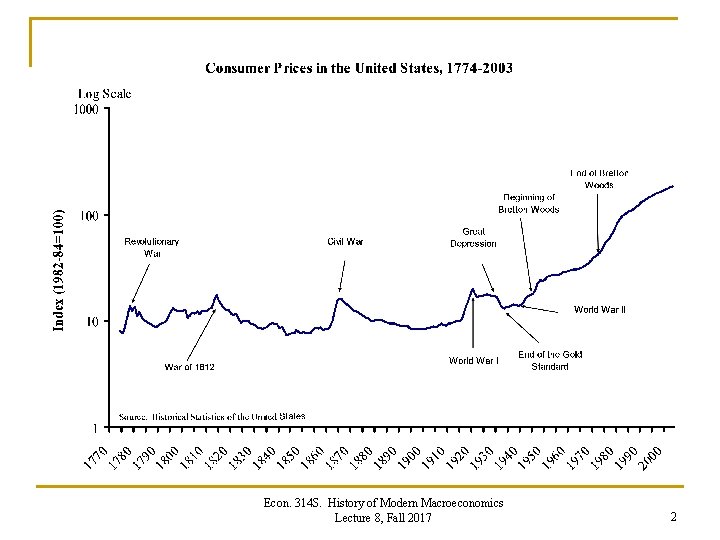
Econ. 314 S. History of Modern Macroeconomics Lecture 8, Fall 2017 2
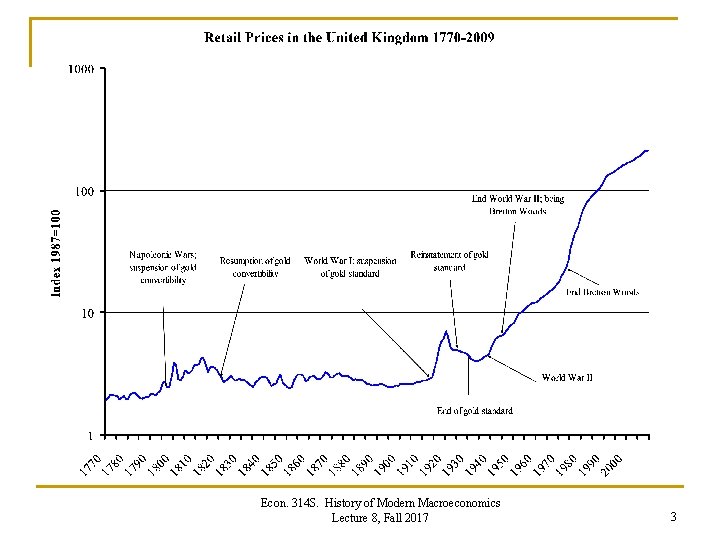
Econ. 314 S. History of Modern Macroeconomics Lecture 8, Fall 2017 3
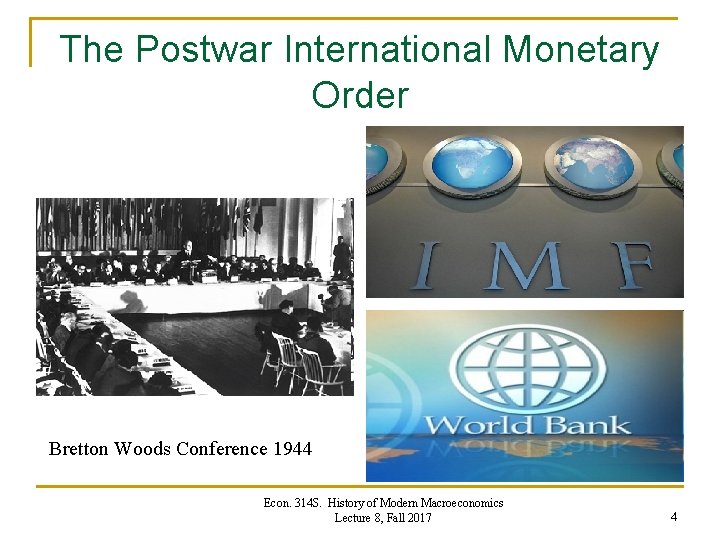
The Postwar International Monetary Order Bretton Woods Conference 1944 Econ. 314 S. History of Modern Macroeconomics Lecture 8, Fall 2017 4
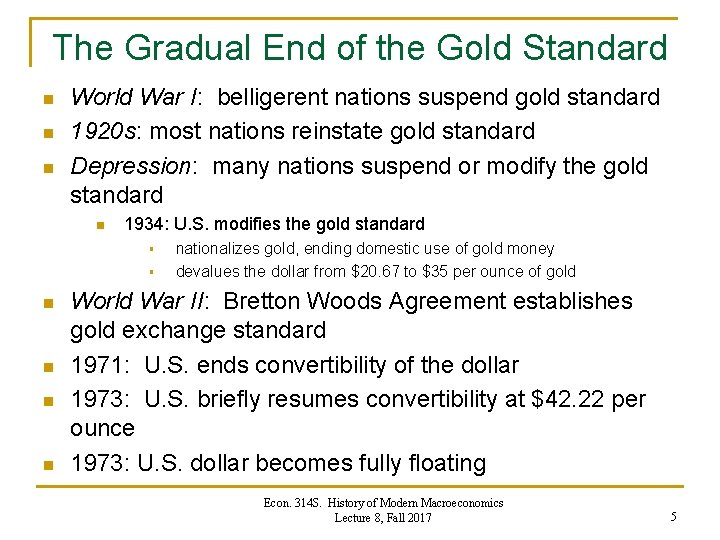
The Gradual End of the Gold Standard n n n World War I: belligerent nations suspend gold standard 1920 s: most nations reinstate gold standard Depression: many nations suspend or modify the gold standard n 1934: U. S. modifies the gold standard § § n n nationalizes gold, ending domestic use of gold money devalues the dollar from $20. 67 to $35 per ounce of gold World War II: Bretton Woods Agreement establishes gold exchange standard 1971: U. S. ends convertibility of the dollar 1973: U. S. briefly resumes convertibility at $42. 22 per ounce 1973: U. S. dollar becomes fully floating Econ. 314 S. History of Modern Macroeconomics Lecture 8, Fall 2017 5
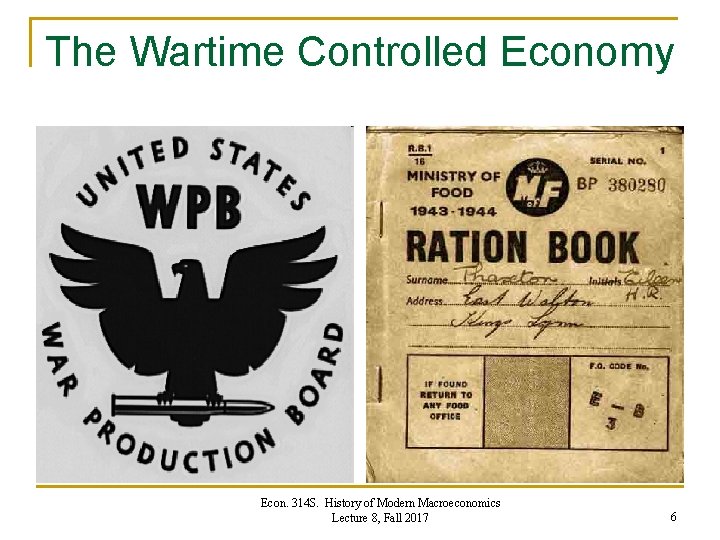
The Wartime Controlled Economy Econ. 314 S. History of Modern Macroeconomics Lecture 8, Fall 2017 6
U. S. Wage and Price Controls n n World War I: brief, limited wage and price controls World War II: comprehensive wage and price controls and rationing of key commodities Korean War: limited wage and price controls 1971 -73: Nixon institutes wage and price controls Econ. 314 S. History of Modern Macroeconomics Lecture 8, Fall 2017 7
Two Types of Inflation Demand-Pull ↑AD ↑expenditure > AS ↑p n Cost-Push ↑ factor price (materials or w) ↑ p [markup relation] further ↑ w [wage-price spiral] n Econ. 314 S. History of Modern Macroeconomics Lecture 8, Fall 2017 8
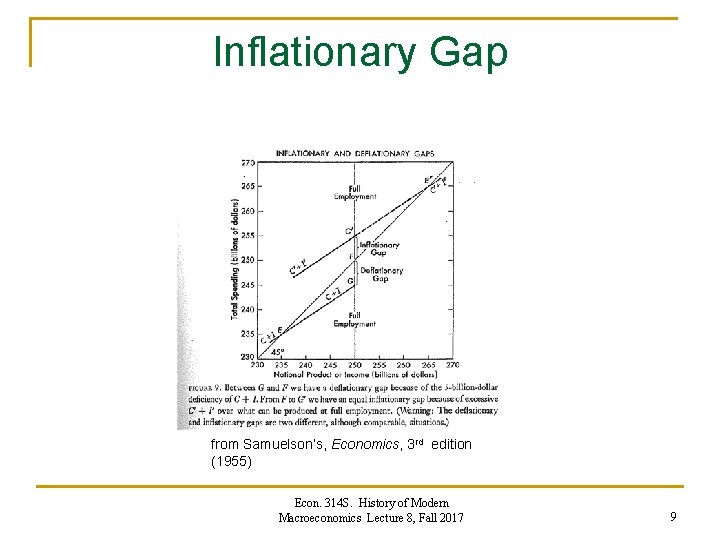
Inflationary Gap from Samuelson’s, Economics, 3 rd edition (1955) Econ. 314 S. History of Modern Macroeconomics Lecture 8, Fall 2017 9
Cost-Push Inflation vs. the Quantity Theory n Quantity Theory of Money Slogans: q q n “Too much money chasing too few goods” “Inflation is always and everywhere a monetary phenomenon” – Milton Friedman Misses Historical Issue q q q no one deny’s continuous inflation requires rising AD but V flexible enough in immediate to intermediate run ↑p independent of M interaction of cost structure and AD small ↓AD large ↑U [an imperfectionist view] Econ. 314 S. History of Modern Macroeconomics Lecture 8, Fall 2017 10
Problem of Modeling Inflation n n IS-LM and early econometric models designed to model level not inflation of prices (NB. Klein-Goldberger 1956 does have a wage-inflation equation) No good account of price setting: q Who sets prices? n n q Kenneth Arrow, "Toward a Theory of Price Adjustment", 1959. Absence of the Walrasian auctioneer socialist calculation debate (1930 s/1940 s) n n n Oscar Lange On the Economic Theory of Socialism, 1938; Price Flexibility and Employment 1944 Abba Lerner The Economics of Control, 1944. Friedrich von Hayek “The Uses of Knowledge in Society” (AER 1945) Econ. 314 S. History of Modern Macroeconomics Lecture 8, Fall 2017 11
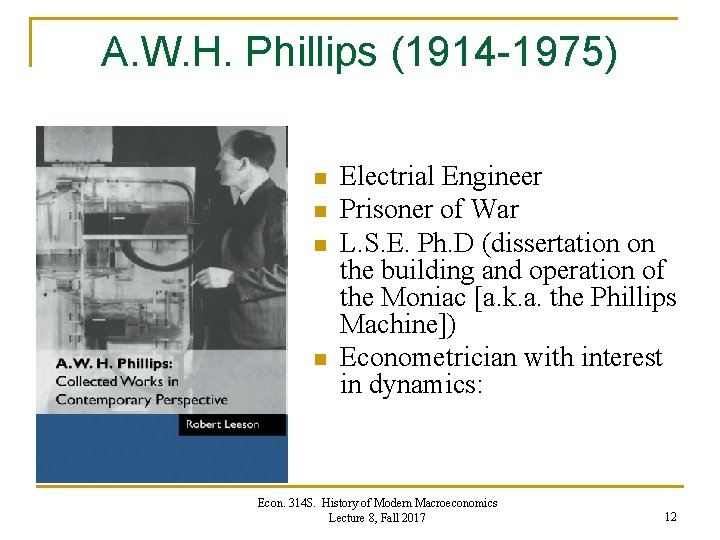
A. W. H. Phillips (1914 -1975) n n Electrial Engineer Prisoner of War L. S. E. Ph. D (dissertation on the building and operation of the Moniac [a. k. a. the Phillips Machine]) Econometrician with interest in dynamics: Econ. 314 S. History of Modern Macroeconomics Lecture 8, Fall 2017 12
The Phillips Curve n Empirical implementation of theoretical work on dynamics: q q n n "Some Notes on the Estimation of Time-forms of Reactions in Interdependent Dynamic Systems", 1956, Economica "Stabilisation Policy and the Time Form of Lagged Response“ (EJ 1957) "The Estimation of Parameters in Systems of Stochastic Differential Equations“ (Biometrika 1959) "Estimation of Systems of Difference Equations with Moving Average Disturbances” (Econometrica, 1966) Goal to determine relative importance of costpush and demand pull inflation in U. K. “a wet weekend’s work. ” (A. W. H. Phillips) Econ. 314 S. History of Modern Macroeconomics Lecture 8, Fall 2017 13
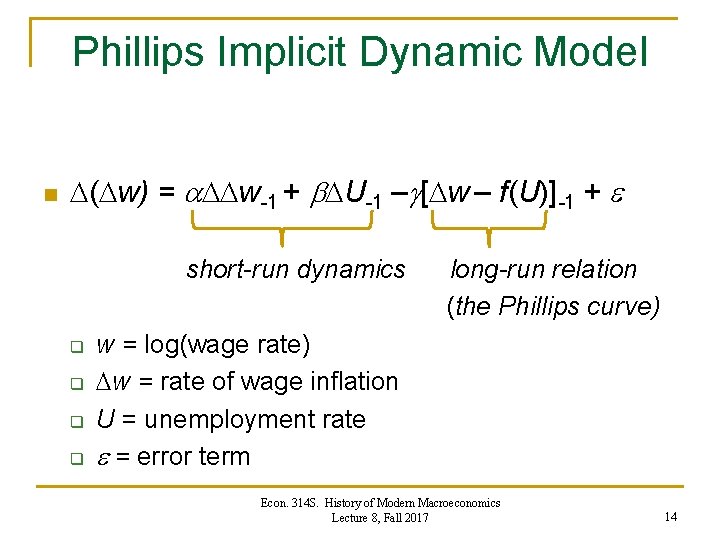
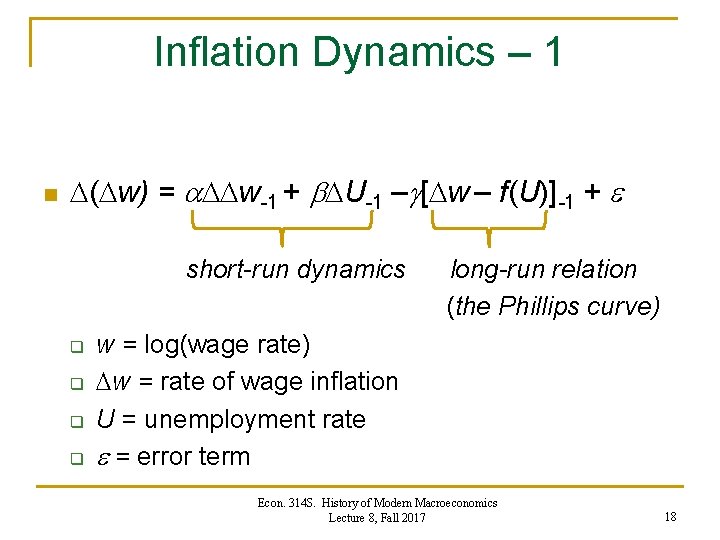
Phillips Implicit Dynamic Model n ( w) = w-1 + U-1 – [ w – f(U)]-1 + short-run dynamics q q long-run relation (the Phillips curve) w = log(wage rate) w = rate of wage inflation U = unemployment rate = error term Econ. 314 S. History of Modern Macroeconomics Lecture 8, Fall 2017 14
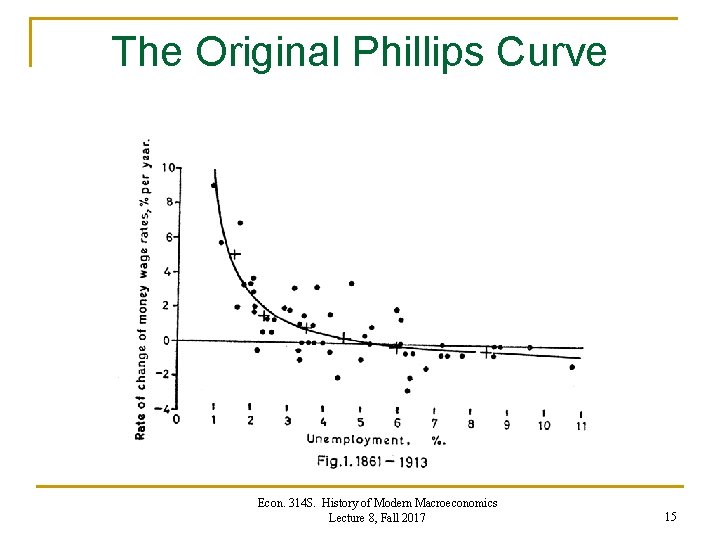
The Original Phillips Curve Econ. 314 S. History of Modern Macroeconomics Lecture 8, Fall 2017 15
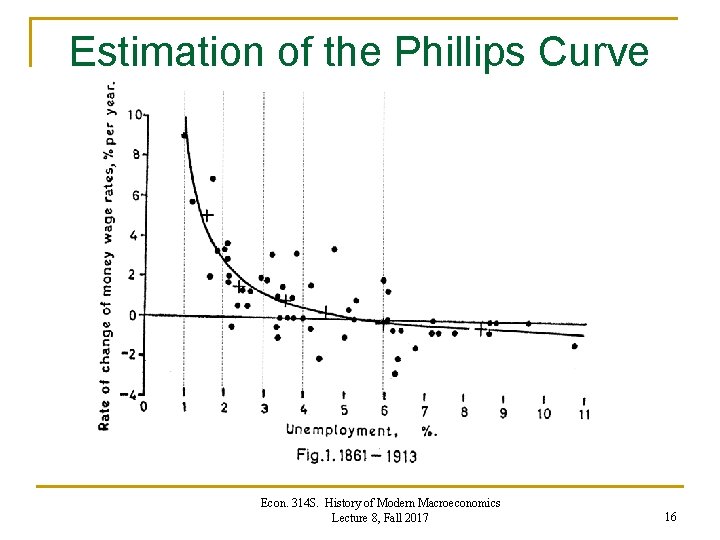
Estimation of the Phillips Curve Econ. 314 S. History of Modern Macroeconomics Lecture 8, Fall 2017 16
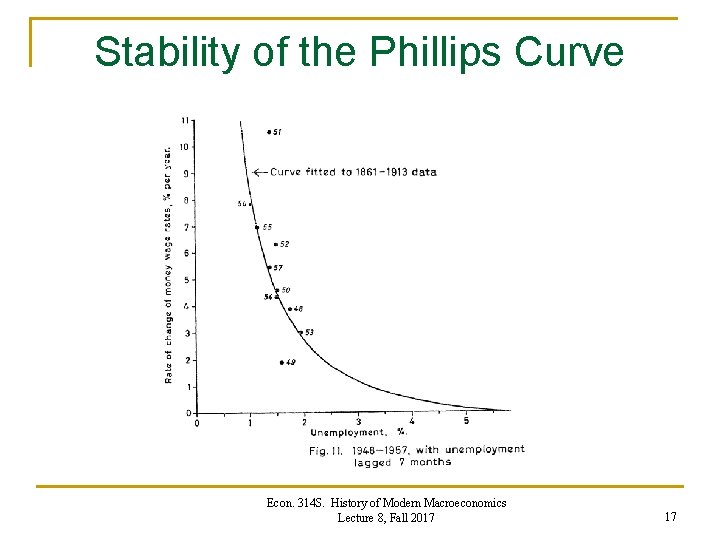
Stability of the Phillips Curve Econ. 314 S. History of Modern Macroeconomics Lecture 8, Fall 2017 17
Inflation Dynamics – 1 n ( w) = w-1 + U-1 – [ w – f(U)]-1 + short-run dynamics q q long-run relation (the Phillips curve) w = log(wage rate) w = rate of wage inflation U = unemployment rate = error term Econ. 314 S. History of Modern Macroeconomics Lecture 8, Fall 2017 18
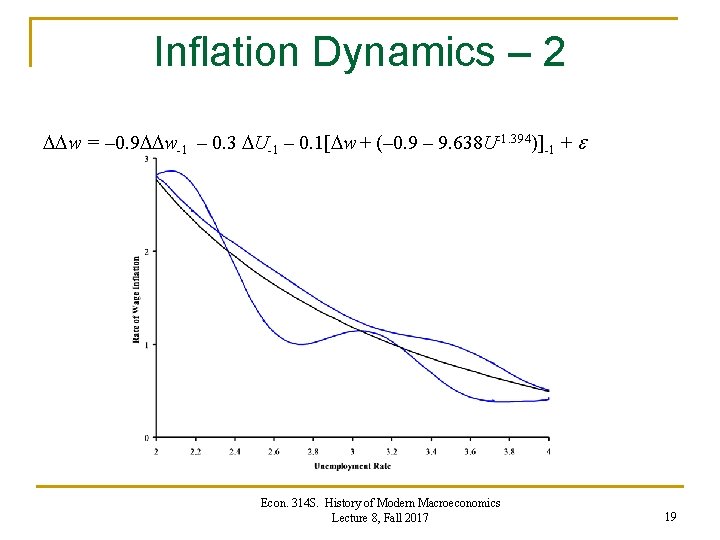
Inflation Dynamics – 2 w = – 0. 9 w-1 – 0. 3 U-1 – 0. 1[ w + (– 0. 9 – 9. 638 U-1. 394)]-1 + Econ. 314 S. History of Modern Macroeconomics Lecture 8, Fall 2017 19
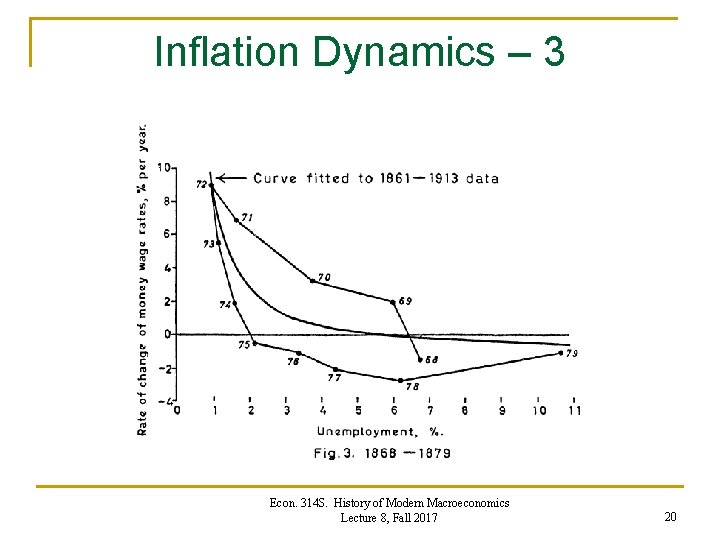
Inflation Dynamics – 3 Econ. 314 S. History of Modern Macroeconomics Lecture 8, Fall 2017 20
Phillips on Cost-Push n Cost-push elements: q q Import prices Agricultural prices Wages through cost-of-living adjustments and contracts COLAs only if real wages (w/p) actually fall; only if p rise exceeds productivity growth (typically from non-demand source) Econ. 314 S. History of Modern Macroeconomics Lecture 8, Fall 2017 21
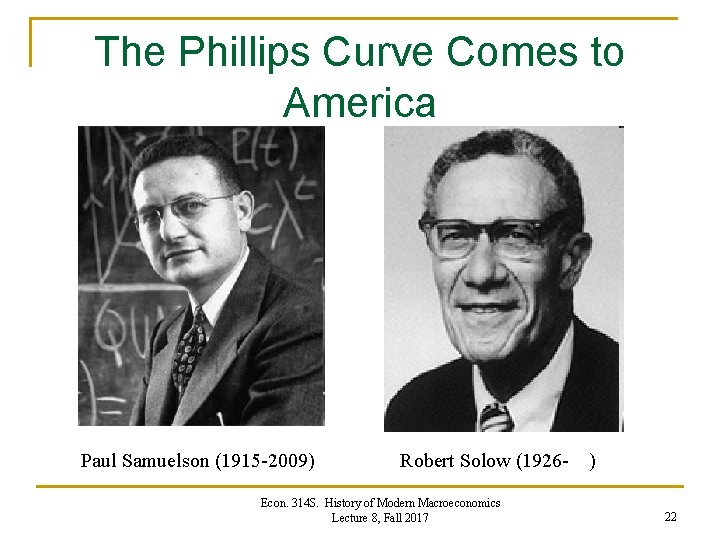
The Phillips Curve Comes to America Paul Samuelson (1915 -2009) Robert Solow (1926 - Econ. 314 S. History of Modern Macroeconomics Lecture 8, Fall 2017 ) 22
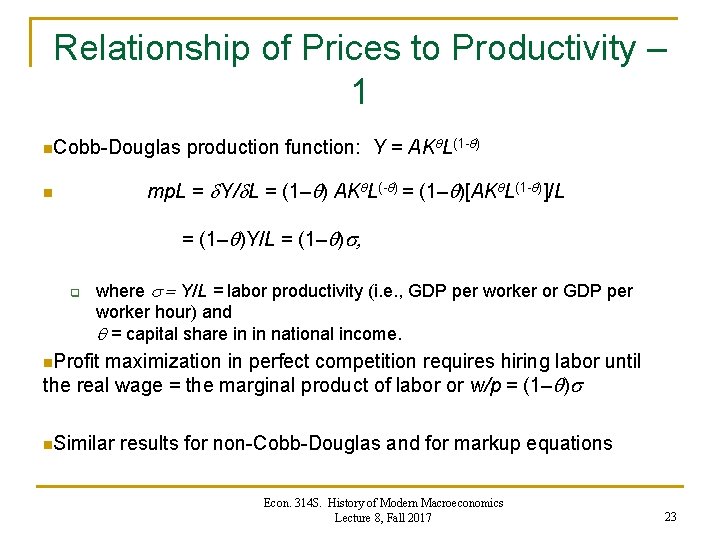
Relationship of Prices to Productivity – 1 n. Cobb-Douglas production function: Y = AK L(1 - ) mp. L = d. Y/d. L = (1– ) AK L(- ) = (1– )[AK L(1 - )]/L n = (1– )Y/L = (1– )s, q where s = Y/L = labor productivity (i. e. , GDP per worker or GDP per worker hour) and = capital share in in national income. n. Profit maximization in perfect competition requires hiring labor until the real wage = the marginal product of labor or w/p = (1– )s n. Similar results for non-Cobb-Douglas and for markup equations Econ. 314 S. History of Modern Macroeconomics Lecture 8, Fall 2017 23
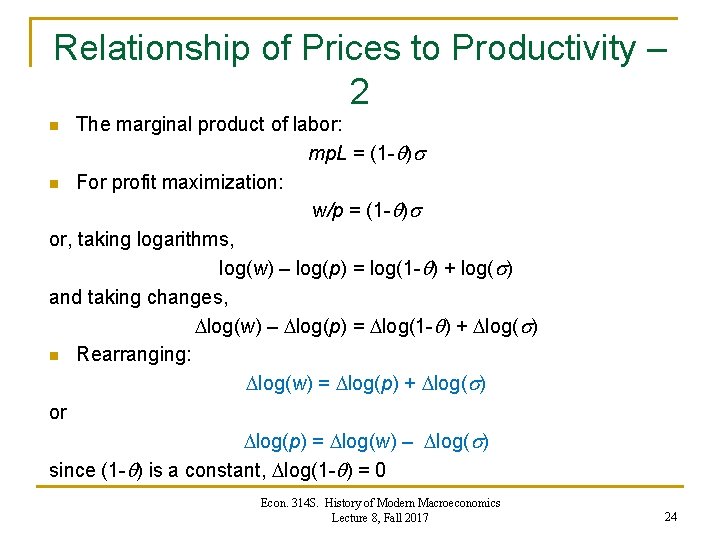
Relationship of Prices to Productivity – 2 The marginal product of labor: mp. L = (1 - )s n For profit maximization: w/p = (1 - )s or, taking logarithms, log(w) – log(p) = log(1 - ) + log(s) and taking changes, log(w) – log(p) = log(1 - ) + log(s) n Rearranging: log(w) = log(p) + log(s) or log(p) = log(w) – log(s) since (1 - ) is a constant, log(1 - ) = 0 n Econ. 314 S. History of Modern Macroeconomics Lecture 8, Fall 2017 24
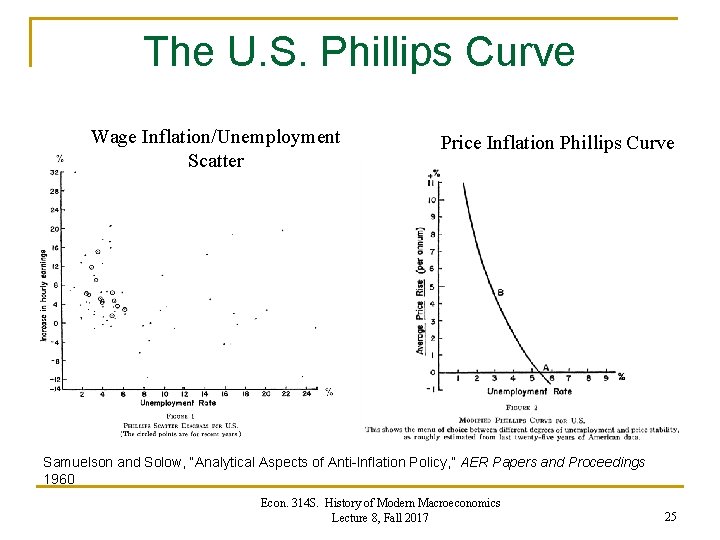
The U. S. Phillips Curve Wage Inflation/Unemployment Scatter Price Inflation Phillips Curve Samuelson and Solow, “Analytical Aspects of Anti-Inflation Policy, ” AER Papers and Proceedings 1960 Econ. 314 S. History of Modern Macroeconomics Lecture 8, Fall 2017 25
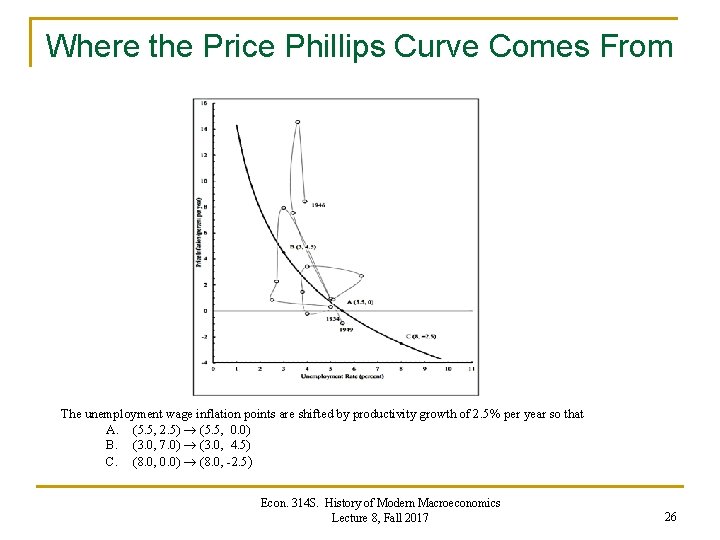
Where the Price Phillips Curve Comes From The unemployment wage inflation points are shifted by productivity growth of 2. 5% per year so that A. (5. 5, 2. 5) (5. 5, 0. 0) B. (3. 0, 7. 0) (3. 0, 4. 5) C. (8. 0, 0. 0) (8. 0, -2. 5) Econ. 314 S. History of Modern Macroeconomics Lecture 8, Fall 2017 26
U. S. Phillips Curve Not Stable in Long Run n Wage inflation scatter does not lie on a simple curve n Phillips curve may shift because of policy: q Possibilities for a “low pressure economy”: n n q Virtuous outcome: improved expectations lower U compatible with constant price inflation (cf. post-Volcker 1980 s) Vicious outcome: constant price inflation requires high U ↑structural U (cf. hysteresis Europe 1990 s; current arguments about deskilling) Reversible (useful for macro policy) only in short run Econ. 314 S. History of Modern Macroeconomics Lecture 8, Fall 2017 27
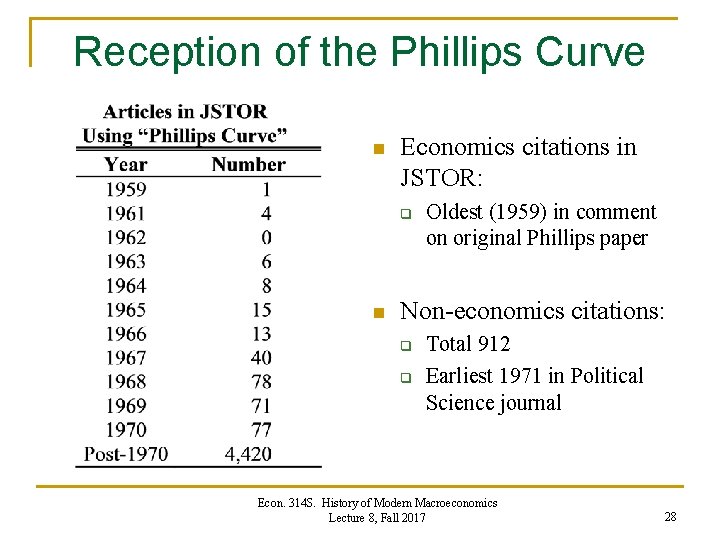
Reception of the Phillips Curve n Economics citations in JSTOR: q n Oldest (1959) in comment on original Phillips paper Non-economics citations: q q Total 912 Earliest 1971 in Political Science journal Econ. 314 S. History of Modern Macroeconomics Lecture 8, Fall 2017 28
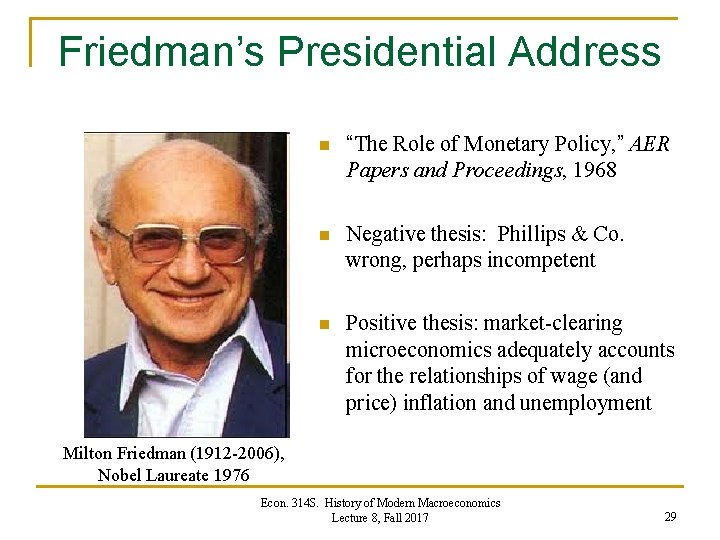
Friedman’s Presidential Address n “The Role of Monetary Policy, ” AER Papers and Proceedings, 1968 n Negative thesis: Phillips & Co. wrong, perhaps incompetent n Positive thesis: market-clearing microeconomics adequately accounts for the relationships of wage (and price) inflation and unemployment Milton Friedman (1912 -2006), Nobel Laureate 1976 Econ. 314 S. History of Modern Macroeconomics Lecture 8, Fall 2017 29
Friedman’s Presidential Address: Negative Thesis n Attack on Phillips and Phillips Curve: q q Mistakes nominal and real quantities – false Assumes curve stable n n q false in short run – notes shift in dynamic processes true for Phillips in long run – but an empirical discovery, not a point of principle; false for Samuelson & Solow. Specified for an environment with zero long-run inflation n n true for Phillips (but again contingent) false for Samuelson and Solow Econ. 314 S. History of Modern Macroeconomics Lecture 8, Fall 2017 30
Friedman’s Presidential Address: Positive Thesis n Real and nominal independence in the long run n Unique equilibrium in the labor market natural rate of unemployment: “. . . the level that would be ground out by the Walrasian system of general equilibrium equations, provided there is imbedded in them the actual structural characteristics of the labor and commodity markets, including market imperfections, stochastic variability in demands and supplies, the cost of gathering information about job vacancies and labor availabilities, the costs of mobility, and so on. ” Milton Friedman, “The Role of Monetary Policy” n Concedes existence of short-run Phillips curve Econ. 314 S. History of Modern Macroeconomics Lecture 8, Fall 2017 31
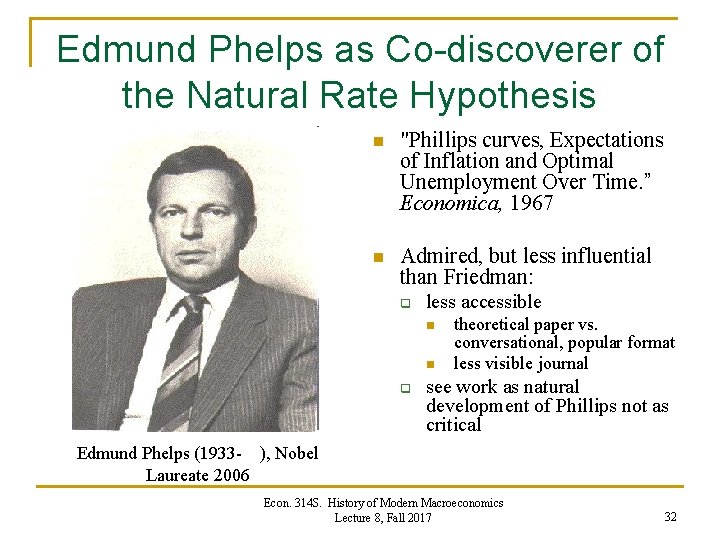
Edmund Phelps as Co-discoverer of the Natural Rate Hypothesis n "Phillips curves, Expectations of Inflation and Optimal Unemployment Over Time. ” Economica, 1967 n Admired, but less influential than Friedman: q less accessible n n q theoretical paper vs. conversational, popular format less visible journal see work as natural development of Phillips not as critical Edmund Phelps (1933 - ), Nobel Laureate 2006 Econ. 314 S. History of Modern Macroeconomics Lecture 8, Fall 2017 32
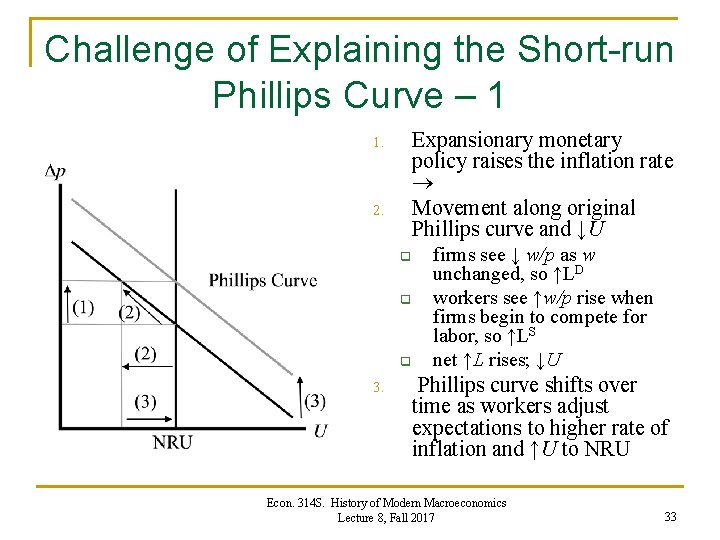
Challenge of Explaining the Short-run Phillips Curve – 1 Expansionary monetary policy raises the inflation rate Movement along original Phillips curve and ↓U 1. 2. q q q 3. firms see ↓ w/p as w unchanged, so ↑LD workers see ↑w/p rise when firms begin to compete for labor, so ↑LS net ↑L rises; ↓U Phillips curve shifts over time as workers adjust expectations to higher rate of inflation and ↑U to NRU Econ. 314 S. History of Modern Macroeconomics Lecture 8, Fall 2017 33
Challenge of Explaining the Short-run Phillips Curve – 2 n Asymmetry of information: q q n Difference between long and short run: q q q n Firms form correct expectations of inflation Workers form correct expectations only with a lag Phillips curve exists in the short run Long-run Phillips curve vertical at the natural rate Long-run for Friedman: “. . . something like two to five years. . . [with] full adjustment [in]. . . say, a couple of decades. ” Causal direction q q Phillips, Samuelson & Solow, and Phelps: U (measure of AD) causes p Friedman: p causes U (measure of AS) Econ. 314 S. History of Modern Macroeconomics Lecture 8, Fall 2017 34
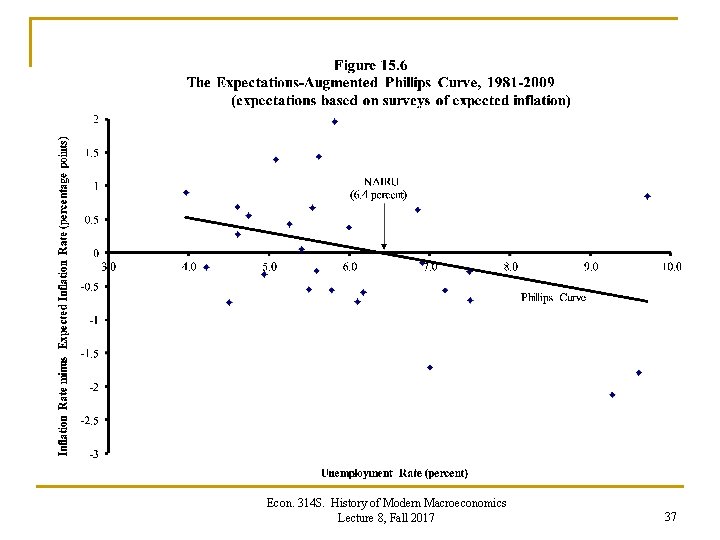
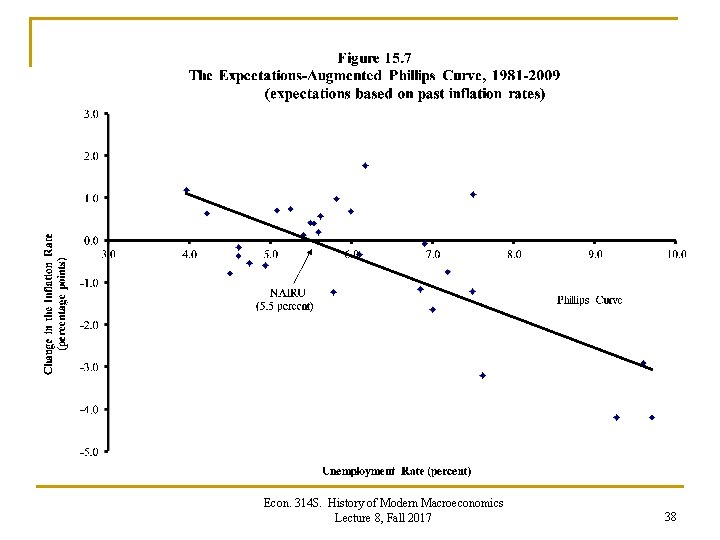
Reception of the Natural Rate Hypothesis n Friedman as prophet: q q widely credit with foreseeing high inflation of 1970 s expectations-augmented Phillips curve compatible with natural rate hypothesis widely adopted: n n p = pe + f(U) + accelerationist version: p = p-1 + f(U) + or p = f(U) + q n rapidly became standard in textbooks Citations in JSTOR to Phillips Curve after 1968 = 96 percent of total citations Econ. 314 S. History of Modern Macroeconomics Lecture 8, Fall 2017 35
NAIRU and Keynesian Pushback n n Keynesians adopted expectations-augmented Phillips curve Alternative interpretation: q q q Retained Phillip’s causal direction: U (measure of AD) causes p Objected to persuasive terminology of natural Alternative NAIRU: n n Non-Accelerating Inflation Rate of Unemployment terminology seems to have arisen in Brookings Institution c. 1976 Econ. 314 S. History of Modern Macroeconomics Lecture 8, Fall 2017 36
Econ. 314 S. History of Modern Macroeconomics Lecture 8, Fall 2017 37
Econ. 314 S. History of Modern Macroeconomics Lecture 8, Fall 2017 38
Friedman: Maker of the Phillips Curve, Seed of a Mythology n Myths fostered by Friedman: q q n Phillip’s curve rested on real/nominal confusion users believed it to be stable over time users believed it provided enduring policy tradeoff between inflation and unemployment influential in 1960 s macroeconomic policy Myths about Friedman: q Friedman anticipated stagflation Econ. 314 S. History of Modern Macroeconomics Lecture 8, Fall 2017 39
Thanks The End Econ. 314 S. History of Modern Macroeconomics Lecture 8, Fall 2017 40