
History of Mental Health Care Ancient Greeks Before
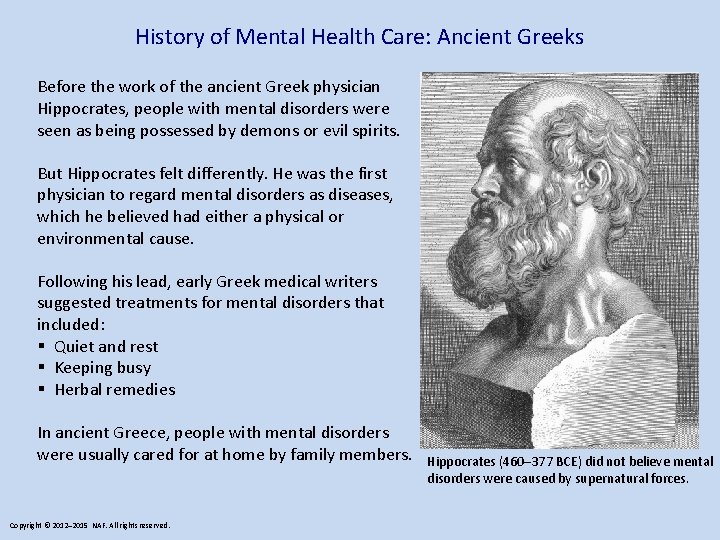
History of Mental Health Care: Ancient Greeks Before the work of the ancient Greek physician Hippocrates, people with mental disorders were seen as being possessed by demons or evil spirits. But Hippocrates felt differently. He was the first physician to regard mental disorders as diseases, which he believed had either a physical or environmental cause. Following his lead, early Greek medical writers suggested treatments for mental disorders that included: § Quiet and rest § Keeping busy § Herbal remedies In ancient Greece, people with mental disorders were usually cared for at home by family members. Copyright © 2012– 2015 NAF. All rights reserved. Hippocrates (460– 377 BCE) did not believe mental disorders were caused by supernatural forces.
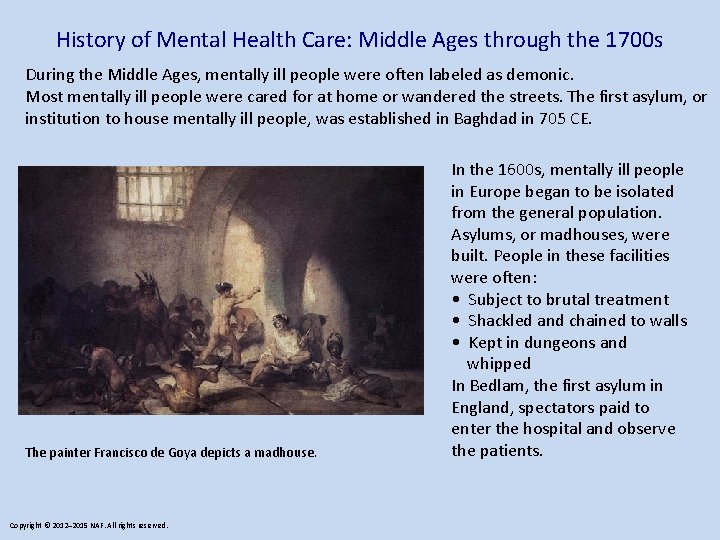
History of Mental Health Care: Middle Ages through the 1700 s During the Middle Ages, mentally ill people were often labeled as demonic. Most mentally ill people were cared for at home or wandered the streets. The first asylum, or institution to house mentally ill people, was established in Baghdad in 705 CE. The painter Francisco de Goya depicts a madhouse. Copyright © 2012– 2015 NAF. All rights reserved. In the 1600 s, mentally ill people in Europe began to be isolated from the general population. Asylums, or madhouses, were built. People in these facilities were often: • Subject to brutal treatment • Shackled and chained to walls • Kept in dungeons and whipped In Bedlam, the first asylum in England, spectators paid to enter the hospital and observe the patients.
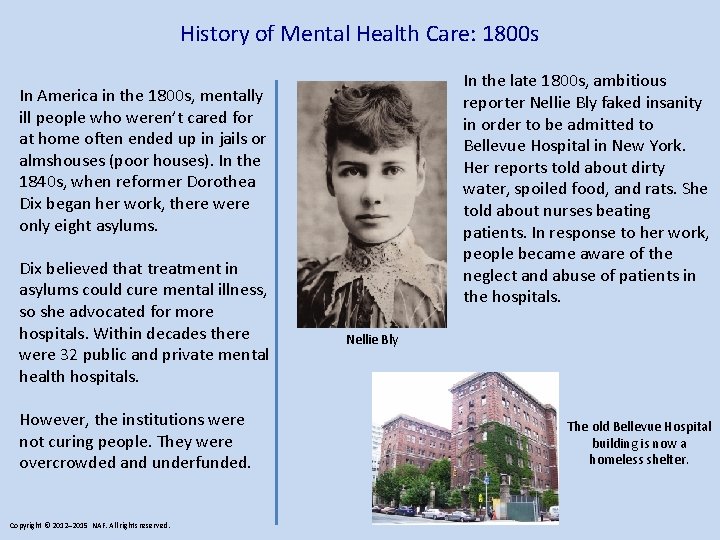
History of Mental Health Care: 1800 s In the late 1800 s, ambitious reporter Nellie Bly faked insanity in order to be admitted to Bellevue Hospital in New York. Her reports told about dirty water, spoiled food, and rats. She told about nurses beating patients. In response to her work, people became aware of the neglect and abuse of patients in the hospitals. In America in the 1800 s, mentally ill people who weren’t cared for at home often ended up in jails or almshouses (poor houses). In the 1840 s, when reformer Dorothea Dix began her work, there were only eight asylums. Dix believed that treatment in asylums could cure mental illness, so she advocated for more hospitals. Within decades there were 32 public and private mental health hospitals. However, the institutions were not curing people. They were overcrowded and underfunded. Copyright © 2012– 2015 NAF. All rights reserved. Nellie Bly The old Bellevue Hospital building is now a homeless shelter.
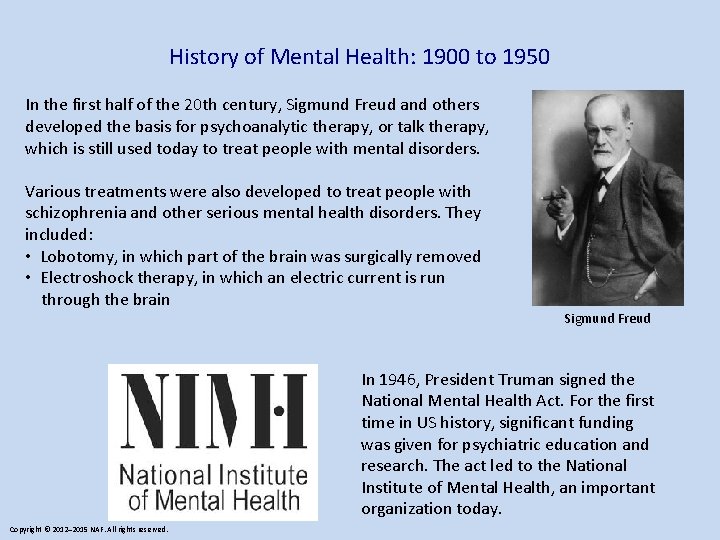
History of Mental Health: 1900 to 1950 In the first half of the 20 th century, Sigmund Freud and others developed the basis for psychoanalytic therapy, or talk therapy, which is still used today to treat people with mental disorders. Various treatments were also developed to treat people with schizophrenia and other serious mental health disorders. They included: • Lobotomy, in which part of the brain was surgically removed • Electroshock therapy, in which an electric current is run through the brain Sigmund Freud In 1946, President Truman signed the National Mental Health Act. For the first time in US history, significant funding was given for psychiatric education and research. The act led to the National Institute of Mental Health, an important organization today. Copyright © 2012– 2015 NAF. All rights reserved.
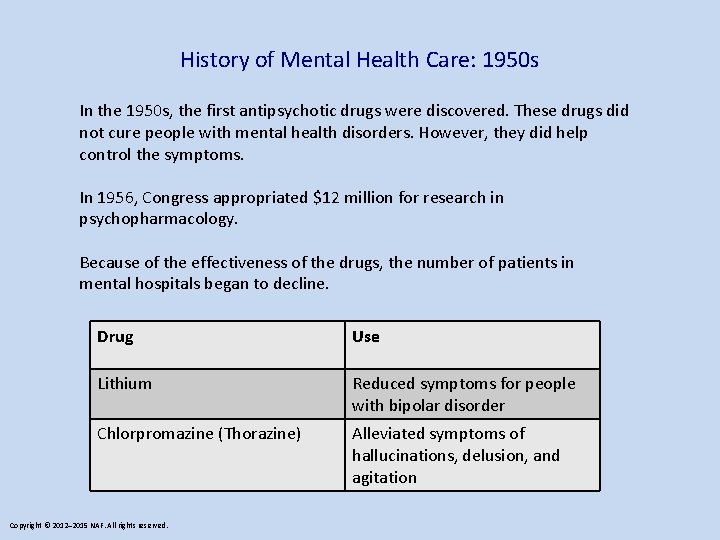
History of Mental Health Care: 1950 s In the 1950 s, the first antipsychotic drugs were discovered. These drugs did not cure people with mental health disorders. However, they did help control the symptoms. In 1956, Congress appropriated $12 million for research in psychopharmacology. Because of the effectiveness of the drugs, the number of patients in mental hospitals began to decline. Drug Use Lithium Reduced symptoms for people with bipolar disorder Chlorpromazine (Thorazine) Alleviated symptoms of hallucinations, delusion, and agitation Copyright © 2012– 2015 NAF. All rights reserved.
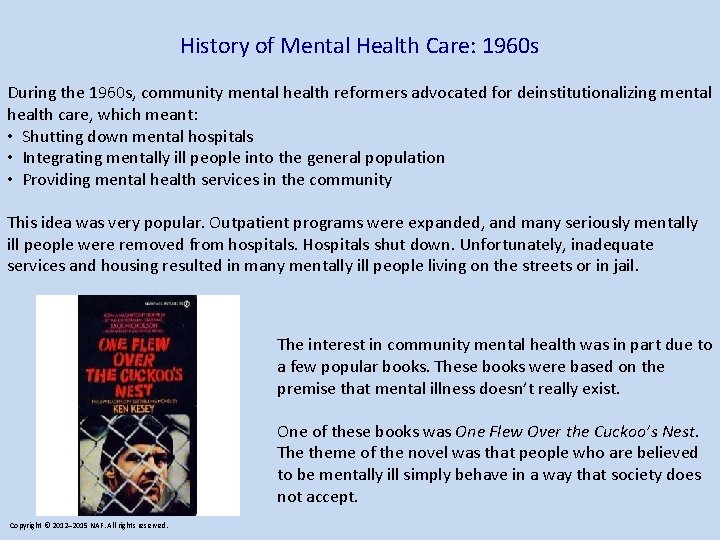
History of Mental Health Care: 1960 s During the 1960 s, community mental health reformers advocated for deinstitutionalizing mental health care, which meant: • Shutting down mental hospitals • Integrating mentally ill people into the general population • Providing mental health services in the community This idea was very popular. Outpatient programs were expanded, and many seriously mentally ill people were removed from hospitals. Hospitals shut down. Unfortunately, inadequate services and housing resulted in many mentally ill people living on the streets or in jail. The interest in community mental health was in part due to a few popular books. These books were based on the premise that mental illness doesn’t really exist. One of these books was One Flew Over the Cuckoo’s Nest. The theme of the novel was that people who are believed to be mentally ill simply behave in a way that society does not accept. Copyright © 2012– 2015 NAF. All rights reserved.
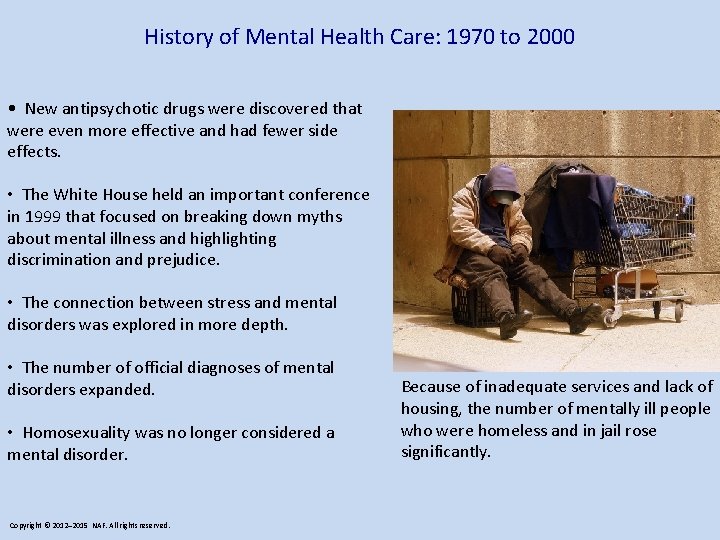
History of Mental Health Care: 1970 to 2000 • New antipsychotic drugs were discovered that were even more effective and had fewer side effects. • The White House held an important conference in 1999 that focused on breaking down myths about mental illness and highlighting discrimination and prejudice. • The connection between stress and mental disorders was explored in more depth. • The number of official diagnoses of mental disorders expanded. • Homosexuality was no longer considered a mental disorder. Copyright © 2012– 2015 NAF. All rights reserved. Because of inadequate services and lack of housing, the number of mentally ill people who were homeless and in jail rose significantly.
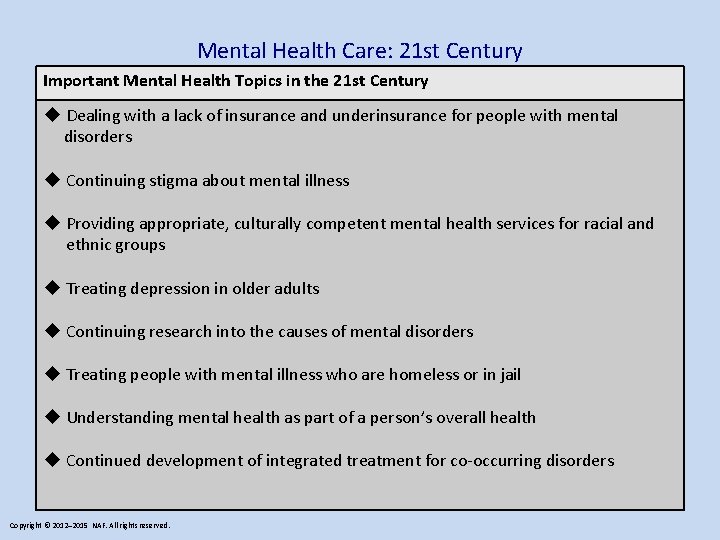
Mental Health Care: 21 st Century Important Mental Health Topics in the 21 st Century u Dealing with a lack of insurance and underinsurance for people with mental disorders u Continuing stigma about mental illness u Providing appropriate, culturally competent mental health services for racial and ethnic groups u Treating depression in older adults u Continuing research into the causes of mental disorders u Treating people with mental illness who are homeless or in jail u Understanding mental health as part of a person’s overall health u Continued development of integrated treatment for co-occurring disorders Copyright © 2012– 2015 NAF. All rights reserved.
- Slides: 8