
History of Manual Therapy Manual Therapy Manual therapy
- Slides: 28
History of Manual Therapy
Manual Therapy • Manual therapy is a specialized area of physical therapy for the management of neuromusculo-skeletal conditions, based on clinical reasoning, using highly specific treatment approaches including manual techniques and therapeutic exercises • Manual therapy also encompasses, and is driven by, the available scientific and clinical evidence and the biopsychosocial framework of each individual patient. IFOMPT, General Meeting Cape Town 2014
History Understanding the origins of manipulation, the various professionals who utilize manipulation helps to understand: • Current legislative and regulatory issues • Different philosophical approaches • Relevant definitions
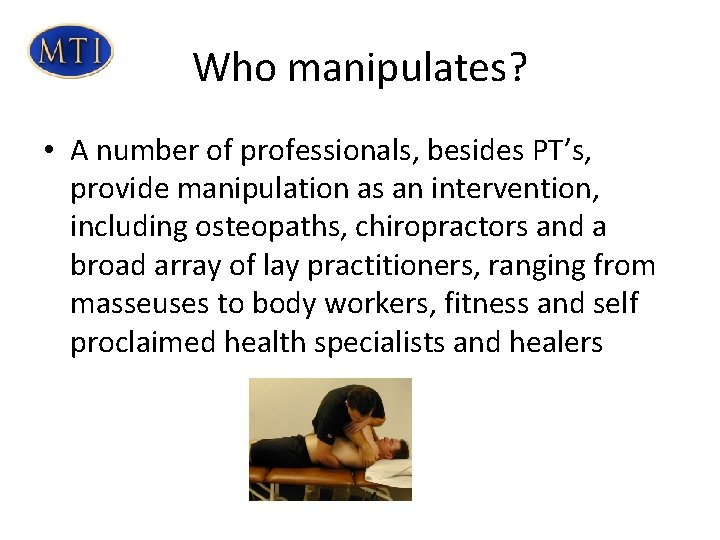
Who manipulates? • A number of professionals, besides PT’s, provide manipulation as an intervention, including osteopaths, chiropractors and a broad array of lay practitioners, ranging from masseuses to body workers, fitness and self proclaimed health specialists and healers
Words matter • Appropriate use of manipulation related terminology is important for communicating with those within our profession, and also in some states could make the difference between practicing within state regulatory guidelines versus practicing outside the scope of physical therapist practice • Understanding the evolution of the definitions and terminology will give one an appreciation of the influence politics has played historically as physical therapists have struggled to employ an intervention that has been part of our practice for decades. • The ability to communicate clearly and accurately, regardless of region or background, is essential if clinicians are to incorporate the latest research in clinical practice
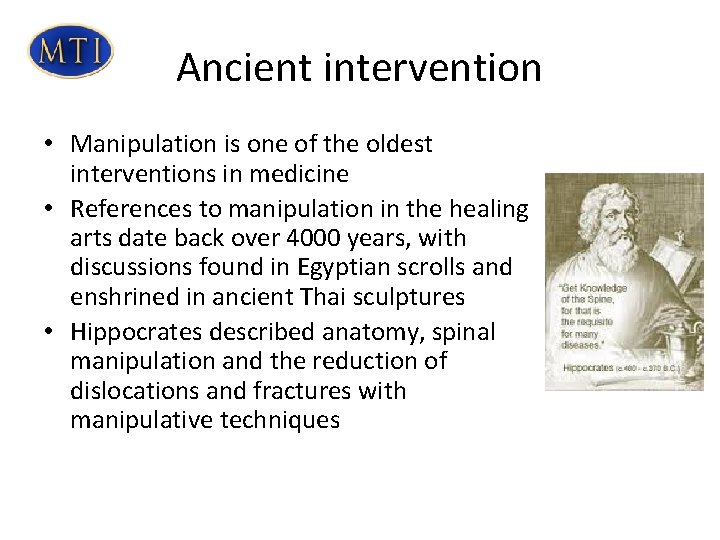
Ancient intervention • Manipulation is one of the oldest interventions in medicine • References to manipulation in the healing arts date back over 4000 years, with discussions found in Egyptian scrolls and enshrined in ancient Thai sculptures • Hippocrates described anatomy, spinal manipulation and the reduction of dislocations and fractures with manipulative techniques
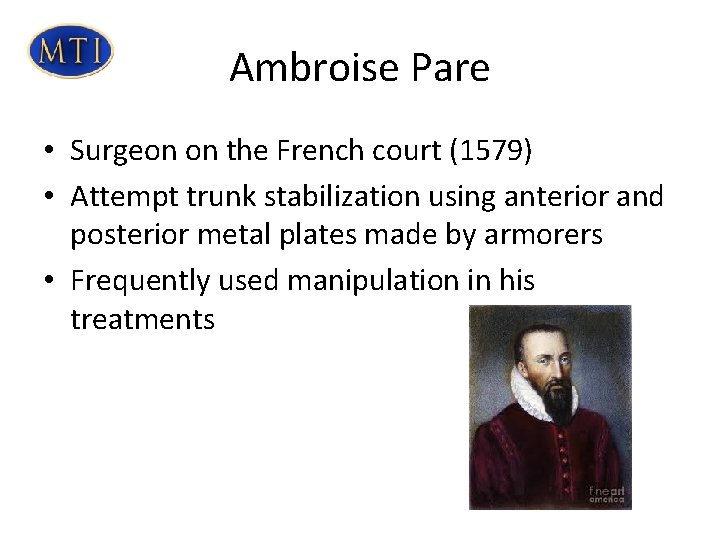
Ambroise Pare • Surgeon on the French court (1579) • Attempt trunk stabilization using anterior and posterior metal plates made by armorers • Frequently used manipulation in his treatments
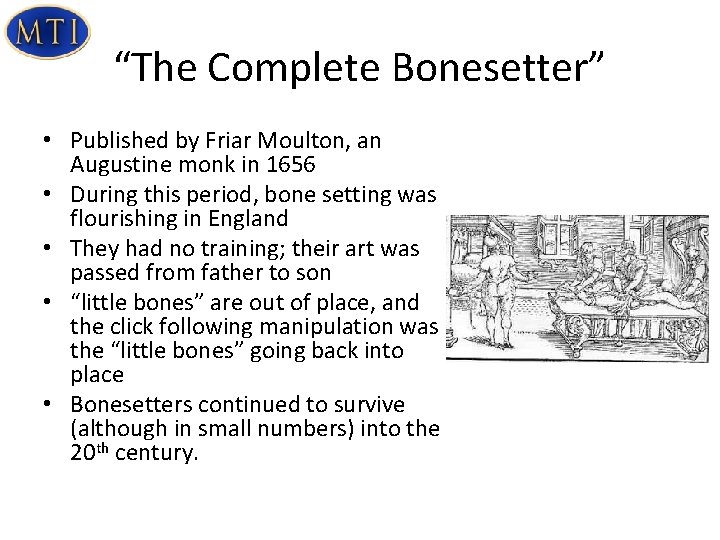
“The Complete Bonesetter” • Published by Friar Moulton, an Augustine monk in 1656 • During this period, bone setting was flourishing in England • They had no training; their art was passed from father to son • “little bones” are out of place, and the click following manipulation was the “little bones” going back into place • Bonesetters continued to survive (although in small numbers) into the 20 th century.
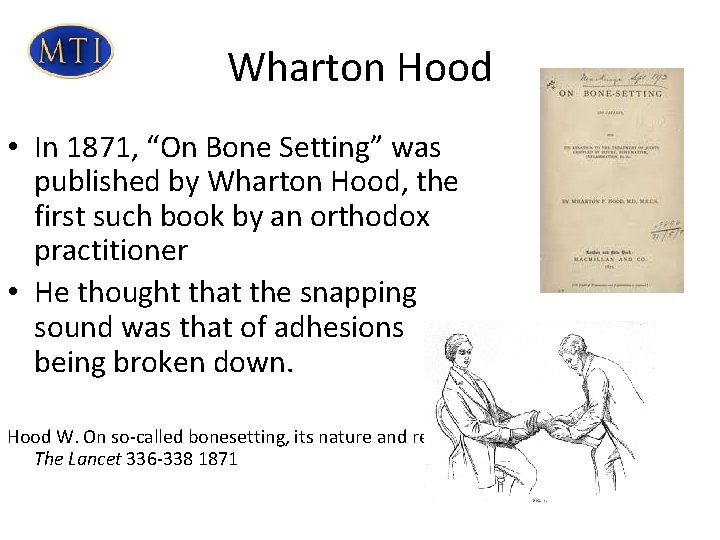
Wharton Hood • In 1871, “On Bone Setting” was published by Wharton Hood, the first such book by an orthodox practitioner • He thought that the snapping sound was that of adhesions being broken down. Hood W. On so-called bonesetting, its nature and results. The Lancet 336 -338 1871
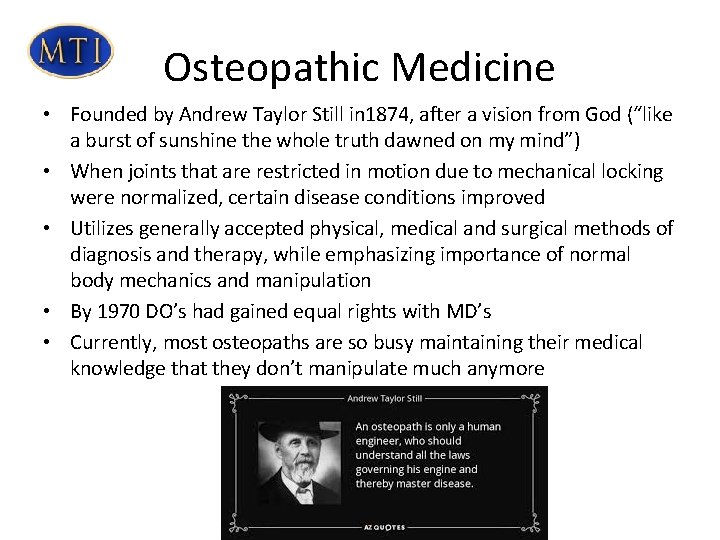
Osteopathic Medicine • Founded by Andrew Taylor Still in 1874, after a vision from God (“like a burst of sunshine the whole truth dawned on my mind”) • When joints that are restricted in motion due to mechanical locking were normalized, certain disease conditions improved • Utilizes generally accepted physical, medical and surgical methods of diagnosis and therapy, while emphasizing importance of normal body mechanics and manipulation • By 1970 DO’s had gained equal rights with MD’s • Currently, most osteopaths are so busy maintaining their medical knowledge that they don’t manipulate much anymore
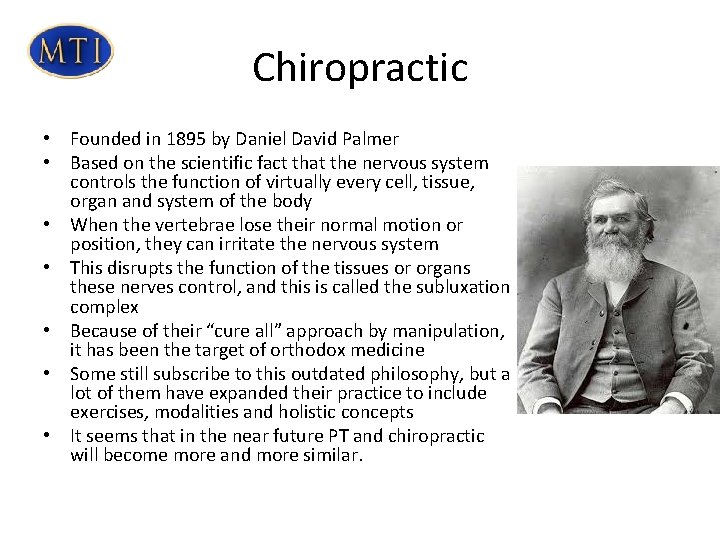
Chiropractic • Founded in 1895 by Daniel David Palmer • Based on the scientific fact that the nervous system controls the function of virtually every cell, tissue, organ and system of the body • When the vertebrae lose their normal motion or position, they can irritate the nervous system • This disrupts the function of the tissues or organs these nerves control, and this is called the subluxation complex • Because of their “cure all” approach by manipulation, it has been the target of orthodox medicine • Some still subscribe to this outdated philosophy, but a lot of them have expanded their practice to include exercises, modalities and holistic concepts • It seems that in the near future PT and chiropractic will become more and more similar.
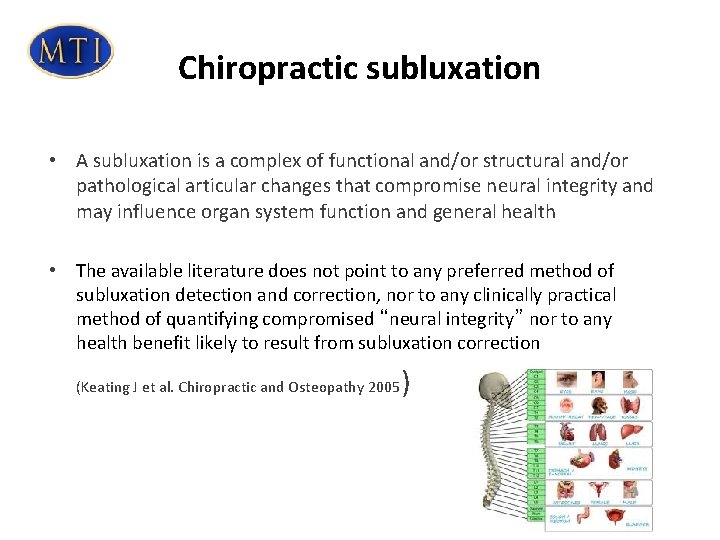
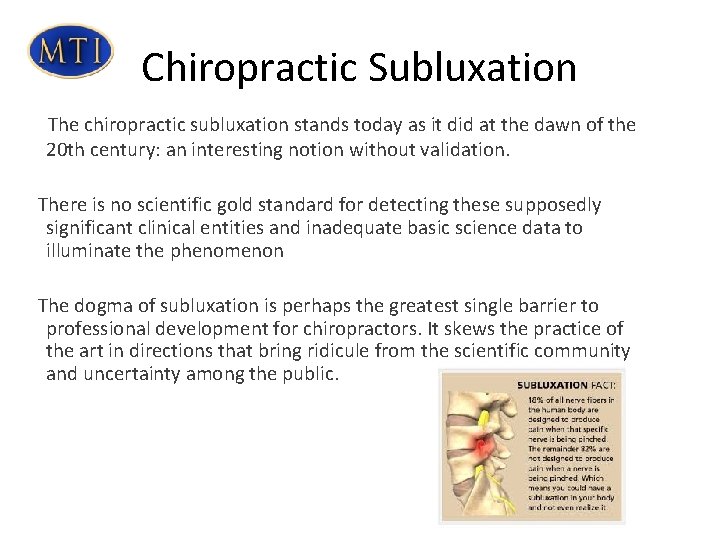
Chiropractic subluxation • A subluxation is a complex of functional and/or structural and/or pathological articular changes that compromise neural integrity and may influence organ system function and general health • The available literature does not point to any preferred method of subluxation detection and correction, nor to any clinically practical method of quantifying compromised “neural integrity” nor to any health benefit likely to result from subluxation correction (Keating J et al. Chiropractic and Osteopathy 2005 )
Chiropractic Subluxation The chiropractic subluxation stands today as it did at the dawn of the 20 th century: an interesting notion without validation. There is no scientific gold standard for detecting these supposedly significant clinical entities and inadequate basic science data to illuminate the phenomenon The dogma of subluxation is perhaps the greatest single barrier to professional development for chiropractors. It skews the practice of the art in directions that bring ridicule from the scientific community and uncertainty among the public.
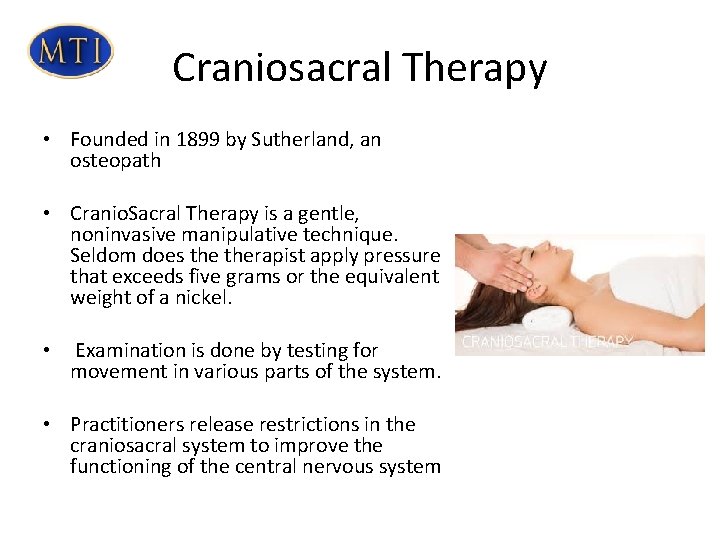
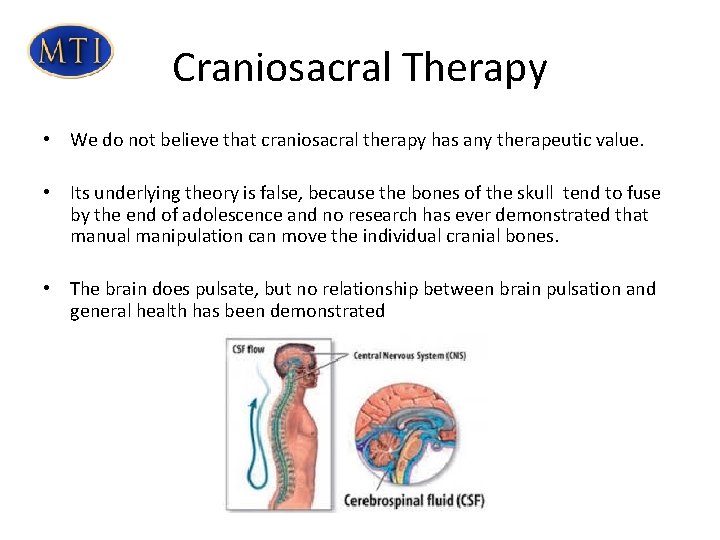
Craniosacral Therapy • Founded in 1899 by Sutherland, an osteopath • Cranio. Sacral Therapy is a gentle, noninvasive manipulative technique. Seldom does therapist apply pressure that exceeds five grams or the equivalent weight of a nickel. • Examination is done by testing for movement in various parts of the system. • Practitioners release restrictions in the craniosacral system to improve the functioning of the central nervous system
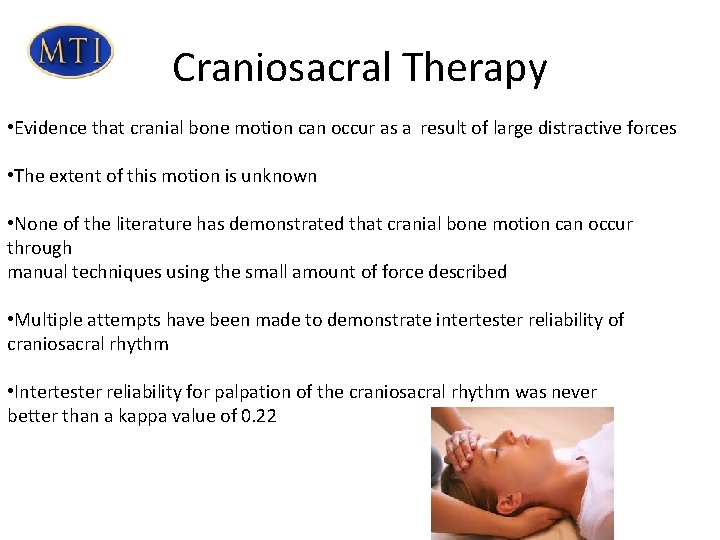
Craniosacral Therapy • Evidence that cranial bone motion can occur as a result of large distractive forces • The extent of this motion is unknown • None of the literature has demonstrated that cranial bone motion can occur through manual techniques using the small amount of force described • Multiple attempts have been made to demonstrate intertester reliability of craniosacral rhythm • Intertester reliability for palpation of the craniosacral rhythm was never better than a kappa value of 0. 22
Craniosacral therapy • It is hypothesized that therapeutic levels of distractive force, 5 to 20 grams, applied to the frontal bone, would result in significant change in ICP and movement across the coronal suture • No significant differences were noted for coronal suture separation or ICP at therapeutic levels of distraction • Change in ICP and movement across the coronal suture were noted in 1 animal following the application of forces dramatically greater than those used clinically in the practice of craniosacral therapy: 20 kg (20000 g) of force was required to produce 1 mm of movement across normal rabbit coronal sutures. Downey P et al. Craniosacral Therapy: the effect of cranial manipulation on intracranial pressure and bone movement. JOSPT 2006
Craniosacral Therapy • We do not believe that craniosacral therapy has any therapeutic value. • Its underlying theory is false, because the bones of the skull tend to fuse by the end of adolescence and no research has ever demonstrated that manual manipulation can move the individual cranial bones. • The brain does pulsate, but no relationship between brain pulsation and general health has been demonstrated
James Menell • In 1951, published “The Science and Art of Joint Manipulation. ” • Recognized binding of facets, adhesions and general postural and traumatic strain • Stressed neurological examination • Coined the phrase “accessory motion
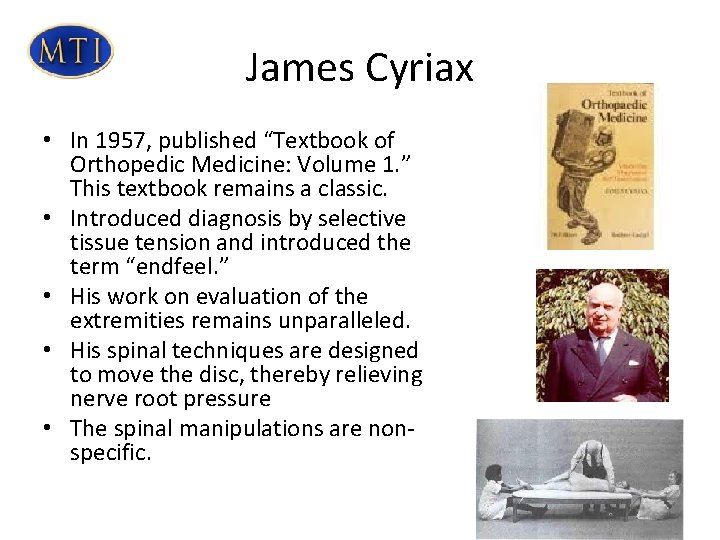
James Cyriax • In 1957, published “Textbook of Orthopedic Medicine: Volume 1. ” This textbook remains a classic. • Introduced diagnosis by selective tissue tension and introduced the term “endfeel. ” • His work on evaluation of the extremities remains unparalleled. • His spinal techniques are designed to move the disc, thereby relieving nerve root pressure • The spinal manipulations are nonspecific.
Robert Maigne • In 1960, Dr. Robert Maigne, a French physician published “Les Manipulations Vertebrales. ” • He advocated techniques that were not painful, specific and done in the opposite direction of the restriction of movement.
John Menell • In 1960, Dr. John Menell (James’ son) published “Back Pain” and “Joint Pain” • He was the first to use the term “joint play” • He thought the principal cause of joint pathology and pain to be arising from synovial joints and not from the intervertebral disc.
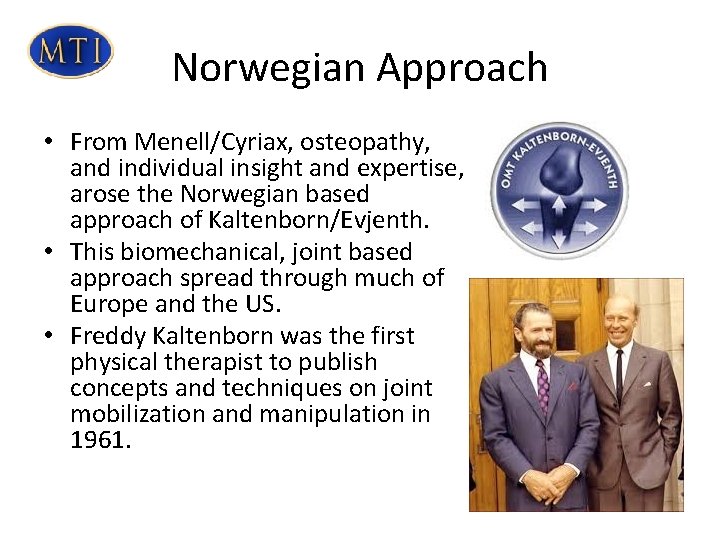
Norwegian Approach • From Menell/Cyriax, osteopathy, and individual insight and expertise, arose the Norwegian based approach of Kaltenborn/Evjenth. • This biomechanical, joint based approach spread through much of Europe and the US. • Freddy Kaltenborn was the first physical therapist to publish concepts and techniques on joint mobilization and manipulation in 1961.
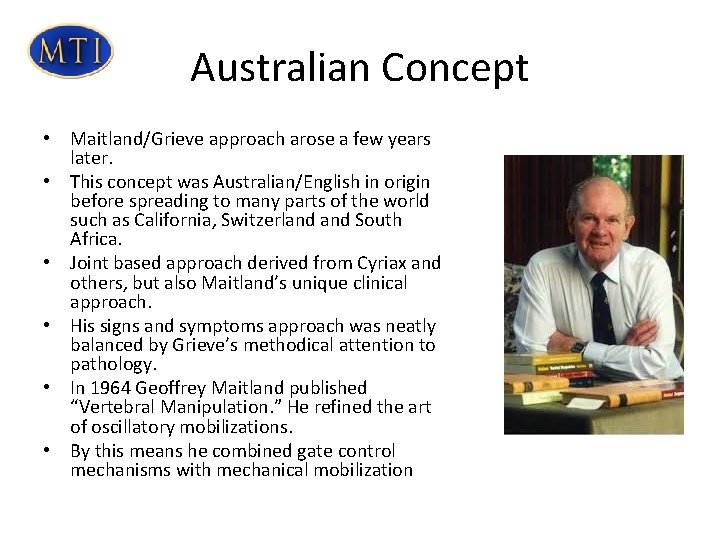
Australian Concept • Maitland/Grieve approach arose a few years later. • This concept was Australian/English in origin before spreading to many parts of the world such as California, Switzerland South Africa. • Joint based approach derived from Cyriax and others, but also Maitland’s unique clinical approach. • His signs and symptoms approach was neatly balanced by Grieve’s methodical attention to pathology. • In 1964 Geoffrey Maitland published “Vertebral Manipulation. ” He refined the art of oscillatory mobilizations. • By this means he combined gate control mechanisms with mechanical mobilization
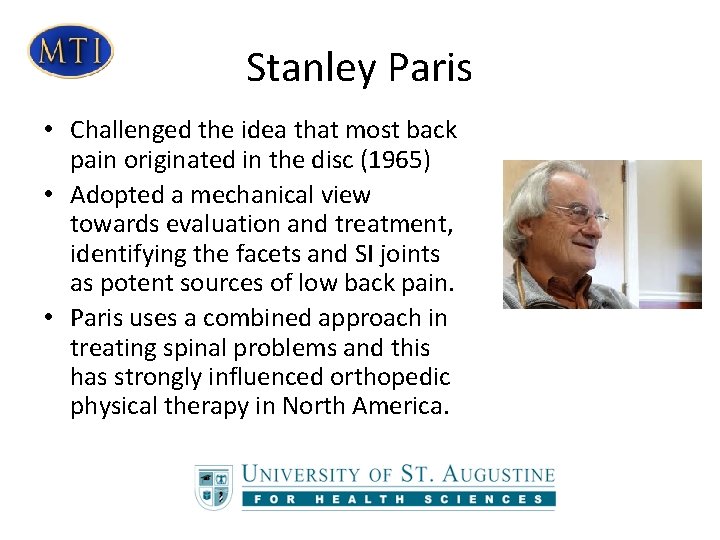
Stanley Paris • Challenged the idea that most back pain originated in the disc (1965) • Adopted a mechanical view towards evaluation and treatment, identifying the facets and SI joints as potent sources of low back pain. • Paris uses a combined approach in treating spinal problems and this has strongly influenced orthopedic physical therapy in North America.
IFOMPT • In 1974, the International Federation of Orthopedic Manipulative Physical Therapy (IFOMT) was formed. • Dick Erhard was it’s first president, although the U. S. did not become a full voting member until 1992.
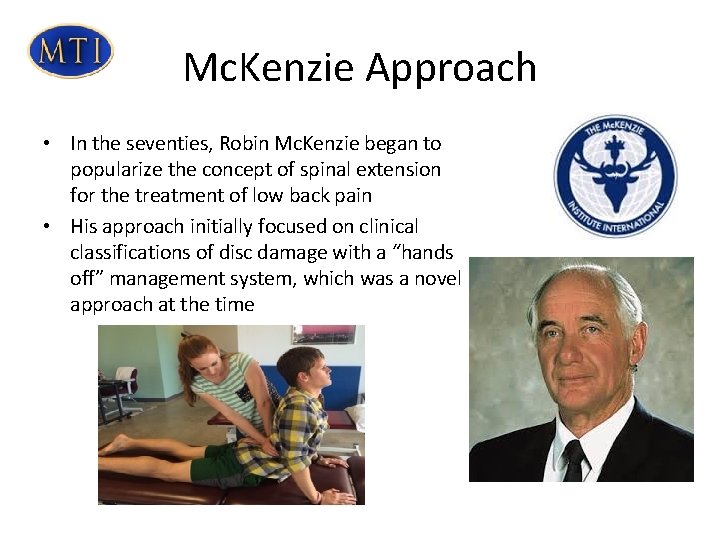
Mc. Kenzie Approach • In the seventies, Robin Mc. Kenzie began to popularize the concept of spinal extension for the treatment of low back pain • His approach initially focused on clinical classifications of disc damage with a “hands off” management system, which was a novel approach at the time
Conflicting Concepts • By the mid sixties, once systems became established, a period of little cross exchange and isolationism ensued. • This was perhaps assisted by the fact that the Norwegian and Australian systems were at either end of the earth. • Groups may even have been suspicious of each other and early IFOMT meetings were reportedly testy. • Although a significant sharing of ideas occurred through the eighties, the groups still kept their identities and differences, as much for political purposes as anything else. • However, it appears that since the 1990 s, many of the approaches are coming together and integrating
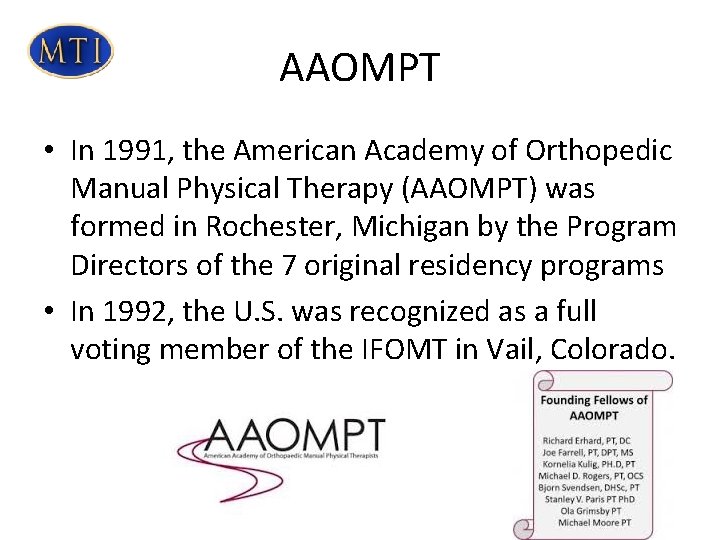
AAOMPT • In 1991, the American Academy of Orthopedic Manual Physical Therapy (AAOMPT) was formed in Rochester, Michigan by the Program Directors of the 7 original residency programs • In 1992, the U. S. was recognized as a full voting member of the IFOMT in Vail, Colorado.