
History of Japan By Claudia Dealbayount Prehistoric Ancient
History of Japan By Claudia Dealba-yount

Prehistoric & Ancient Japan (30, 000 BC – 538 AD) First Japanese (30, 000 BC – 10, 000 BC) l Humans are believed to have first arrived in Japan by around 35, 000 to 40, 000 years ago, possibly following great herds of animals across land bridges connecting the islands of Japan with the Asian continent but more likely on boats via the chain of islands that link Taiwan, Okinawa and the southern Japanese island of Kyushu. Jōmon Period (14, 000 BC - 300 BC), (縄文時代, joumon-jidai) l the inhabitants of the Japanese islands were gatherers, fishers and hunters. Jomom is the name of the era’s pottery.

Prehistoric & Ancient Japan (30, 000 BC – 538 AD) Yayoi Period (300 BC-250 AD), (弥生時代、yayoi-jidai) New technologies and modes of living took over from the Jōmon culture, spreading from northern Kyushu. the rice culture was imported into Japan. With the introduction of agriculture, social classes started to evolve, l local government (land lord) began, l a queen called Himiko (or Pimiku) reigned over Japan at that time. l the introduction of Bronze and iron weapons and tools from China and Korea. l l
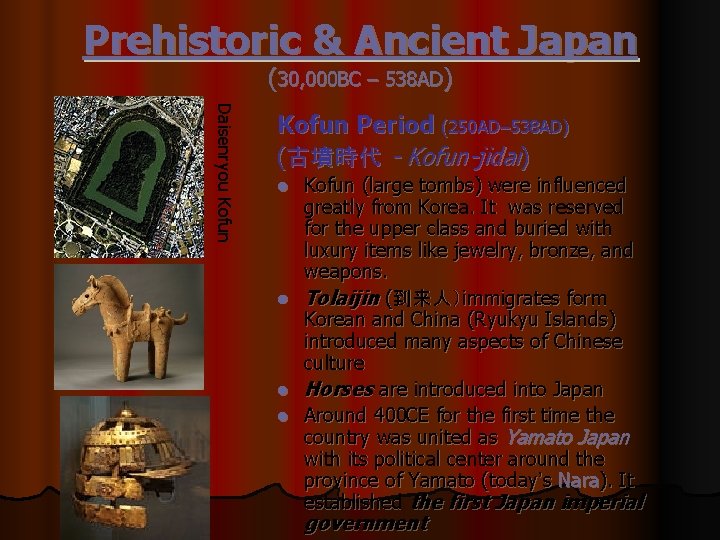
Prehistoric & Ancient Japan (30, 000 BC – 538 AD) Daisenryou Kofun Period (250 AD– 538 AD) (古墳時代 - Kofun-jidai) l l Kofun (large tombs) were influenced greatly from Korea. It was reserved for the upper class and buried with luxury items like jewelry, bronze, and weapons. Tolaijin (到来人)immigrates form Korean and China (Ryukyu Islands) introduced many aspects of Chinese culture Horses are introduced into Japan Around 400 CE for the first time the country was united as Yamato Japan with its political center around the province of Yamato (today’s Nara). It established the first Japan imperial government

Classical Japan (538 – 1185) Asuka period (538 - 710) (飛鳥時代, Asuka-jidai, Yamato Clans) • • Buddhism is introduced from Korean theories of Confucianism and Taoism, as well as the Chinese writing system were introduced. Prince Shotoku have played an especially important role in promoting Chinese ideas by introduced Confucian etiquette to the courts designed to bring about harmony; Modeling many Japanese social programs from China. the Seventeen-Article Constitution and 12 -ranks of court was established Transform through fine-arts and architecture the first uses of the word Nihon (日本) as a name for the emerging state. the Taika Reform, which led to private land began to public, taxes were enforced.
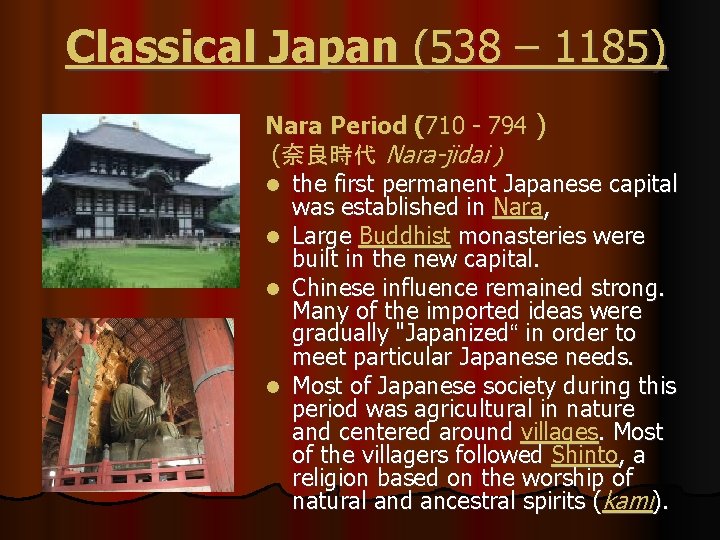
Classical Japan (538 – 1185) Nara Period (710 - 794 ) (奈良時代 Nara-jidai ) l the first permanent Japanese capital was established in Nara, l Large Buddhist monasteries were built in the new capital. l Chinese influence remained strong. Many of the imported ideas were gradually "Japanized“ in order to meet particular Japanese needs. l Most of Japanese society during this period was agricultural in nature and centered around villages. Most of the villagers followed Shinto, a religion based on the worship of natural and ancestral spirits (kami).
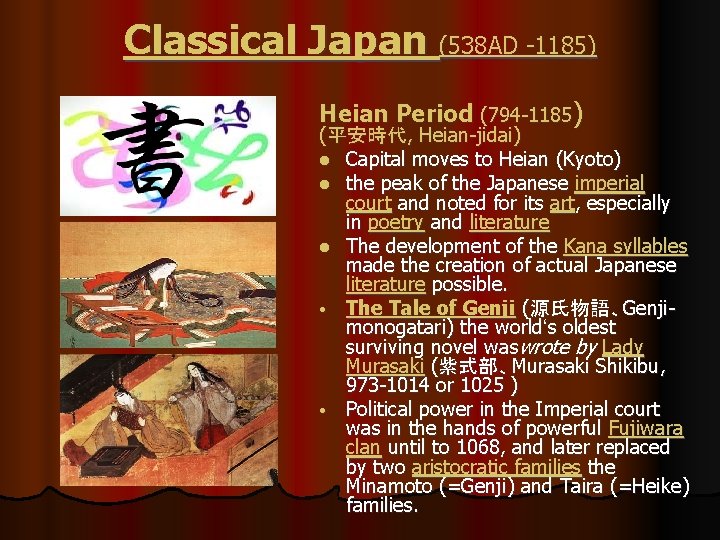
Classical Japan (538 AD -1185) Heian Period (794 -1185) (平安時代, Heian-jidai) l Capital moves to Heian (Kyoto) l the peak of the Japanese imperial court and noted for its art, especially in poetry and literature l The development of the Kana syllables made the creation of actual Japanese literature possible. • The Tale of Genji (源氏物語、Genjimonogatari) the world‘s oldest surviving novel waswrote by Lady Murasaki (紫式部、Murasaki Shikibu, 973 -1014 or 1025 ) • Political power in the Imperial court was in the hands of powerful Fujiwara clan until to 1068, and later replaced by two aristocratic families the Minamoto (=Genji) and Taira (=Heike) families.
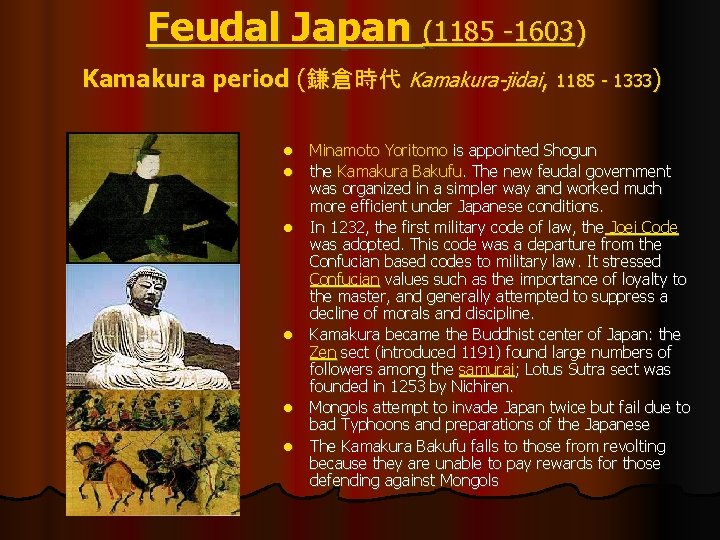
Feudal Japan (1185 -1603) Kamakura period (鎌倉時代 Kamakura-jidai, 1185 - 1333) l l l Minamoto Yoritomo is appointed Shogun the Kamakura Bakufu. The new feudal government was organized in a simpler way and worked much more efficient under Japanese conditions. In 1232, the first military code of law, the Joei Code was adopted. This code was a departure from the Confucian based codes to military law. It stressed Confucian values such as the importance of loyalty to the master, and generally attempted to suppress a decline of morals and discipline. Kamakura became the Buddhist center of Japan: the Zen sect (introduced 1191) found large numbers of followers among the samurai; Lotus Sutra sect was founded in 1253 by Nichiren. Mongols attempt to invade Japan twice but fail due to bad Typhoons and preparations of the Japanese The Kamakura Bakufu falls to those from revolting because they are unable to pay rewards for those defending against Mongols
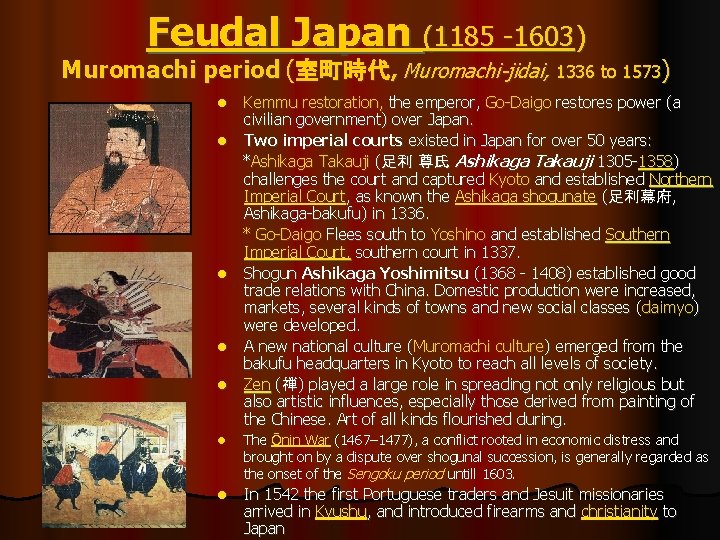
Feudal Japan (1185 -1603) Muromachi period (室町時代, Muromachi-jidai, 1336 to 1573) l l l Kemmu restoration, the emperor, Go-Daigo restores power (a civilian government) over Japan. Two imperial courts existed in Japan for over 50 years: *Ashikaga Takauji (足利 尊氏 Ashikaga Takauji 1305 -1358) challenges the court and captured Kyoto and established Northern Imperial Court, as known the Ashikaga shogunate (足利幕府, Ashikaga-bakufu) in 1336. * Go-Daigo Flees south to Yoshino and established Southern Imperial Court. southern court in 1337. Shogun Ashikaga Yoshimitsu (1368 - 1408) established good trade relations with China. Domestic production were increased, markets, several kinds of towns and new social classes (daimyo) were developed. A new national culture (Muromachi culture) emerged from the bakufu headquarters in Kyoto to reach all levels of society. Zen (禅) played a large role in spreading not only religious but also artistic influences, especially those derived from painting of the Chinese. Art of all kinds flourished during. l The Ōnin War (1467– 1477), a conflict rooted in economic distress and brought on by a dispute over shogunal succession, is generally regarded as the onset of the Sengoku period untill 1603. l In 1542 the first Portuguese traders and Jesuit missionaries arrived in Kyushu, and introduced firearms and christianity to Japan
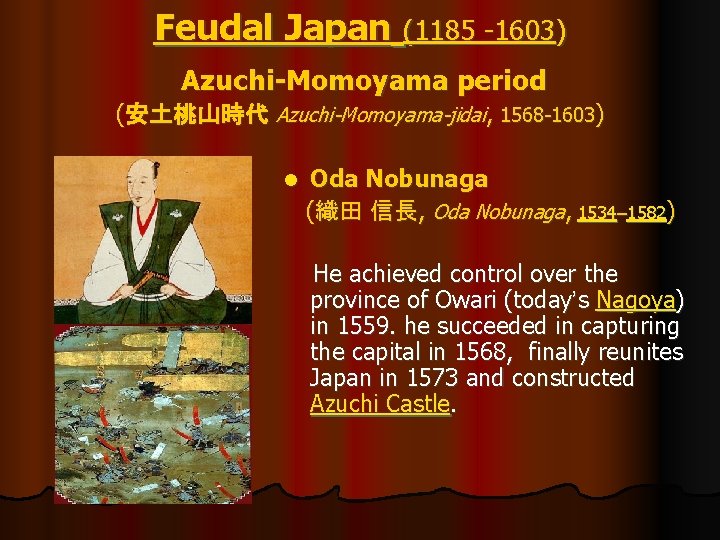
Feudal Japan (1185 -1603) Azuchi-Momoyama period (安土桃山時代 Azuchi-Momoyama-jidai, 1568 -1603) l Oda Nobunaga (織田 信長, Oda Nobunaga, 1534– 1582) He achieved control over the province of Owari (today’s Nagoya) in 1559. he succeeded in capturing the capital in 1568, finally reunites Japan in 1573 and constructed Azuchi Castle.
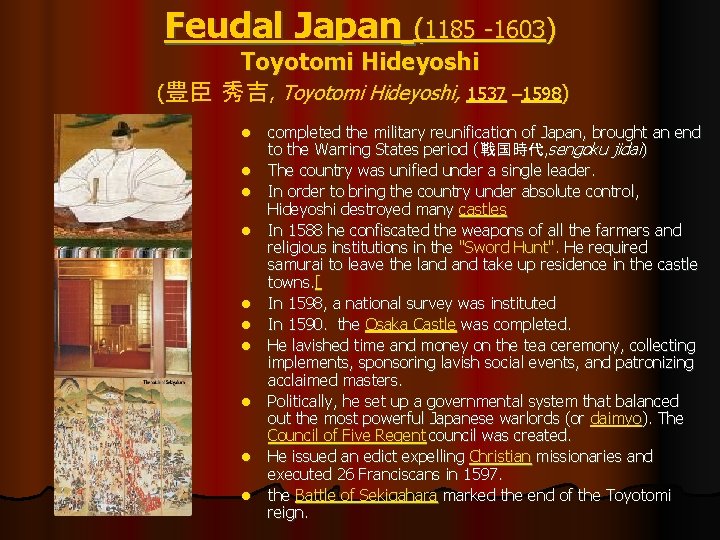
Feudal Japan (1185 -1603) Toyotomi Hideyoshi (豊臣 秀吉, Toyotomi Hideyoshi, 1537 – 1598) l l l l l completed the military reunification of Japan, brought an end to the Warring States period (戦国時代, sengoku jidai) The country was unified under a single leader. In order to bring the country under absolute control, Hideyoshi destroyed many castles In 1588 he confiscated the weapons of all the farmers and religious institutions in the "Sword Hunt". He required samurai to leave the land take up residence in the castle towns. [ In 1598, a national survey was instituted In 1590. the Osaka Castle was completed. He lavished time and money on the tea ceremony, collecting implements, sponsoring lavish social events, and patronizing acclaimed masters. Politically, he set up a governmental system that balanced out the most powerful Japanese warlords (or daimyo). The Council of Five Regent council was created. He issued an edict expelling Christian missionaries and executed 26 Franciscans in 1597. the Battle of Sekigahara marked the end of the Toyotomi reign.
Early Modem Japan Edo Period (江戸時代 Edo-jidai, 1600 – 1867) Tokugawa shoguns (徳川幕府、tokugawa-bakufu) l l l l l Tokugawa Ieyasu after won the Sekigahara battle, he achieved almost unlimited power and wealth. In 1603, he was appointed Shogun by the emperor and established his government in Edo (Tokyo). Using Neo-Confucianism philosophy to stressing the importance of morals, education and hierarchical order in the government and society He brought the whole country under tight control, redistributed the gained land among the daimyo A strict four class system: the samurai, the peasants, artisans and merchants. In 1633, forbade travelling abroad and almost completely isolated Japan from western the Genroku era (1688 - 1703), popular culture flourished. New art forms like kabuki and ukiyo-e became very popular especially among the townspeople. the samurai were educating themselves not only in the martial arts but also in literature, philosophy, the arts the tea ceremony. In 1720, the ban of Western literature was cancelled, and several new teachings entered Japan from China and Europe (Dutch Learning). New nationalist schools that combined Shinto and Confucianist elements also developed. Commodore Perry in 1853 and again in 1854 who forced the Tokugawa government to open a limited number of ports for international trade.
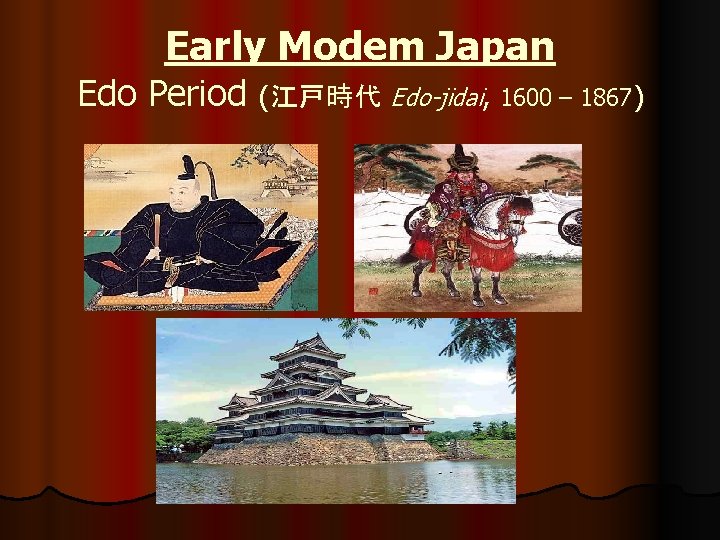
Early Modem Japan Edo Period (江戸時代 Edo-jidai, 1600 – 1867)
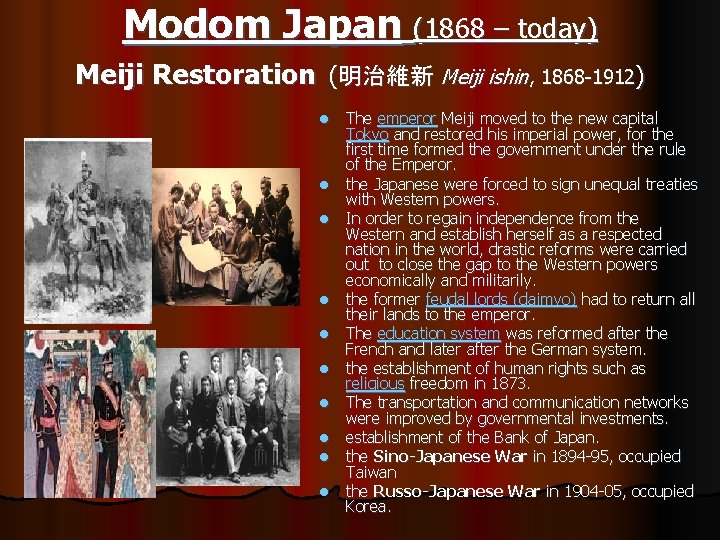
Modom Japan (1868 – today) Meiji Restoration (明治維新 Meiji ishin, 1868 -1912) l l l l l The emperor Meiji moved to the new capital Tokyo and restored his imperial power, for the first time formed the government under the rule of the Emperor. the Japanese were forced to sign unequal treaties with Western powers. In order to regain independence from the Western and establish herself as a respected nation in the world, drastic reforms were carried out to close the gap to the Western powers economically and militarily. the former feudal lords (daimyo) had to return all their lands to the emperor. The education system was reformed after the French and later after the German system. the establishment of human rights such as religious freedom in 1873. The transportation and communication networks were improved by governmental investments. establishment of the Bank of Japan. the Sino-Japanese War in 1894 -95, occupied Taiwan the Russo-Japanese War in 1904 -05, occupied Korea.
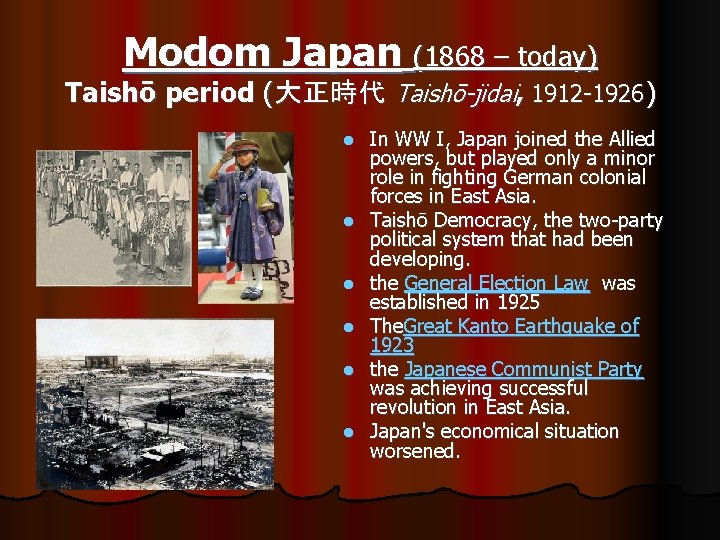
Modom Japan (1868 – today) Taishō period (大正時代 Taishō-jidai, 1912 -1926) l l l In WW I, Japan joined the Allied powers, but played only a minor role in fighting German colonial forces in East Asia. Taishō Democracy, the two-party political system that had been developing. the General Election Law was established in 1925 The. Great Kanto Earthquake of 1923 the Japanese Communist Party was achieving successful revolution in East Asia. Japan's economical situation worsened.
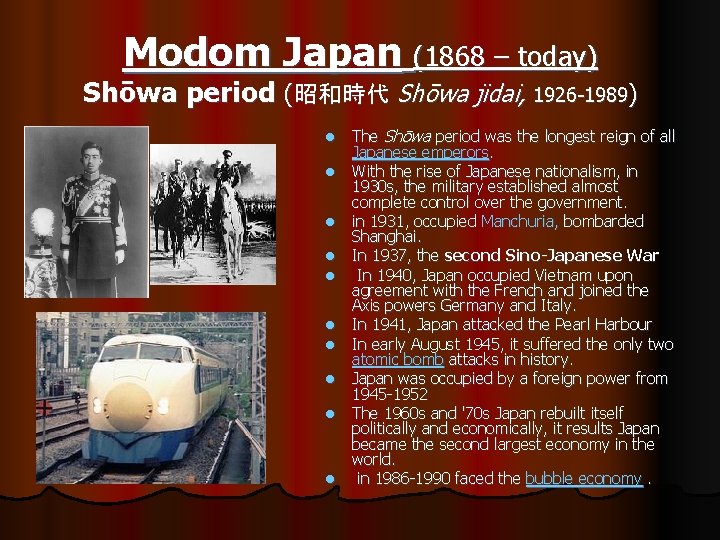
Modom Japan (1868 – today) Shōwa period (昭和時代 Shōwa jidai, 1926 -1989) l l l l l The Shōwa period was the longest reign of all Japanese emperors. With the rise of Japanese nationalism, in 1930 s, the military established almost complete control over the government. in 1931, occupied Manchuria, bombarded Shanghai. In 1937, the second Sino-Japanese War In 1940, Japan occupied Vietnam upon agreement with the French and joined the Axis powers Germany and Italy. In 1941, Japan attacked the Pearl Harbour In early August 1945, it suffered the only two atomic bomb attacks in history. Japan was occupied by a foreign power from 1945 -1952 The 1960 s and '70 s Japan rebuilt itself politically and economically, it results Japan became the second largest economy in the world. in 1986 -1990 faced the bubble economy.
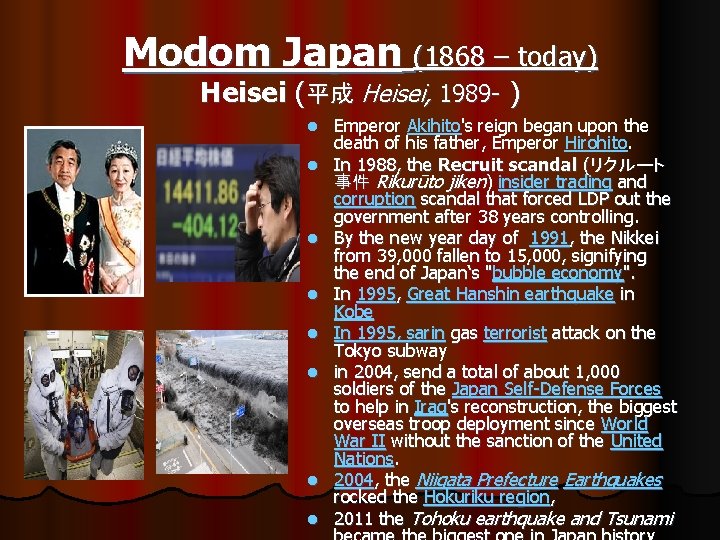
Modom Japan (1868 – today) Heisei (平成 Heisei, 1989 - ) l l l l Emperor Akihito's reign began upon the death of his father, Emperor Hirohito. In 1988, the Recruit scandal (リクルート 事件 Rikurūto jiken) insider trading and corruption scandal that forced LDP out the government after 38 years controlling. By the new year day of 1991, the Nikkei from 39, 000 fallen to 15, 000, signifying the end of Japan‘s "bubble economy". In 1995, Great Hanshin earthquake in Kobe In 1995, sarin gas terrorist attack on the Tokyo subway in 2004, send a total of about 1, 000 soldiers of the Japan Self-Defense Forces to help in Iraq's reconstruction, the biggest overseas troop deployment since World War II without the sanction of the United Nations. 2004, the Niigata Prefecture Earthquakes rocked the Hokuriku region, 2011 the Tohoku earthquake and Tsunami
- Slides: 17