
History of Internet Bart Meulenbroeks Content Introduction n
History of Internet Bart Meulenbroeks
Content Introduction n Creation of ARPANET n From ARPANET to Internet n From Internet to the World Wide Web n Development of the World Wide Web n Questions n
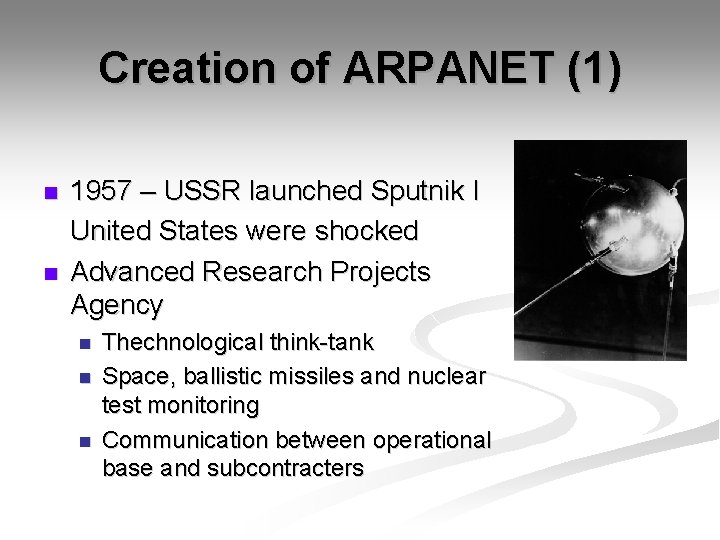
Creation of ARPANET (1) n n 1957 – USSR launched Sputnik I United States were shocked Advanced Research Projects Agency n n n Thechnological think-tank Space, ballistic missiles and nuclear test monitoring Communication between operational base and subcontracters
Creation of ARPANET (2) n 1962 – computer research program n n n Leaded by John Licklider (MIT) Leonard Kleinrock published his first paper on packet-switching theory 1965 – first “wide area network” created n Connection between Berkeley and MIT

Creation of ARPANET (3) n 1967 – plans for ARPANET were published n n 1969 – Interface Message Processor (IMP) n n MIT – NPL (UK) – RAND 4 computers (UCLA, SRI, UCSB and UTAH) 1971 – 23 host computers (15 nodes)
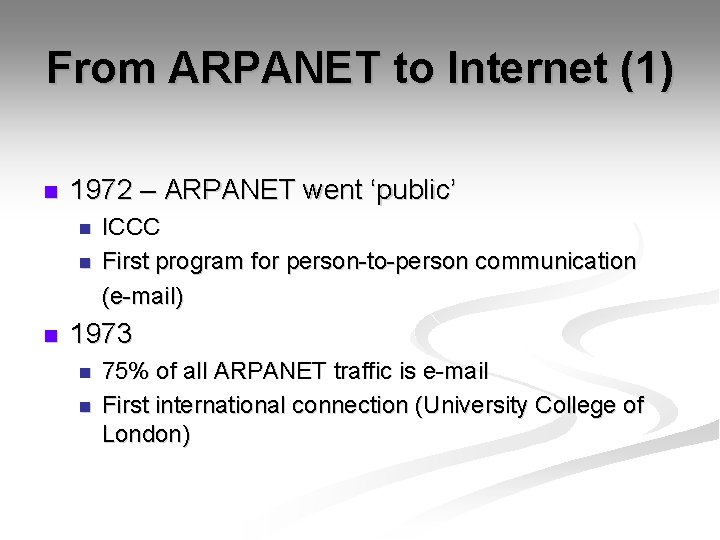
From ARPANET to Internet (1) n 1972 – ARPANET went ‘public’ n n n ICCC First program for person-to-person communication (e-mail) 1973 n n 75% of all ARPANET traffic is e-mail First international connection (University College of London)
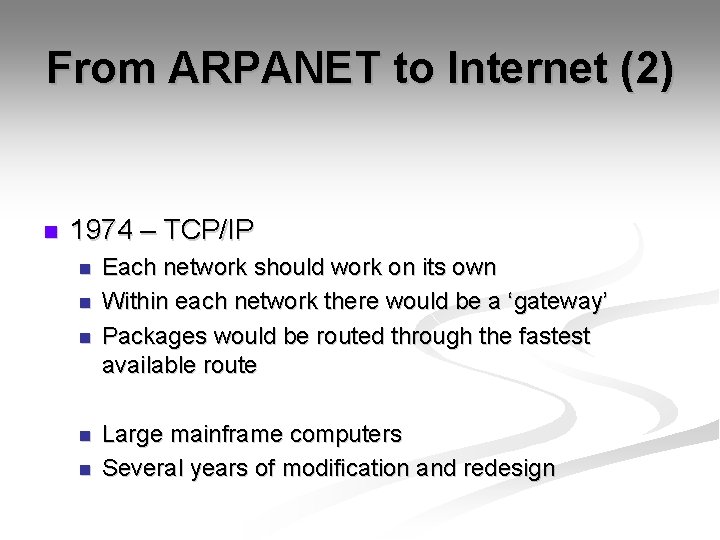
From ARPANET to Internet (2) n 1974 – TCP/IP n n n Each network should work on its own Within each network there would be a ‘gateway’ Packages would be routed through the fastest available route Large mainframe computers Several years of modification and redesign
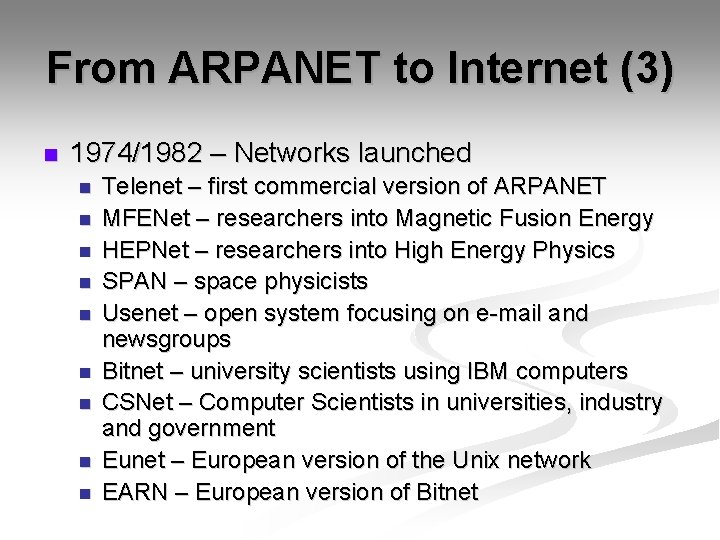
From ARPANET to Internet (3) n 1974/1982 – Networks launched n n n n n Telenet – first commercial version of ARPANET MFENet – researchers into Magnetic Fusion Energy HEPNet – researchers into High Energy Physics SPAN – space physicists Usenet – open system focusing on e-mail and newsgroups Bitnet – university scientists using IBM computers CSNet – Computer Scientists in universities, industry and government Eunet – European version of the Unix network EARN – European version of Bitnet
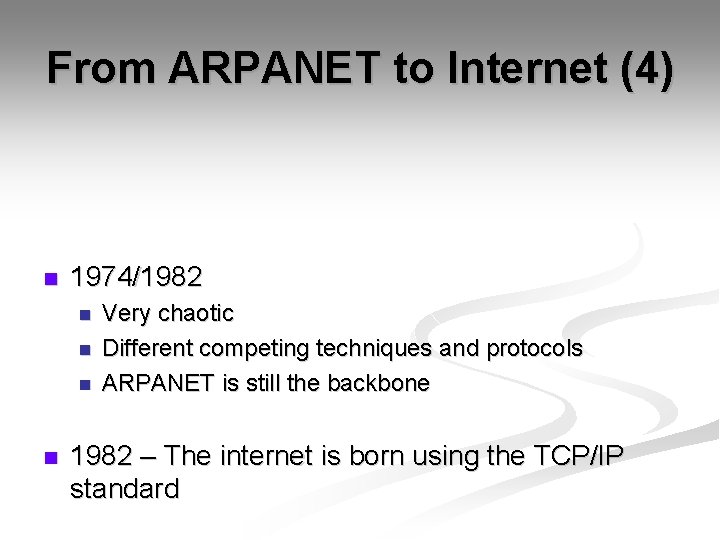
From ARPANET to Internet (4) n 1974/1982 n n Very chaotic Different competing techniques and protocols ARPANET is still the backbone 1982 – The internet is born using the TCP/IP standard
From Internet to WWW (1) n System expands n n n Problems created by its own success n n n Advances in computer capacities and speeds Introduction of glass-fibre cables More computers are linked (1984 – 1000 hosts) Large volume of traffic (success of e-mail) 1984 – Introduction DNS
From Internet to WWW (2) n Use of internet throughout the higher educational system n n n British government – Joint Academic Network US National Science Foundation – NSFNet n n n Use of TCP/IP Federal Agencies share cost of infrastructures NSFNet shared infrastructure Support behind the ‘Internet Activities Board’ NSFNet provided the ‘backbone’
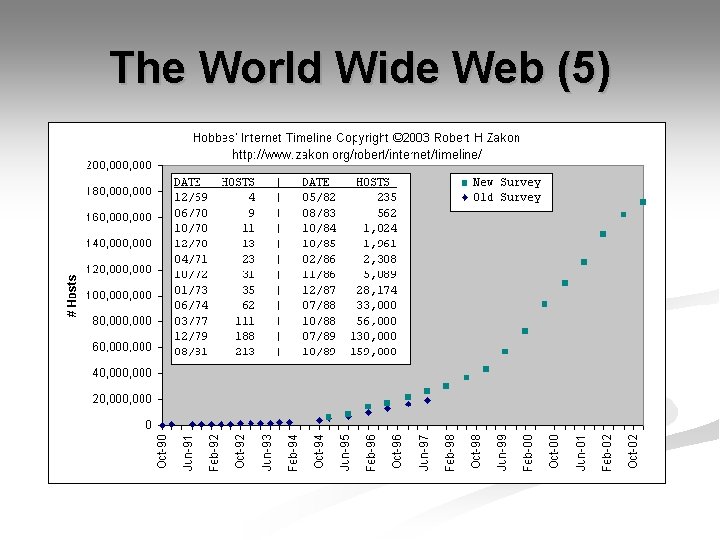
From Internet to WWW (3) n NSFNet n n broke the capacity bottleneck encouraged a surge in Internet use n n n n 1984 – 1, 000 hosts 1986 – 5, 000 hosts 1987 – 28, 000 hosts 1989 – 100, 000 hosts 1990 – 300, 000 hosts encouraged the development of private Internet providers Commercial users
From Internet to WWW (4) n n 1990 – ARPANET was wound up 1990 – first search-engine (Archie) 1991 – NSF removed restrictions on private access “Information superhighway” project
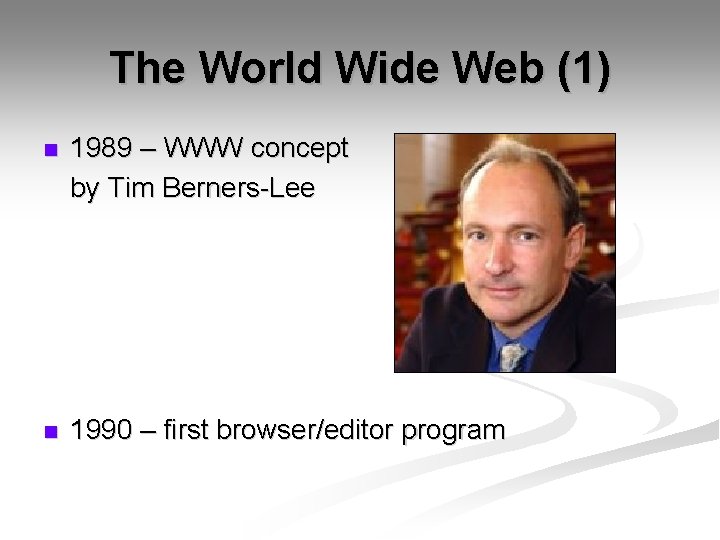
The World Wide Web (1) n 1989 – WWW concept by Tim Berners-Lee n 1990 – first browser/editor program
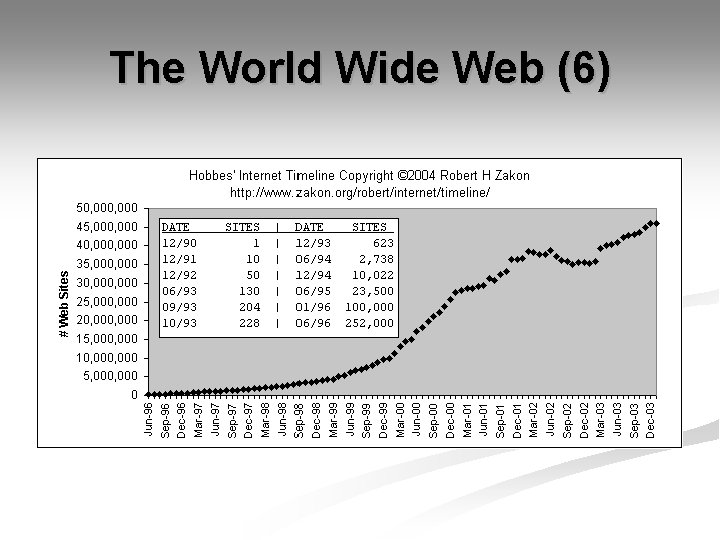
The World Wide Web (2) n n National Center for Super. Computing Applications launched Mosaic X Commercial websites began their proliferation Followed by local shool/club/family sites The web exploded n n 1994 – 3, 2 million hosts and 3, 000 websites 1995 – 6, 4 million hosts and 25, 000 websites 1997 – 19, 5 million hosts and 1, 2 million websites January 2001 – 110 million hosts and 30 million websites
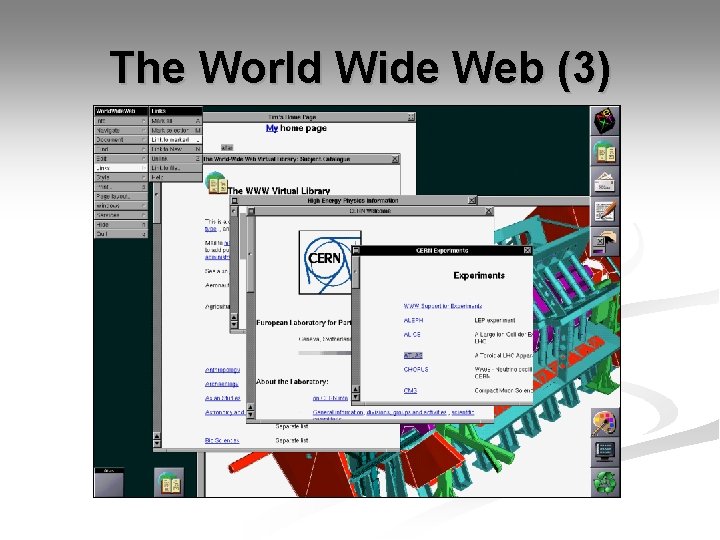
The World Wide Web (3)
The World Wide Web (4) n Some facts 1994 – Hotmail starts web based email n 1994 – World Wide Web Consortium (W 3 C) was founded n 1995 – JAVA source code was released n 1996 – Mirabilis (Israel) starts ICQ n 1998 – Google is founded n
The World Wide Web (5)
The World Wide Web (6)

Questions? ? ?
- Slides: 20