
History of Health Information Technology in the U
- Slides: 28
History of Health Information Technology in the U. S. History of Electronic Health Records (EHRs) Lecture b – Evolution of Functional Requirements for EHRs This material (Comp 5 Unit 6) was developed by the University of Alabama at Birmingham, funded by the Department of Health and Human Services, Office of the National Coordinator for Health Information Technology under Award Number 90 WT 0007. This work is licensed under the Creative Commons Attribution-Non. Commercial-Share. Alike 4. 0 International License. To view a copy of this license, visit http: //creativecommons. org.
History of Electronic Health Records Learning Objectives • Describe some early examples of electronic medical records • Discuss lessons learned from the early EHR implementations • Discuss how the attributes that were identified for a computer-based patient record in the 1991 Institute of Medicine report relate to the concept of meaningful use • Discuss differences between the terms electronic health record (EHR) and personal health record (PHR) 2
IOM Criteria for CPR • The Computer-Based Patient Record • 1991 • Criteria for CPR Source: (Dick, et al. , 1991) 3
IOM Criteria for CPR 2 • The Computer-Based Patient Record – Two editions: 1991 and 1997 • Recommendations for CPR – Gold standard – Vendor community Source: (Dick, et al. , 1997) 4
IOM Criteria for CPR 3 • Problem list 5
IOM Criteria for CPR 4 • Health status measures 6
IOM Criteria for CPR 5 • Rationale for decision making 7
IOM Criteria for CPR 6 • Records integration – Other settings – Other time periods 8
IOM Criteria for CPR 7 • Protection of confidentiality 9
IOM Criteria for CPR 8 • Timely access – Simultaneous – Remote 10
IOM Criteria for CPR 9 • Tailored views 11
IOM Criteria for CPR 10 • Access to local and remote databases – Medical literature – Clinical guidelines Source: (Miller, et al. , 2005) 12
IOM Criteria for CPR 11 • Clinical problem solving assistance – Decision support tools 13
IOM Criteria for CPR 12 • Structured data entry by physicians – Defined vocabulary 14
IOM Criteria for CPR 13 • Assessment – Quality and cost 15
IOM Criteria for CPR 14 • Flexible and expandable 16
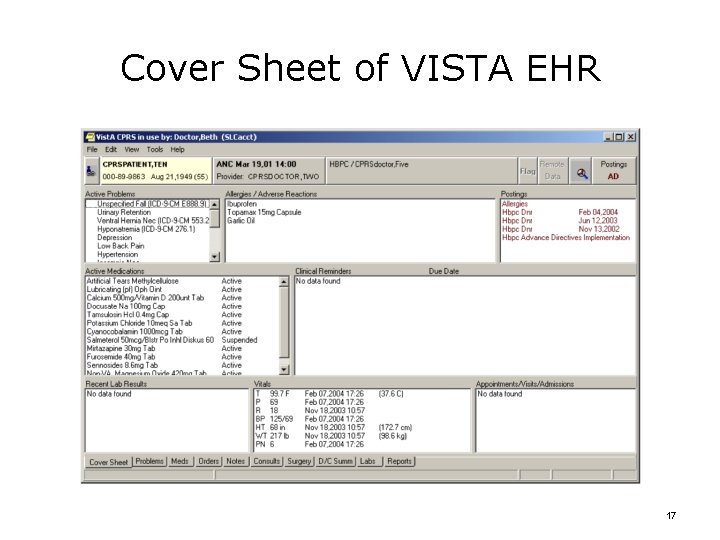
Cover Sheet of VISTA EHR 17
Electronic Health Record System Capabilities • IOM Committee on Data Standards – 2003 • CPR versus EHR – EHR assumes involvement of patients Source: (Institute of Medicine, 2003) 18
Electronic Health Record System Capabilities 2 • Direct care functions • Supportive functions • Information infrastructure 19
Electronic Health Record System Capabilities 3 • Direct care functions – Care management – Clinical decision support – Operations management and communication 20
Electronic Health Record System Capabilities 4 • Supportive functions – Clinical support (e. g. , demographics) – Measurement, analysis, research, reporting – Administrative and financial 21
Electronic Health Record System Capabilities 5 • Information Infrastructure Functions – Security – Records management – Unique identity, registry and directory services – Health informatics and terminology standards – Interoperability – Management of business rules – Workflow 22
Meaningful Use • Major current recommendations – Computerized Provider Order Entry (CPOE) – Clinical Decision Support (CDS) – Electronic Prescribing (E-prescribing) – Structured documentation of quality measures – Up-to-date problem lists and diagnoses – Providing patients with health information electronically – Information exchange 23
EHR Adoption • Increased dramatically since 2009 – In 2014, 97% of hospitals used certified EHR technology(CEHRT) – In 2014, 74% of physicians used CEHRT – 76% of hospitals and 51% of physicians used basic EHR functions in 2014 Sources Charles et al. , 2015. Heisey-Grove & Patel, 2015 24
History of Electronic Health Records (EHRs) Summary • 1991 IOM report still the gold standard • Most systems today still do not meet all of the IOM criteria • Early systems met many of the criteria • Broader development of EHRs with HITECH 25
Acknowledgment Some of the material in this presentation is also included in the following book and is used with permission: Smaltz DH, Berner ES. The executive’s guide to electronic health records. Chicago IL: Health Administration Press; 2007. 26
History of Electronic Health Records References – Lecture b References Dick RS, Steen EB, Detmer DE. The computer-based patient record: an essential technology for healthcare. Revised Edition. Washington, DC: National Academy Press; 1997. Institute of Medicine. Committee on Data Standards for Patient Safety, Board of Health Care Services. Key capabilities of an electronic health record system. Letter report. Washington (DC): The National Academies Press; 2003 Jul. Miller RA, Waitman LR, Chen S, Rosenbloom ST. The anatomy of decision support during inpatient care provider order entry (CPOE): empirical observations from a decade of CPOE experience at Vanderbilt. J Biomed Inform. 2005 Dec; 38(6): 469 -85. Smaltz DH, Berner ES. The executive’s guide to electronic health records. Chicago (IL): Health Administration Press; 2007. Charles D, Gabriel M, Searcy T. Adoption of Electronic Health Record Systems among U. S. Non. Federal Acute Care Hospitals: 2008 -2014. ONC Data Brief, No. 23. Office of the National Coordinator for Health Information Technology: Washington DC. , April 2015. www. healthit. gov Accessed May 21, 2016. Heisey-Grove D, Patel V. Any, Certified, or Basic: Quantifying Physician EHR Adoption. ONC Data Brief, No. 28. Office of the National Coordinator for Health Information Technology: Washington DC. , , September 2015. www. healthit. gov. Accessed May 21, 2016 Images Slide 17: Available from: www. va. gov 27
History of HIT in the US History of Electronic Health Records Lecture b This material was developed by the University of Alabama at Birmingham, funded by the Department of Health and Human Services, Office of the National Coordinator for Health Information Technology under Award Number 90 WT 0007. 28