
History of Health Information Technology in the U
- Slides: 23
History of Health Information Technology in the U. S. History of Electronic Health Records (EHRs) Lecture a – Early EHR Prototypes This material (Comp 5 Unit 6) was developed by the University of Alabama at Birmingham, funded by the Department of Health and Human Services, Office of the National Coordinator for Health Information Technology under Award Number 90 WT 0007. This work is licensed under the Creative Commons Attribution-Non. Commercial-Share. Alike 4. 0 International License. To view a copy of this license, visit http: //creativecommons. org.
History of Electronic Health Records Learning Objectives • Describe some early examples of electronic medical records • Discuss lessons learned from the early EHR implementations • Discuss how the attributes that were identified for a computer-based patient record in the 1991 Institute of Medicine Report relate to the concept of meaningful use • Discuss differences between the terms electronic health record (EHR) and personal health record (PHR) 2
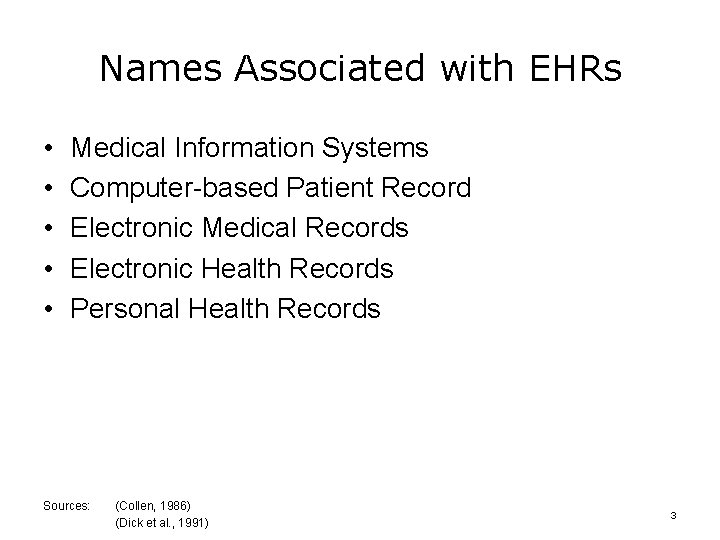
Names Associated with EHRs • • • Medical Information Systems Computer-based Patient Record Electronic Medical Records Electronic Health Records Personal Health Records Sources: (Collen, 1986) (Dick et al. , 1991) 3
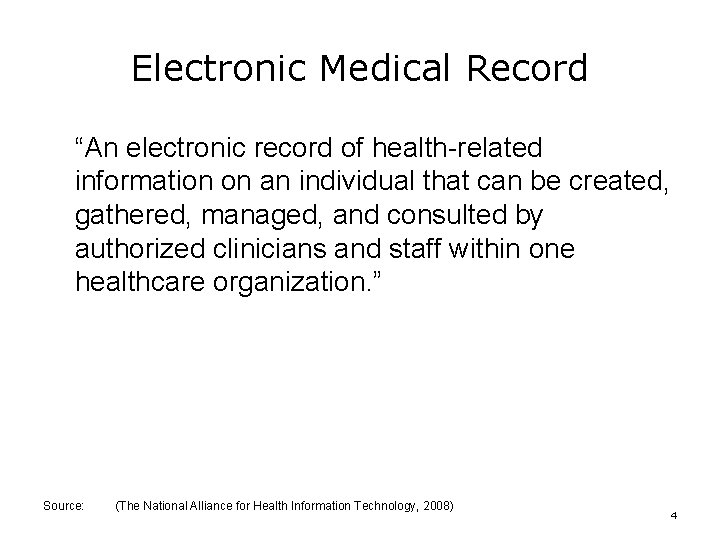
Electronic Medical Record “An electronic record of health-related information on an individual that can be created, gathered, managed, and consulted by authorized clinicians and staff within one healthcare organization. ” Source: (The National Alliance for Health Information Technology, 2008) 4
Electronic Health Record “An electronic record of health-related information on an individual that conforms to nationally-recognized interoperability standards and that can be created, managed, and consulted by authorized clinicians and staff across more than one healthcare organization. ” Source: (The National Alliance for Health Information Technology, 2008) 5
Personal Health Record “An electronic record of health-related information on an individual that conforms to nationally-recognized interoperability standards and that can be drawn from multiple sources while being managed, shared, and controlled by the individual. ” Source: (The National Alliance for Health Information Technology, 2008) 6
1960 s — 1990 s • Problems with paper records – Inaccessible/unavailable – Illegible – Incomplete • Prototypes – EMRs – Multimedia EMR – Portable PHRs Sources: (Collen, 1995) (Smith, et al. , 2005) 7
COmputer-STored Ambulatory Record • Development begun in the 1960 s at Massachusetts General Hospital • G. Octo Barnett and colleagues • Developed MUMPS computer language • Design goals: – Accessibility for clinicians – Administrative and financial needs – User queries – Quality assurance Source: (Barnett, et al. , 1982) 8
COSTAR Features • • • Directory/Data dictionary Modular design/User configuration Structured encounter form for data capture Queryable database Integrated administrative, financial and clinical data 9
The Medical Record • Developed at Duke in the 1970 s • W. Edward Hammond and William Stead and colleagues • Originally developed as obstetric history taking program • Expanded to other departments and other functions Source: Hammond, 2001. 10
TMR Features • • • Modular design Data definition dictionaries Problem-oriented and time-oriented formats Multiple input modes—computer, paper, dictation User configuration, choice of data collection content and methods 11
Regenstrief Medical Record System • Development begun in the 1970 s at the Regenstrief Medical Institute • Clement Mc. Donald, William Tierney and colleagues • Begun in Regenstrief Diabetes Clinic • Expanded to other outpatient and inpatient units • Goals – Data capture – Automated reminders, clinical decision support Source: (Mc. Donald, et al. , 1992) 12
RMRS Features • Data capture – Electronic interfaces if possible, e. g. devices – Dictation/manual coding and entry – Structured forms/manual coding and entry – Direct computer entry 13
RMRS Features 2 • Clinical decision support – Hundreds of rules to generate reminders and alerts – Provided since 1974 – Studies of impact on costs and patient health outcomes 14
RMRS • Integrated administrative and financial functions • Still in use today • Expanded to multiple inpatient and outpatient facilities 15
Lessons Learned • Incremental build – Modular – Start small with easy to capture data • Configure for different settings, user needs • Multiple methods of data input • Coded data for storage and retrieval • Data dictionary • Standards for sharing information Source: (Hammond, 2001) 16
Lessons Learned 2 • Integrate administrative and clinical functions, especially in outpatient setting • Data entry – Challenges for direct physician data entry Orders more structured and easiest for physicians o Clinical documentation more challenging o • User training and support 17
Barriers to Use • Cost of hardware and software • Inability to accommodate all types of data – Unstructured data • Design not optimal – User interface – Support physician cognition – Data entry difficult • Lack of physician acceptance/interest Source: (Collen, 1995) 18
Goals • • • Accessibility Improve efficiency/reduce costs Improve quality of patient care Facilitate health services research Facilitate claims processing Source: (Collen, 1995) 19
HITECH Vision (2009) • Improved individual and population health outcomes • Increased transparency and efficiency • Improved ability to study [healthcare] • Improved care delivery Source: (Blumenthal, 2010) 20
History of Electronic Health Records Summary – Lecture a • EHR terminology over time • Examples of early EHRs • Struggle to define requirements 21
History of Electronic Health Records References – Lecture a References Barnett GO, Zielstorff RD, Piggins J, et al. COSTAR: a comprehensive medical information system for ambulatory care. Proc Annu Symp Comput Appl Med Care. 1982 Nov 2; 8– 18. Blumenthal D. Launching HITECH. N Engl J Med. 2010 Feb 4; 362(5): 382 -5. Collen M. A history of medical informatics in the United States, 1950 -1990. Washington, DC: American Medical Informatics Association; 1995. Collen MF. Origins of medical informatics. Medical informatics [special issue]. West J Med. 1986 Dec; 145: 778 -85. Dick RS, Steen EB, Detmer DE. The computer-based patient record: an essential technology for healthcare. Washington, DC: National Academy Press; 1991. Hammond WE. How the past teaches the future: ACMI distinguished lecture. J Am Med Inform Assoc. 2001 May-Jun; 8(3): 222 -34. Mc. Donald CJ, Tierney WM, Overhage JM, Martin DK, Wilson GA. The Regenstrief Medical Record System: 20 years of experience in hospitals, clinics, and neighborhood health centers. MD Comput. 1992 Jul-Aug; 9(4): 206 -17. The National Alliance for Health Information Technology. Report to the Office of the National Coordinator for Health Information Technology on defining key health information technology terms. The National Alliance for Health Information Technology. 2008 Apr 28. p. 6. Smith PC, Araya-Guerra R, Bublitz C, et al. Missing clinical information during primary care visits. JAMA. 2005 Feb 2; 293(5): 565 -71. 22
History of Health IT in the US History of Electronic Health Records Lecture a This material was developed by the University of Alabama at Birmingham, funded by the Department of Health and Human Services, Office of the National Coordinator for Health Information Technology under Award Number 90 WT 0007. 23