
History of HCI Key People and events Series

- Slides: 32
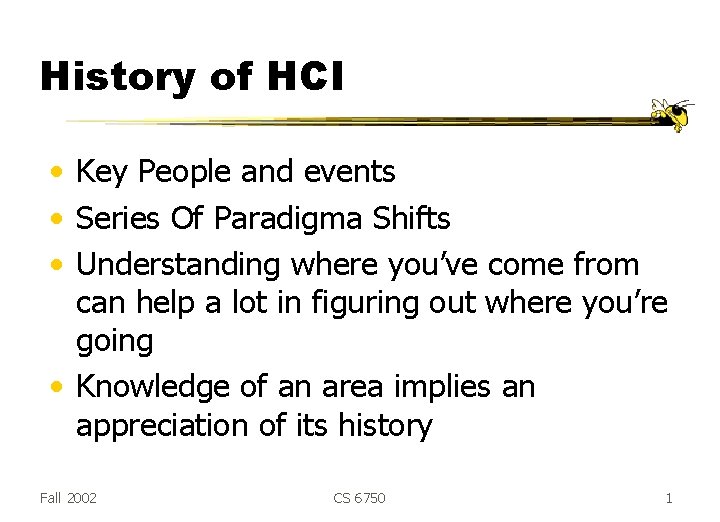
History of HCI • Key People and events • Series Of Paradigma Shifts • Understanding where you’ve come from can help a lot in figuring out where you’re going • Knowledge of an area implies an appreciation of its history Fall 2002 CS 6750 1
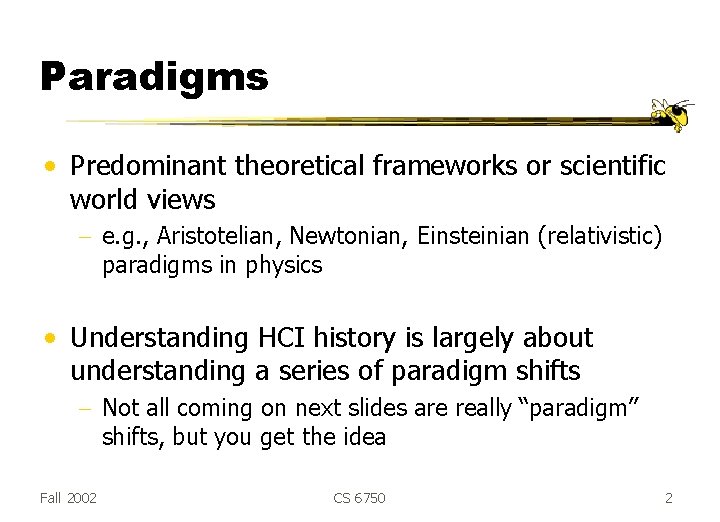
Paradigms • Predominant theoretical frameworks or scientific world views - e. g. , Aristotelian, Newtonian, Einsteinian (relativistic) paradigms in physics • Understanding HCI history is largely about understanding a series of paradigm shifts - Not all coming on next slides are really “paradigm” shifts, but you get the idea Fall 2002 CS 6750 2
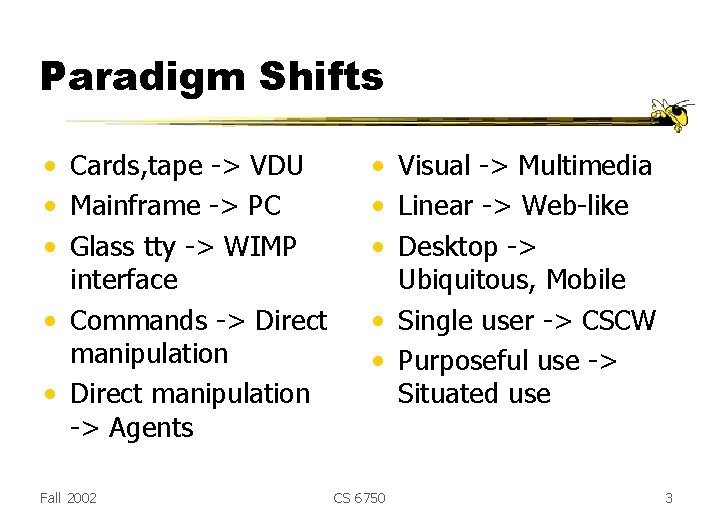
Paradigm Shifts • Cards, tape -> VDU • Mainframe -> PC • Glass tty -> WIMP interface • Commands -> Direct manipulation • Direct manipulation -> Agents Fall 2002 • Visual -> Multimedia • Linear -> Web-like • Desktop -> Ubiquitous, Mobile • Single user -> CSCW • Purposeful use -> Situated use CS 6750 3
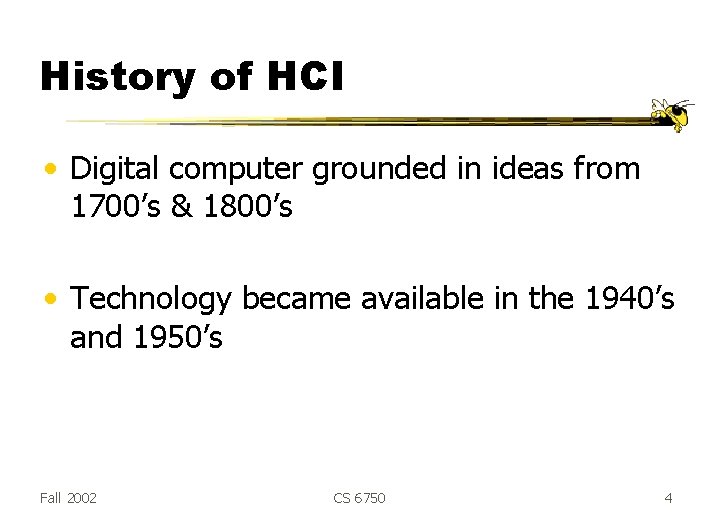
History of HCI • Digital computer grounded in ideas from 1700’s & 1800’s • Technology became available in the 1940’s and 1950’s Fall 2002 CS 6750 4
Vannevar Bush • “As We May Think” - 1945 Atlantic Monthly “…publication has been extended far beyond our present ability to make real use of the record. ” Fall 2002 CS 6750 5
Bush • Postulated Memex device - Can store all records/articles/communications - Large memory - Items retrieved by indexing, keywords, cross references - Can make a trail of links through material - etc. • Envisioned as microfilm, not computer Fall 2002 CS 6750 6
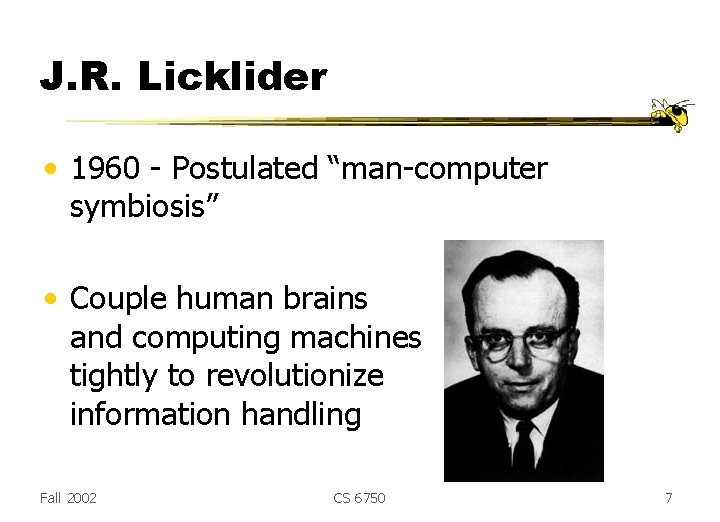
J. R. Licklider • 1960 - Postulated “man-computer symbiosis” • Couple human brains and computing machines tightly to revolutionize information handling Fall 2002 CS 6750 7
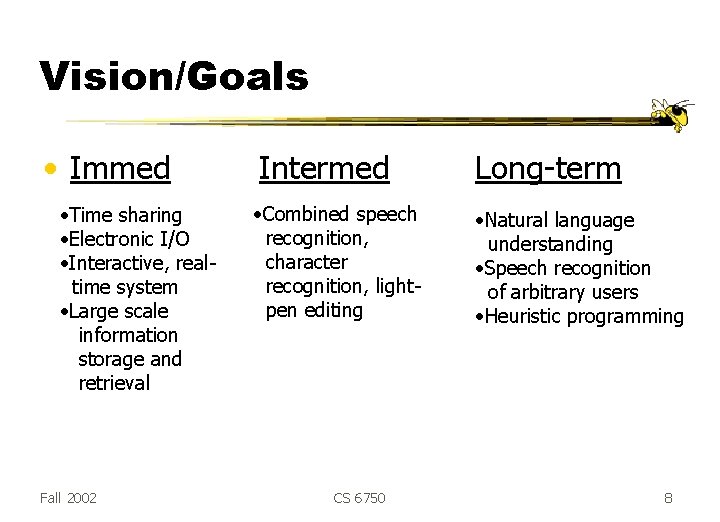
Vision/Goals • Immed • Time sharing • Electronic I/O • Interactive, realtime system • Large scale information storage and retrieval Fall 2002 Intermed Long-term • Combined speech recognition, character recognition, lightpen editing • Natural language understanding • Speech recognition of arbitrary users • Heuristic programming CS 6750 8
Mid 1960’s • Computers too expensive for individuals -> timesharing - increased accessibility - interactive systems, not jobs - text processing, editing - email, shared file system Fall 2002 CS 6750 Need for HCI 9
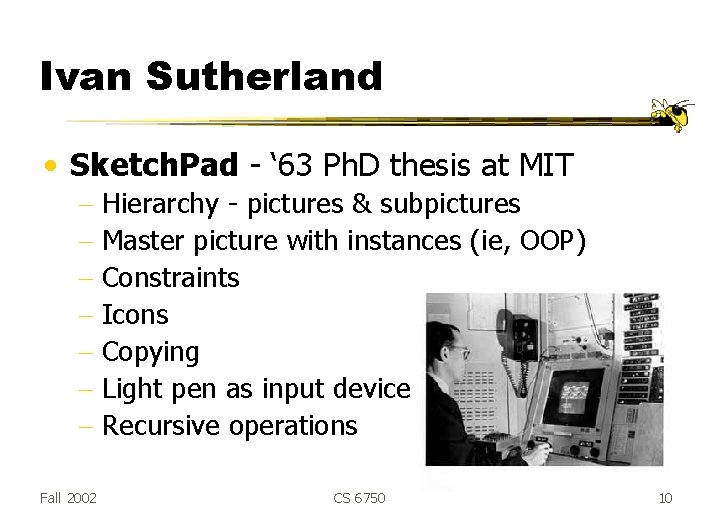
Ivan Sutherland • Sketch. Pad - ‘ 63 Ph. D thesis at MIT - Hierarchy - pictures & subpictures - Master picture with instances (ie, OOP) - Constraints - Icons - Copying - Light pen as input device - Recursive operations Fall 2002 CS 6750 10
Video Display Units • More suitable medium than paper • Sutherland’s Sketchpad as landmark system • Computers used for visualizing and manipulating data Fall 2002 CS 6750 11
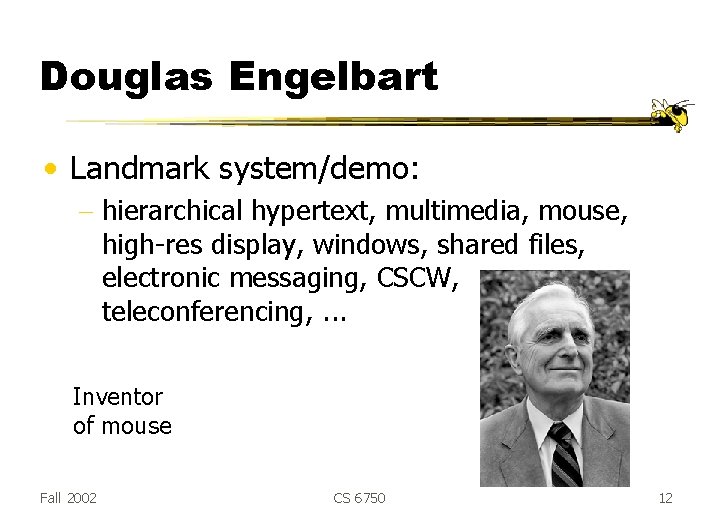
Douglas Engelbart • Landmark system/demo: - hierarchical hypertext, multimedia, mouse, high-res display, windows, shared files, electronic messaging, CSCW, teleconferencing, . . . Inventor of mouse Fall 2002 CS 6750 12
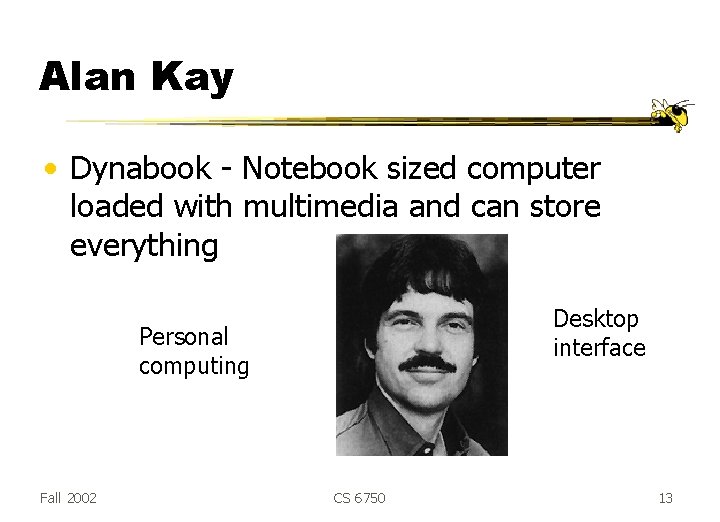
Alan Kay • Dynabook - Notebook sized computer loaded with multimedia and can store everything Desktop interface Personal computing Fall 2002 CS 6750 13
Personal Computing • System is more powerful if it’s easier to use • Small, powerful machines dedicated to individual • Importance of networks and time-sharing • Kay’s Dynabook, IBM PC Fall 2002 CS 6750 14
Personal Computers • ‘ 70’s IBM PC - Text and command-based - Sold lots Fall 2002 CS 6750 15
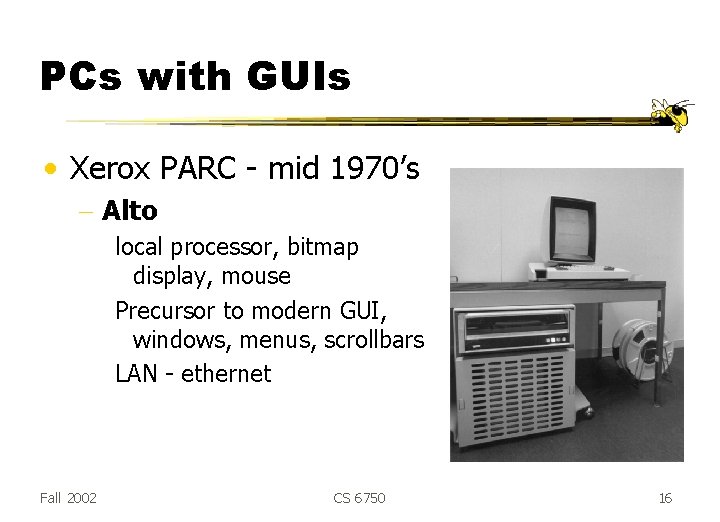
PCs with GUIs • Xerox PARC - mid 1970’s - Alto local processor, bitmap display, mouse Precursor to modern GUI, windows, menus, scrollbars LAN - ethernet Fall 2002 CS 6750 16
Xerox Star - ‘ 81 • First commercial PC designed for “business professionals” - desktop metaphor, pointing, WYSIWYG, high degree of consistency and simplicity • First system based on usability engineering - Paper prototyping and analysis - Usability testing and iterative refinement Fall 2002 CS 6750 17
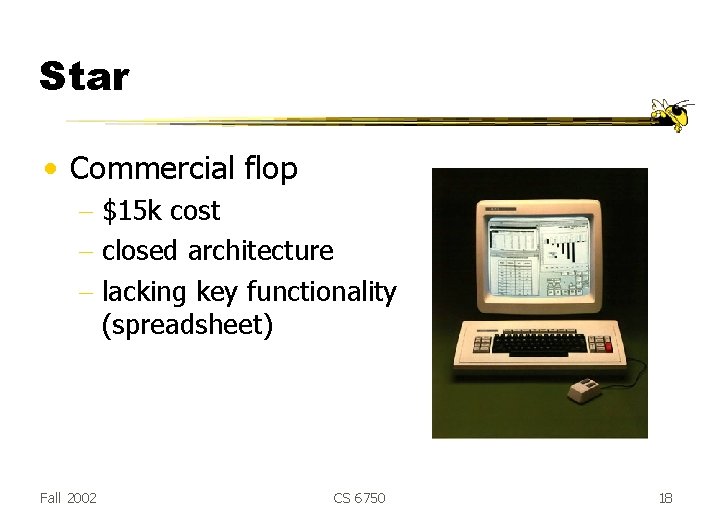
Star • Commercial flop - $15 k cost - closed architecture - lacking key functionality (spreadsheet) Fall 2002 CS 6750 18
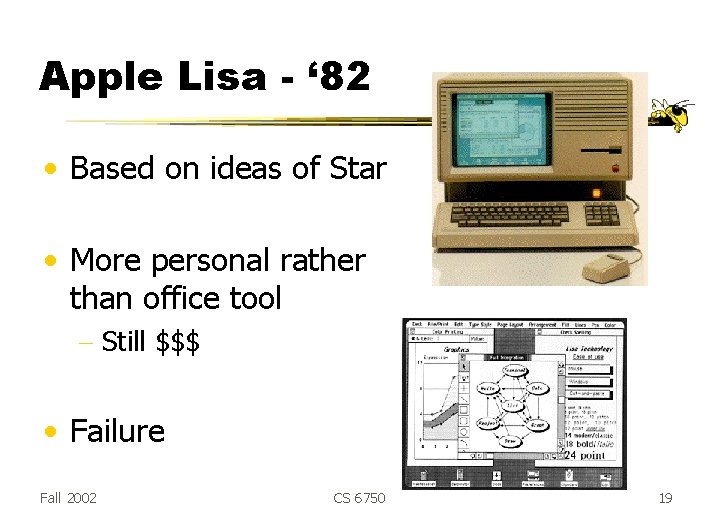
Apple Lisa - ‘ 82 • Based on ideas of Star • More personal rather than office tool - Still $$$ • Failure Fall 2002 CS 6750 19
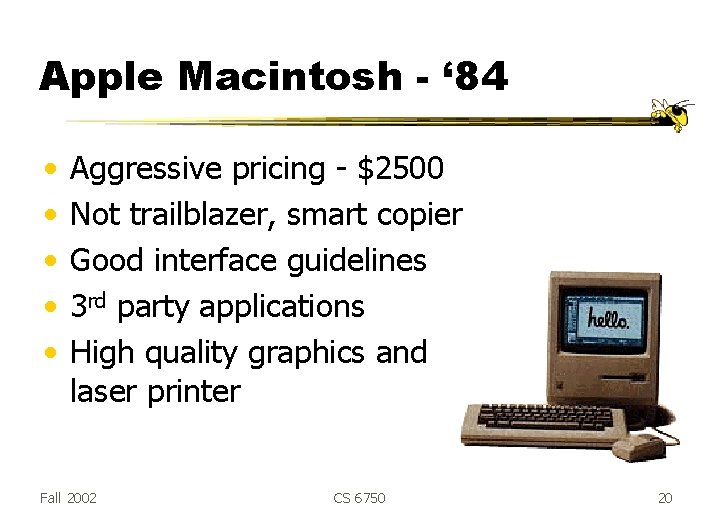
Apple Macintosh - ‘ 84 • • • Aggressive pricing - $2500 Not trailblazer, smart copier Good interface guidelines 3 rd party applications High quality graphics and laser printer Fall 2002 CS 6750 20
WIMP • • Windows, Icons, Menus, Pointers Can do several things simulataneously Familiar GUI interface Xerox Alto, Star; early Apples Fall 2002 CS 6750 21
Metaphor • All use is problem-solving or learning to some extent • Relating computing to real-world activity is effective learning mechanism - File management on office desktop - Financial analysis as spreadsheets Fall 2002 CS 6750 22
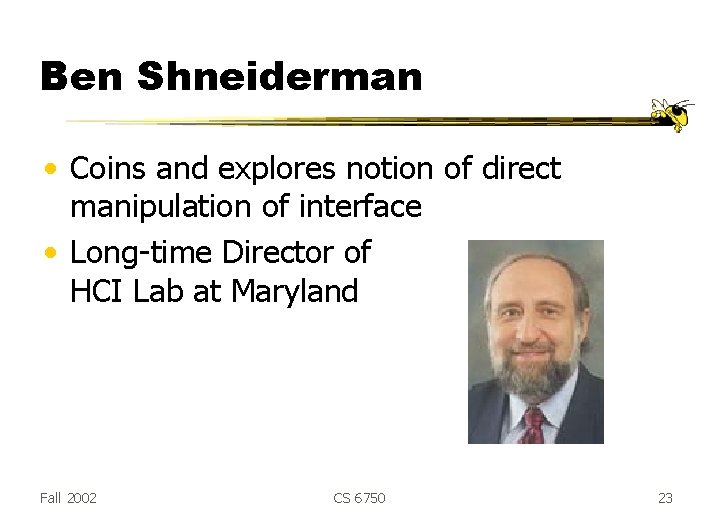
Ben Shneiderman • Coins and explores notion of direct manipulation of interface • Long-time Director of HCI Lab at Maryland Fall 2002 CS 6750 23
Direct Manipulation • ‘ 82 Shneiderman describes appeal of graphically-based interaction - object visibility - incremental action and rapid feedback - reversibility encourages exploration - replace language with action - syntactic correctness of all actions • WYSIWYG, Apple Mac Fall 2002 CS 6750 24
Multimodality • Mode is a human communication channel - Not just the senses, e. g. , speech and nonspeech audio are two modes • Emphasis on simultaneous use of multiple channels for I/O Fall 2002 CS 6750 25
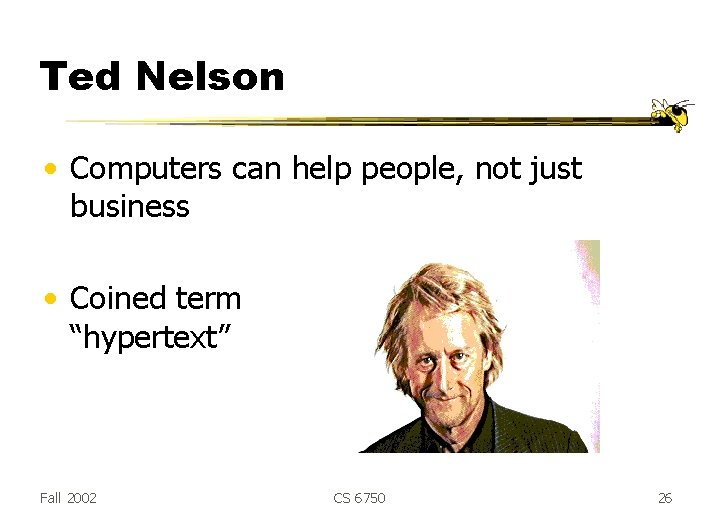
Ted Nelson • Computers can help people, not just business • Coined term “hypertext” Fall 2002 CS 6750 26
Hypertext • Think of information not as linear flow but as interconnected nodes • Bush’s MEMEX, Nelson’s hypertext • Non-linear browsing structure • WWW ‘ 93 Fall 2002 CS 6750 27
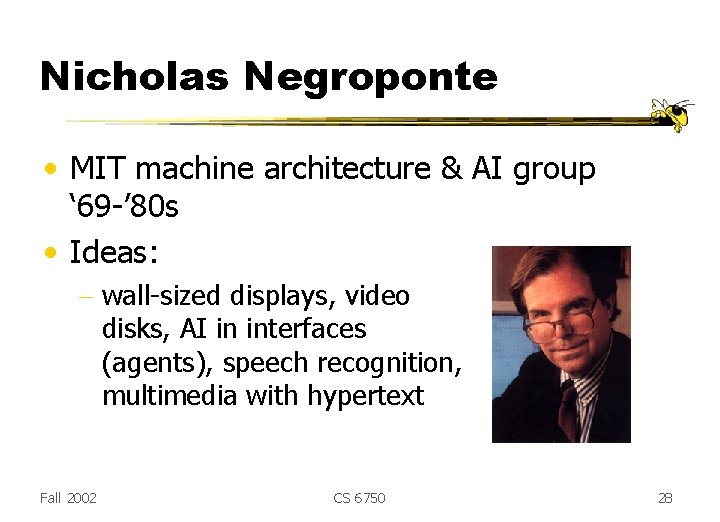
Nicholas Negroponte • MIT machine architecture & AI group ‘ 69 -’ 80 s • Ideas: - wall-sized displays, video disks, AI in interfaces (agents), speech recognition, multimedia with hypertext Fall 2002 CS 6750 28
Language (Agents) • Actions do not always speak louder than words • Interface as mediator or agent • Language paradigm Fall 2002 CS 6750 29
CSCW • • Computer-Supported Cooperative Work No longer single user/single system Micro-social aspects are crucial E-mail as prominent success but other groupware still not widely used Fall 2002 CS 6750 30
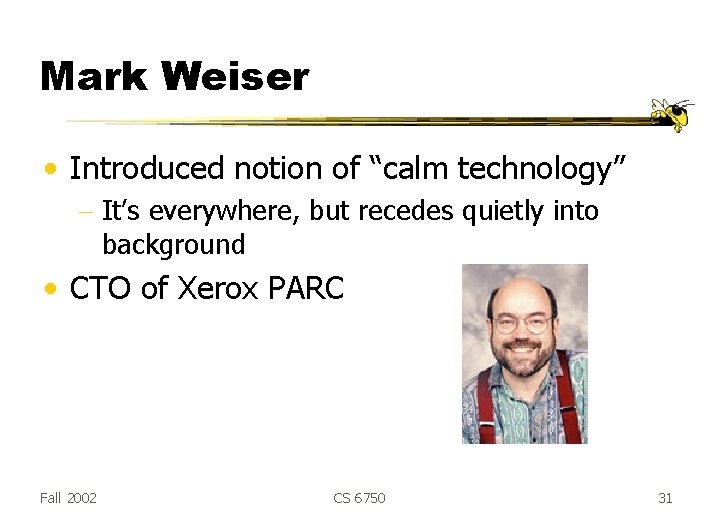
Mark Weiser • Introduced notion of “calm technology” - It’s everywhere, but recedes quietly into background • CTO of Xerox PARC Fall 2002 CS 6750 31
Ubiquity • Person is no longer user of virtual device but occupant of virtual, computationallyrich environment • Can no longer neglect macro-social aspects • Late ‘ 90 s - PDAs, VEs, . . . Fall 2002 CS 6750 32