
History of Geography Began to assist with navigation
History of Geography • Began to assist with navigation • 2300 BC (Babylonians) – oldest surviving maps • Eratosthenes – 1 st person to use the term “geography”

Pattison’s 4 traditions of Geography • Spatial Tradition (also called Locational Tradition) – Spatial analysis – Boundaries and densities – Movement and transportation – Quantitative techniques and tools, such as computerized mapping and Geographic Information Systems – Central Place Theory – Areal distribution – Spatial patterns – mapping

Pattison’s 4 traditions of Geography • Area Studies Tradition (also called Regional Tradition) – Description of regions or areas – World regional geography – International trends and relationships – How regions are different from one another – The chorographic tradition (regions)

Pattison’s 4 traditions of Geography • Man-Land Tradition (also called Human-Environmental, Human -Land, or Culture-Environment Tradition) – Human impact on nature – Impact of nature on humans – Natural hazards – Perception of environment – Environmentalism – Cultural, political, and population geography

Pattison’s 4 traditions of Geography • Earth Science Tradition – Physical geography – The lithosphere, hydrosphere, atmosphere, and biosphere – Earth-sun interaction – Offshoots are geology, mineralogy, paleontology, glaciology, geomorphology, and meteorology – The study of the earth as the home to humans
Site Factors – a place’s physical factors 1. Climate 2. Vegetation 3. Soil 4. Landforms 5. Natural Disasters
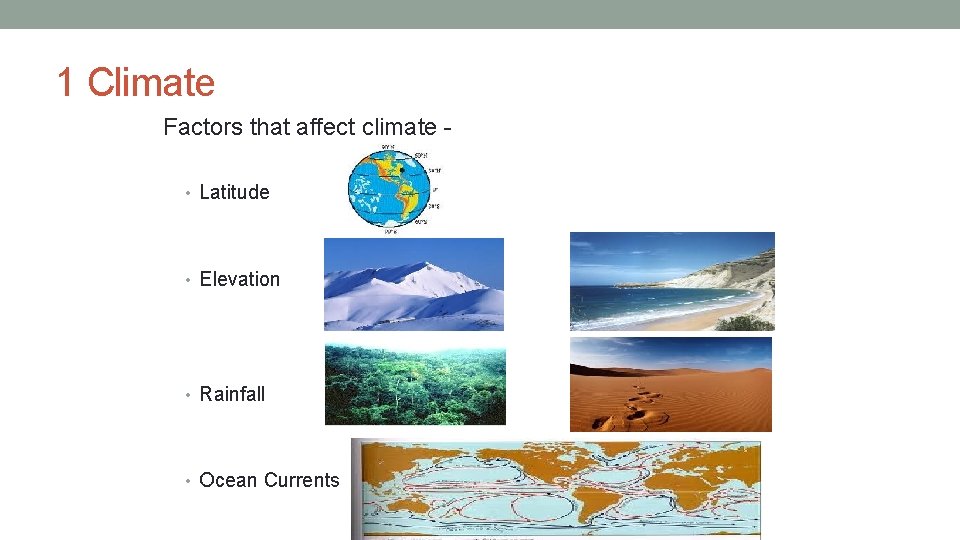
1 Climate Factors that affect climate • Latitude • Elevation • Rainfall • Ocean Currents
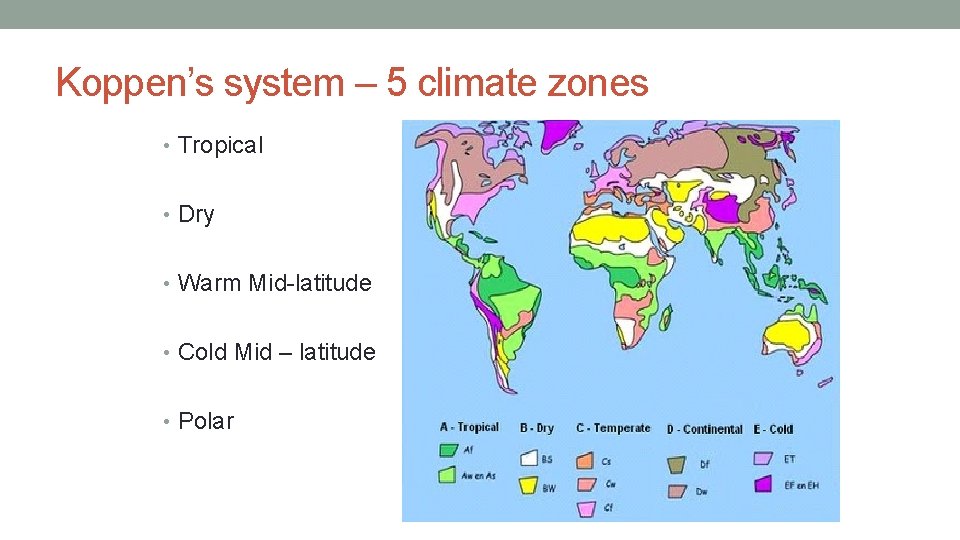
Koppen’s system – 5 climate zones • Tropical • Dry • Warm Mid-latitude • Cold Mid – latitude • Polar
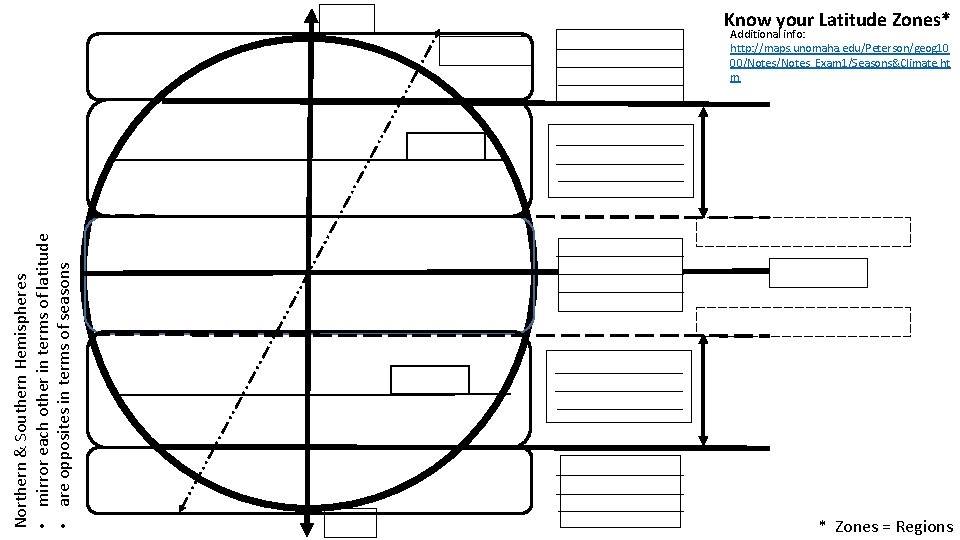
Know your Latitude Zones* 900 N Axis, 23. 50 High Latitude (Polar Zone) 66. 50 N – 900 N Additional info: http: //maps. unomaha. edu/Peterson/geog 10 00/Notes_Exam 1/Seasons&Climate. ht m Northern & Southern Hemispheres • mirror each other in terms of latitude • are opposites in terms of seasons Mid-Latitude (Temperate Zone) 23. 50 – 66. 50 N Low Latitude (Tropical Zone) 00 – 23. 50 N/S Tropic of Cancer, 23. 50 N Equator, 00 Tropic of Capricorn, 23. 50 S Mid-Latitude (Temperate Zone) 23. 50 – 66. 50 S 900 S High Latitude (Polar Zone) 66. 50 S – 900 S * Zones = Regions
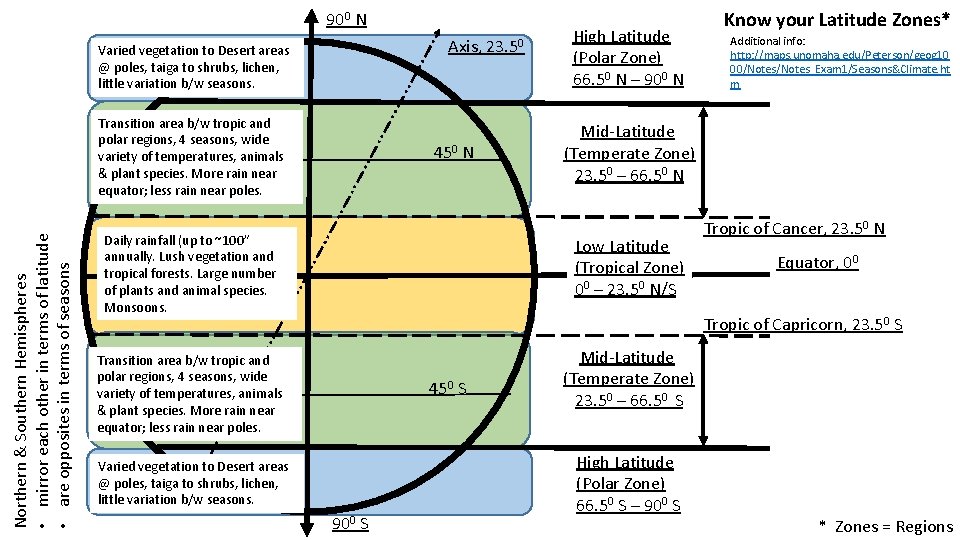
900 N Axis, 23. 50 Varied vegetation to Desert areas @ poles, taiga to shrubs, lichen, little variation b/w seasons. Northern & Southern Hemispheres • mirror each other in terms of latitude • are opposites in terms of seasons Transition area b/w tropic and polar regions, 4 seasons, wide variety of temperatures, animals & plant species. More rain near equator; less rain near poles. 450 N High Latitude (Polar Zone) 66. 50 N – 900 N Know your Latitude Zones* Additional info: http: //maps. unomaha. edu/Peterson/geog 10 00/Notes_Exam 1/Seasons&Climate. ht m Mid-Latitude (Temperate Zone) 23. 50 – 66. 50 N Daily rainfall (up to ~100” annually. Lush vegetation and tropical forests. Large number of plants and animal species. Monsoons. Low Latitude (Tropical Zone) 00 – 23. 50 N/S Transition area b/w tropic and polar regions, 4 seasons, wide variety of temperatures, animals & plant species. More rain near equator; less rain near poles. Mid-Latitude (Temperate Zone) 23. 50 – 66. 50 S Tropic of Cancer, 23. 50 N Equator, 00 Tropic of Capricorn, 23. 50 S 450 S Varied vegetation to Desert areas @ poles, taiga to shrubs, lichen, little variation b/w seasons. 900 S High Latitude (Polar Zone) 66. 50 S – 900 S * Zones = Regions
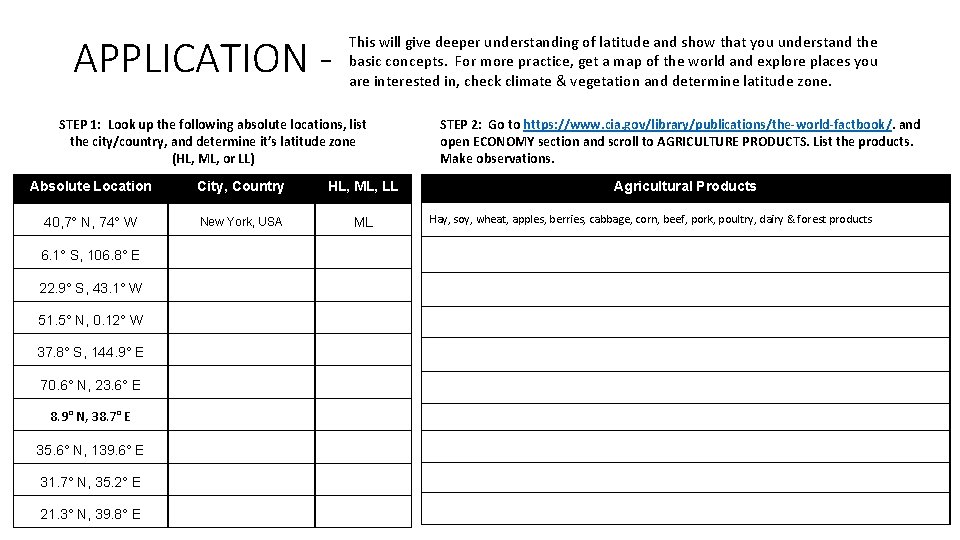
APPLICATION - This will give deeper understanding of latitude and show that you understand the basic concepts. For more practice, get a map of the world and explore places you are interested in, check climate & vegetation and determine latitude zone. STEP 1: Look up the following absolute locations, list the city/country, and determine it’s latitude zone (HL, ML, or LL) STEP 2: Go to https: //www. cia. gov/library/publications/the-world-factbook/. and open ECONOMY section and scroll to AGRICULTURE PRODUCTS. List the products. Make observations. Absolute Location City, Country HL, ML, LL 40, 7° N, 74° W New York, USA ML 6. 1° S, 106. 8° E Jakarta. Indonesia LL rubber and similar products, palm oil, poultry, beef, forest products, shrimp, cocoa, coffee, medicinal and spices 22. 9° S, 43. 1° W Rio de Janeiro. Brazil LL coffee, soybeans, wheat, rice, corn, sugarcane, cocoa, citrus; beef 51. 5° N, 0. 12° W London. UK ML cereals, oilseed, potatoes, vegetables; cattle, sheep, poultry; fish 37. 8° S, 144. 9° E Melbourne. Australia ML wheat, barley, sugarcane, fruits; cattle, sheep, poultry 70. 6° N, 23. 6° E Hammerfest, Norway HL barley, wheat, potatoes; pork, beef, veal, milk; fish 8. 9° N, 38. 7° E Addis Ababa. Ethiopia LL cereals, coffee, oilseed, cotton, sugarcane, vegetables, flowers; hides, cattle, sheep, goats; fish 35. 6° N, 139. 6° E Tokyo. Japan ML vegetables, rice, fish, poultry, fruit, dairy products, pork, beef, flowers, potatoes/taros/yams, sugar cane, 31. 7° N, 35. 2° E Jerusalem. Israel ML citrus, vegetables, cotton; beef, poultry, dairy products 21. 3° N, 39. 8° E Mecca. Saudi Arabia LL wheat, barley, tomatoes, melons, dates, citrus; mutton, chickens, eggs, milk Agricultural Products Hay, soy, wheat, apples, berries, cabbage, corn, beef, pork, poultry, dairy & forest products
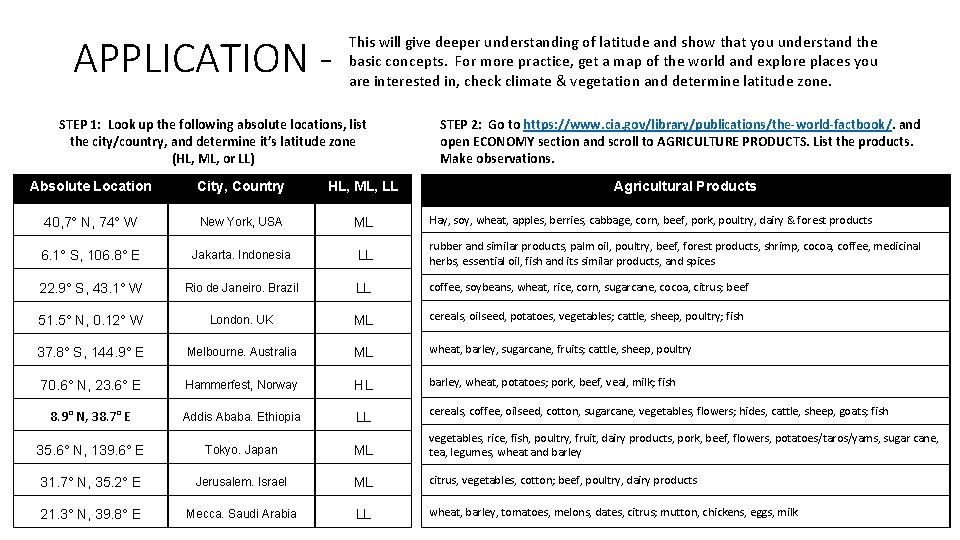
APPLICATION - This will give deeper understanding of latitude and show that you understand the basic concepts. For more practice, get a map of the world and explore places you are interested in, check climate & vegetation and determine latitude zone. STEP 1: Look up the following absolute locations, list the city/country, and determine it’s latitude zone (HL, ML, or LL) STEP 2: Go to https: //www. cia. gov/library/publications/the-world-factbook/. and open ECONOMY section and scroll to AGRICULTURE PRODUCTS. List the products. Make observations. Absolute Location City, Country HL, ML, LL Agricultural Products 40, 7° N, 74° W New York, USA ML 6. 1° S, 106. 8° E Jakarta. Indonesia LL rubber and similar products, palm oil, poultry, beef, forest products, shrimp, cocoa, coffee, medicinal herbs, essential oil, fish and its similar products, and spices 22. 9° S, 43. 1° W Rio de Janeiro. Brazil LL coffee, soybeans, wheat, rice, corn, sugarcane, cocoa, citrus; beef 51. 5° N, 0. 12° W London. UK ML cereals, oilseed, potatoes, vegetables; cattle, sheep, poultry; fish 37. 8° S, 144. 9° E Melbourne. Australia ML wheat, barley, sugarcane, fruits; cattle, sheep, poultry 70. 6° N, 23. 6° E Hammerfest, Norway HL barley, wheat, potatoes; pork, beef, veal, milk; fish 8. 9° N, 38. 7° E Addis Ababa. Ethiopia LL cereals, coffee, oilseed, cotton, sugarcane, vegetables, flowers; hides, cattle, sheep, goats; fish 35. 6° N, 139. 6° E Tokyo. Japan ML vegetables, rice, fish, poultry, fruit, dairy products, pork, beef, flowers, potatoes/taros/yams, sugar cane, tea, legumes, wheat and barley 31. 7° N, 35. 2° E Jerusalem. Israel ML citrus, vegetables, cotton; beef, poultry, dairy products 21. 3° N, 39. 8° E Mecca. Saudi Arabia LL wheat, barley, tomatoes, melons, dates, citrus; mutton, chickens, eggs, milk Hay, soy, wheat, apples, berries, cabbage, corn, beef, pork, poultry, dairy & forest products
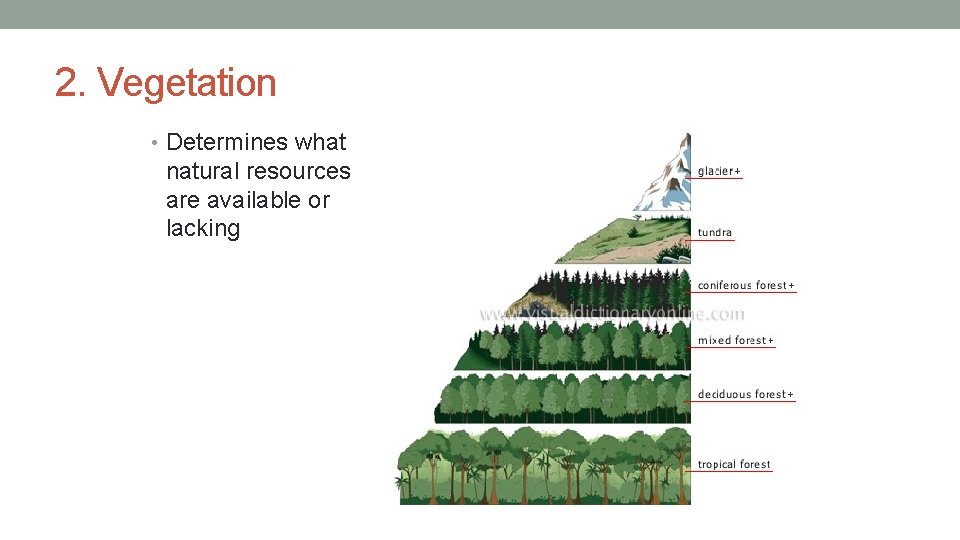
2. Vegetation • Determines what natural resources are available or lacking
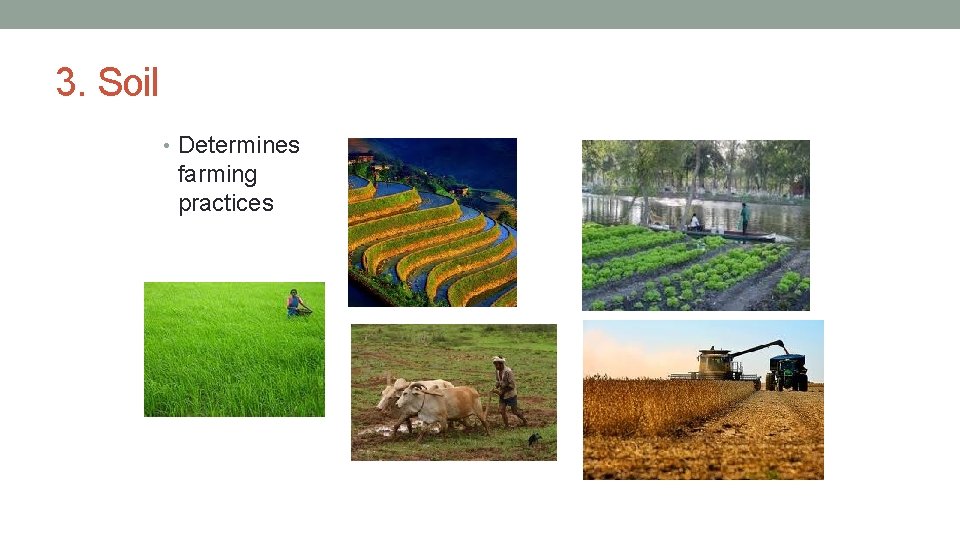
3. Soil • Determines farming practices
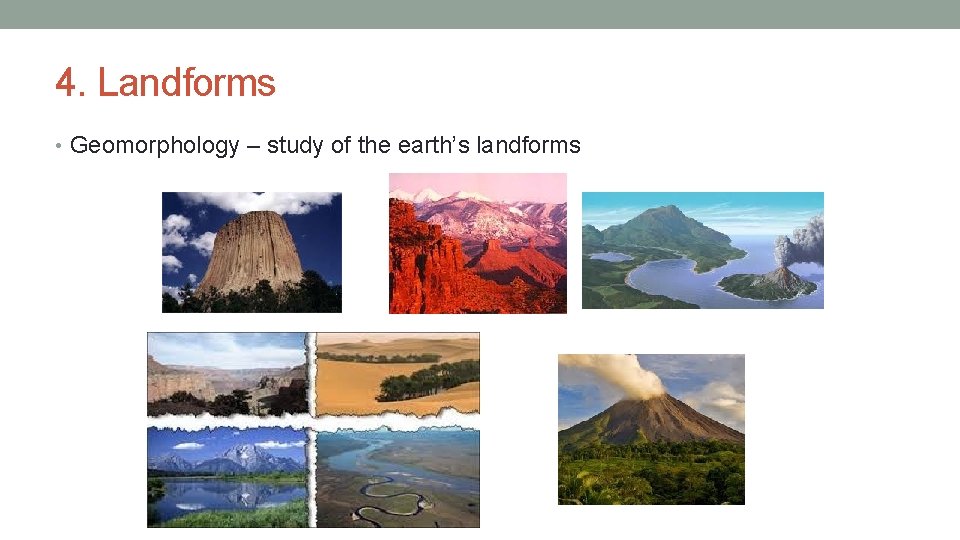
4. Landforms • Geomorphology – study of the earth’s landforms
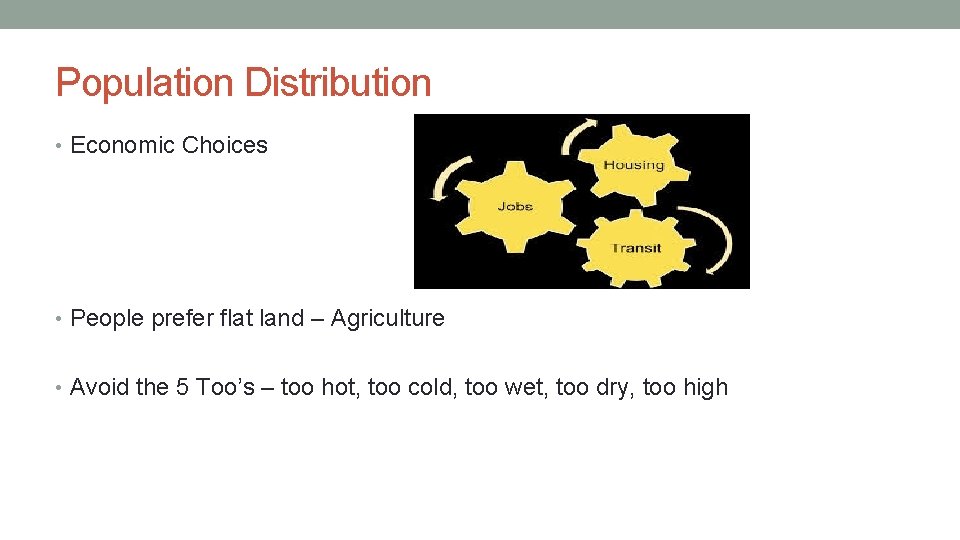
Population Distribution • Economic Choices • People prefer flat land – Agriculture • Avoid the 5 Too’s – too hot, too cold, too wet, too dry, too high
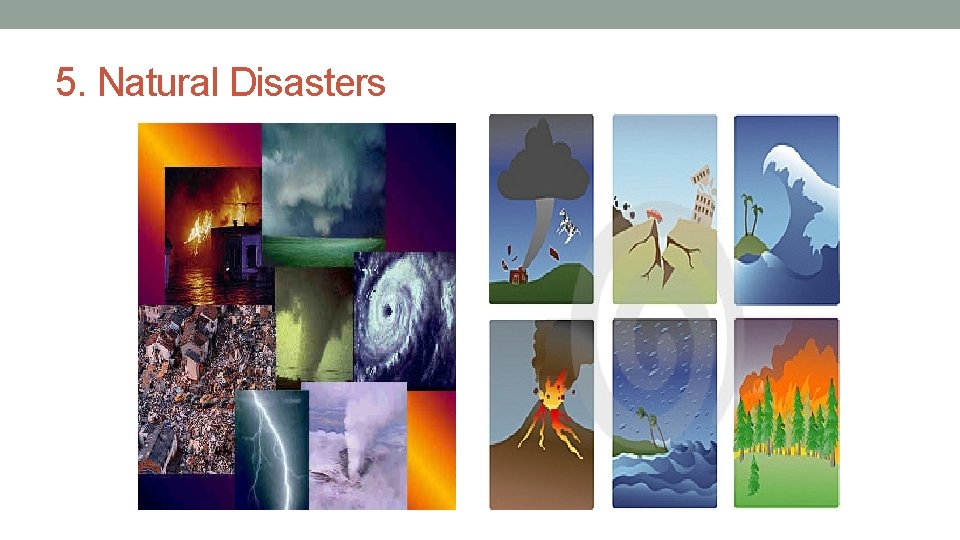
5. Natural Disasters
- Slides: 17