
History of galaxy observation Great Andromeda Nebula 1920
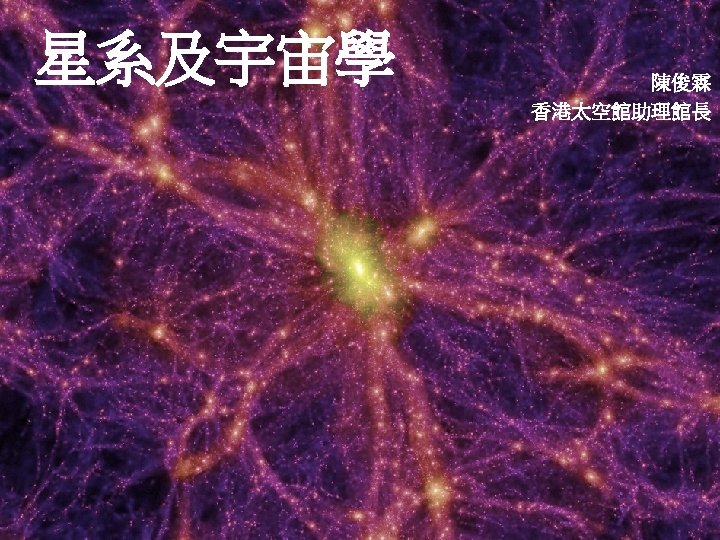
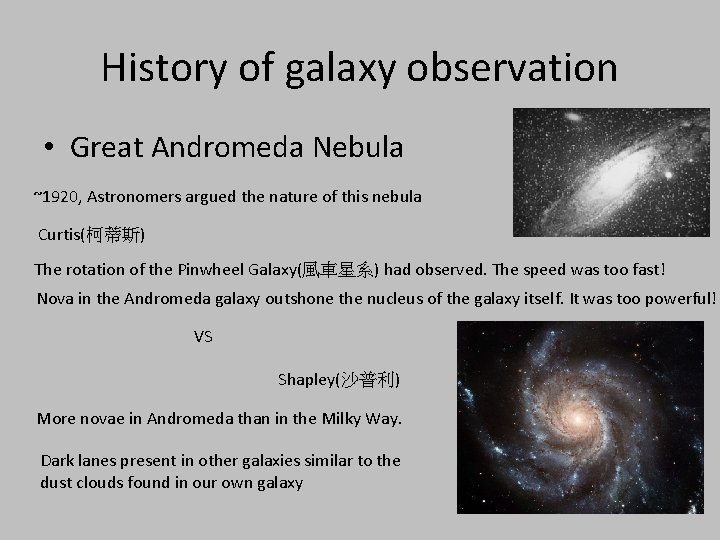
History of galaxy observation • Great Andromeda Nebula ~1920, Astronomers argued the nature of this nebula Curtis(柯蒂斯) The rotation of the Pinwheel Galaxy(風車星系) had observed. The speed was too fast! Nova in the Andromeda galaxy outshone the nucleus of the galaxy itself. It was too powerful! VS Shapley(沙普利) More novae in Andromeda than in the Milky Way. Dark lanes present in other galaxies similar to the dust clouds found in our own galaxy
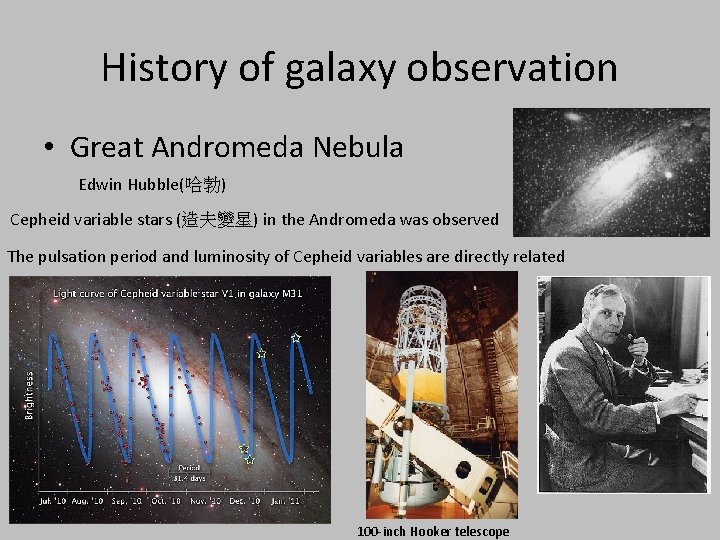
History of galaxy observation • Great Andromeda Nebula Edwin Hubble(哈勃) Cepheid variable stars (造夫變星) in the Andromeda was observed The pulsation period and luminosity of Cepheid variables are directly related 100 -inch Hooker telescope
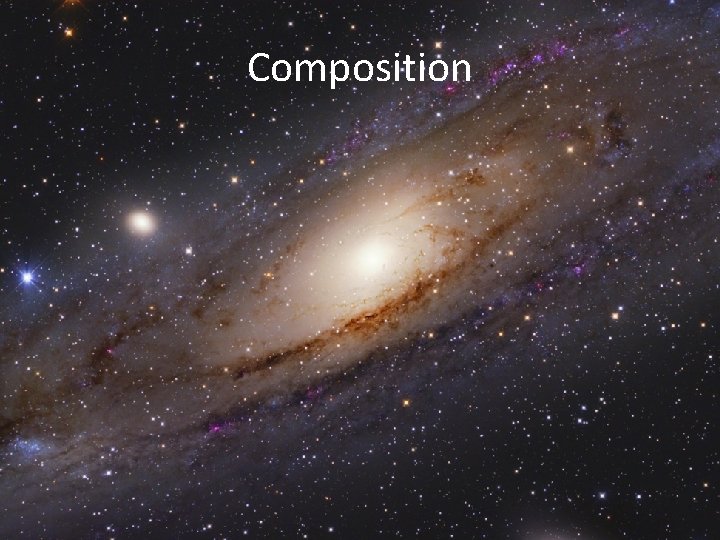
Composition
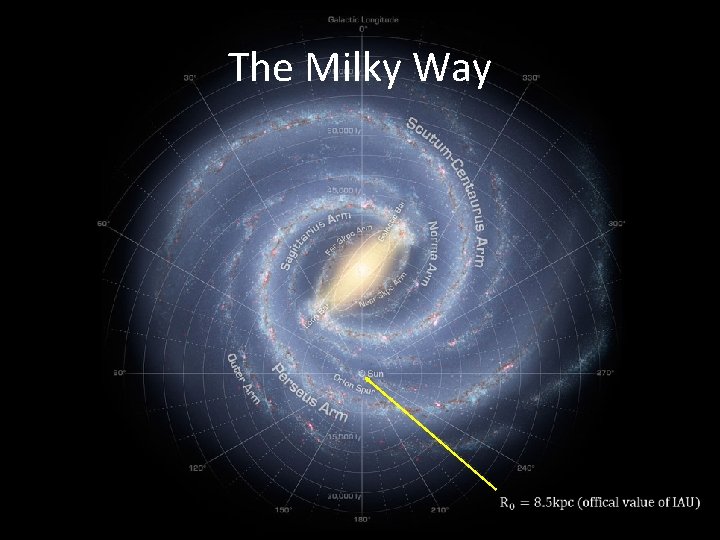
The Milky Way
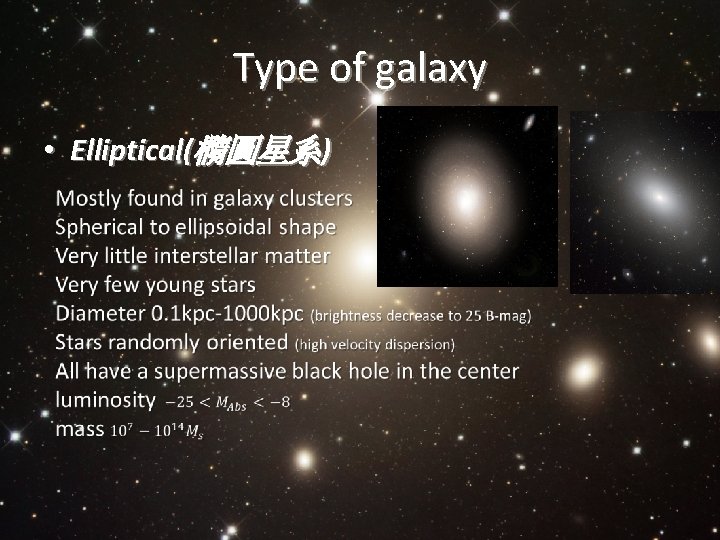
Type of galaxy • Elliptical(橢圓星系)
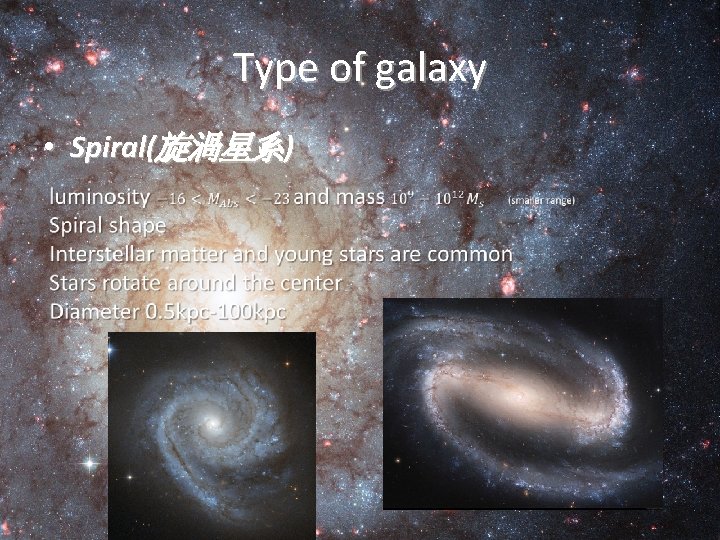
Type of galaxy • Spiral(旋渦星系)
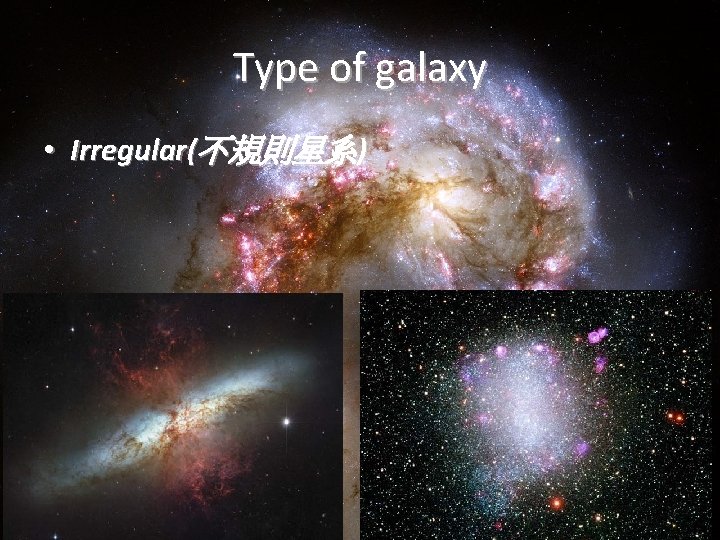
Type of galaxy • Irregular(不規則星系)
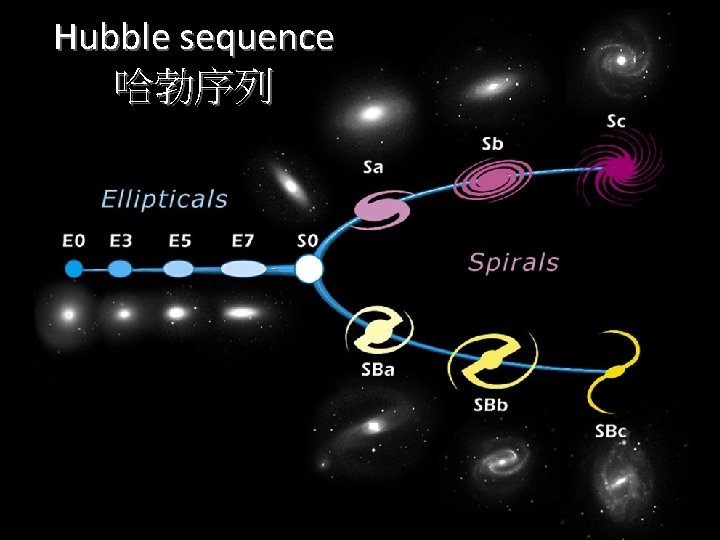
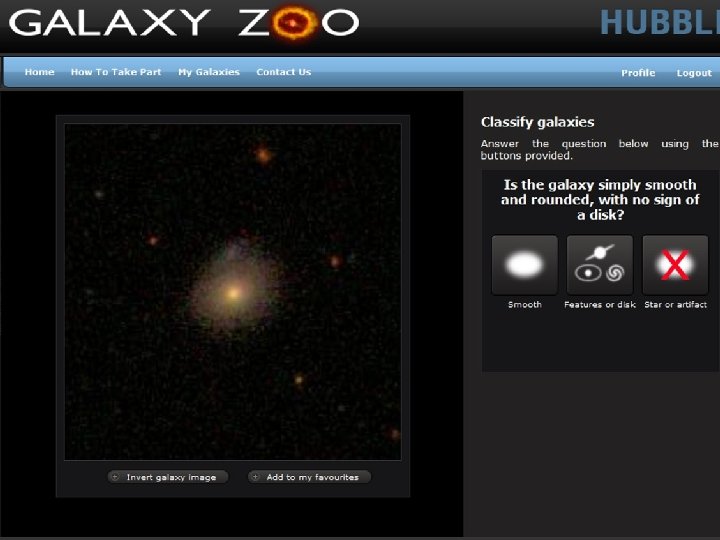
Hubble sequence 哈勃序列
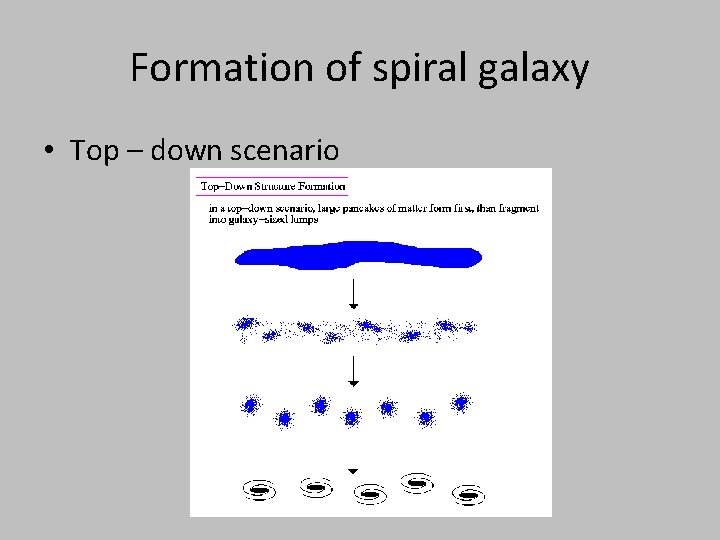
Formation of spiral galaxy • Top – down scenario
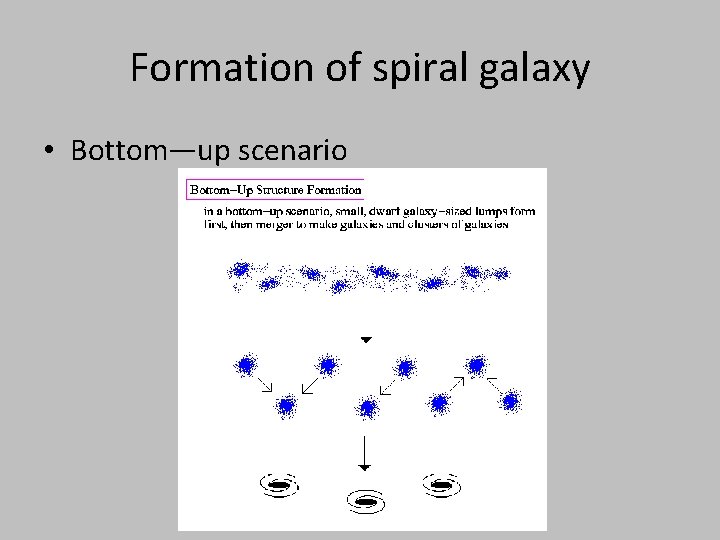
Formation of spiral galaxy • Bottom—up scenario
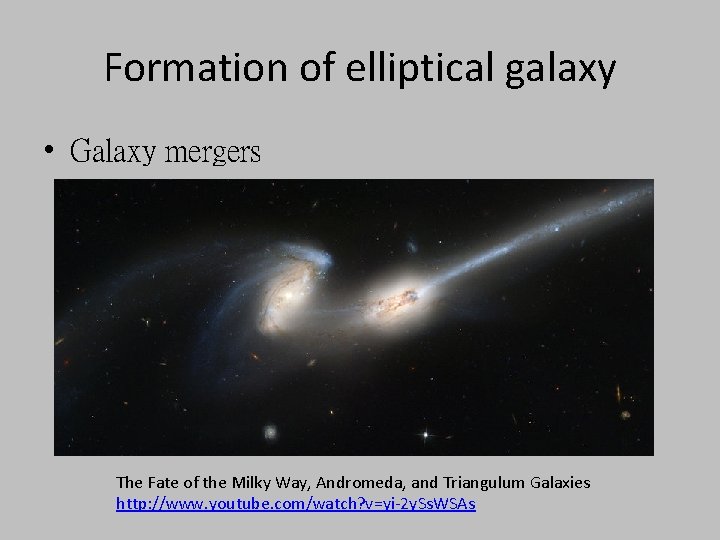
Formation of elliptical galaxy • Galaxy mergers The Fate of the Milky Way, Andromeda, and Triangulum Galaxies http: //www. youtube. com/watch? v=yi-2 y. Ss. WSAs
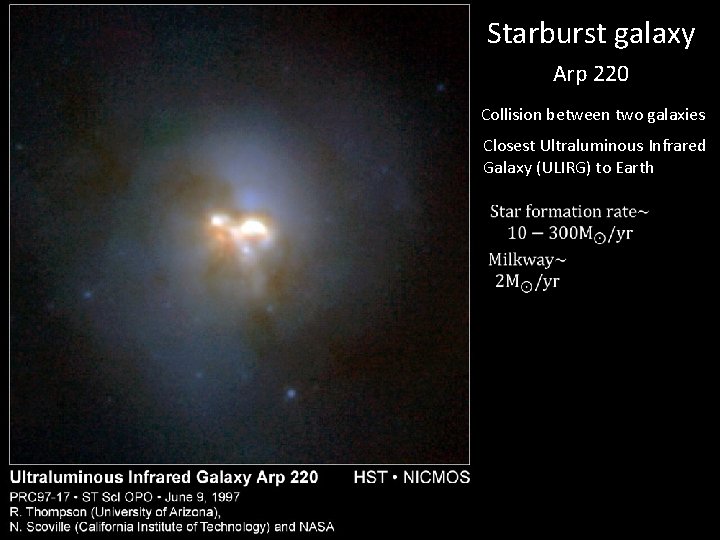
Starburst galaxy Arp 220 Collision between two galaxies Closest Ultraluminous Infrared Galaxy (ULIRG) to Earth
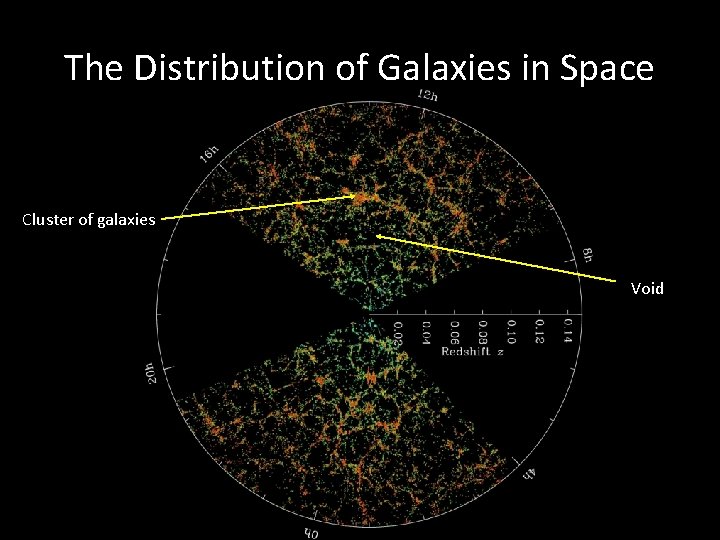
The Distribution of Galaxies in Space Cluster of galaxies Void
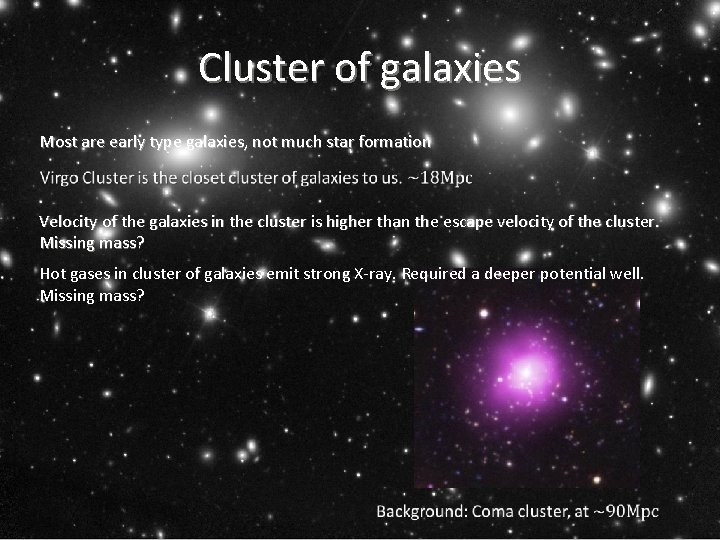
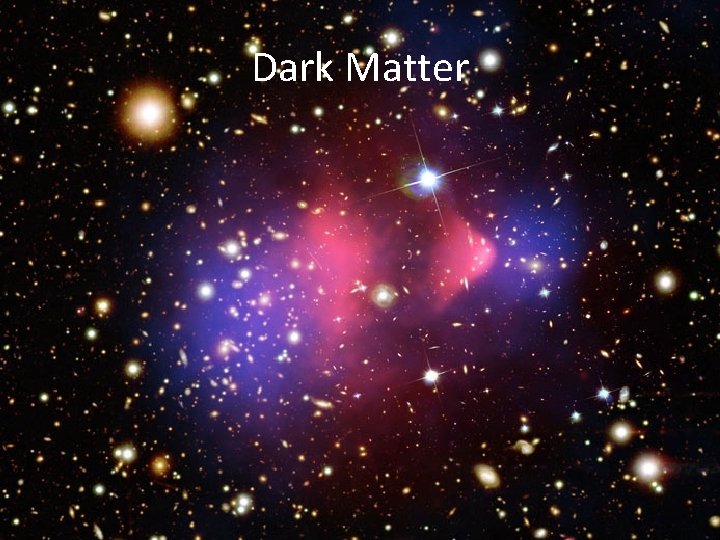
Cluster of galaxies Most are early type galaxies, not much star formation Velocity of the galaxies in the cluster is higher than the escape velocity of the cluster. Missing mass? Hot gases in cluster of galaxies emit strong X-ray. Required a deeper potential well. Missing mass?
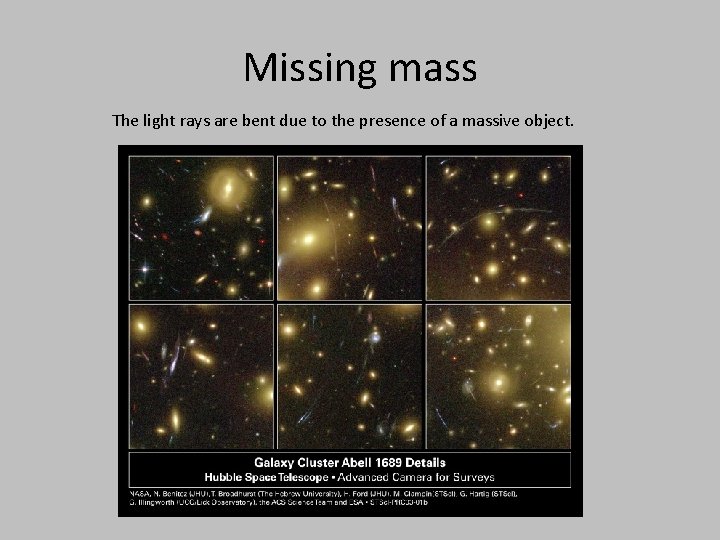
Missing mass The light rays are bent due to the presence of a massive object.
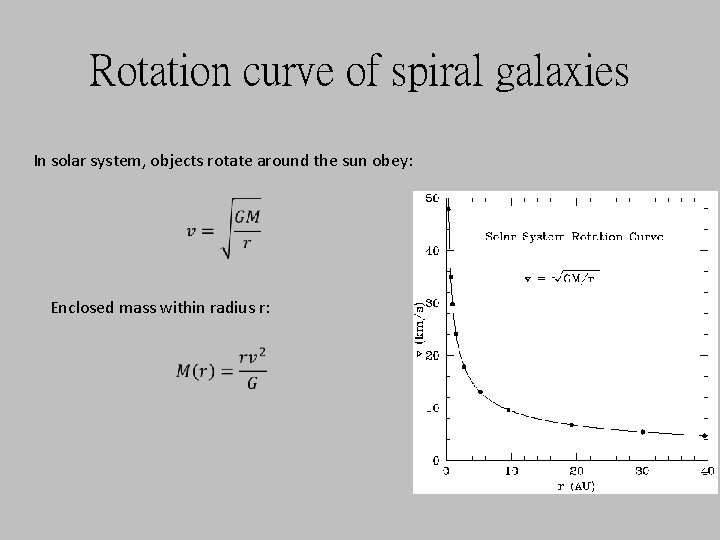
Rotation curve of spiral galaxies In solar system, objects rotate around the sun obey: Enclosed mass within radius r:
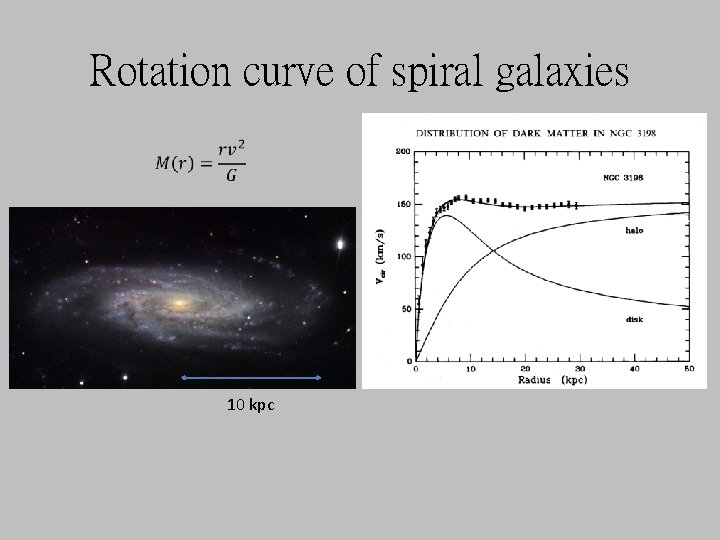
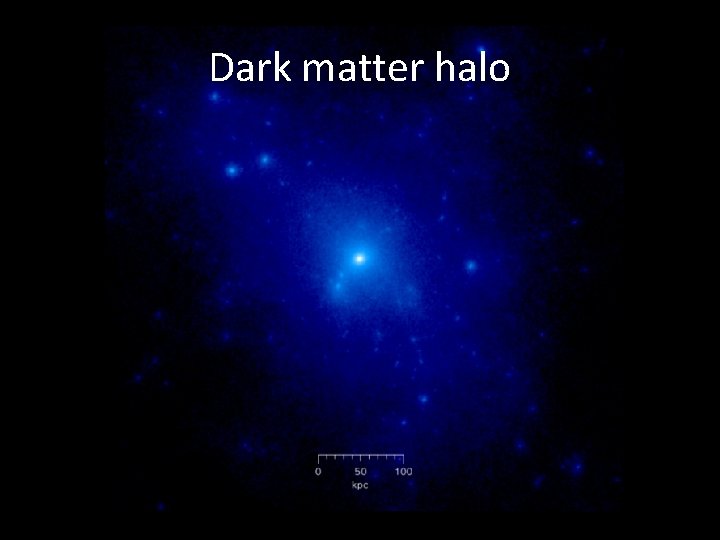
Rotation curve of spiral galaxies 10 kpc
Dark matter halo
Dark Matter
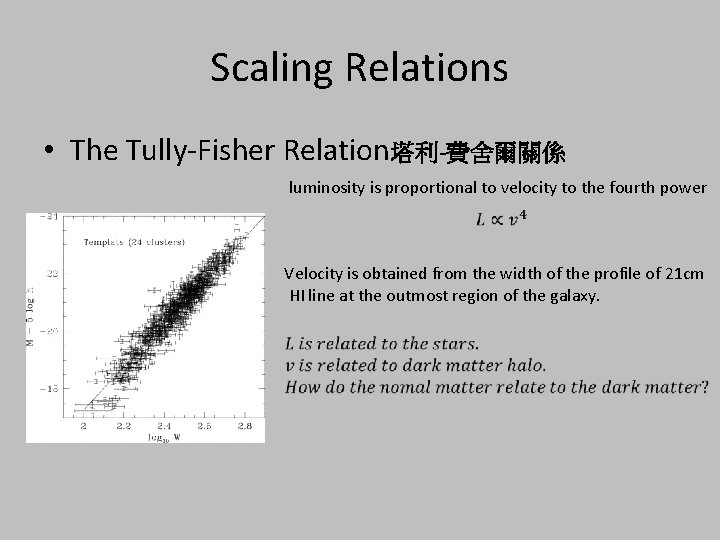
Scaling Relations • The Tully-Fisher Relation塔利-費舍爾關係 luminosity is proportional to velocity to the fourth power Velocity is obtained from the width of the profile of 21 cm HI line at the outmost region of the galaxy.
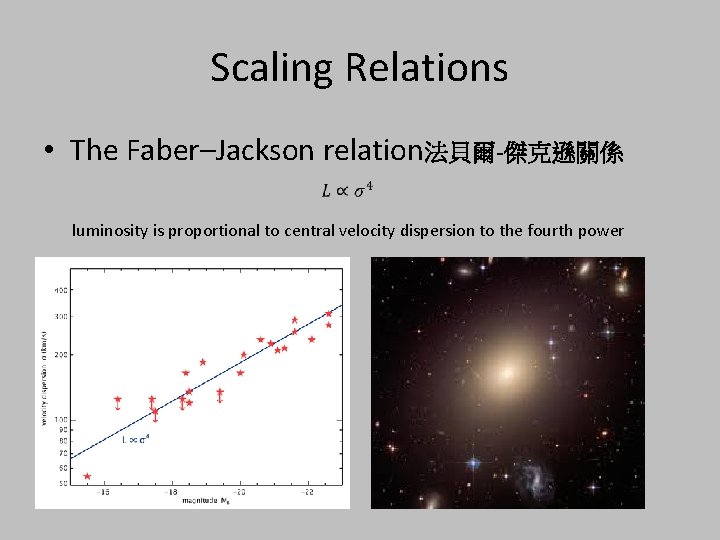
Scaling Relations • The Faber–Jackson relation法貝爾-傑克遜關係 luminosity is proportional to central velocity dispersion to the fourth power
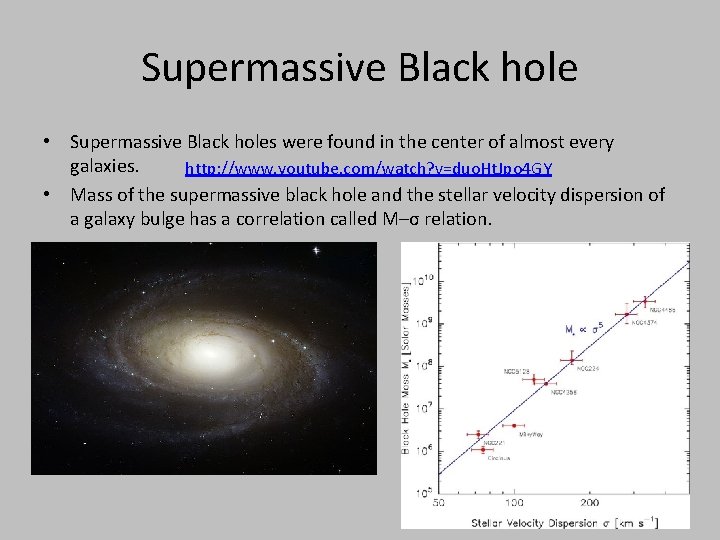
Supermassive Black hole • Supermassive Black holes were found in the center of almost every galaxies. http: //www. youtube. com/watch? v=duo. Ht. Jpo 4 GY • Mass of the supermassive black hole and the stellar velocity dispersion of a galaxy bulge has a correlation called M–σ relation.
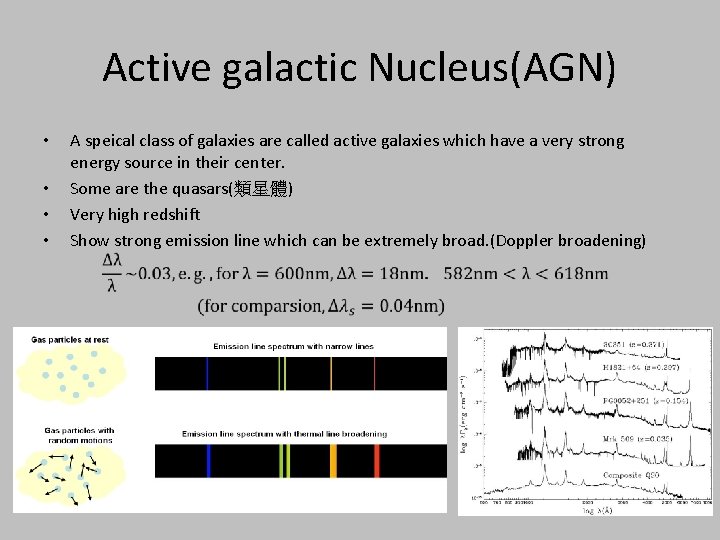
Active galactic Nucleus(AGN) • • A speical class of galaxies are called active galaxies which have a very strong energy source in their center. Some are the quasars(類星體) Very high redshift Show strong emission line which can be extremely broad. (Doppler broadening)
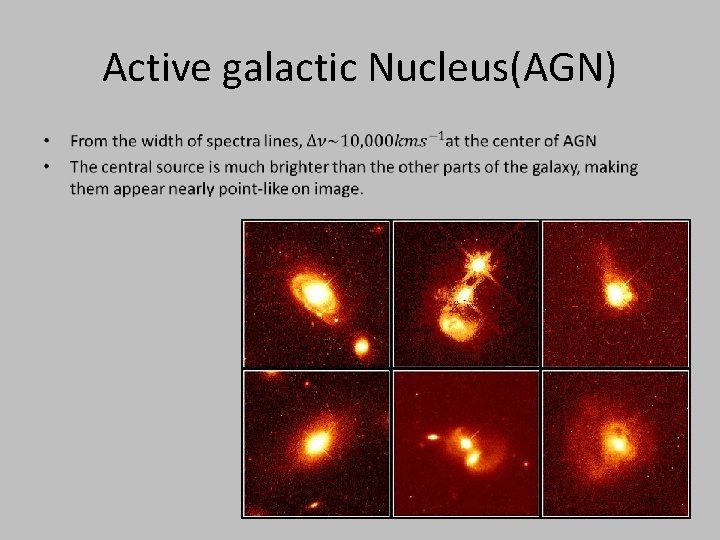
Active galactic Nucleus(AGN) •
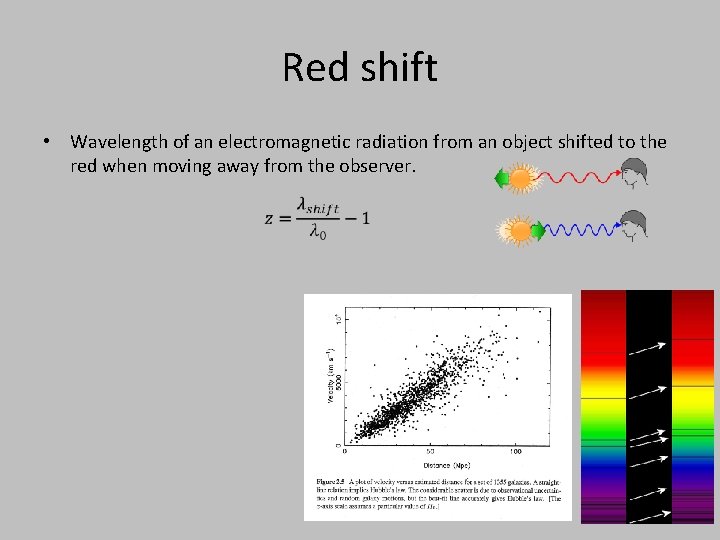
Red shift • Wavelength of an electromagnetic radiation from an object shifted to the red when moving away from the observer.
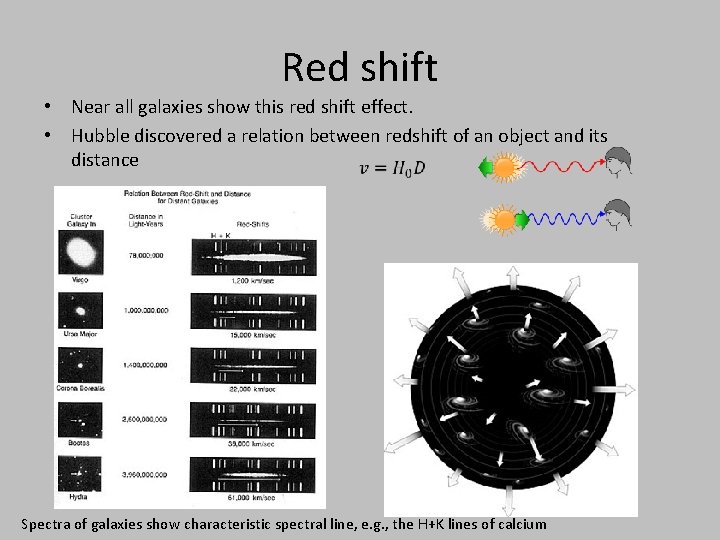
Red shift • Near all galaxies show this red shift effect. • Hubble discovered a relation between redshift of an object and its distance Spectra of galaxies show characteristic spectral line, e. g. , the H+K lines of calcium
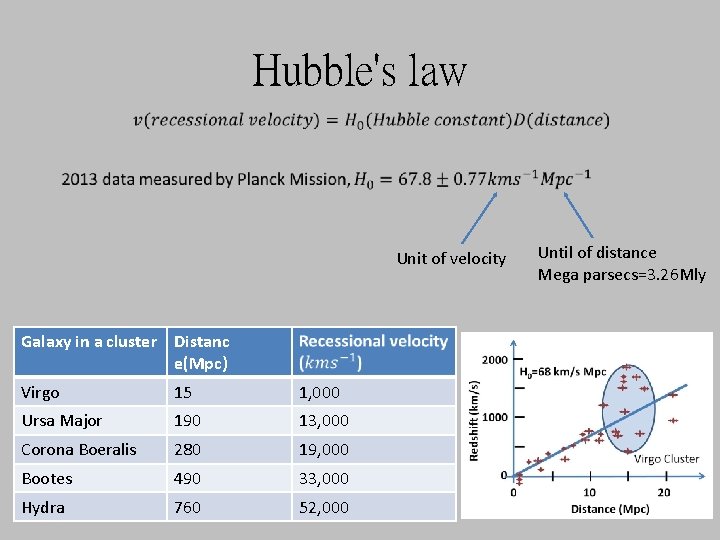
Hubble's law Unit of velocity Galaxy in a cluster Distanc e(Mpc) Virgo 15 1, 000 Ursa Major 190 13, 000 Corona Boeralis 280 19, 000 Bootes 490 33, 000 Hydra 760 52, 000 Until of distance Mega parsecs=3. 26 Mly
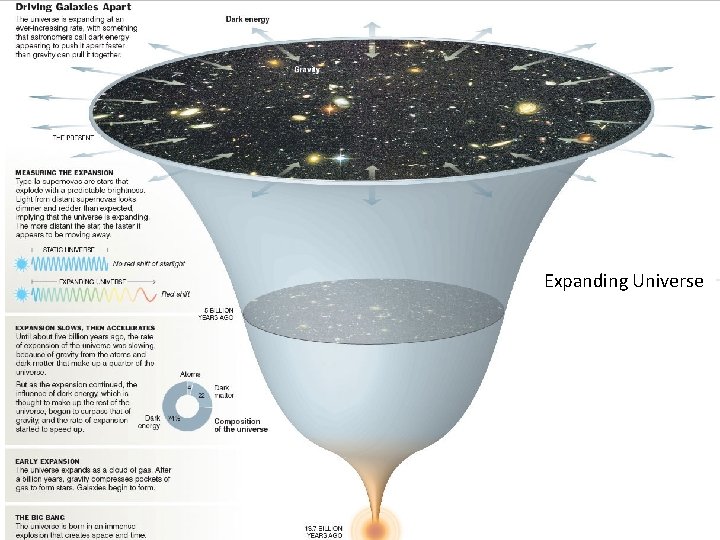
Expanding Universe
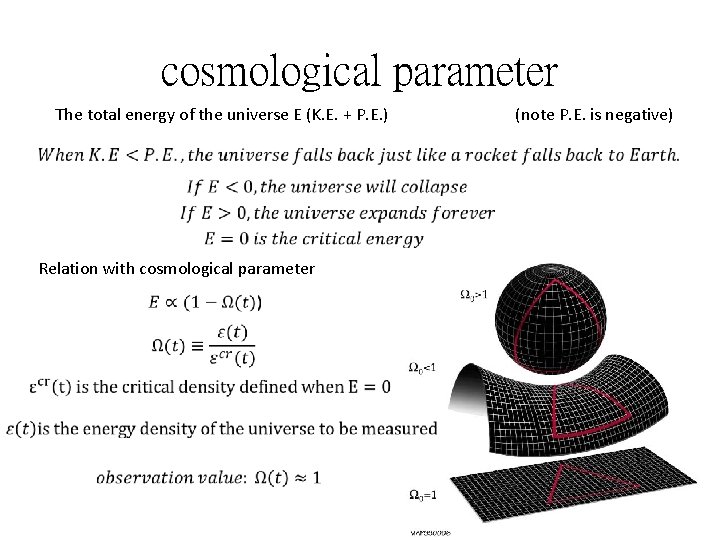
cosmological parameter The total energy of the universe E (K. E. + P. E. ) Relation with cosmological parameter (note P. E. is negative)
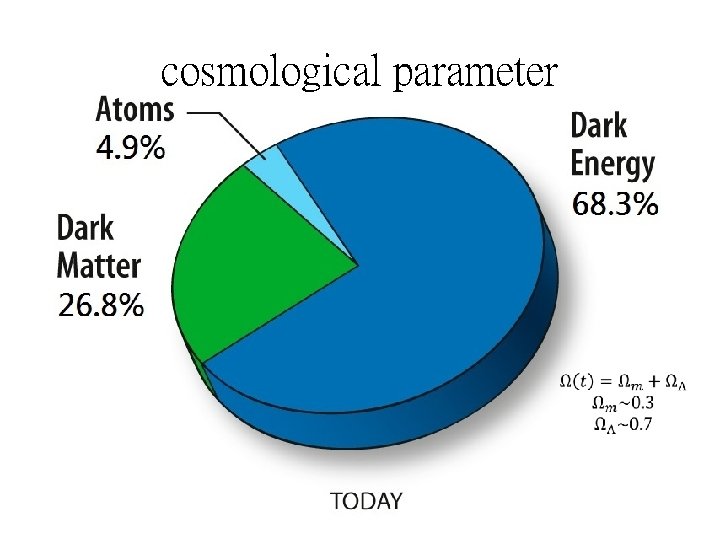
cosmological parameter
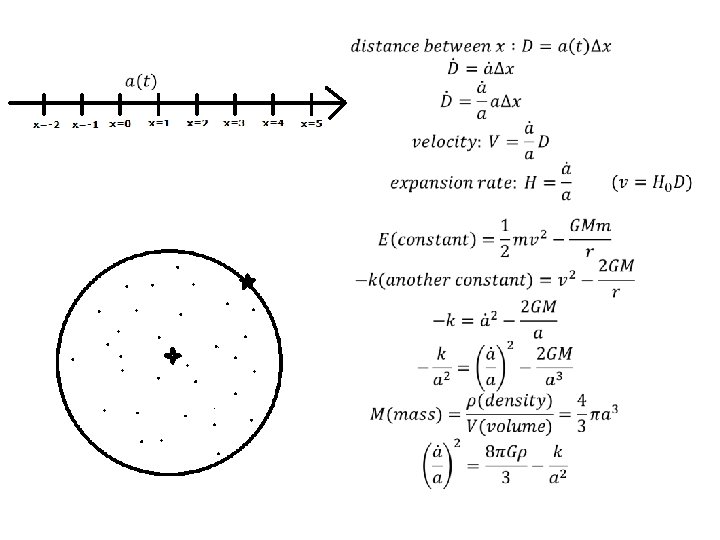
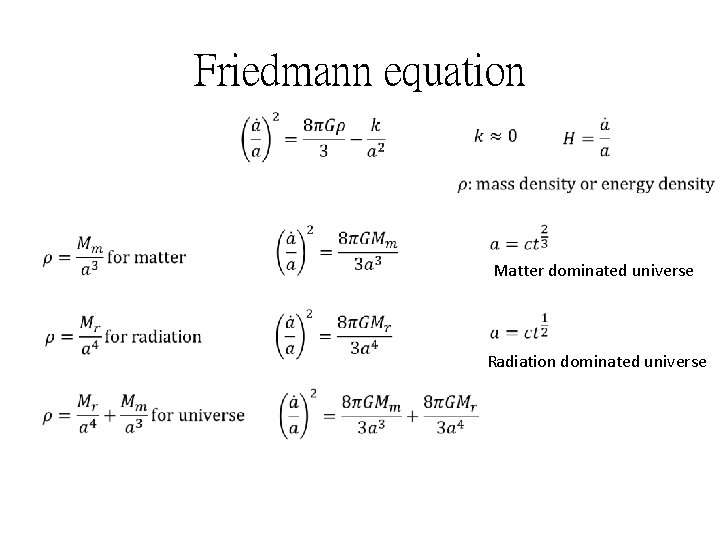
Friedmann equation Matter dominated universe Radiation dominated universe
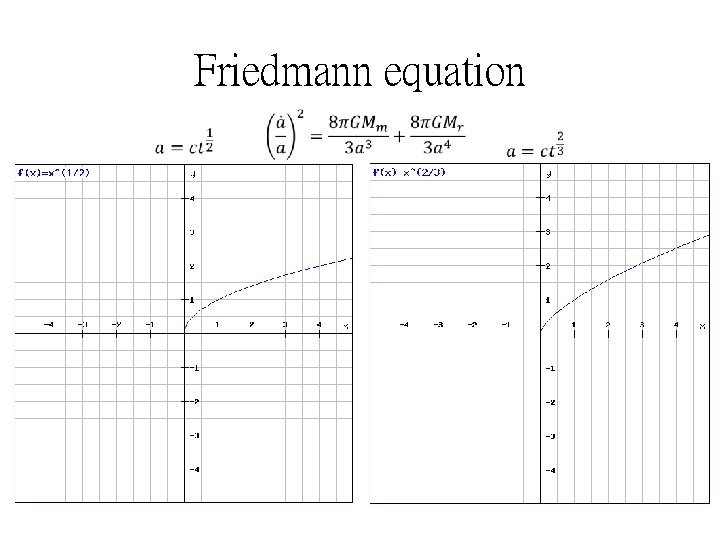
Friedmann equation
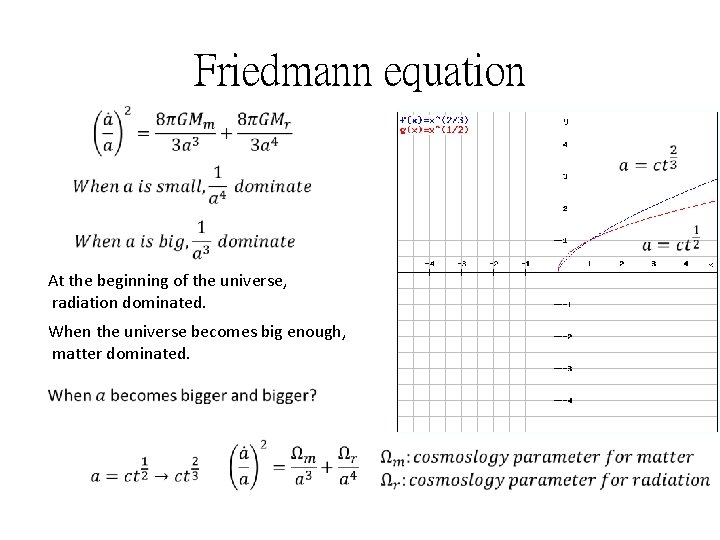
Friedmann equation At the beginning of the universe, radiation dominated. When the universe becomes big enough, matter dominated.
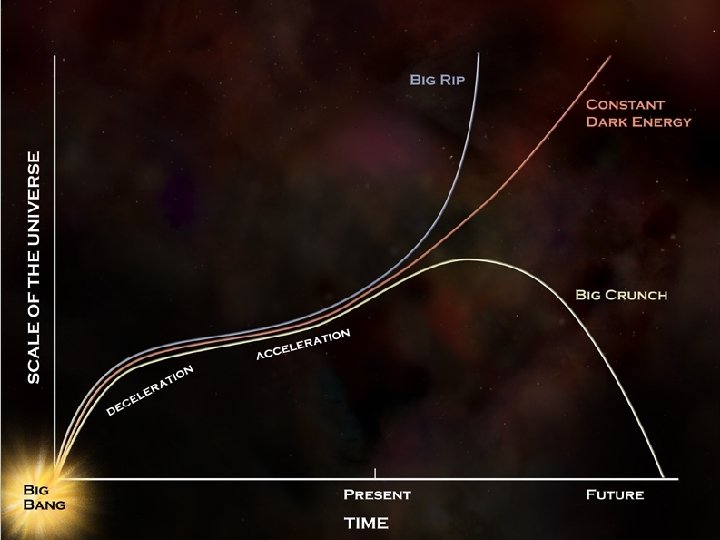

Dark energy?
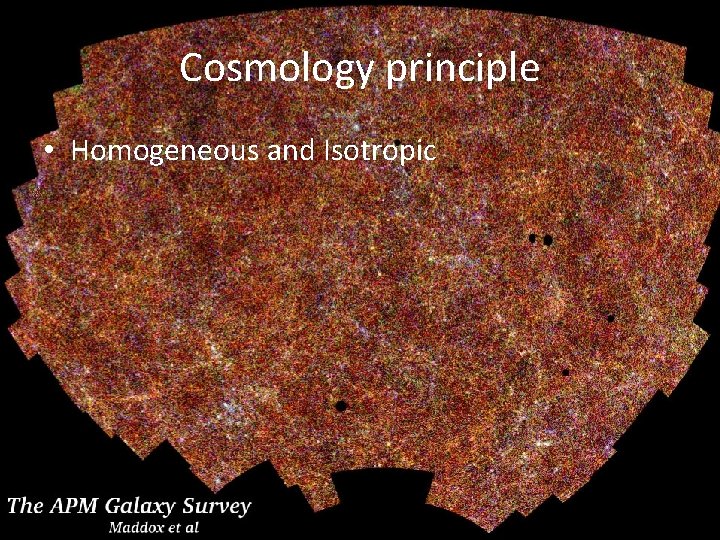
Cosmology principle • Homogeneous and Isotropic
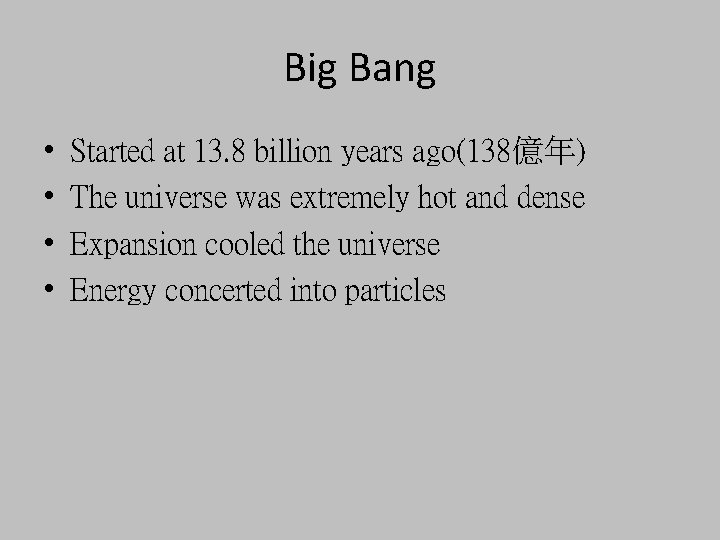
Big Bang • • Started at 13. 8 billion years ago(138億年) The universe was extremely hot and dense Expansion cooled the universe Energy concerted into particles
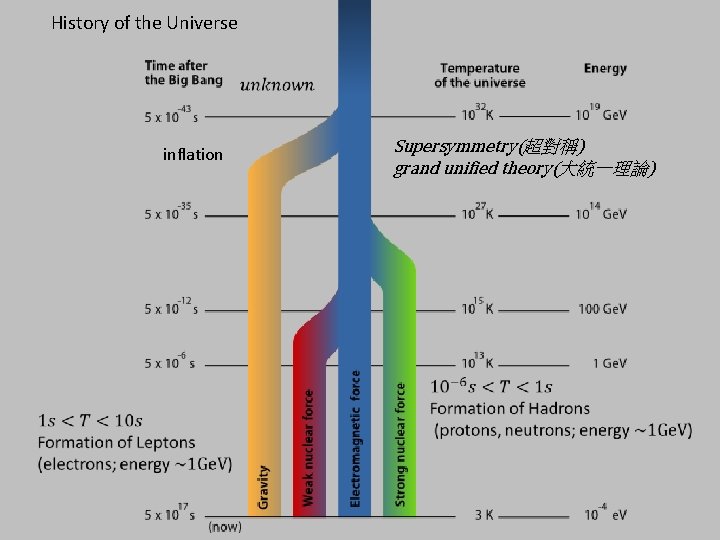
History of the Universe inflation Supersymmetry(超對稱) grand unified theory(大統一理論)
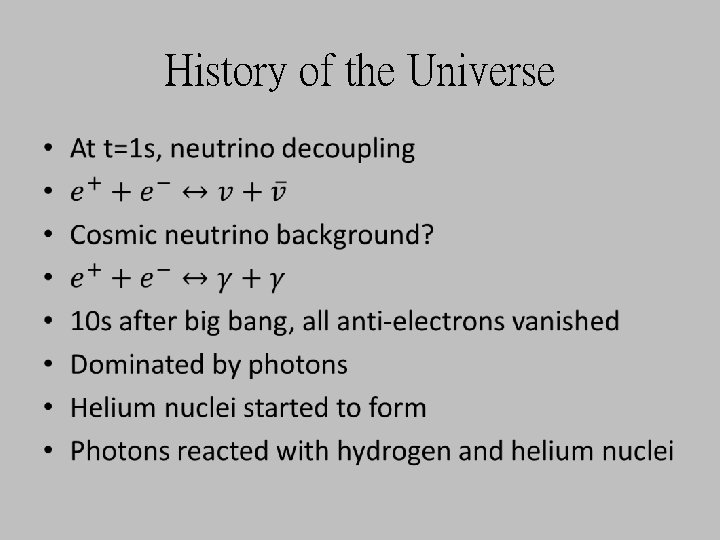
History of the Universe •
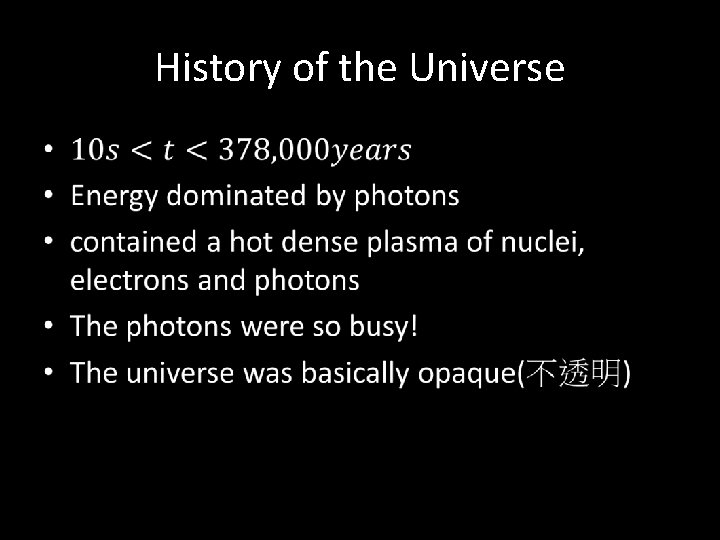
History of the Universe •
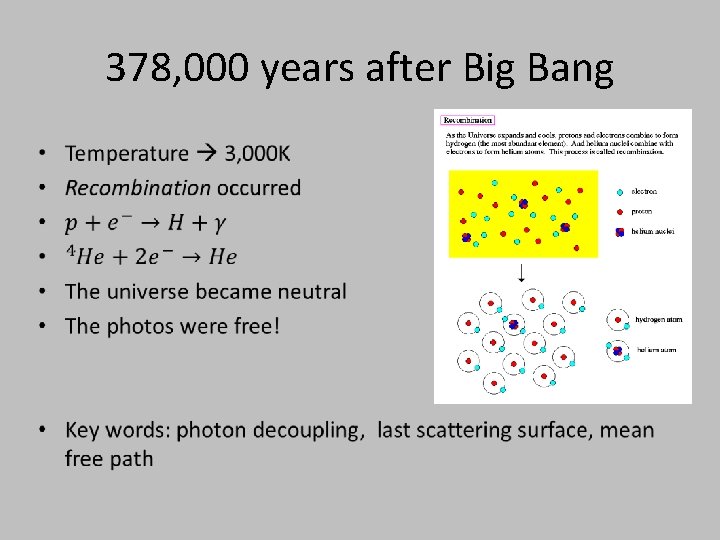
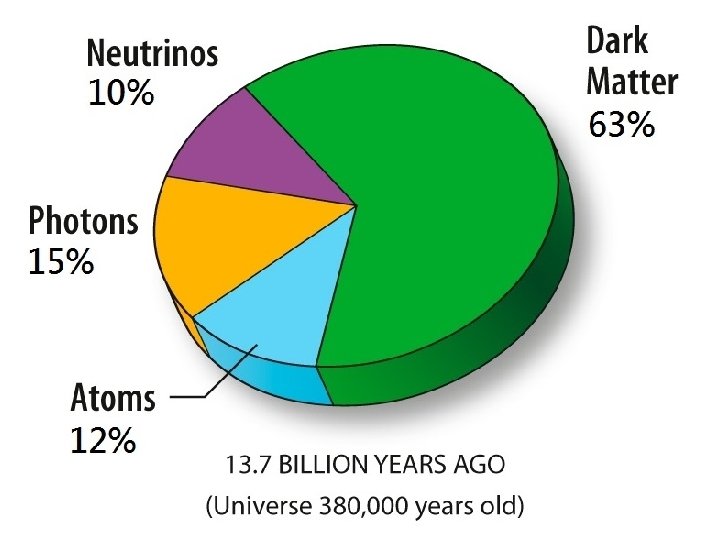
378, 000 years after Big Bang •
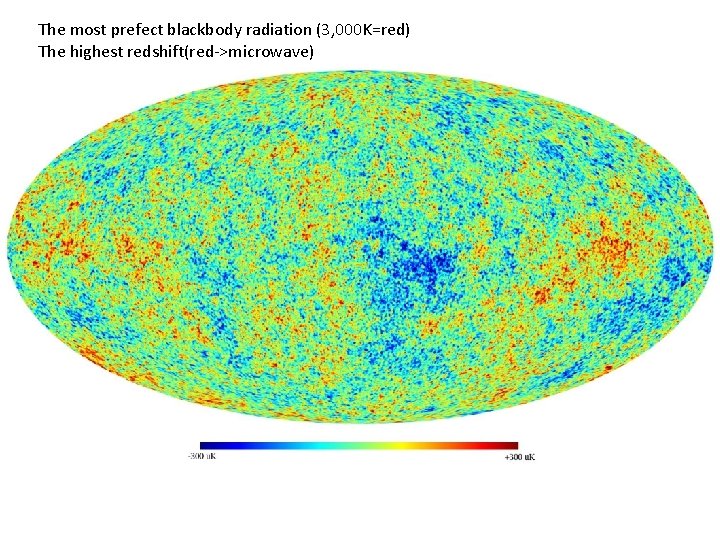
The most prefect blackbody radiation (3, 000 K=red) The highest redshift(red->microwave)
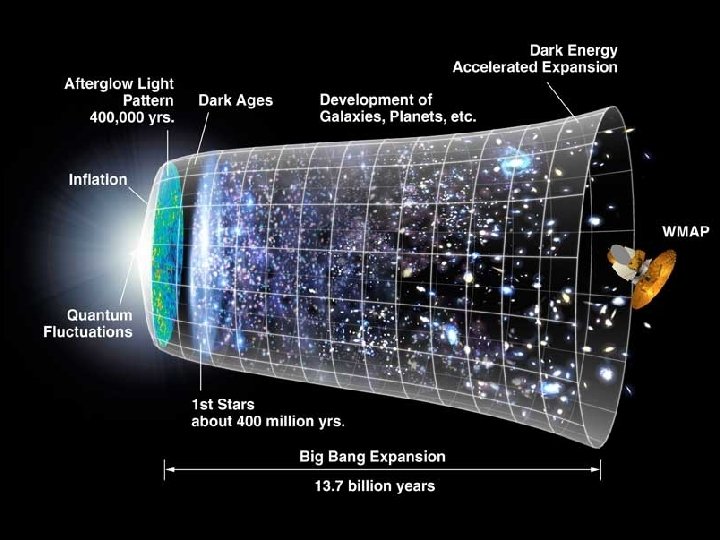
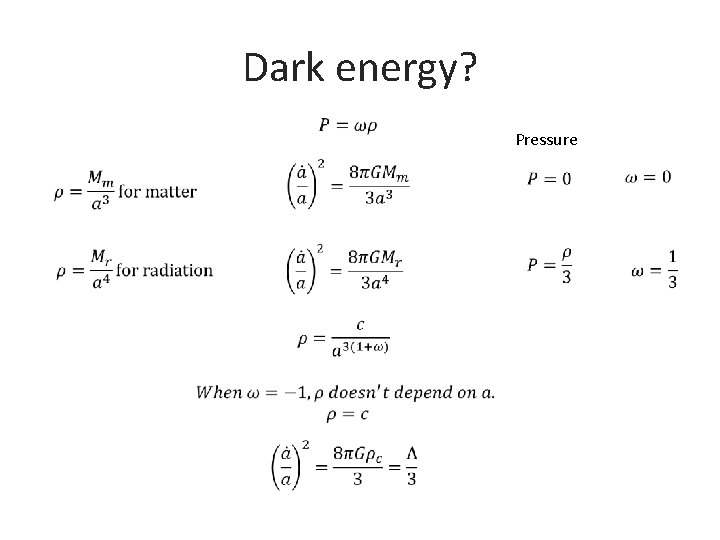
Dark energy? Pressure
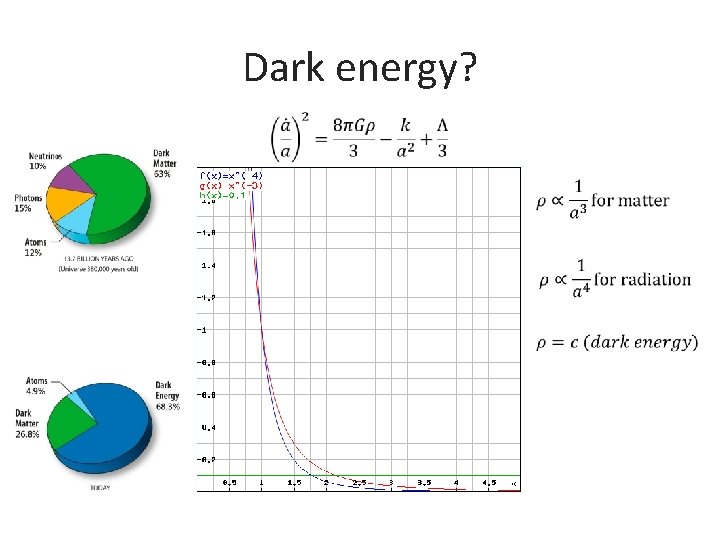
Dark energy?
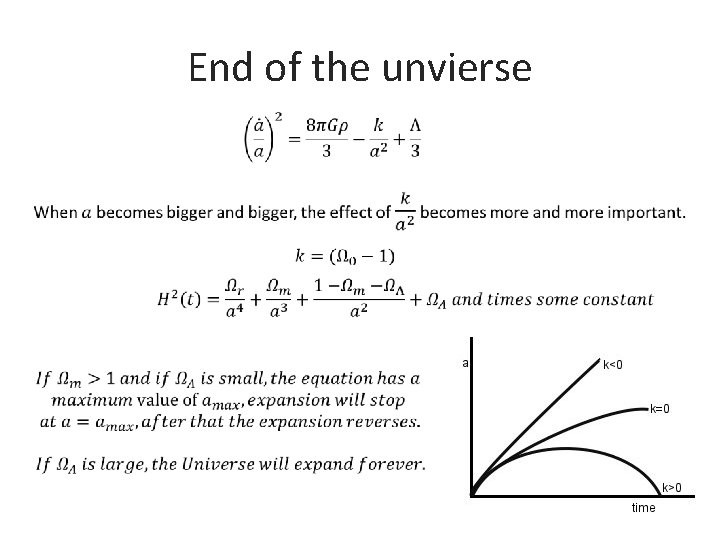
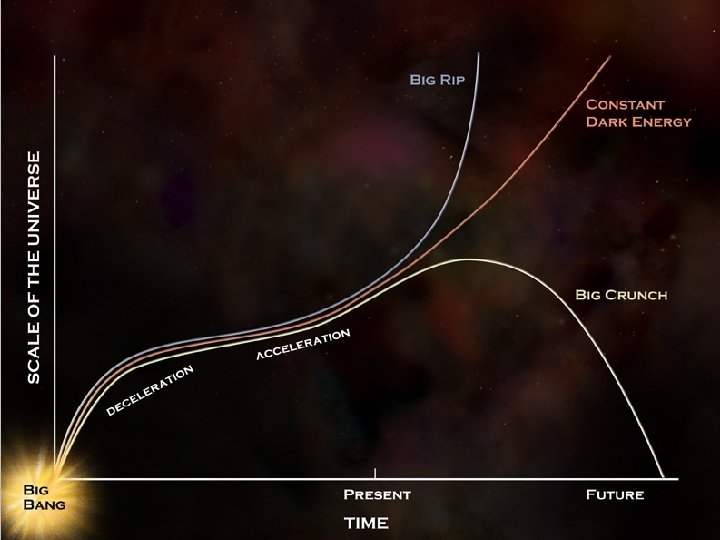
End of the unvierse
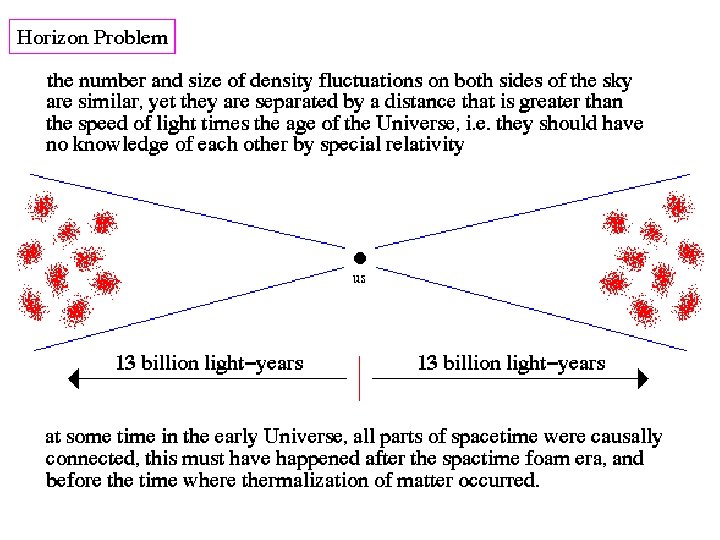
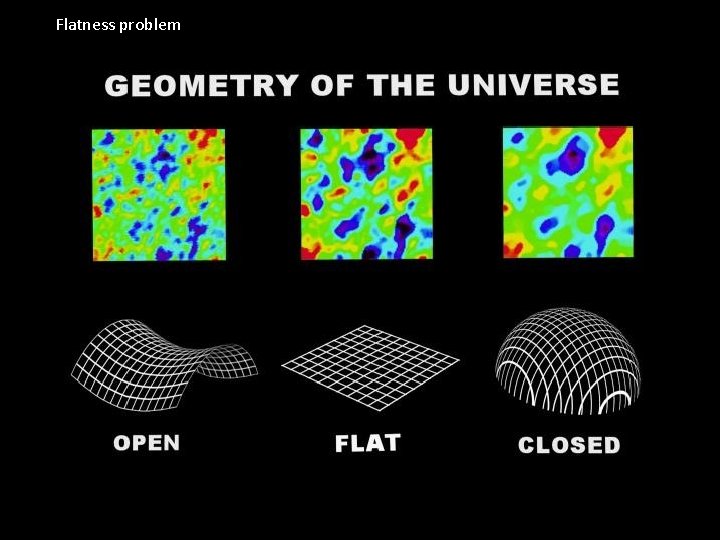
Flatness problem
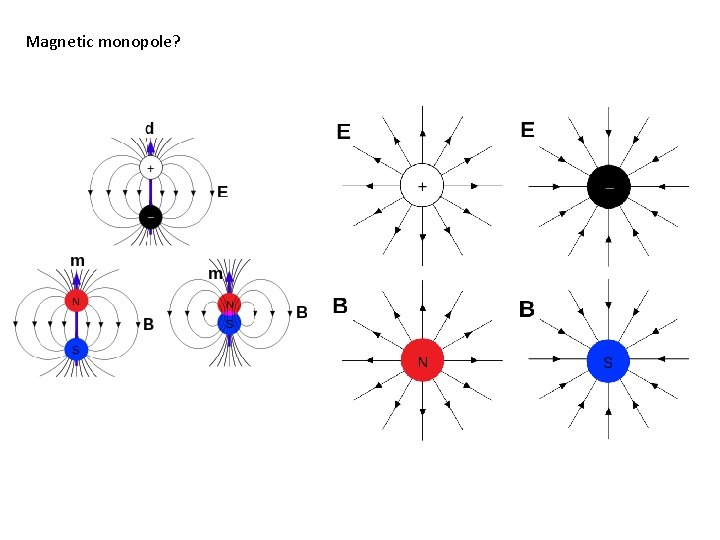
Magnetic monopole?
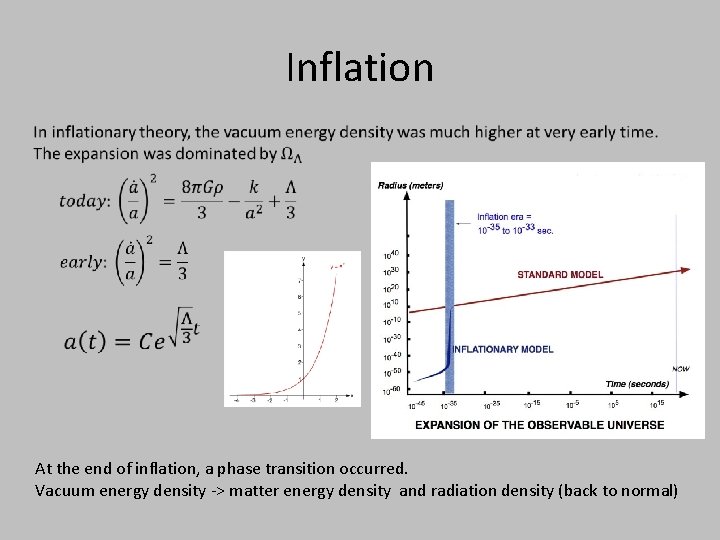
Inflation At the end of inflation, a phase transition occurred. Vacuum energy density -> matter energy density and radiation density (back to normal)
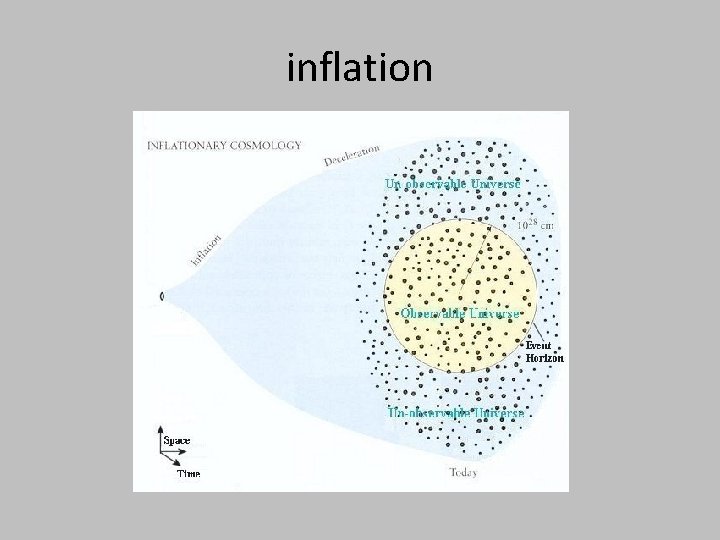
inflation
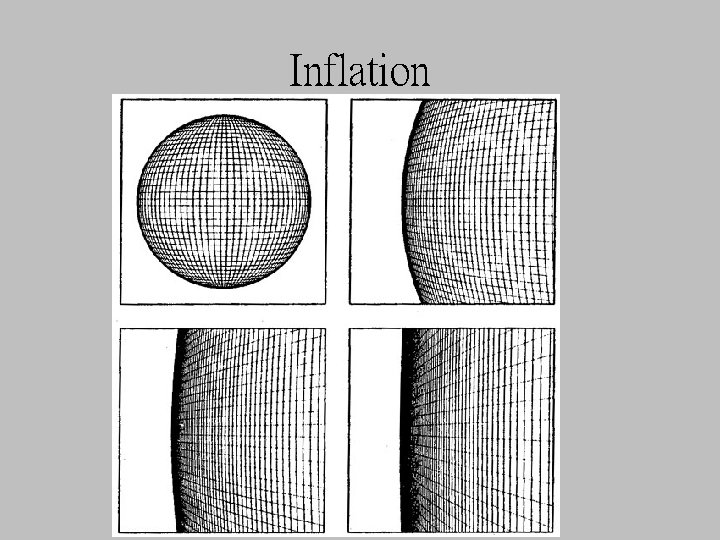
Inflation
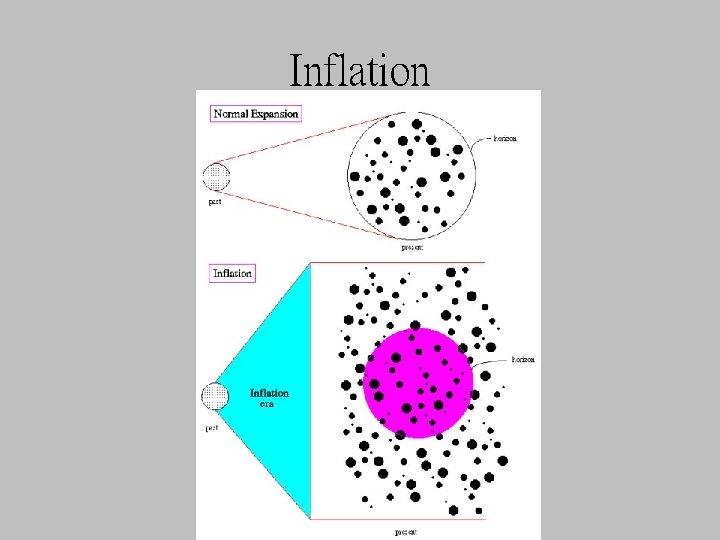
Inflation
- Slides: 60