
History of Film Welcome to the movies n
- Slides: 24
History of Film
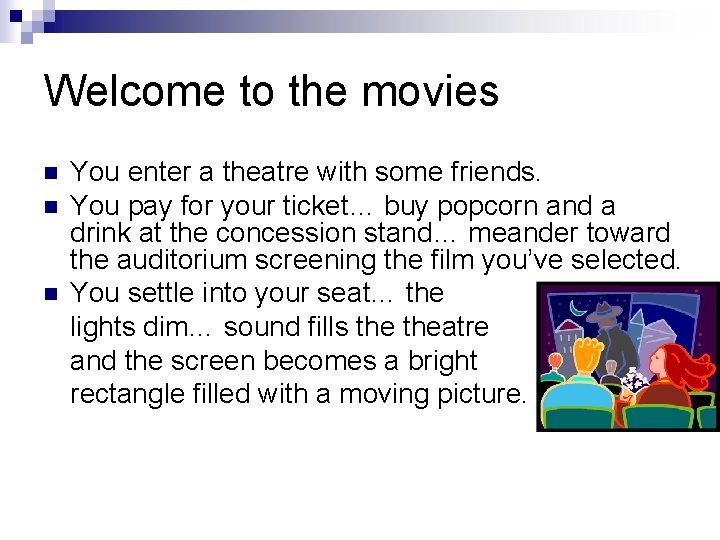
Welcome to the movies n n n You enter a theatre with some friends. You pay for your ticket… buy popcorn and a drink at the concession stand… meander toward the auditorium screening the film you’ve selected. You settle into your seat… the lights dim… sound fills theatre and the screen becomes a bright rectangle filled with a moving picture.
Movie Magic n Like all technological advances, there was no single “aha” moment, but rather the convergence of a number of discoveries.
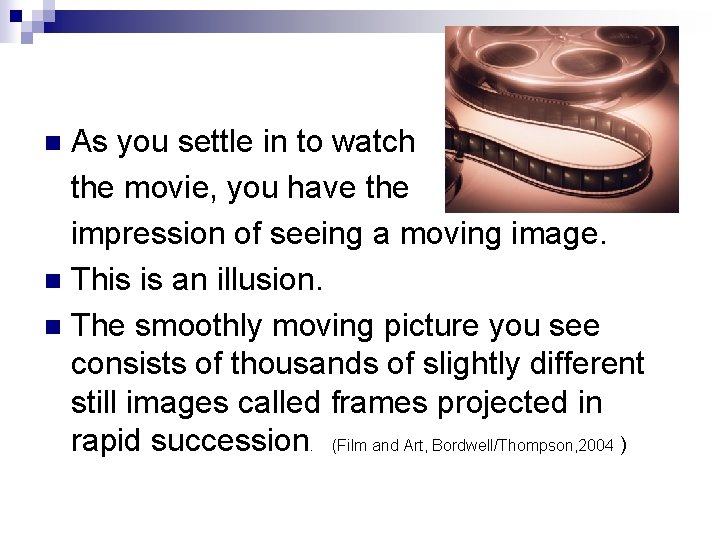
As you settle in to watch the movie, you have the impression of seeing a moving image. n This is an illusion. n The smoothly moving picture you see consists of thousands of slightly different still images called frames projected in rapid succession. (Film and Art, Bordwell/Thompson, 2004 ) n
Perception of Motion n n n What makes a movie move? No one knows the full answer. Film depends on the human ability to see and to hold in the mind a series of images. This ability has still not been adequately explained. Early theories of “Persistence of Vision” suggested that this ability was a “phenomenon of the eye by which an afterimage is thought to persist for approximately one twenty-fifth of a second on the retina. ” (Wikipedia) This theory was discredited in 1912.
Persistence of Vision n n Current thinking is that the illusion of continuous motion is caused by beta movement (the brain assuming movement between two static images when shown in quick succession). There is no clearly agreed upon explanation. Film makers have determined the optimal “frame rate” for human perception of motion Modern theatrical film runs at 24 frames a second. This is the case for both physical film and digital cinema systems. This film speed creates the illusion of smooth motion
n n n A frame rate of less than 16 frames per second causes the mind to see flashing images. Early silent films were shot at a lower rate (16 -20 images per second) which produced a “flickering” image: hence the slang term “The flicks” Audiences are able to interpret motion at rates as low as ten frames per second or slower (as in a flipbook), but the flicker caused by the shutter of a film projector is distracting below the 16 frame threshold.
The development of film Film technology grew out of the discoveries made in a wide variety of other disciplines. n Like all technological advances, there was no single “aha”, but rather the convergence of a number of discoveries. n
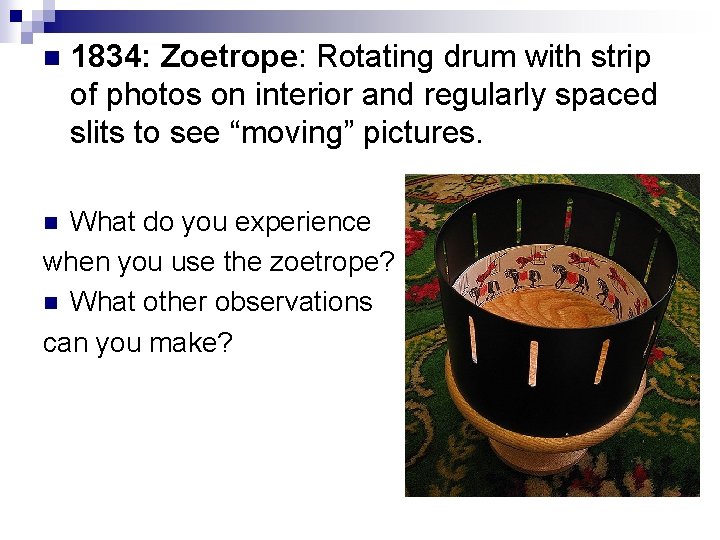
n 1834: Zoetrope: Rotating drum with strip of photos on interior and regularly spaced slits to see “moving” pictures. What do you experience when you use the zoetrope? n What other observations can you make? n
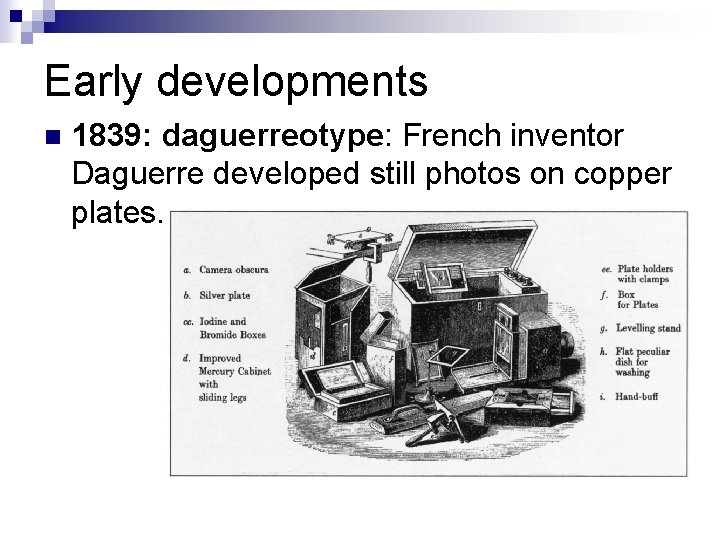
Early developments n 1839: daguerreotype: French inventor Daguerre developed still photos on copper plates.
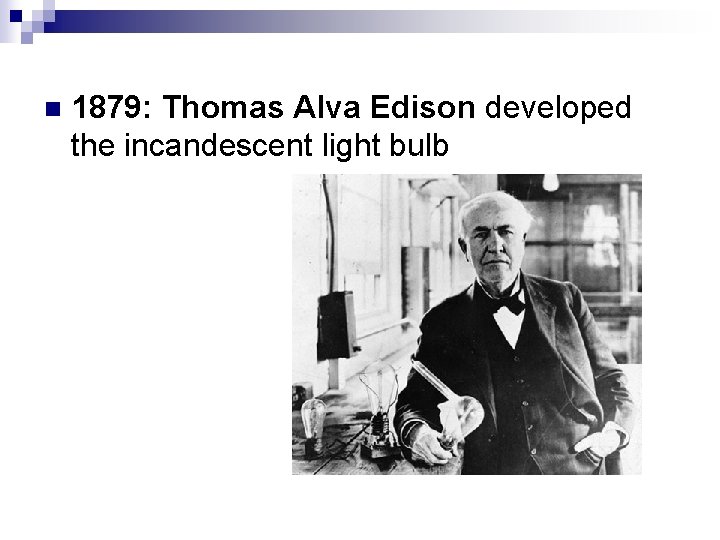
n 1879: Thomas Alva Edison developed the incandescent light bulb
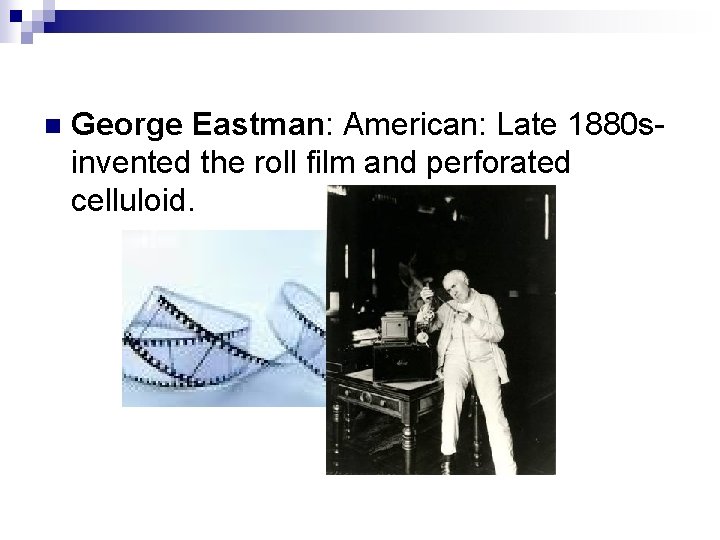
n George Eastman: American: Late 1880 sinvented the roll film and perforated celluloid.
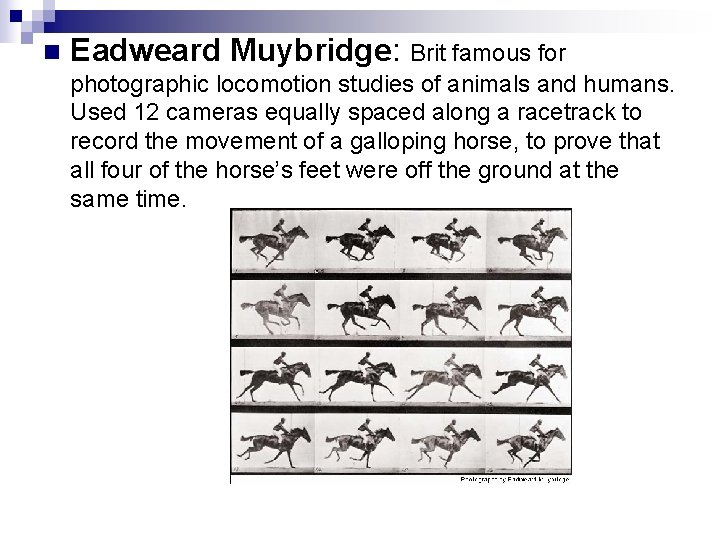
n Eadweard Muybridge: Brit famous for photographic locomotion studies of animals and humans. Used 12 cameras equally spaced along a racetrack to record the movement of a galloping horse, to prove that all four of the horse’s feet were off the ground at the same time.
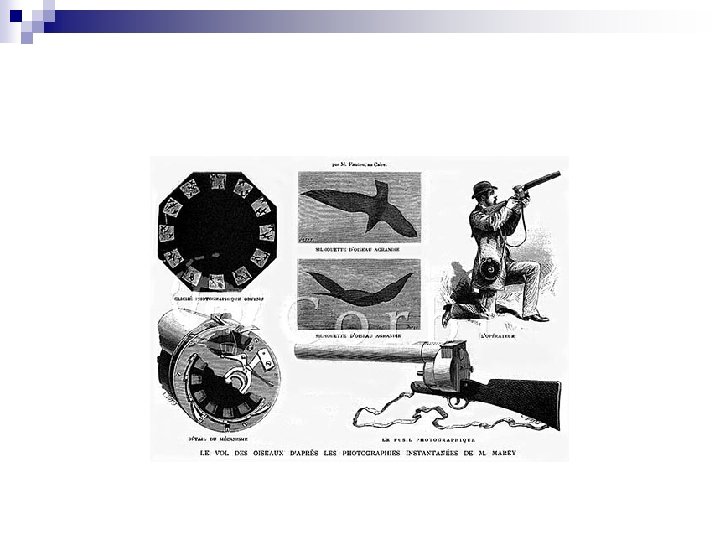
Etienne-Jules Marey n n n Parisian: also studied and recorded bodies in motion. Constructed a “photographic gun” that could take twelve photographs per second. He called this technique chronophotography. The term “shooting a film” may have come from this invention. Able to record multiple images on the same camera plate and eventually on celluloid film which passed automatically through a camera he designed. Laid the groundwork for the development of motion picture cameras and projectors.
The Birth of the Cinema: n The “Cinema” developed concurrently in both North America and Europe. n Late 1880’s: Edison and his assistant William Kennedy Laurie Dickson developed the Kenetophone, a projector connected to a phonograph with a pulley system; didn’t work well and was difficult to synchronize. Dickson then developed the Kinetograph, a motor-driven camera that could capture movement with a synchronized shutter and sprocket system. n
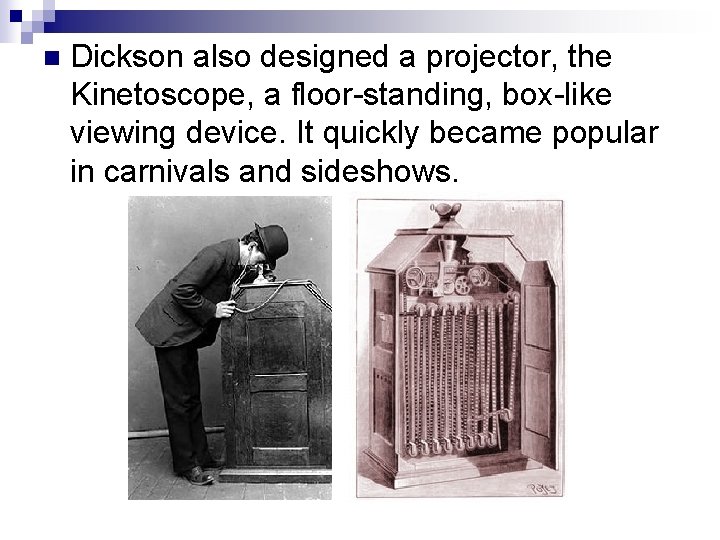
n Dickson also designed a projector, the Kinetoscope, a floor-standing, box-like viewing device. It quickly became popular in carnivals and sideshows.
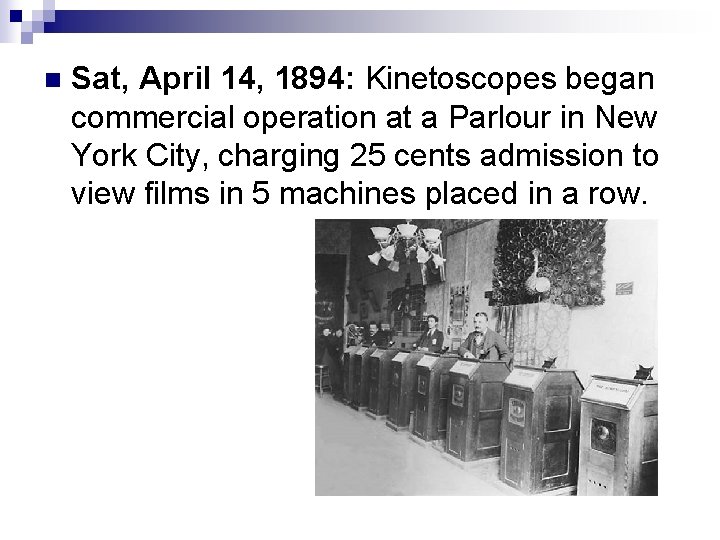
n Sat, April 14, 1894: Kinetoscopes began commercial operation at a Parlour in New York City, charging 25 cents admission to view films in 5 machines placed in a row.
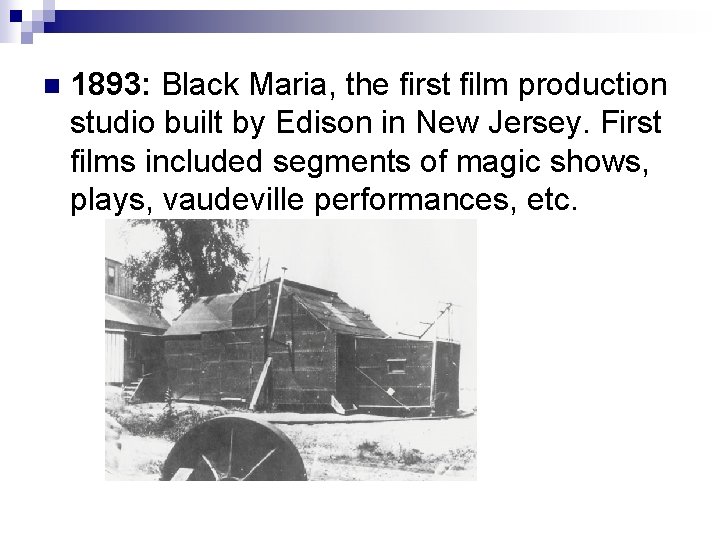
n 1893: Black Maria, the first film production studio built by Edison in New Jersey. First films included segments of magic shows, plays, vaudeville performances, etc.
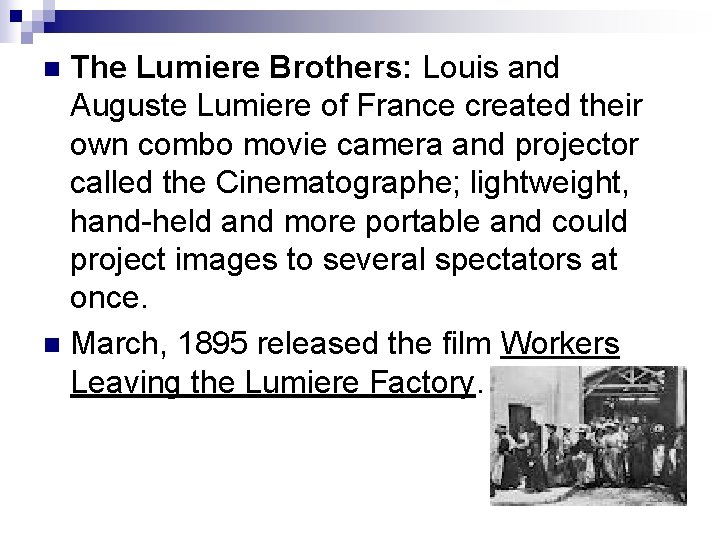
The Lumiere Brothers: Louis and Auguste Lumiere of France created their own combo movie camera and projector called the Cinematographe; lightweight, hand-held and more portable and could project images to several spectators at once. n March, 1895 released the film Workers Leaving the Lumiere Factory. n
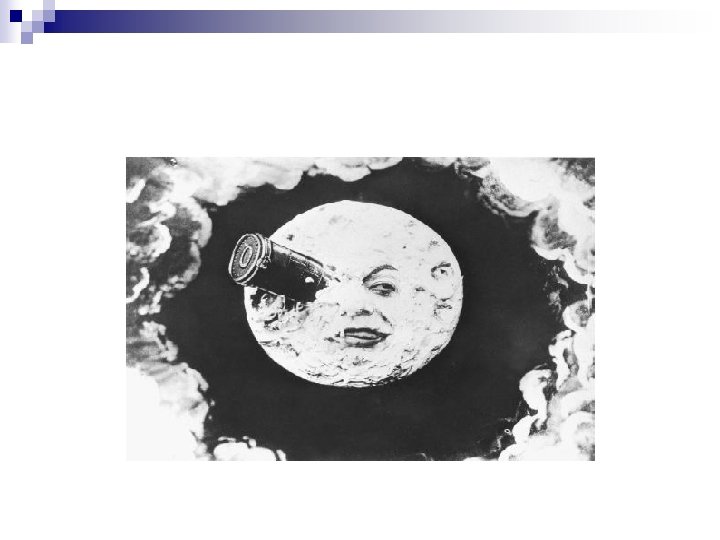
n n n George Melies: Frenchman: set up Europe’s first film studio in 1897 and began to make fantasy films. Before this most films were “actualities” (“reality” films) and comedies. Melies created a pioneering work of Science Fiction called Le Voyage Dans la Lune (A Trip to the Moon) in 1902. This film used special effects. Also introduced the idea of narrative storylines, plots, character development, illusion, and fantasy. Introduced trick photography, dissolves, wipes, super-impositions, slow-motion, etc.
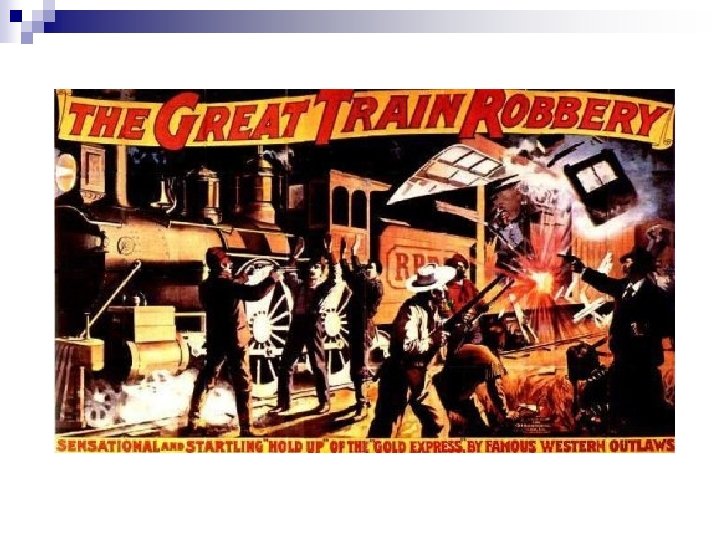
n n n Edwin S. Porter: American who began as a news cameraman, directed the first American documentary. The Great Train Robbery (1903): one reel, 14 scenes, 10 -minutes long It was the first American-made movie to tell a fictional story on film. Set many milestones at the time: ¨ First narrative film with a storyline ¨ One of the earliest films to be shot out of chronological sequence ¨ First motion picture “hit”, introducing the idea that film could be commercially-viable. ¨ Continued to develop the process of film editing.