
History of Economic Thought Gary Becker 1930 2014
History of Economic Thought Gary Becker (1930 – 2014)
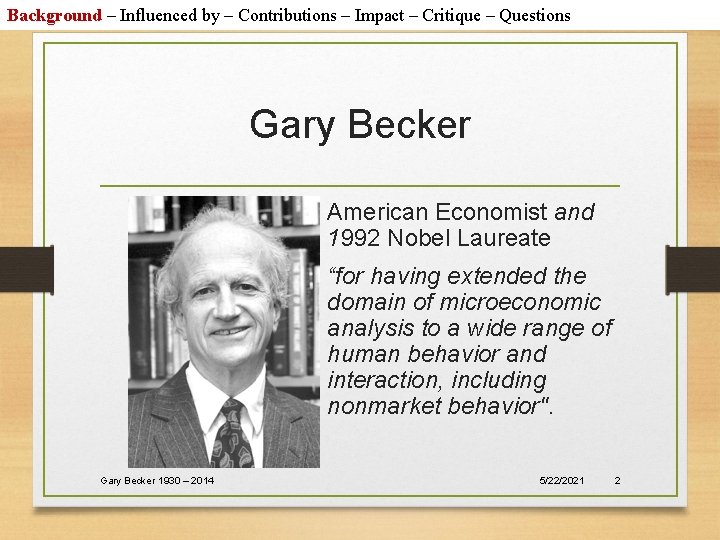
Background – Influenced by – Contributions – Impact – Critique – Questions Gary Becker American Economist and 1992 Nobel Laureate “for having extended the domain of microeconomic analysis to a wide range of human behavior and interaction, including nonmarket behavior". Gary Becker 1930 – 2014 5/22/2021 2
Background – Influenced by – Contributions – Impact – Critique – Questions Early life, education • Born in Pottsville, Pennsylvania - a little coal mining town in Eastern Pennsylvania • Moved to Brooklyn in the mid-1930’s Gary Becker 1930 – 2014 5/22/2021 3
Background – Influenced by – Contributions – Impact – Critique – Questions Early life, education Well Grounded in Brooklyn “We had many lively discussions in the house about politics and justice. I believe this does help explain why by the time I finished high school, my interest in mathematics was beginning to compete with a desire to do something useful for society. ” Gary Becker 1930 – 2014 5/22/2021 4
Background – Influenced by – Contributions – Impact – Critique – Questions Early life, education • B. A. Princeton University – 1951 • Graduated in three years • “I accidentally took a course in economics, and was greatly attracted by the mathematical rigor of a subject that dealt with social organization. During the following summer I read several books on economics. ” Gary Becker 1930 – 2014 5/22/2021 5
Background – Influenced by – Contributions – Impact – Critique – Questions Early life, education • Ph. D University of Chicago – 1955 • “My first encounter in 1951 with Milton Friedman's course on microeconomics renewed my excitement about economics. ” • “I published two articles in 1952, based on my research at Princeton. But I realized shortly after arriving in Chicago that I had to begin to learn again what economics is all about. ” Gary Becker 1930 – 2014 5/22/2021 6
Background – Influenced by – Contributions – Impact – Critique – Questions Career • Columbia University - 1958 • Becker turned down a much larger salary from Chicago to take a similar appointment at Columbia and a position at the National Bureau of Economic Research • “I developed greater independence and selfconfidence than seems likely if I remained at Chicago. ” Gary Becker 1930 – 2014 5/22/2021 7
Background – Influenced by – Contributions – Impact – Critique – Questions Career • Returned to University of Chicago - 1970 • Felt intellectually stale at Columbia so returned to Chicago • Decision to leave hastened by the student riots in 1968 • “…many faculty members behaved no better than the students. ” Gary Becker 1930 – 2014 5/22/2021 8
Background – Influenced by – Contributions – Impact – Critique – Questions Career • Nobel Prize in Economics in 1992 • Gary Becker's research contribution consists primarily of having extended the domain of economic theory to aspects of human behavior which had previously been dealt with - if at all by other social science disciplines such as sociology, demography and criminology. In so doing, he has stimulated economists to tackle new problems. Gary Becker 1930 – 2014 5/22/2021 9
Background – Influenced by – Contributions – Impact – Critique – Questions Other Accomplishments • Held joint appointments with the Department of Economics, the Department of Sociology, and the Graduate School of Business. • Becker won the John Bates Clark Medal in 1967, awarded to “that American economist under the age of forty who is adjudged to have made a significant contribution to economic thought and knowledge”. Gary Becker 1930 – 2014 5/22/2021 10
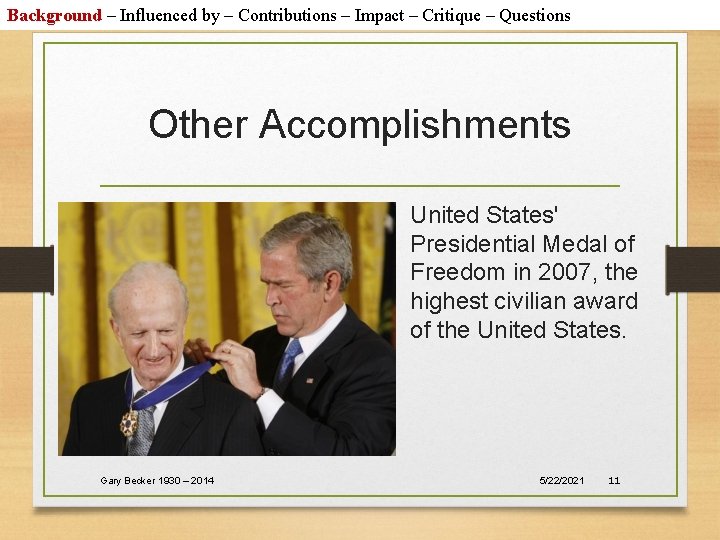
Background – Influenced by – Contributions – Impact – Critique – Questions Other Accomplishments United States' Presidential Medal of Freedom in 2007, the highest civilian award of the United States. Gary Becker 1930 – 2014 5/22/2021 11
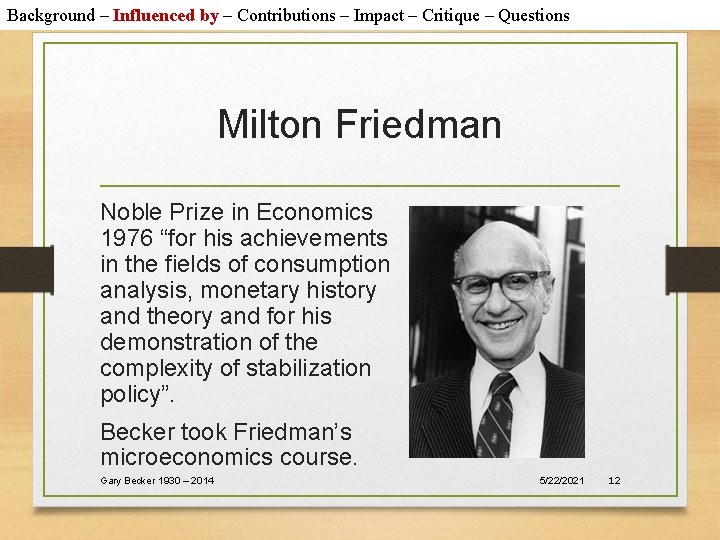
Background – Influenced by – Contributions – Impact – Critique – Questions Milton Friedman Noble Prize in Economics 1976 “for his achievements in the fields of consumption analysis, monetary history and theory and for his demonstration of the complexity of stabilization policy”. Becker took Friedman’s microeconomics course. Gary Becker 1930 – 2014 5/22/2021 12
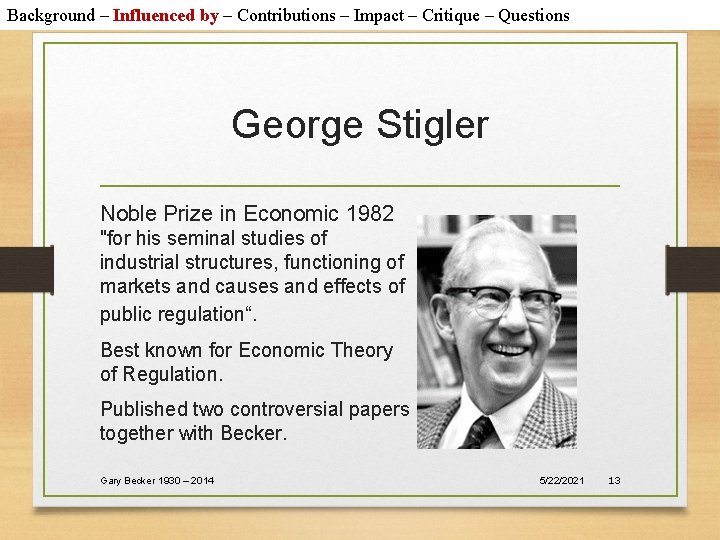
Background – Influenced by – Contributions – Impact – Critique – Questions George Stigler Noble Prize in Economic 1982 "for his seminal studies of industrial structures, functioning of markets and causes and effects of public regulation“. Best known for Economic Theory of Regulation. Published two controversial papers together with Becker. Gary Becker 1930 – 2014 5/22/2021 13
Background – Influenced by – Contributions – Impact – Critique – Questions Other Influences • • Gregg Lewis - labor markets T. W. Schultz - human capital Aaron Director - industrial organization L. J. Savage - subjective probability and the foundation of statistics • Thomas Malthus - wages and average income Gary Becker 1930 – 2014 5/22/2021 14
Background – Influenced by – Contributions – Impact – Critique – Questions Main Contributions 1. 2. 3. 4. 5. 6. 7. Human Capital Family Economics of Discrimination Crime and Punishment Addiction Politics Organ Markets Gary Becker 1930 – 2014 5/22/2021 15
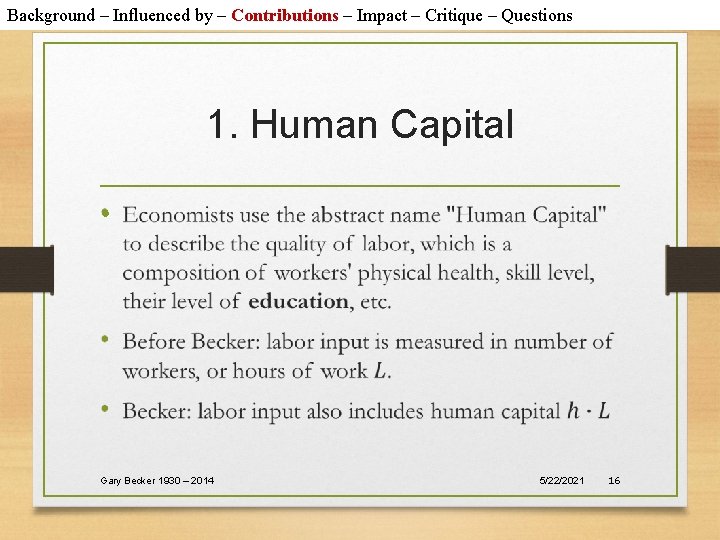
Background – Influenced by – Contributions – Impact – Critique – Questions 1. Human Capital • Gary Becker 1930 – 2014 5/22/2021 16
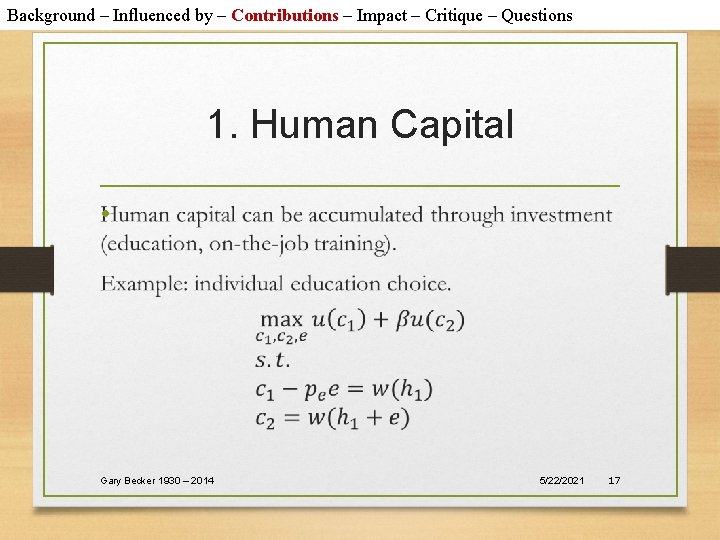
Background – Influenced by – Contributions – Impact – Critique – Questions 1. Human Capital • Gary Becker 1930 – 2014 5/22/2021 17
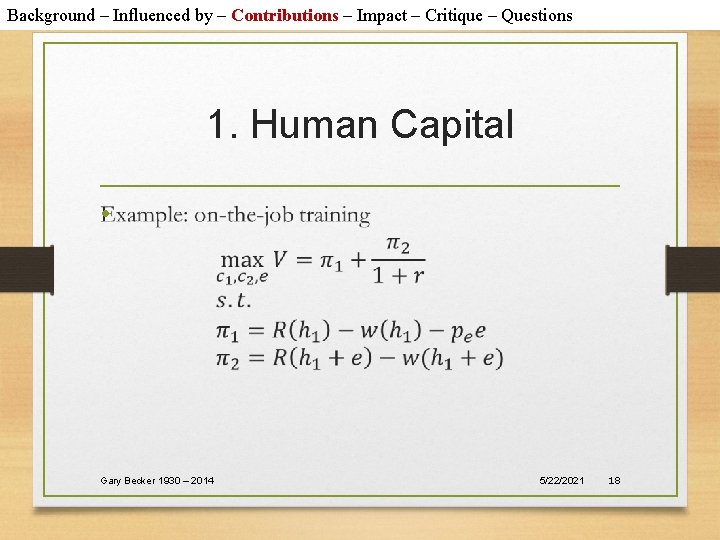
Background – Influenced by – Contributions – Impact – Critique – Questions 1. Human Capital • Gary Becker 1930 – 2014 5/22/2021 18
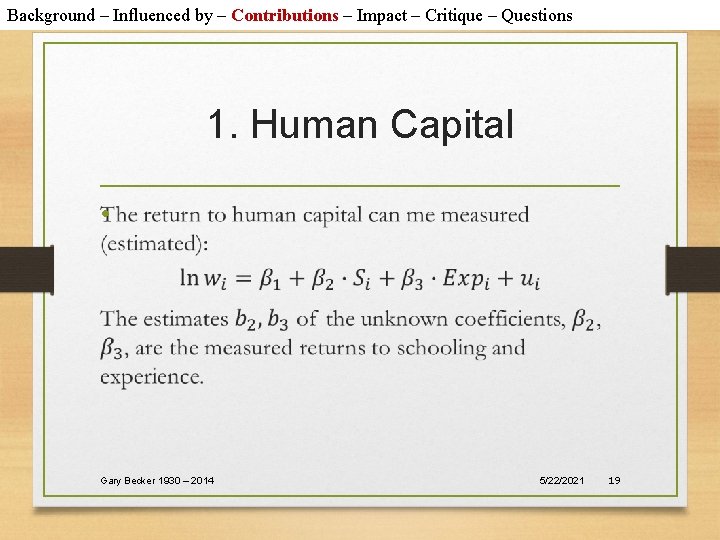
Background – Influenced by – Contributions – Impact – Critique – Questions 1. Human Capital • Gary Becker 1930 – 2014 5/22/2021 19
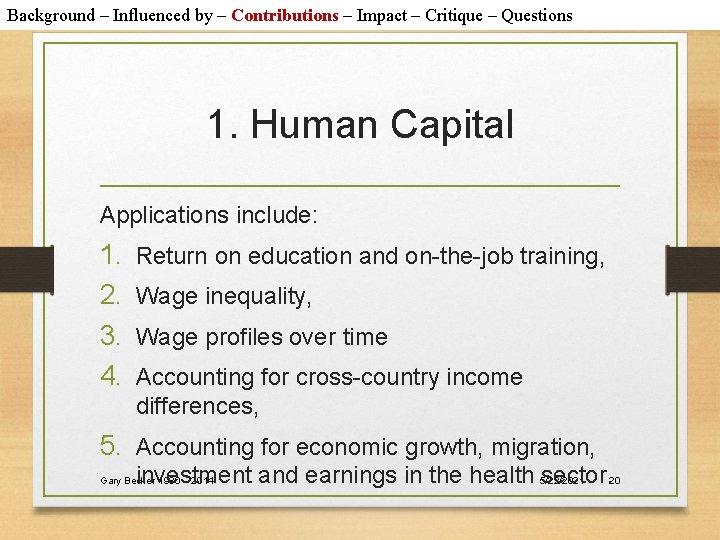
Background – Influenced by – Contributions – Impact – Critique – Questions 1. Human Capital Applications include: 1. 2. 3. 4. Return on education and on-the-job training, Wage inequality, Wage profiles over time Accounting for cross-country income differences, 5. Accounting for economic growth, migration, investment and earnings in the health 5/22/2021 sector. 20 Gary Becker 1930 – 2014
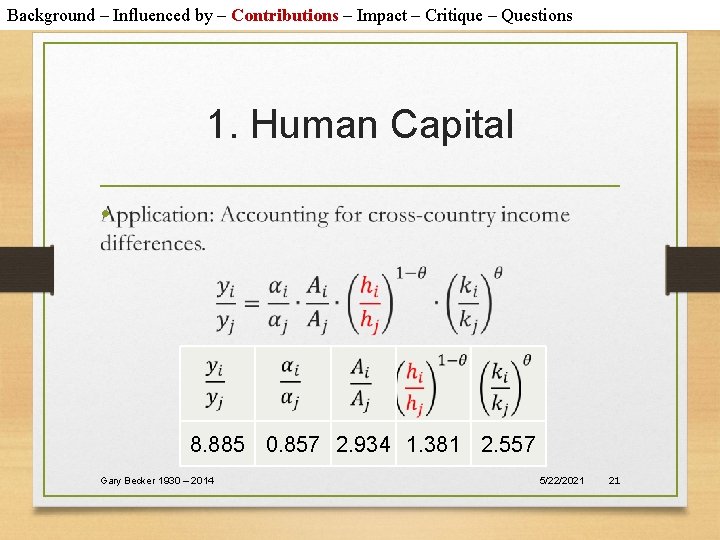
Background – Influenced by – Contributions – Impact – Critique – Questions 1. Human Capital • 8. 885 0. 857 2. 934 1. 381 2. 557 Gary Becker 1930 – 2014 5/22/2021 21
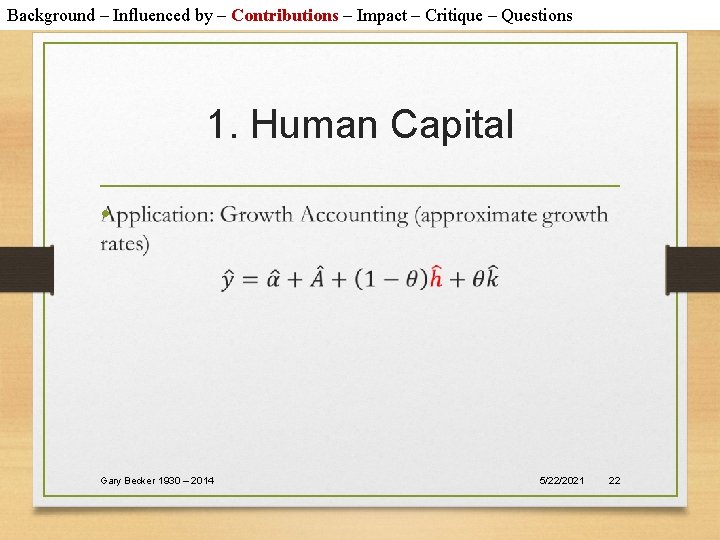
Background – Influenced by – Contributions – Impact – Critique – Questions 1. Human Capital • Gary Becker 1930 – 2014 5/22/2021 22
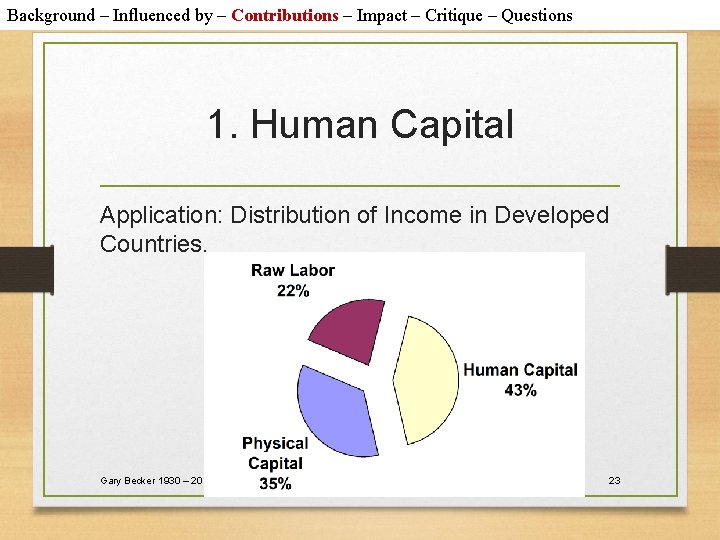
Background – Influenced by – Contributions – Impact – Critique – Questions 1. Human Capital Application: Distribution of Income in Developed Countries. Gary Becker 1930 – 2014 5/22/2021 23
Background – Influenced by – Contributions – Impact – Critique – Questions 1. Human Capital Human capital theory explains why the conflict between laborers and capitalists did not bring and end to Capitalism, as Marx predicted. With access to education, workers are also capitalists. Gary Becker 1930 – 2014 5/22/2021 24
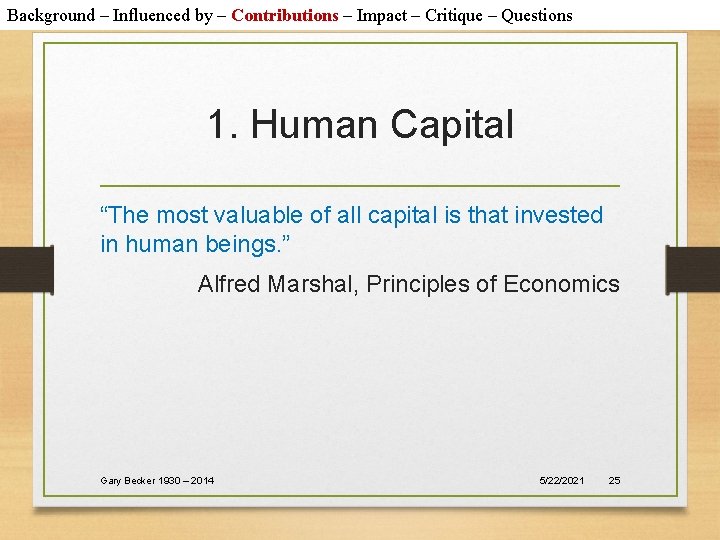
Background – Influenced by – Contributions – Impact – Critique – Questions 1. Human Capital “The most valuable of all capital is that invested in human beings. ” Alfred Marshal, Principles of Economics Gary Becker 1930 – 2014 5/22/2021 25
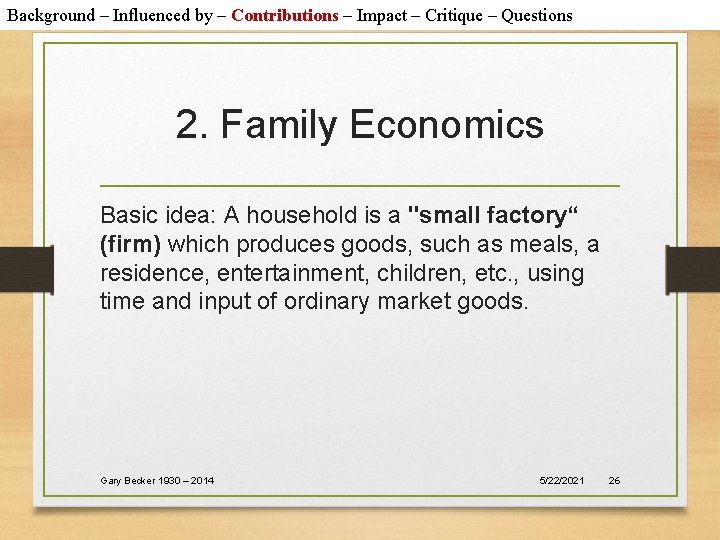
Background – Influenced by – Contributions – Impact – Critique – Questions 2. Family Economics Basic idea: A household is a "small factory“ (firm) which produces goods, such as meals, a residence, entertainment, children, etc. , using time and input of ordinary market goods. Gary Becker 1930 – 2014 5/22/2021 26
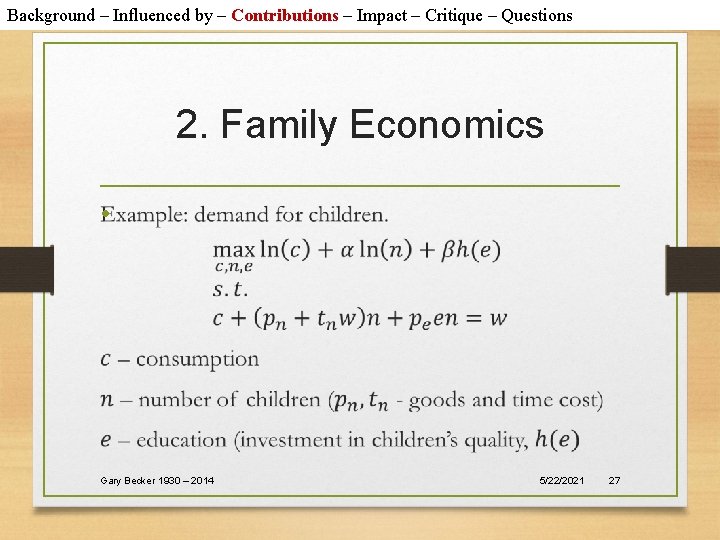
Background – Influenced by – Contributions – Impact – Critique – Questions 2. Family Economics • Gary Becker 1930 – 2014 5/22/2021 27
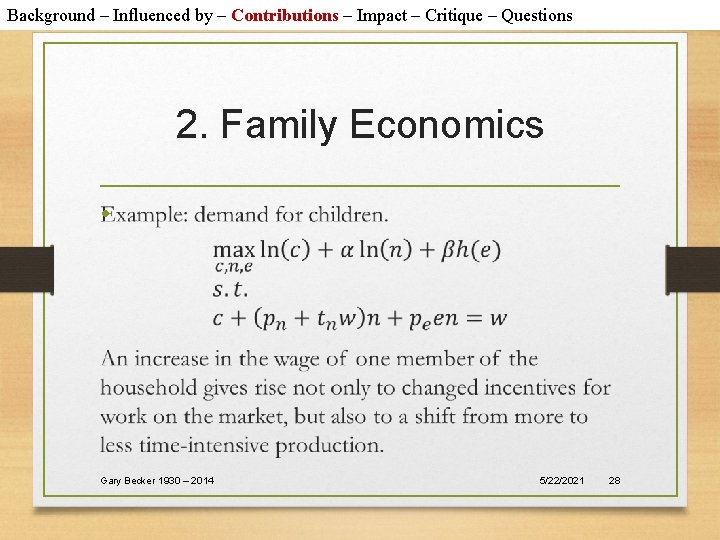
Background – Influenced by – Contributions – Impact – Critique – Questions 2. Family Economics • Gary Becker 1930 – 2014 5/22/2021 28
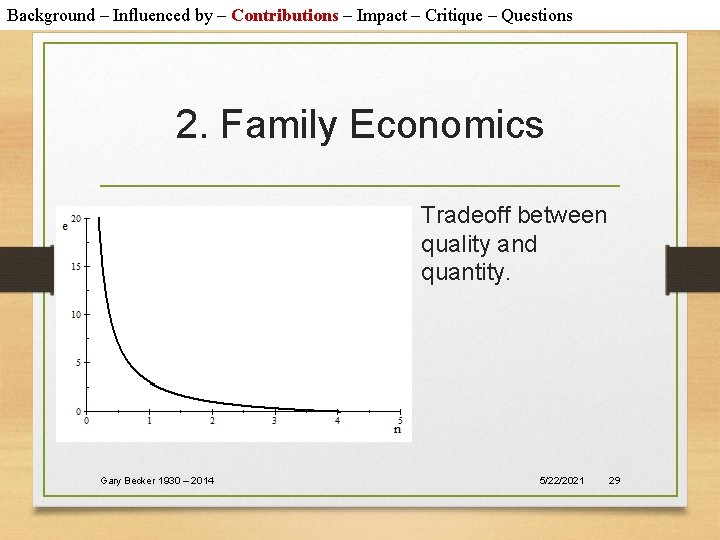
Background – Influenced by – Contributions – Impact – Critique – Questions 2. Family Economics Tradeoff between quality and quantity. Gary Becker 1930 – 2014 5/22/2021 29
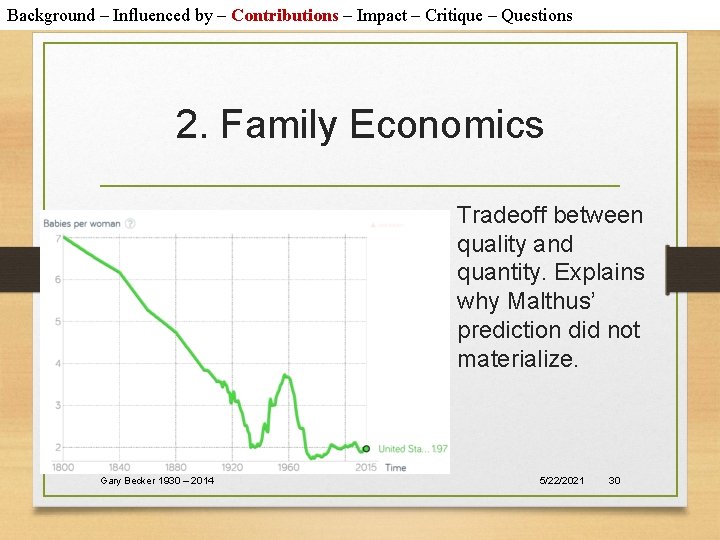
Background – Influenced by – Contributions – Impact – Critique – Questions 2. Family Economics Tradeoff between quality and quantity. Explains why Malthus’ prediction did not materialize. Gary Becker 1930 – 2014 5/22/2021 30
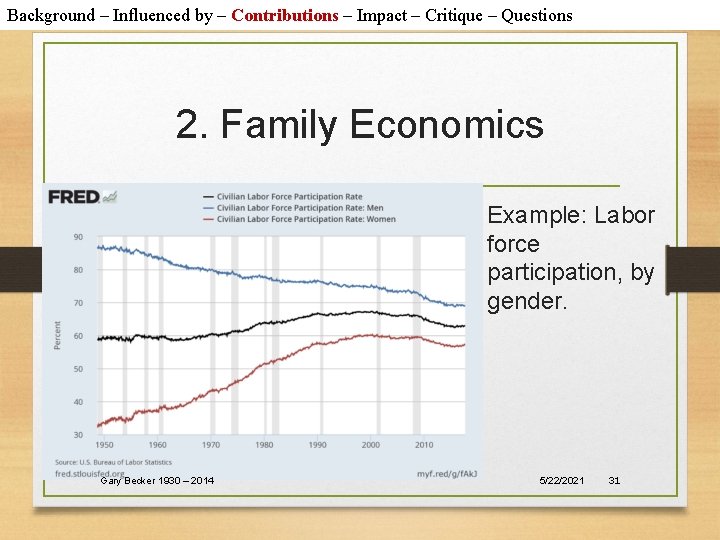
Background – Influenced by – Contributions – Impact – Critique – Questions 2. Family Economics Example: Labor force participation, by gender. Gary Becker 1930 – 2014 5/22/2021 31
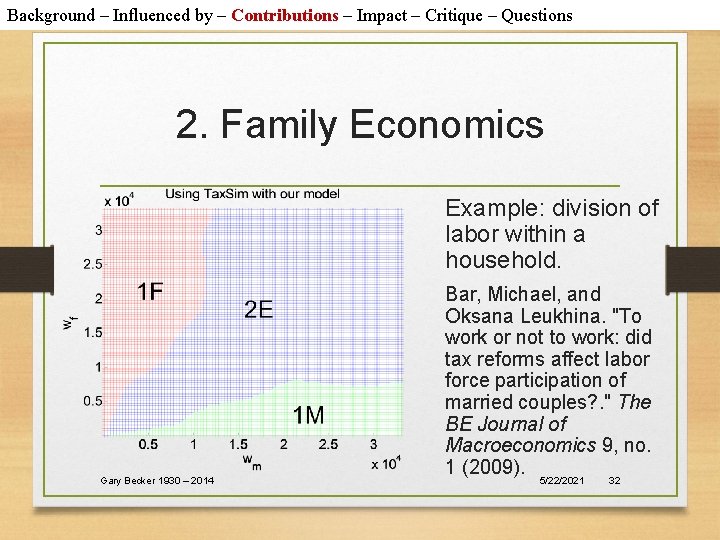
Background – Influenced by – Contributions – Impact – Critique – Questions 2. Family Economics Example: division of labor within a household. Gary Becker 1930 – 2014 Bar, Michael, and Oksana Leukhina. "To work or not to work: did tax reforms affect labor force participation of married couples? . " The BE Journal of Macroeconomics 9, no. 1 (2009). 5/22/2021 32
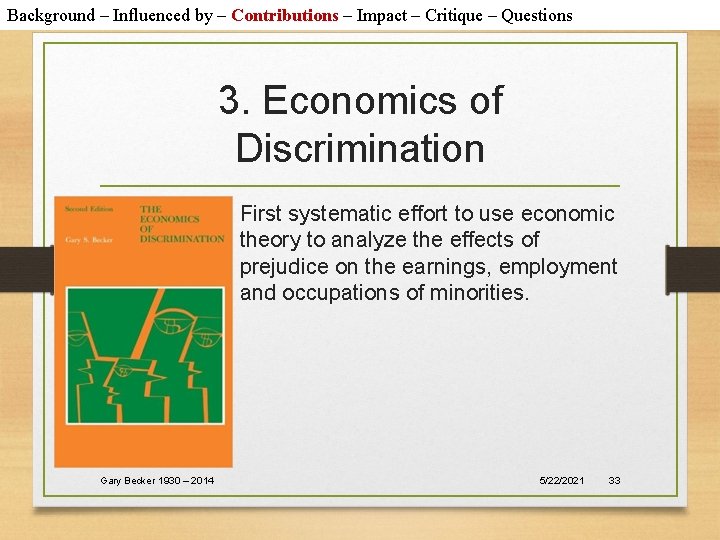
Background – Influenced by – Contributions – Impact – Critique – Questions 3. Economics of Discrimination First systematic effort to use economic theory to analyze the effects of prejudice on the earnings, employment and occupations of minorities. Gary Becker 1930 – 2014 5/22/2021 33
Background – Influenced by – Contributions – Impact – Critique – Questions 3. Economics of Discrimination is defined as a situation where an economic agent is prepared to incur a cost in order to refrain from an economic transaction with someone who is not in his/her own group (e. g. race, sex). Becker demonstrates that such behavior, acts as a "tax" on the discriminator. Discrimination thus tends to be economically detrimental not only to those who are discriminated against, but also to those who practice discrimination. Gary Becker 1930 – 2014 5/22/2021 34
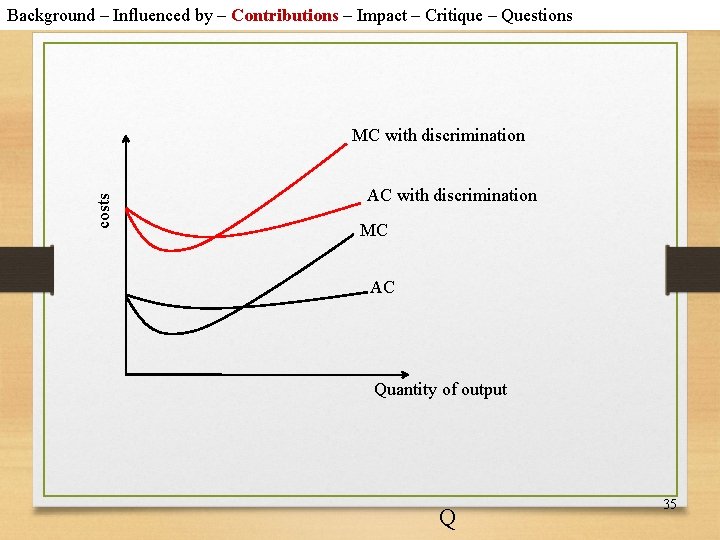
Background – Influenced by – Contributions – Impact – Critique – Questions costs MC with discrimination AC with discrimination MC AC Quantity of output Q 35
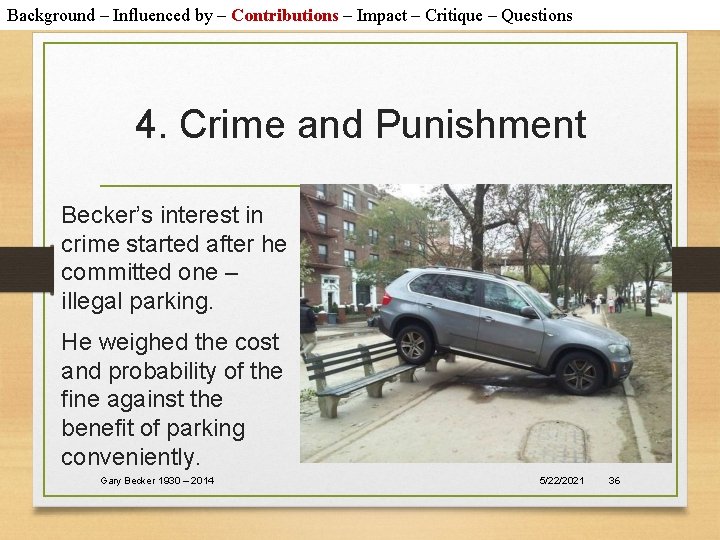
Background – Influenced by – Contributions – Impact – Critique – Questions 4. Crime and Punishment Becker’s interest in crime started after he committed one – illegal parking. He weighed the cost and probability of the fine against the benefit of parking conveniently. Gary Becker 1930 – 2014 5/22/2021 36
Background – Influenced by – Contributions – Impact – Critique – Questions 4. Crime and Punishment Becker’s interest in crime started after he committed one – illegal parking. A criminal, with the exception of a limited number of psychopaths, is a rational individual, who weighs cost and benefits of an action. Instead of regarding criminal activity as irrational behavior associated with the specific psychological and social status of an offender, criminality is analyzed as rational behavior 5/22/2021 under 37 Gary Becker 1930 – 2014 uncertainty.
Background – Influenced by – Contributions – Impact – Critique – Questions Impact on Economics • Expanded the Horizons of Economics. • Introduced economic reasoning to sociological issues, such as discrimination, family, and crime, previously considered outside of economics by Neoclassic economists. He uses the same tools in examining marriage markets as in examining financial markets. • Brought to light the importance of human capital in growth economics. Gary Becker 1930 – 2014 5/22/2021 38
Background – Influenced by – Contributions – Impact – Critique – Questions Impact on Economics • Most of the research in labor economics today is focused on Becker’s ideas of education, family. Gary Becker 1930 – 2014 5/22/2021 39
Background – Influenced by – Contributions – Impact – Critique – Questions Impact on Policy Becker consulted the government regarding data collection and policies to improve the quality of education. Gary Becker 1930 – 2014 5/22/2021 40
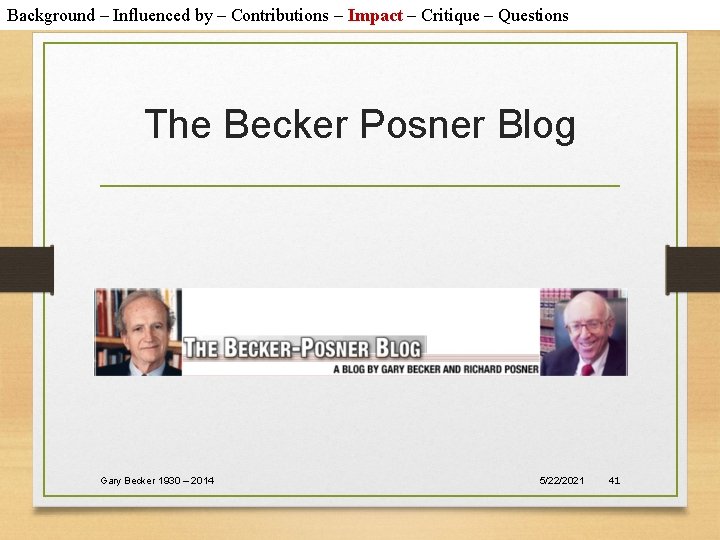
Background – Influenced by – Contributions – Impact – Critique – Questions The Becker Posner Blog Gary Becker 1930 – 2014 5/22/2021 41
Background – Influenced by – Contributions – Impact – Critique – Questions Alexander Rosenberg: Professor of Philosophy – Duke University • “Intellectuals are like mafia—they only kill each other. ” • Alexander Rosenberg makes criticism of Becker’s main argument about the applicability of economic approach to all human behavior. He calls Becker’s approach the “homo economicus” model in the social sciences. Gary Becker 1930 – 2014 5/22/2021 42
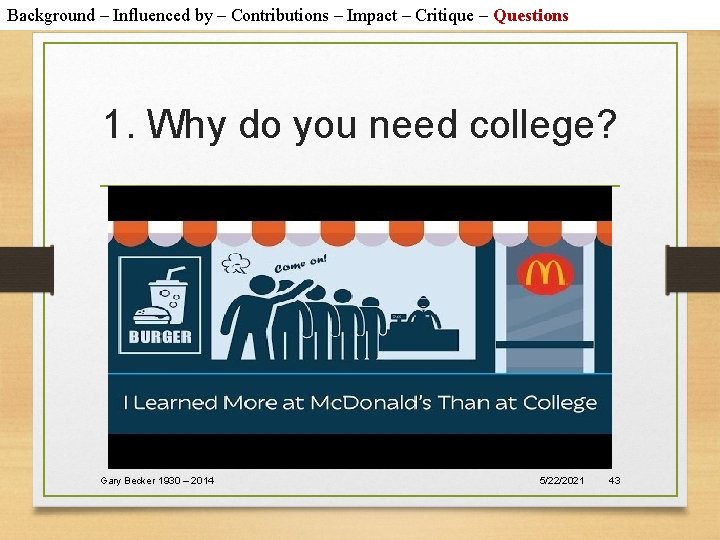
Background – Influenced by – Contributions – Impact – Critique – Questions 1. Why do you need college? Gary Becker 1930 – 2014 5/22/2021 43
Background – Influenced by – Contributions – Impact – Critique – Questions 2. Are suicide terrorists rational? How do you propose fight terrorism in the following cases: a. Suicide terrorists are irrational. b. Suicide terrorists are rational. Gary Becker 1930 – 2014 5/22/2021 44
Background – Influenced by – Contributions – Impact – Critique – Questions More Questions 3. Give example when you applied cost/benefit analysis when deciding whether break the law or not. 4. Can you come up with example in which you made a choice without cost/benefit analysis? In other words, are there choices that we make, that don’t involve cost/benefit analysis? Gary Becker 1930 – 2014 5/22/2021 45
- Slides: 45