
History of DNA How it Was Discovered Friedrich
- Slides: 10
History of DNA How it Was Discovered
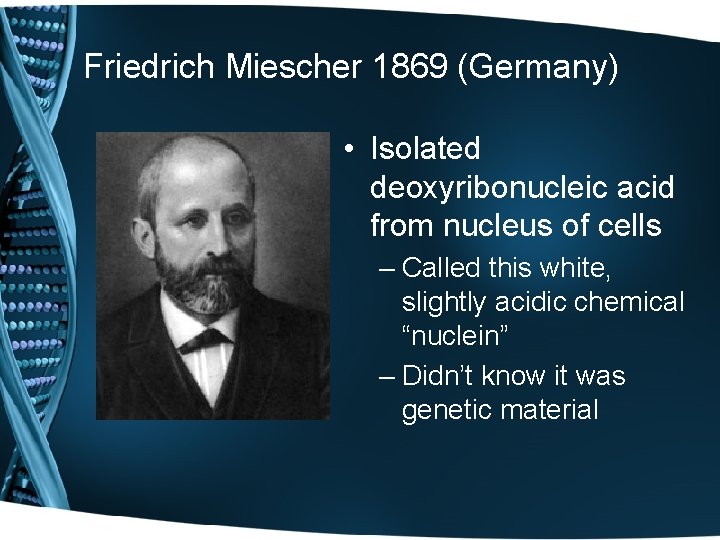
Friedrich Miescher 1869 (Germany) • Isolated deoxyribonucleic acid from nucleus of cells – Called this white, slightly acidic chemical “nuclein” – Didn’t know it was genetic material
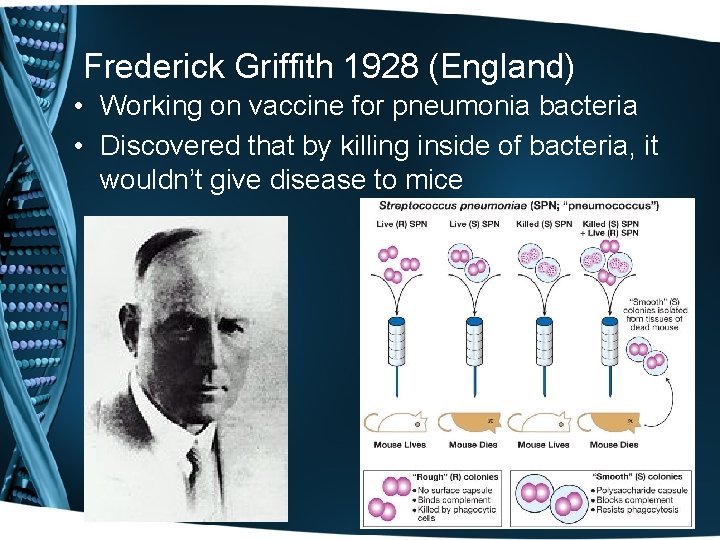
Frederick Griffith 1928 (England) • Working on vaccine for pneumonia bacteria • Discovered that by killing inside of bacteria, it wouldn’t give disease to mice
Many Scientists 1940 • By this time, many scientists isolated all of the chemicals found in DNA – Phosphate (PO 4) – Sugar (deoxyribose) – Four nitrogen bases (adenine, thymine, cytosine, guanine) • Now called “deoxyribose nucleic acid” or DNA
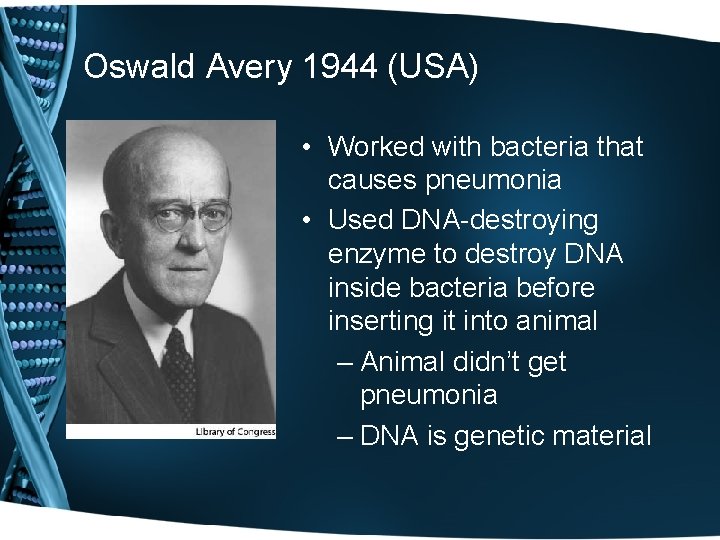
Oswald Avery 1944 (USA) • Worked with bacteria that causes pneumonia • Used DNA-destroying enzyme to destroy DNA inside bacteria before inserting it into animal – Animal didn’t get pneumonia – DNA is genetic material
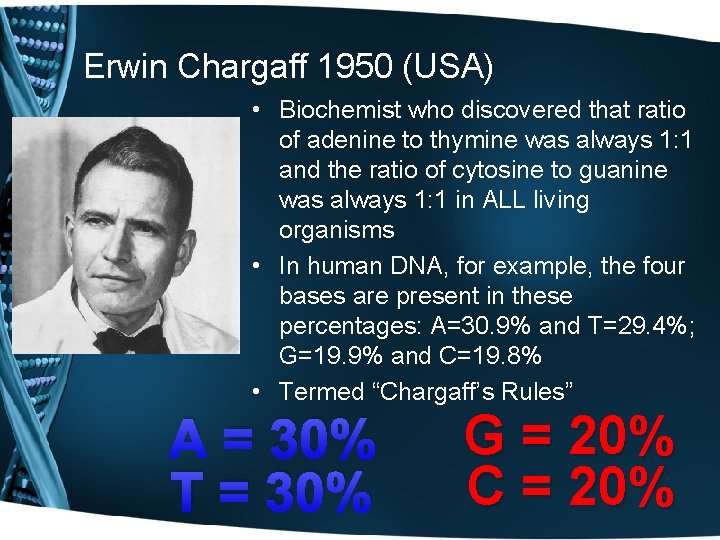
Erwin Chargaff 1950 (USA) • Biochemist who discovered that ratio of adenine to thymine was always 1: 1 and the ratio of cytosine to guanine was always 1: 1 in ALL living organisms • In human DNA, for example, the four bases are present in these percentages: A=30. 9% and T=29. 4%; G=19. 9% and C=19. 8% • Termed “Chargaff’s Rules” A = 30% T = 30% G = 20% C = 20%
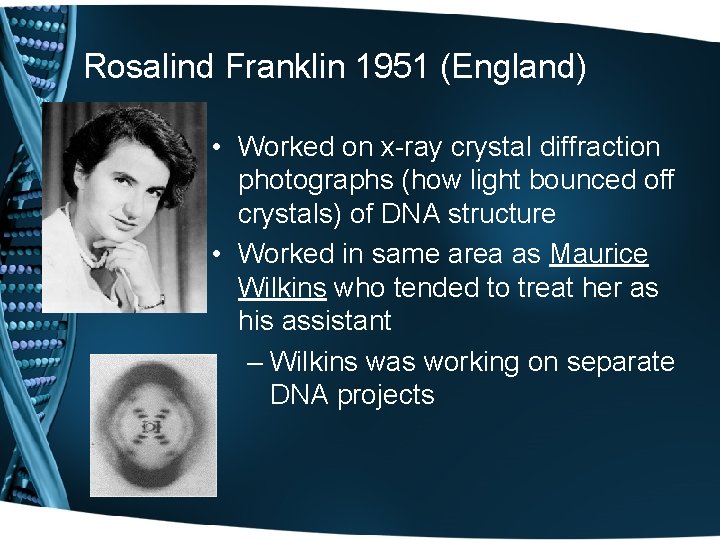
Rosalind Franklin 1951 (England) • Worked on x-ray crystal diffraction photographs (how light bounced off crystals) of DNA structure • Worked in same area as Maurice Wilkins who tended to treat her as his assistant – Wilkins was working on separate DNA projects
Structure • … was still unknown – How did the phosphate, deoxyribose, and 4 nitrogenous bases fit together?
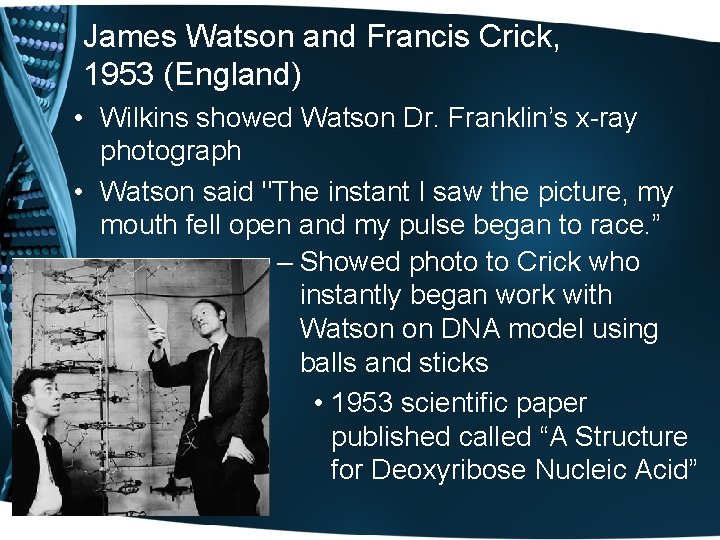
James Watson and Francis Crick, 1953 (England) • Wilkins showed Watson Dr. Franklin’s x-ray photograph • Watson said "The instant I saw the picture, my mouth fell open and my pulse began to race. ” – Showed photo to Crick who instantly began work with Watson on DNA model using balls and sticks • 1953 scientific paper published called “A Structure for Deoxyribose Nucleic Acid”
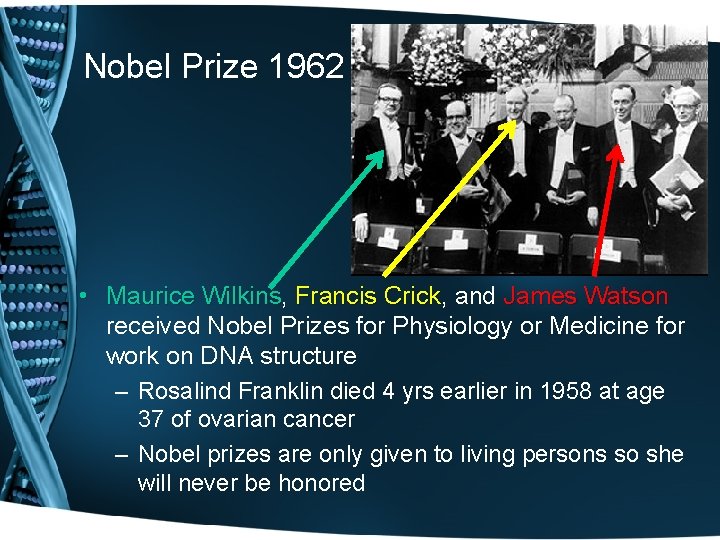
Nobel Prize 1962 • Maurice Wilkins, Francis Crick, Crick and James Watson received Nobel Prizes for Physiology or Medicine for work on DNA structure – Rosalind Franklin died 4 yrs earlier in 1958 at age 37 of ovarian cancer – Nobel prizes are only given to living persons so she will never be honored