
History of Democracy Modern Era Democracy in Europe
- Slides: 24
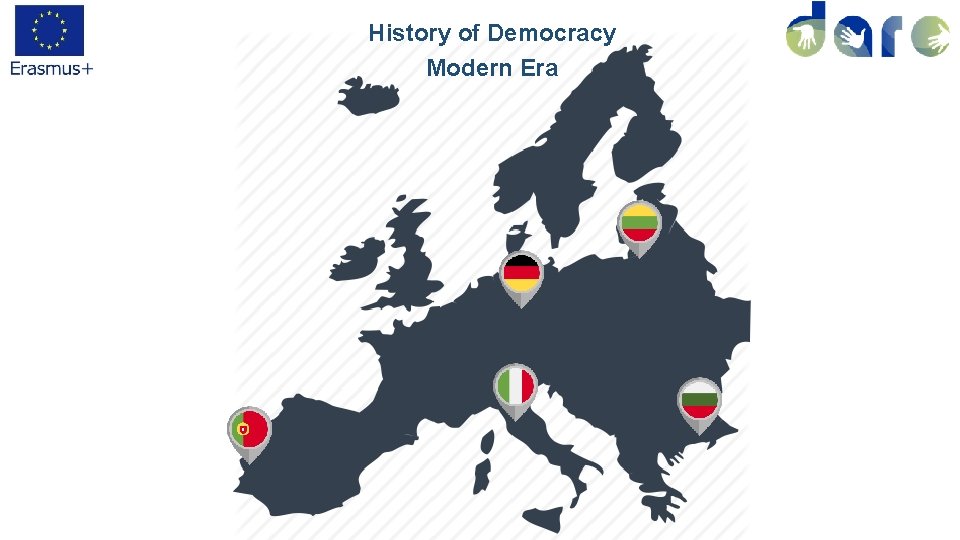
History of Democracy Modern Era
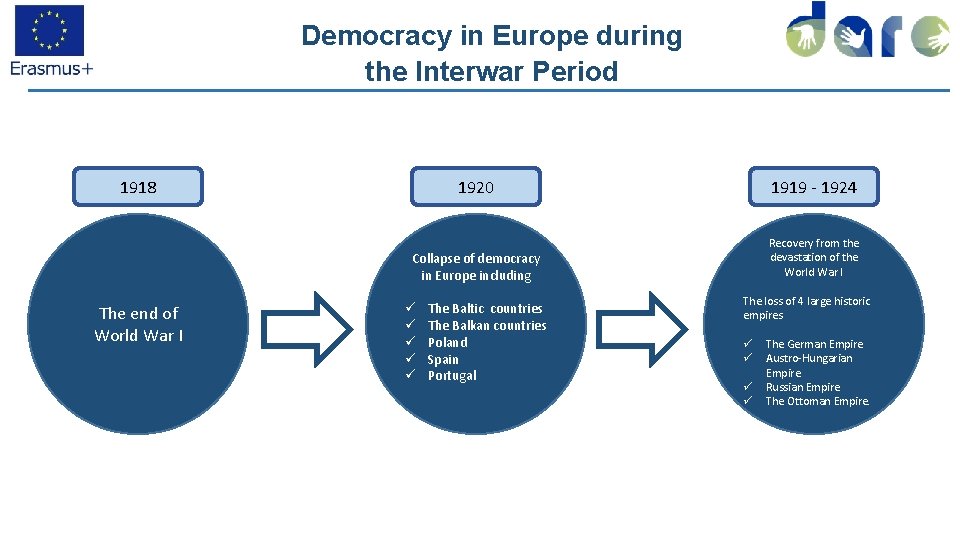
Democracy in Europe during the Interwar Period 1918 The end of World War I 1920 1919 - 1924 Collapse of democracy in Europe including Recovery from the devastation of the World War I ü ü ü The Baltic countries The Balkan countries Poland Spain Portugal The loss of 4 large historic empires ü The German Empire ü Austro-Hungarian Empire ü Russian Empire ü The Ottoman Empire.
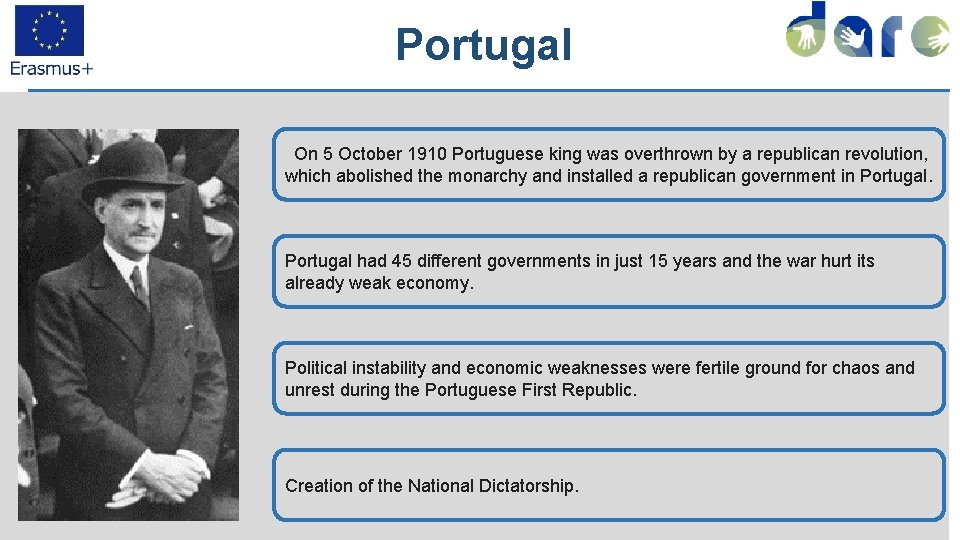
Portugal On 5 October 1910 Portuguese king was overthrown by a republican revolution, which abolished the monarchy and installed a republican government in Portugal had 45 different governments in just 15 years and the war hurt its already weak economy. Political instability and economic weaknesses were fertile ground for chaos and unrest during the Portuguese First Republic. Creation of the National Dictatorship.
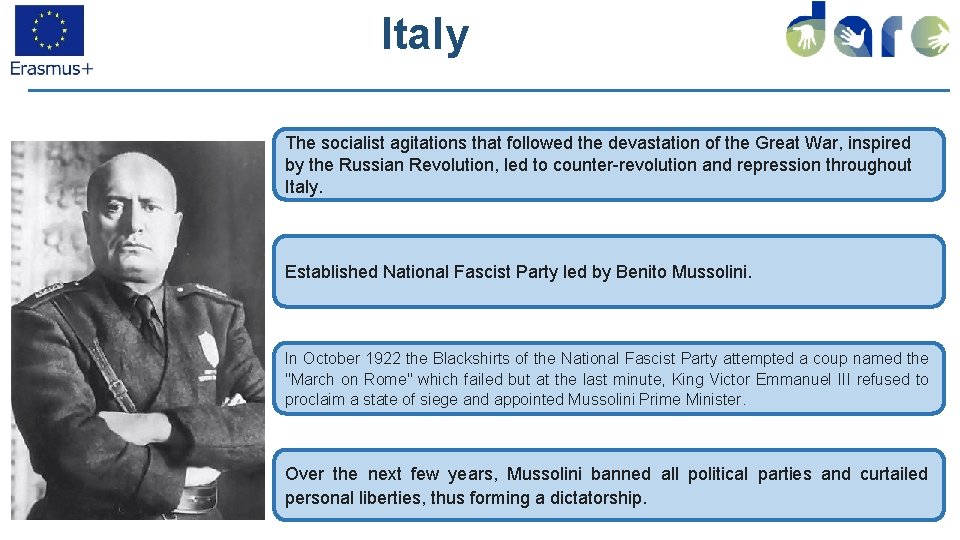
Italy The socialist agitations that followed the devastation of the Great War, inspired by the Russian Revolution, led to counter-revolution and repression throughout Italy. Established National Fascist Party led by Benito Mussolini. In October 1922 the Blackshirts of the National Fascist Party attempted a coup named the "March on Rome" which failed but at the last minute, King Victor Emmanuel III refused to proclaim a state of siege and appointed Mussolini Prime Minister. Over the next few years, Mussolini banned all political parties and curtailed personal liberties, thus forming a dictatorship.
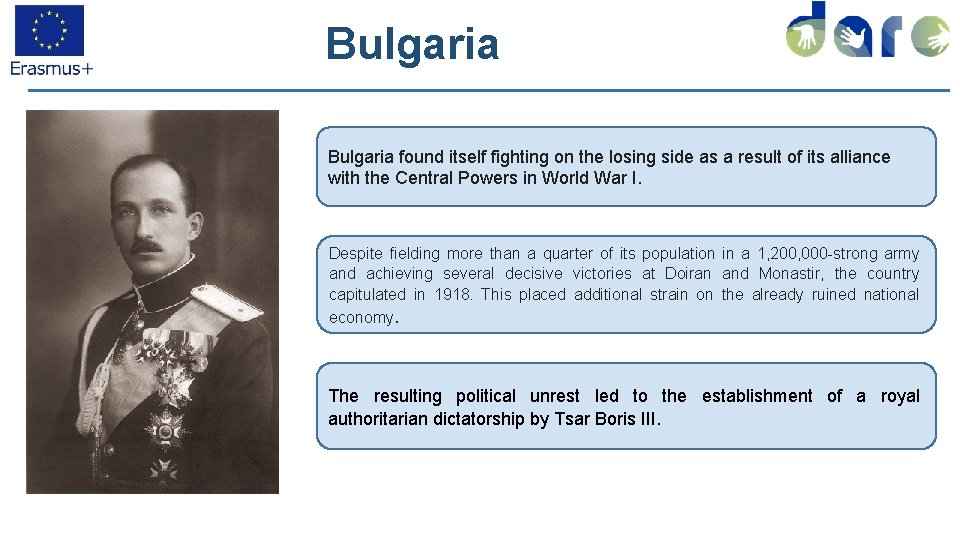
Bulgaria found itself fighting on the losing side as a result of its alliance with the Central Powers in World War I. Despite fielding more than a quarter of its population in a 1, 200, 000 -strong army and achieving several decisive victories at Doiran and Monastir, the country capitulated in 1918. This placed additional strain on the already ruined national economy. The resulting political unrest led to the establishment of a royal authoritarian dictatorship by Tsar Boris III.
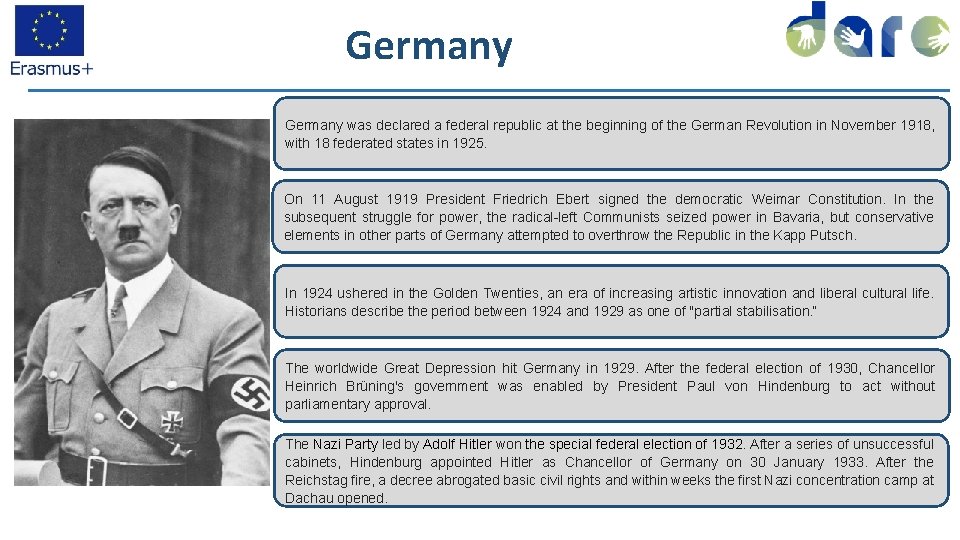
Germany was declared a federal republic at the beginning of the German Revolution in November 1918, with 18 federated states in 1925. On 11 August 1919 President Friedrich Ebert signed the democratic Weimar Constitution. In the subsequent struggle for power, the radical-left Communists seized power in Bavaria, but conservative elements in other parts of Germany attempted to overthrow the Republic in the Kapp Putsch. In 1924 ushered in the Golden Twenties, an era of increasing artistic innovation and liberal cultural life. Historians describe the period between 1924 and 1929 as one of "partial stabilisation. “ The worldwide Great Depression hit Germany in 1929. After the federal election of 1930, Chancellor Heinrich Brüning's government was enabled by President Paul von Hindenburg to act without parliamentary approval. The Nazi Party led by Adolf Hitler won the special federal election of 1932. After a series of unsuccessful cabinets, Hindenburg appointed Hitler as Chancellor of Germany on 30 January 1933. After the Reichstag fire, a decree abrogated basic civil rights and within weeks the first Nazi concentration camp at Dachau opened.
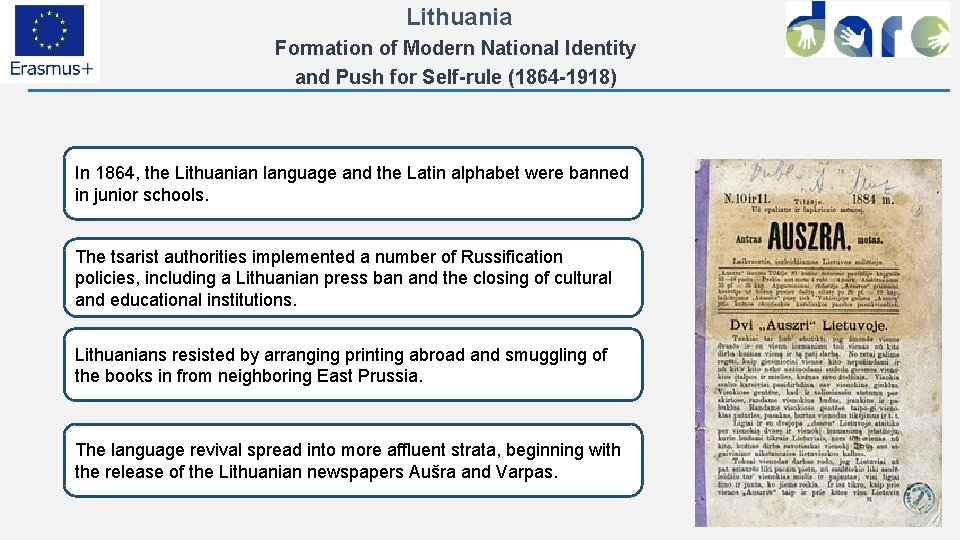
Lithuania Formation of Modern National Identity and Push for Self-rule (1864 -1918) In 1864, the Lithuanian language and the Latin alphabet were banned in junior schools. The tsarist authorities implemented a number of Russification policies, including a Lithuanian press ban and the closing of cultural and educational institutions. Lithuanians resisted by arranging printing abroad and smuggling of the books in from neighboring East Prussia. The language revival spread into more affluent strata, beginning with the release of the Lithuanian newspapers Aušra and Varpas.
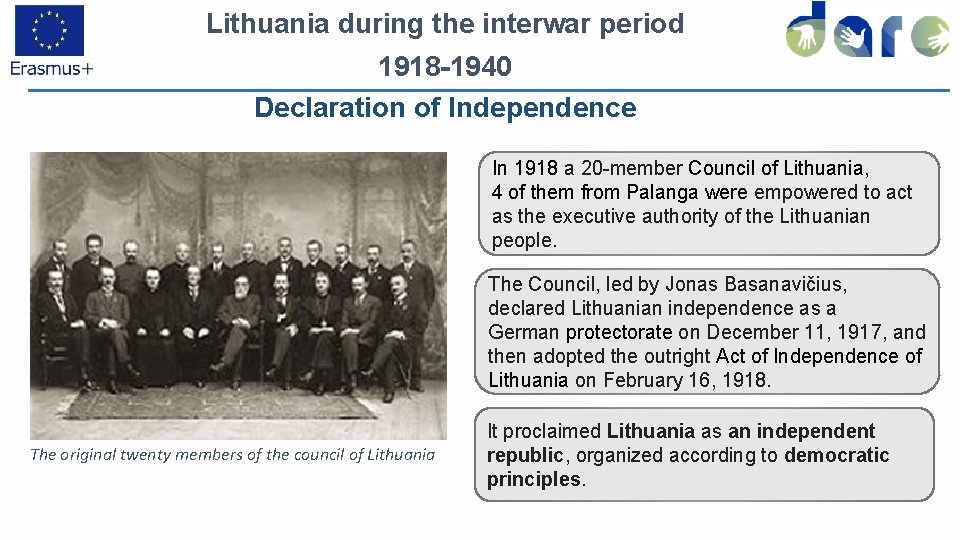
Lithuania during the interwar period 1918 -1940 Declaration of Independence In 1918 a 20 -member Council of Lithuania, 4 of them from Palanga were empowered to act as the executive authority of the Lithuanian people. The Council, led by Jonas Basanavičius, declared Lithuanian independence as a German protectorate on December 11, 1917, and then adopted the outright Act of Independence of Lithuania on February 16, 1918. The original twenty members of the council of Lithuania It proclaimed Lithuania as an independent republic, organized according to democratic principles.
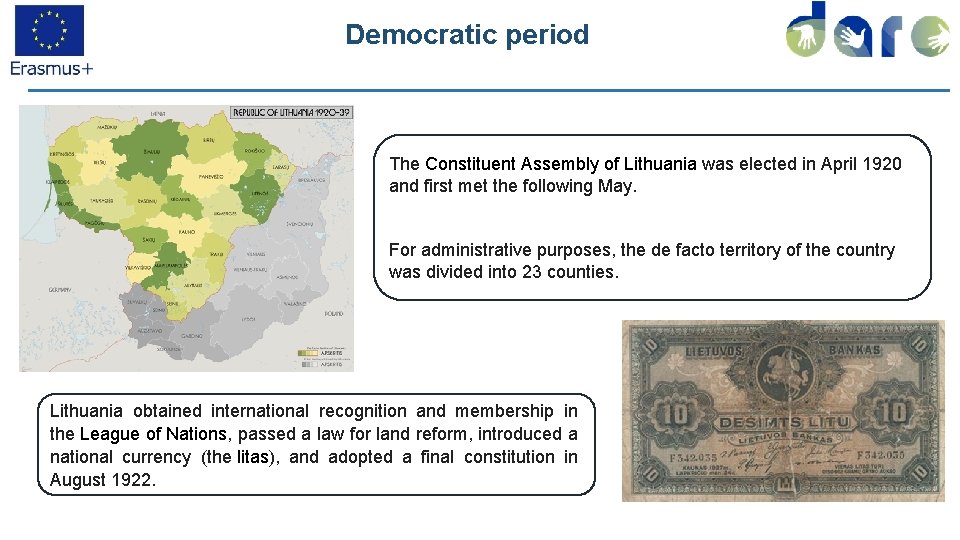
Democratic period The Constituent Assembly of Lithuania was elected in April 1920 and first met the following May. For administrative purposes, the de facto territory of the country was divided into 23 counties. Lithuania obtained international recognition and membership in the League of Nations, passed a law for land reform, introduced a national currency (the litas), and adopted a final constitution in August 1922.
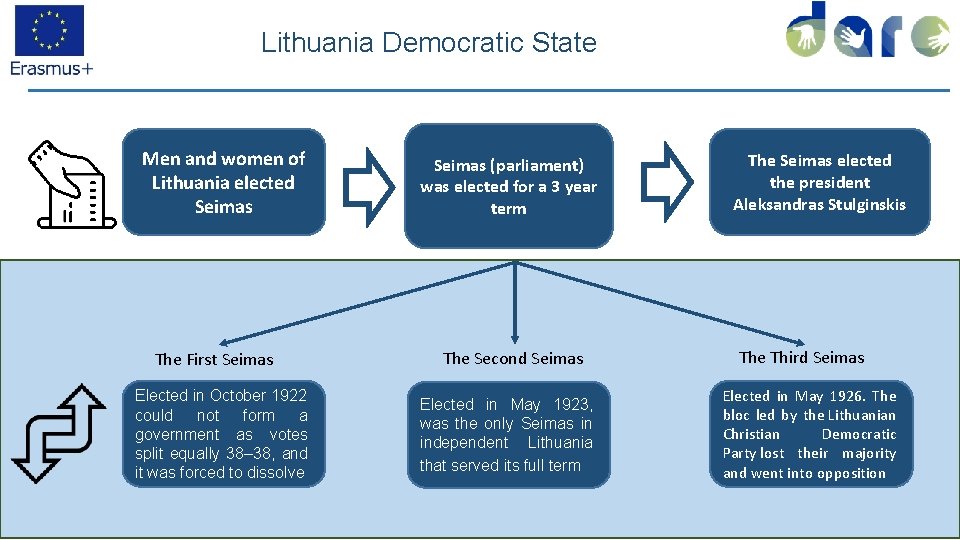
Lithuania Democratic State Men and women of Lithuania elected Seimas The First Seimas Elected in October 1922 could not form a government as votes split equally 38– 38, and it was forced to dissolve Seimas (parliament) was elected for a 3 year term The Second Seimas Elected in May 1923, was the only Seimas in independent Lithuania that served its full term The Seimas elected the president Aleksandras Stulginskis The Third Seimas Elected in May 1926. The bloc led by the Lithuanian Christian Democratic Party lost their majority and went into opposition
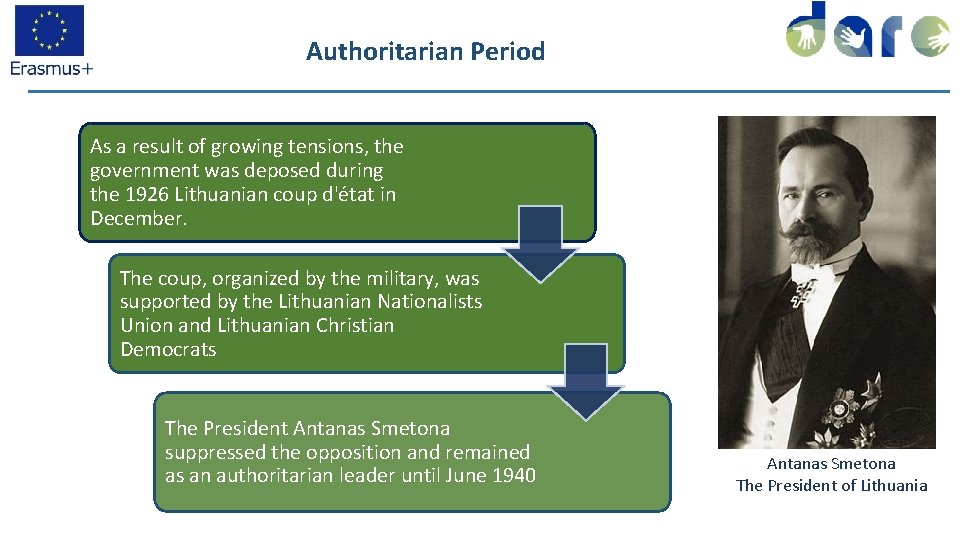
Authoritarian Period As a result of growing tensions, the government was deposed during the 1926 Lithuanian coup d'état in December. The coup, organized by the military, was supported by the Lithuanian Nationalists Union and Lithuanian Christian Democrats The President Antanas Smetona suppressed the opposition and remained as an authoritarian leader until June 1940 Antanas Smetona The President of Lithuania
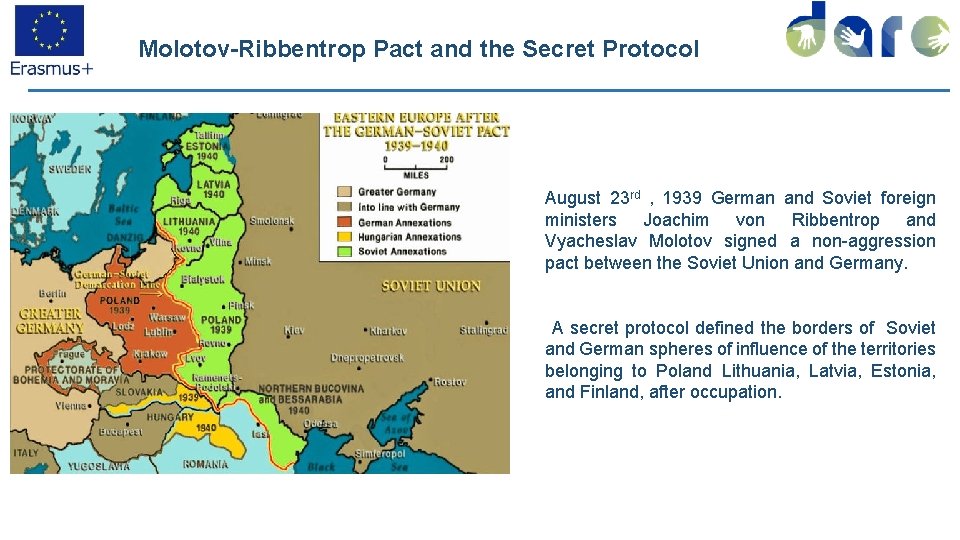
Molotov-Ribbentrop Pact and the Secret Protocol August 23 rd , 1939 German and Soviet foreign ministers Joachim von Ribbentrop and Vyacheslav Molotov signed a non-aggression pact between the Soviet Union and Germany. A secret protocol defined the borders of Soviet and German spheres of influence of the territories belonging to Poland Lithuania, Latvia, Estonia, and Finland, after occupation.
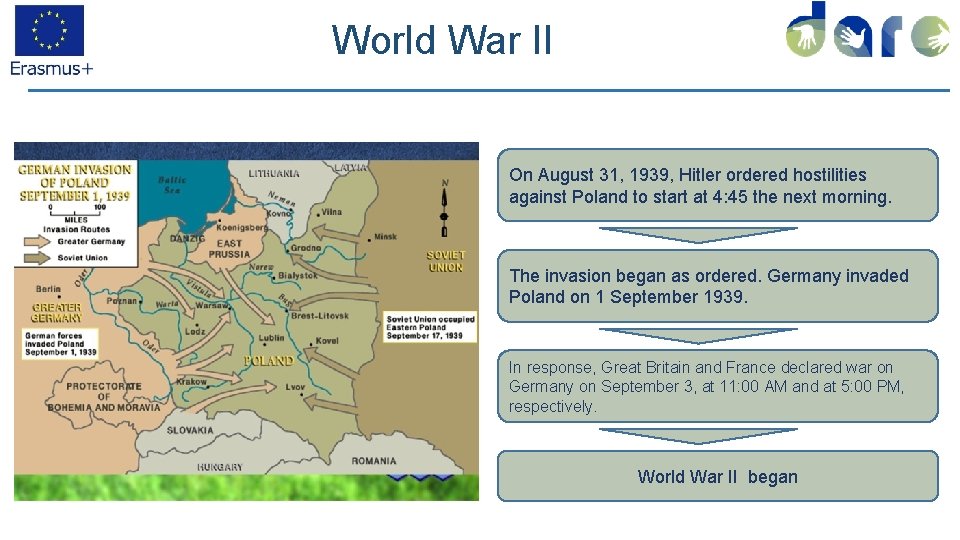
World War II On August 31, 1939, Hitler ordered hostilities against Poland to start at 4: 45 the next morning. The invasion began as ordered. Germany invaded Poland on 1 September 1939. In response, Great Britain and France declared war on Germany on September 3, at 11: 00 AM and at 5: 00 PM, respectively. World War II began
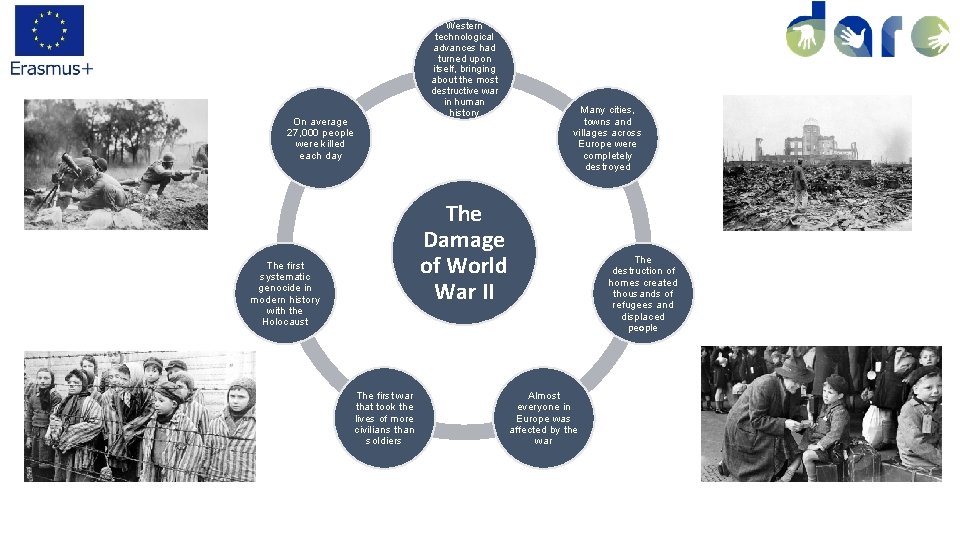
On average 27, 000 people were killed each day Western technological advances had turned upon itself, bringing about the most destructive war in human history Many cities, towns and villages across Europe were completely destroyed The Damage of World War II The first systematic genocide in modern history with the Holocaust The first war that took the lives of more civilians than soldiers Almost everyone in Europe was affected by the war The destruction of homes created thousands of refugees and displaced people
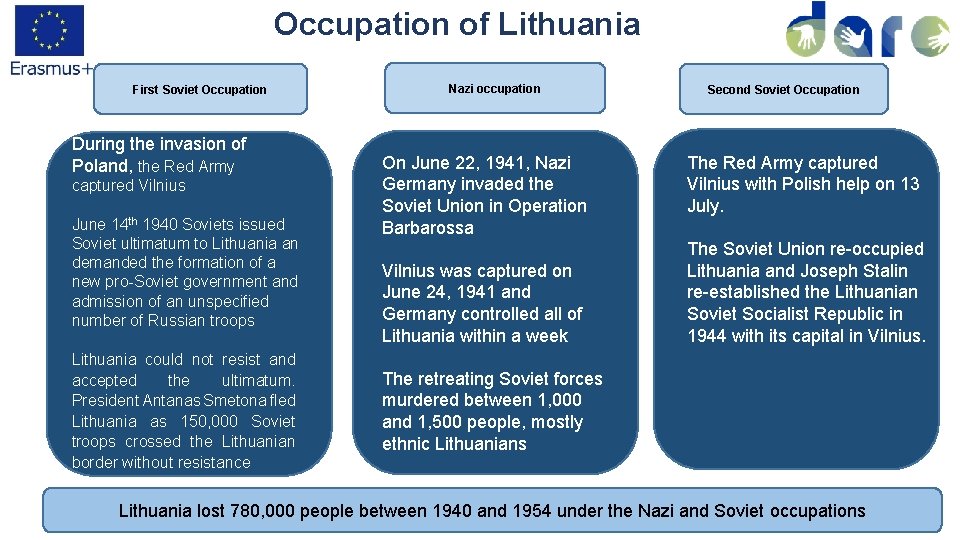
Occupation of Lithuania First Soviet Occupation During the invasion of Poland, the Red Army captured Vilnius June 14 th 1940 Soviets issued Soviet ultimatum to Lithuania an demanded the formation of a new pro-Soviet government and admission of an unspecified number of Russian troops Lithuania could not resist and accepted the ultimatum. President Antanas Smetona fled Lithuania as 150, 000 Soviet troops crossed the Lithuanian border without resistance Nazi occupation On June 22, 1941, Nazi Germany invaded the Soviet Union in Operation Barbarossa Vilnius was captured on June 24, 1941 and Germany controlled all of Lithuania within a week Second Soviet Occupation The Red Army captured Vilnius with Polish help on 13 July. The Soviet Union re-occupied Lithuania and Joseph Stalin re-established the Lithuanian Soviet Socialist Republic in 1944 with its capital in Vilnius. The retreating Soviet forces murdered between 1, 000 and 1, 500 people, mostly ethnic Lithuanians Lithuania lost 780, 000 people between 1940 and 1954 under the Nazi and Soviet occupations
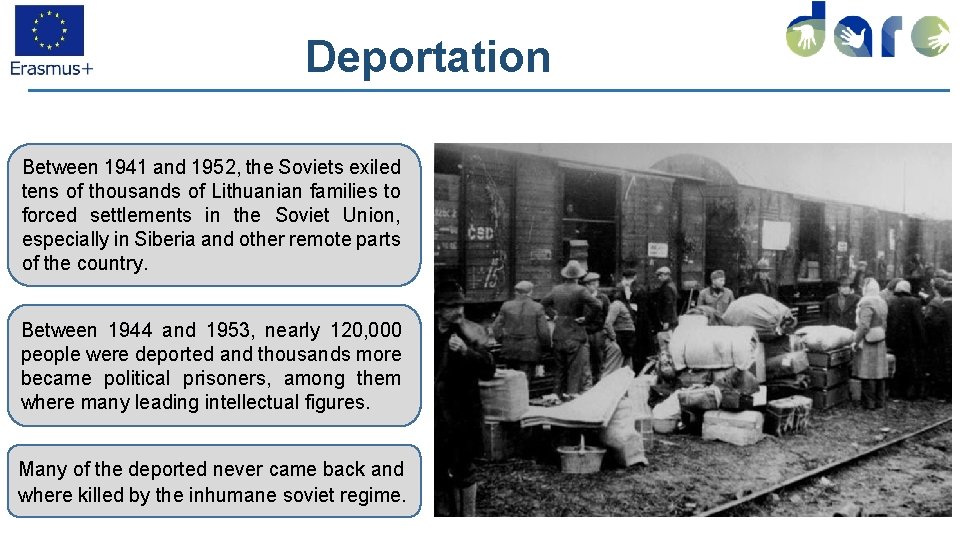
Deportation Between 1941 and 1952, the Soviets exiled tens of thousands of Lithuanian families to forced settlements in the Soviet Union, especially in Siberia and other remote parts of the country. Between 1944 and 1953, nearly 120, 000 people were deported and thousands more became political prisoners, among them where many leading intellectual figures. Many of the deported never came back and where killed by the inhumane soviet regime.
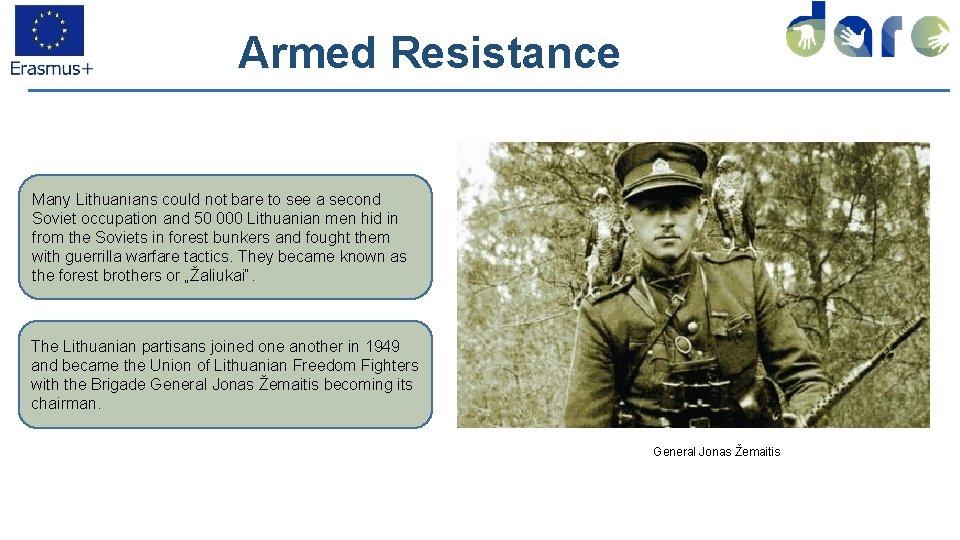
Armed Resistance Many Lithuanians could not bare to see a second Soviet occupation and 50 000 Lithuanian men hid in from the Soviets in forest bunkers and fought them with guerrilla warfare tactics. They became known as the forest brothers or „Žaliukai“. The Lithuanian partisans joined one another in 1949 and became the Union of Lithuanian Freedom Fighters with the Brigade General Jonas Žemaitis becoming its chairman. General Jonas Žemaitis
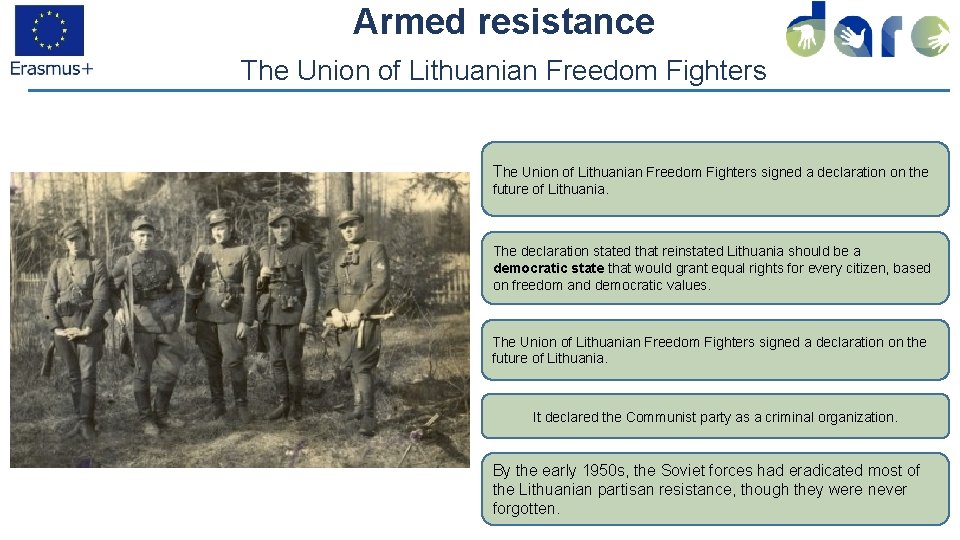
Armed resistance The Union of Lithuanian Freedom Fighters signed a declaration on the future of Lithuania. The declaration stated that reinstated Lithuania should be a democratic state that would grant equal rights for every citizen, based on freedom and democratic values. The Union of Lithuanian Freedom Fighters signed a declaration on the future of Lithuania. It declared the Communist party as a criminal organization. By the early 1950 s, the Soviet forces had eradicated most of the Lithuanian partisan resistance, though they were never forgotten.
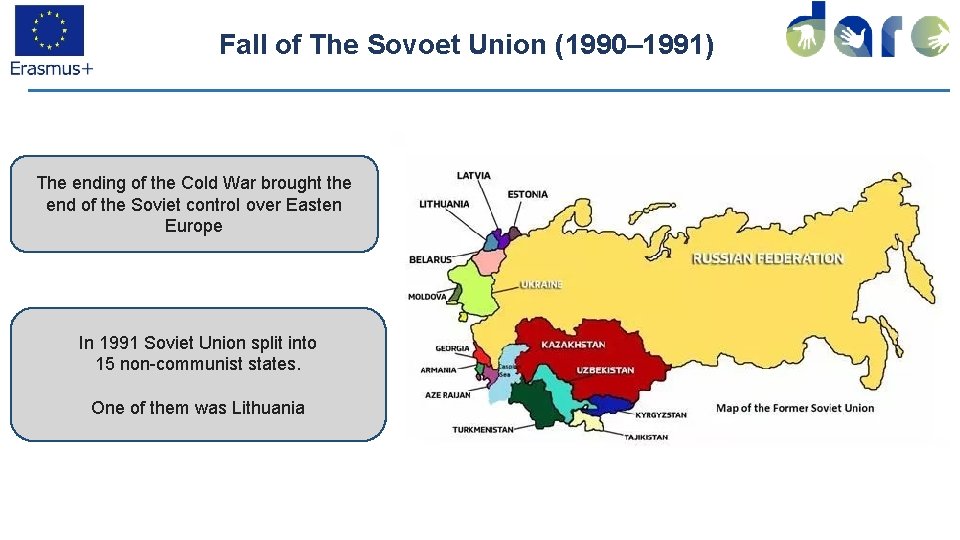
Fall of The Sovoet Union (1990– 1991) The ending of the Cold War brought the end of the Soviet control over Easten Europe In 1991 Soviet Union split into 15 non-communist states. One of them was Lithuania
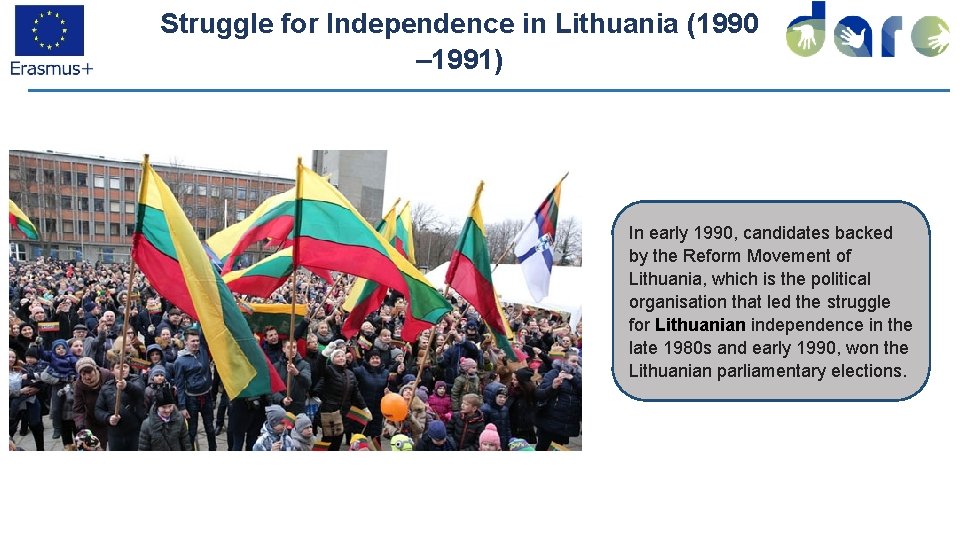
Struggle for Independence in Lithuania (1990 – 1991) In early 1990, candidates backed by the Reform Movement of Lithuania, which is the political organisation that led the struggle for Lithuanian independence in the late 1980 s and early 1990, won the Lithuanian parliamentary elections.
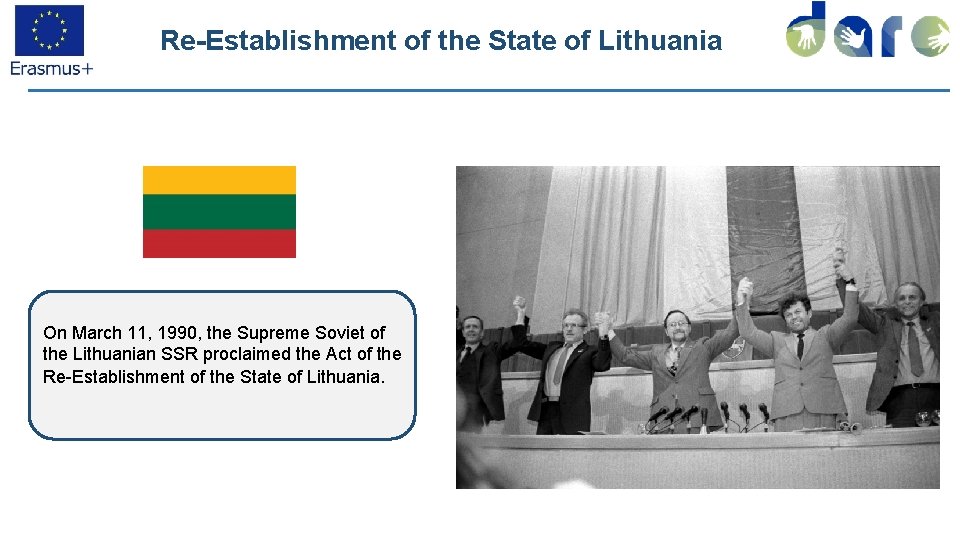
Re-Establishment of the State of Lithuania On March 11, 1990, the Supreme Soviet of the Lithuanian SSR proclaimed the Act of the Re-Establishment of the State of Lithuania.
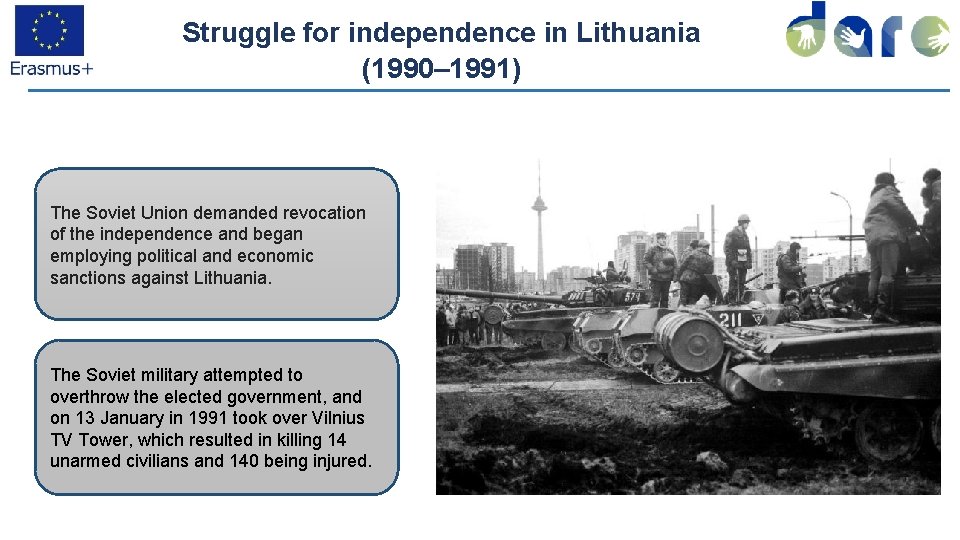
Struggle for independence in Lithuania (1990– 1991) The Soviet Union demanded revocation of the independence and began employing political and economic sanctions against Lithuania. The Soviet military attempted to overthrow the elected government, and on 13 January in 1991 took over Vilnius TV Tower, which resulted in killing 14 unarmed civilians and 140 being injured.
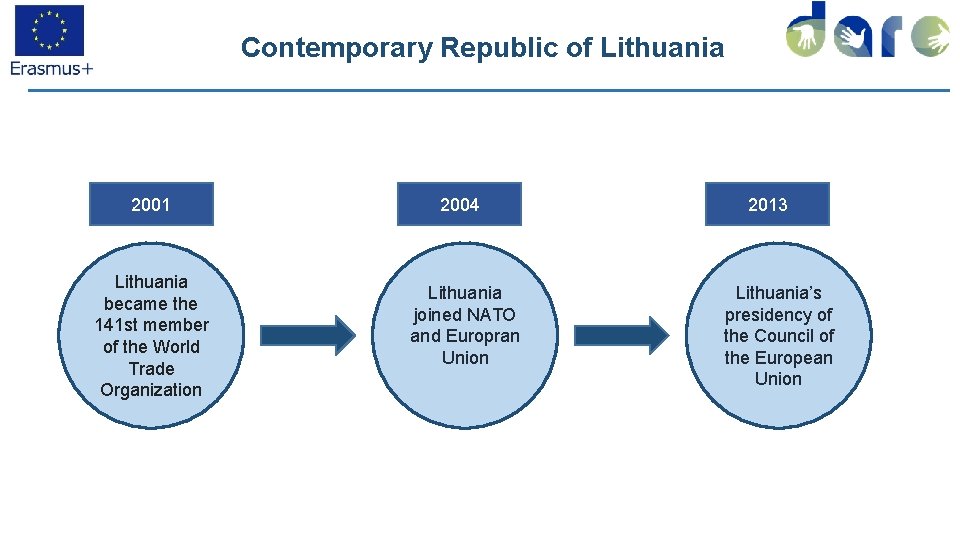
Contemporary Republic of Lithuania 2001 Lithuania became the 141 st member of the World Trade Organization 2004 Lithuania joined NATO and Europran Union 2013 Lithuania’s presidency of the Council of the European Union
Prepared by Marius Gruzdys Dovydas Zemaitaitis Dominykas Rekus Adomas Janusas Palanga Seniji Gimnazija, Lithuania 2019 Responsibility for the information and views set out in this presentation lies entirely with the authors