
History of Crime Victimization Informal social control dominated

- Slides: 11
History of Crime Victimization • Informal social control dominated the regulation of early societies • The victim, offender and the community were intimately involved with the response to violations of the social order deemed harmful. • A shift in the treatment of crime and victims occurred with the formation of Nation-Sates in the 16 th and 17 th centuries. • During this period, crimes came to be redefined as an offence against the State, rather than against individuals • This lead to a dramatic decline in the victims’ participation in the formal criminal justice process
Victim Participation in the Criminal Justice “Process” • Police are mainly the first contact with victims • One common complaint of crime victims is that they feel the police do not give them enough updates as to the status of the case • The police supply the District Attorney’s office with their report • The D. A. can proceed with the original charge, pursue a lesser charge, or choose not to prosecute at all • Hearings proceed if the D. A. decides to prosecute • There may be additional discussions between the prosecutor and the defense attorney about plea bargaining • Oftentimes, victims are not included
Victim Participation in the Criminal Justice “Process” Continued • Trial: Prosecutor and defense will present opening statements Prosecutor will present their case Defense will present its case Both sides will present closing arguments If found guilty: sentencing hearing Victim impact statement is included in the presentence investigation history put together by the probation office and submitted to the Judge • If the offender is sentenced to prison, a victim can request to be notified when the offender is going to get released • • •
History of Victimology • Criminology the study of crime • Victimology emerged with in the field of Criminology due to the realization of the lack of attention given to victims of crime • Victimology is the scientific study of victims of crime • Victim refers to those individuals who have suffered harm, however the term survivor is also used by practitioners, such as activists and service providers, to describe the same individuals
Identifying and Defining Victims of Crime • Social changes and social movements brought more attention to different forms of victimization • Women’s Rights and Feminist Movements of the 1960’s and 1970’s • Professionals were also at the forefront of the identification process.
Identifying and Defining Victims of Crime • Vulnerable populations • Crimes against the elderly • Homeless • Immigrants • Newly identified victims • Natural disasters • Animals • White collar crimes • Technology and globalization • Transnational crimes • Organized crimes • International crimes
Explaining Victimization • Continuum of victims’ contribution to crime • Perspectives that focus on the victim’s role in the crime dyad tend to be characterized as victim-blaming or victim precipitation approaches • Passive precipitation places the least amount of perceived blame on the victim for their victimization • Active precipitation, on the other hand, can be characterized by those victims who are viewed as being the most responsible for bringing about their own victimization • “Just world outlook” or “just world philosophy”, which reinforces in the mind of the observer that the victim must have done something to bring the crime on themselves and can reassure the observer that they themselves are safe from harm
Explaining Victimization Continued • Offender-blaming approach. This approach reflects some of the more traditional criminological perspectives which seek to explain all crime thorough the offender’s actions, placing no responsibility on the victim • Lifestyle theories explain crime and victimization as consequences of the different ways people live their lives • Deviant place theory is linked to lifestyle theories in that it connects the place where victimization may occur to the lifestyle one leads
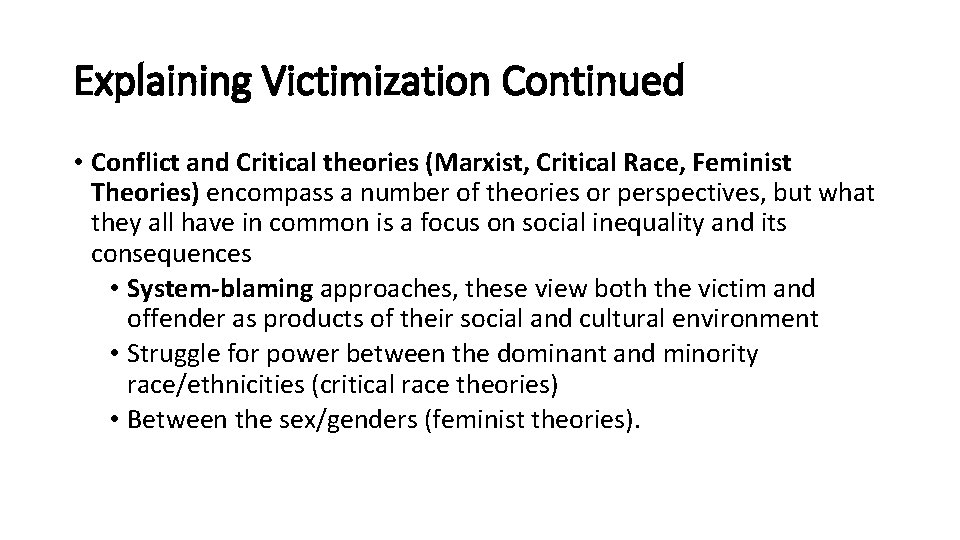
Explaining Victimization Continued • Conflict and Critical theories (Marxist, Critical Race, Feminist Theories) encompass a number of theories or perspectives, but what they all have in common is a focus on social inequality and its consequences • System-blaming approaches, these view both the victim and offender as products of their social and cultural environment • Struggle for power between the dominant and minority race/ethnicities (critical race theories) • Between the sex/genders (feminist theories).
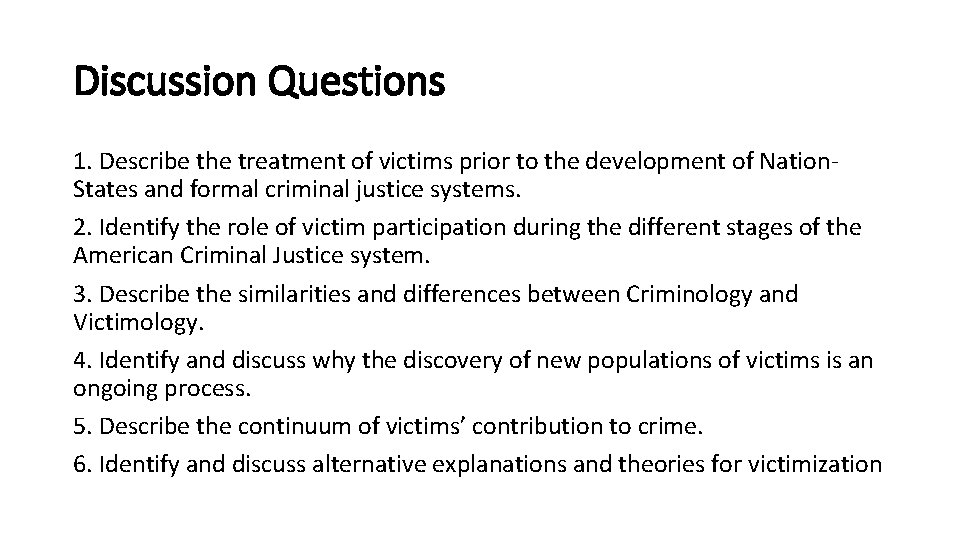
Discussion Questions 1. Describe the treatment of victims prior to the development of Nation. States and formal criminal justice systems. 2. Identify the role of victim participation during the different stages of the American Criminal Justice system. 3. Describe the similarities and differences between Criminology and Victimology. 4. Identify and discuss why the discovery of new populations of victims is an ongoing process. 5. Describe the continuum of victims’ contribution to crime. 6. Identify and discuss alternative explanations and theories for victimization
The full set of 380 slides is available upon adoption of Crime Victimization, Second Edition. If you are a professor using this book for a course, please email Beth at bhall@cap-press. com to request your slides.