
History of Computers Necessity Is the Mother of
- Slides: 34
History of Computers “Necessity Is the Mother of Invention”
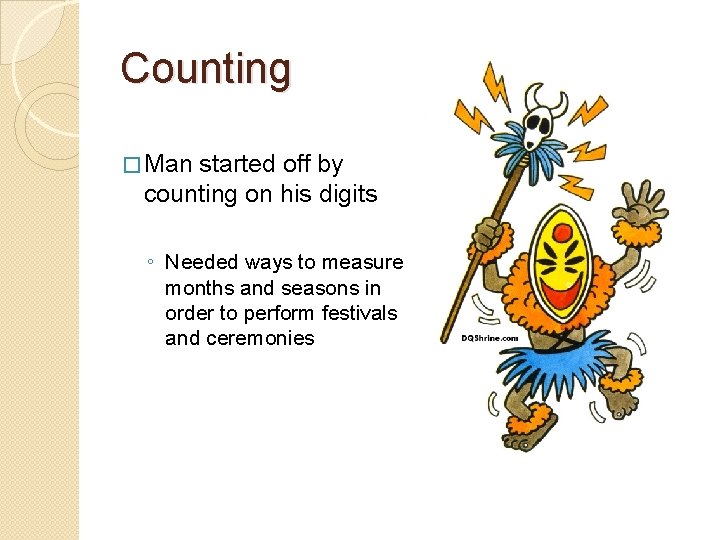
Counting � Man started off by counting on his digits ◦ Needed ways to measure months and seasons in order to perform festivals and ceremonies
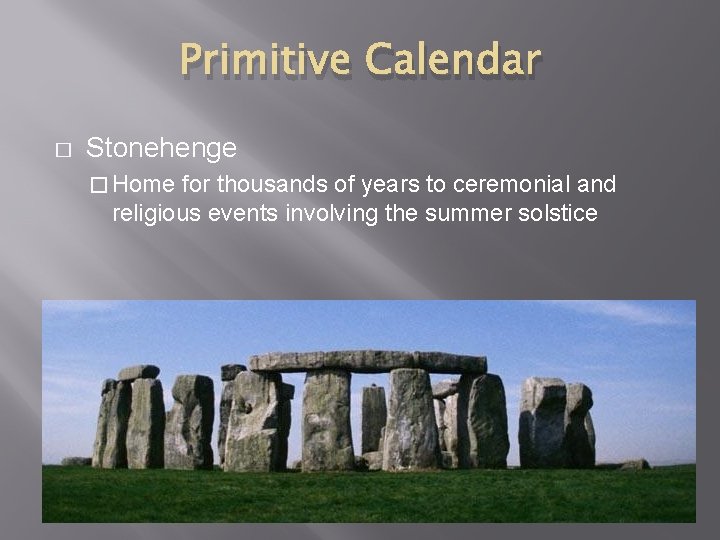
Primitive Calendar � Stonehenge � Home for thousands of years to ceremonial and religious events involving the summer solstice
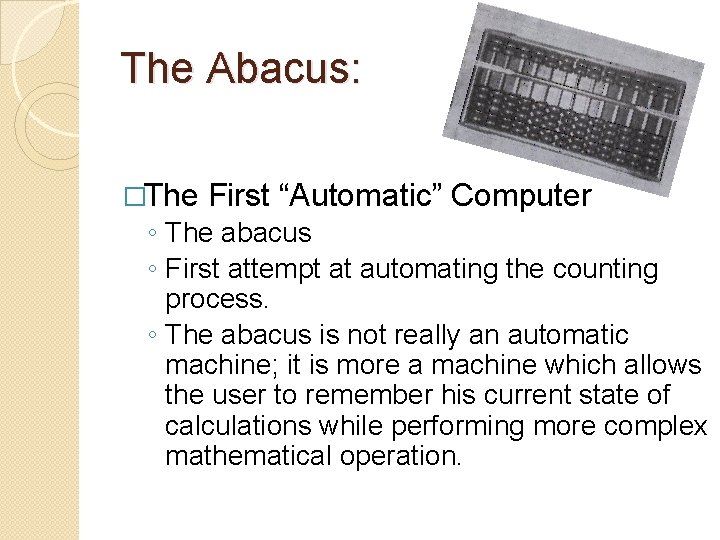
The Abacus: �The First “Automatic” Computer ◦ The abacus ◦ First attempt at automating the counting process. ◦ The abacus is not really an automatic machine; it is more a machine which allows the user to remember his current state of calculations while performing more complex mathematical operation.
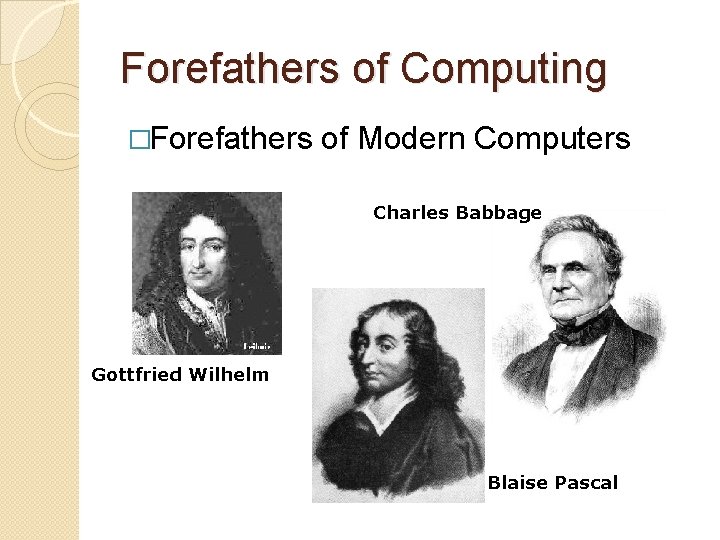
Forefathers of Computing �Forefathers of Modern Computers Charles Babbage Gottfried Wilhelm Blaise Pascal
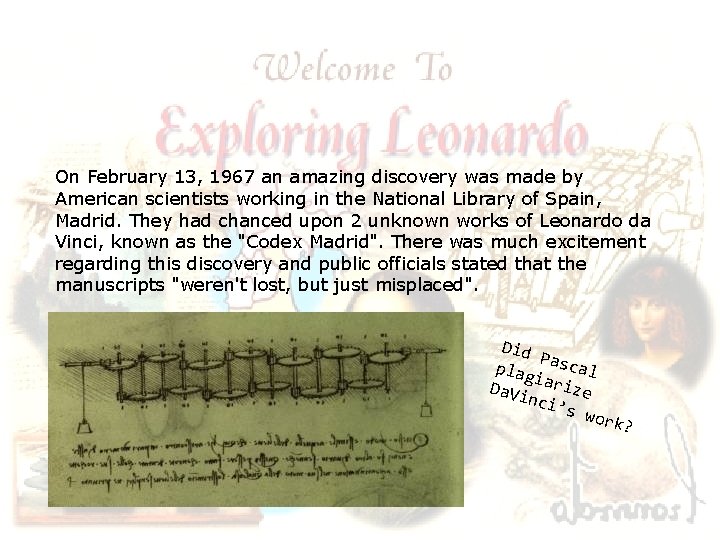
And Before That. . On February 13, 1967 an amazing discovery was made by American scientists working in the National Library of Spain, Madrid. They had chanced upon 2 unknown works of Leonardo da Vinci, known as the "Codex Madrid". There was much excitement regarding this discovery and public officials stated that the manuscripts "weren't lost, but just misplaced". Did P plag ascal i Da. Vi arize nci’ s wo rk?
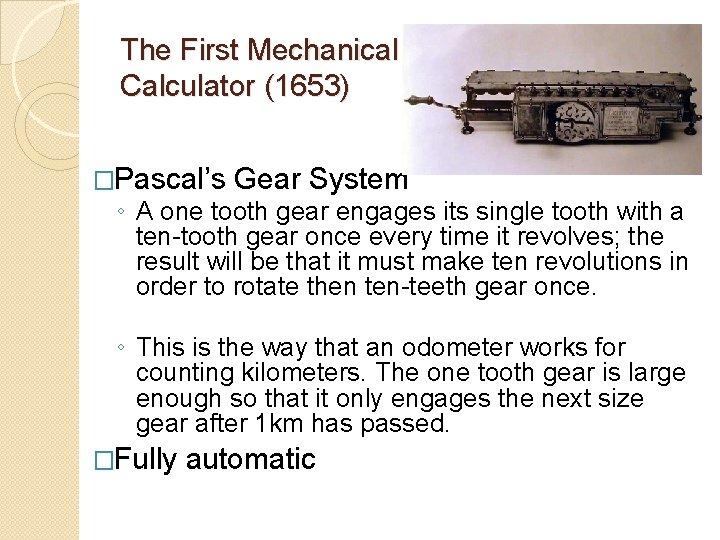
The First Mechanical Calculator (1653) �Pascal’s Gear System ◦ A one tooth gear engages its single tooth with a ten-tooth gear once every time it revolves; the result will be that it must make ten revolutions in order to rotate then ten-teeth gear once. ◦ This is the way that an odometer works for counting kilometers. The one tooth gear is large enough so that it only engages the next size gear after 1 km has passed. �Fully automatic
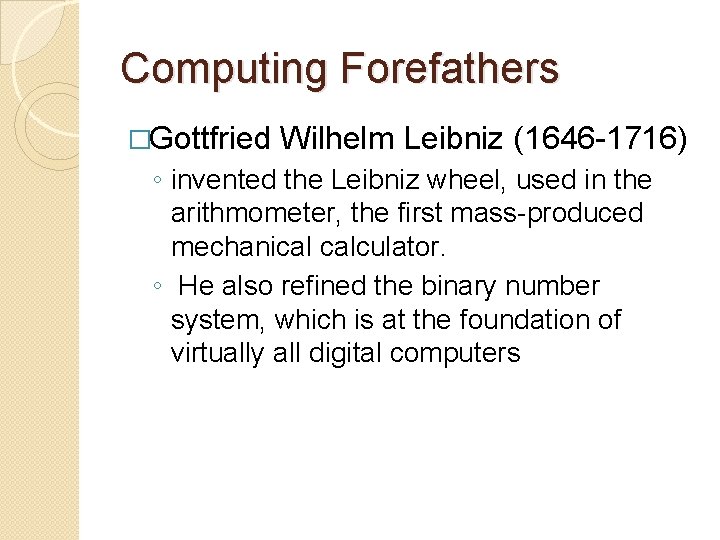
Computing Forefathers �Gottfried Wilhelm Leibniz (1646 -1716) ◦ invented the Leibniz wheel, used in the arithmometer, the first mass-produced mechanical calculator. ◦ He also refined the binary number system, which is at the foundation of virtually all digital computers
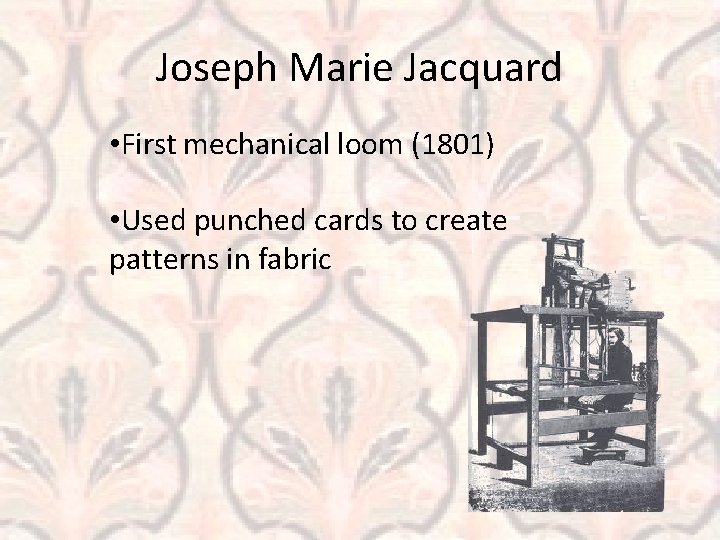
Joseph Marie Jacquard • First mechanical loom (1801) • Used punched cards to create patterns in fabric
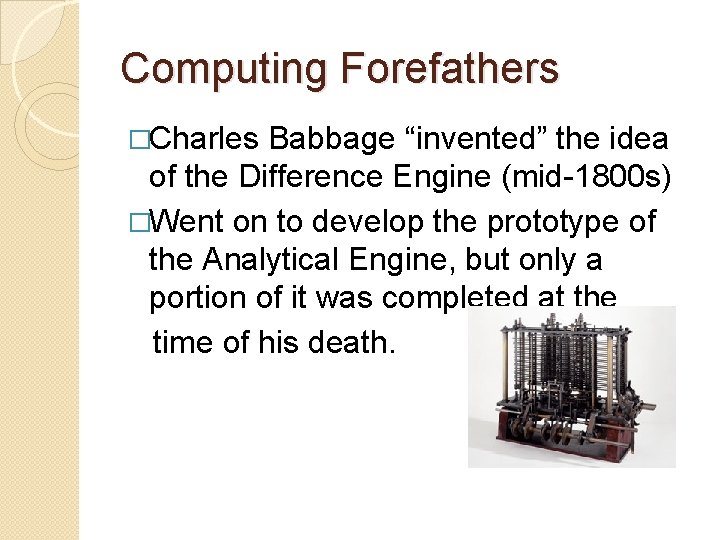
Computing Forefathers �Charles Babbage “invented” the idea of the Difference Engine (mid-1800 s) �Went on to develop the prototype of the Analytical Engine, but only a portion of it was completed at the time of his death.
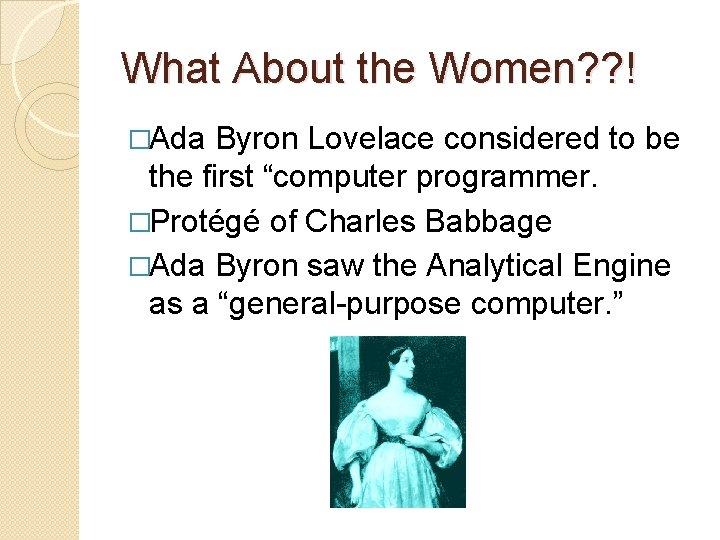
What About the Women? ? ! �Ada Byron Lovelace considered to be the first “computer programmer. �Protégé of Charles Babbage �Ada Byron saw the Analytical Engine as a “general-purpose computer. ”
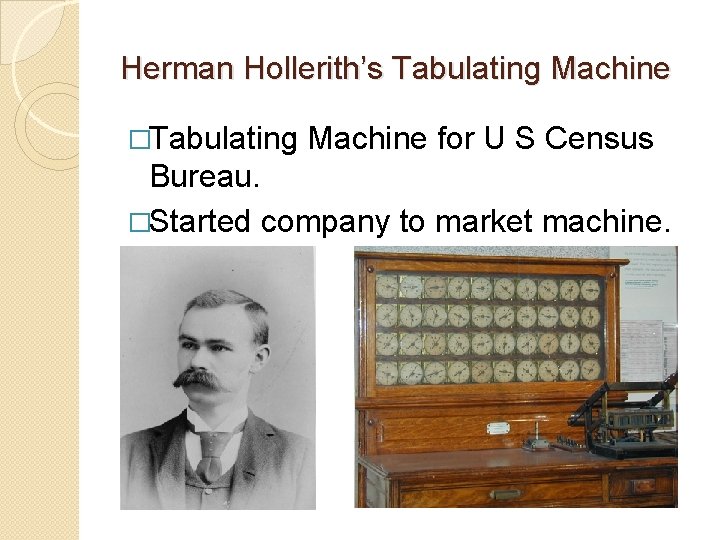
Herman Hollerith’s Tabulating Machine �Tabulating Machine for U S Census Bureau. �Started company to market machine.
IBM �Hollerith sold his Tabulating Machine Company, which then merged with several other businesses �Thomas Watson became president of merged companies in 1920 s and changed name to International Business Machines.
Alan Turing �Turing first described the Turing machine in an article published in 1936, “On Computable Numbers. ” �A Turing machine is an idealized computing device consisting of a read/write head (or 'scanner') with a paper tape passing through it. � The tape is divided into squares, each square bearing a single symbol--'0' or '1', for example. This tape is the machine's general purpose storage medium, serving both as the vehicle for input and output
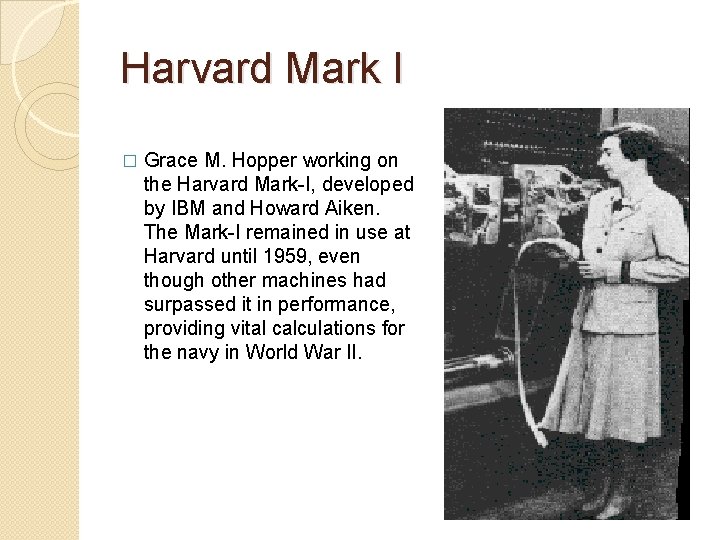
Harvard Mark I � Grace M. Hopper working on the Harvard Mark-I, developed by IBM and Howard Aiken. The Mark-I remained in use at Harvard until 1959, even though other machines had surpassed it in performance, providing vital calculations for the navy in World War II.
Konrad Zuse--Binary Representations �Numbers can be converted to decimal to adding together the values of the holes, given that the first hole = 1 and the second 2, etc. �For example, 26=2^5+2^3+2^1+2^0 �Holes represent an “on” signal. �With 6 holes permissible, 2^6 numbers possible.
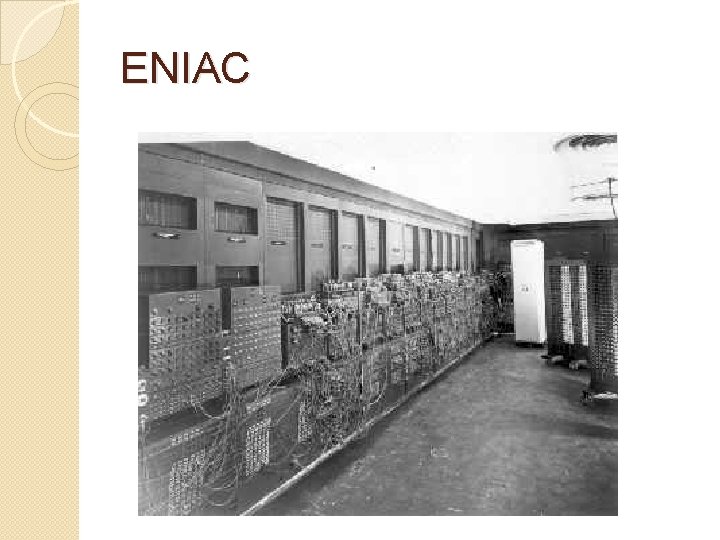
ENIAC
What about the ABC Computer? �John Atanazoff and Clifford Berry developed the ABC Computer before the ENIAC �In 1973, a Court ruled that the ABC Computer was actually first!— developed in Iowa in late 1930 s.
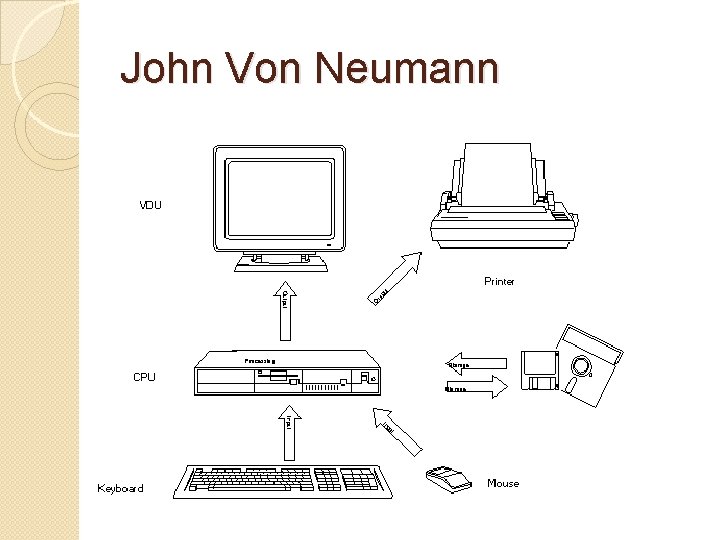
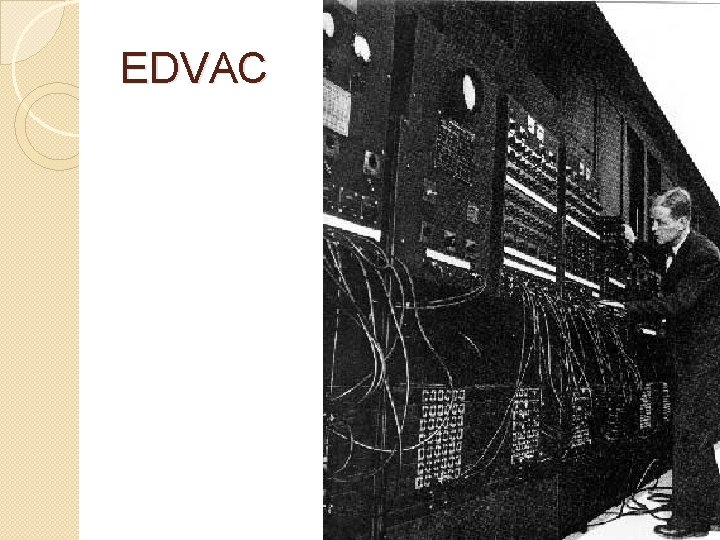
John Von Neumann � The Von Neumann Machine ◦ Data and program can be stored in the same space. Thus, the machine itself can alter either its program or its internal data. ◦ Conditional goto’s to other points in the code ◦ Von Neumann worked with Mauchly and Eckert on the design for EDVAC ◦ Also a contributor to the fields of game theory and cellular automata
John Von Neumann
EDVAC
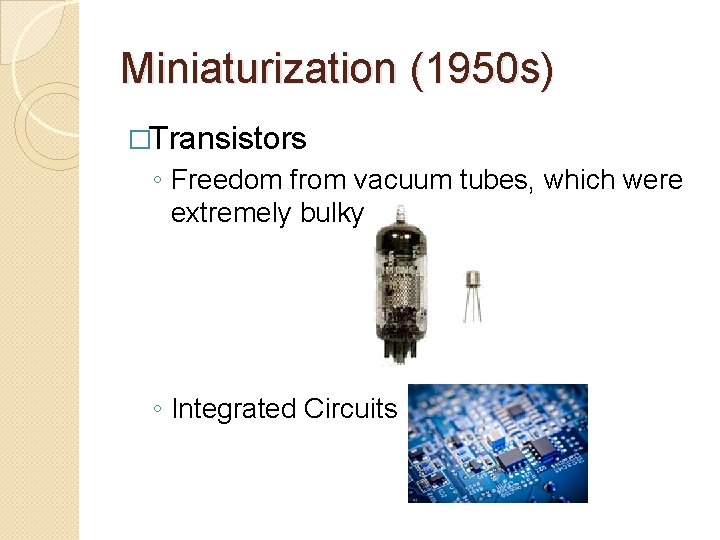
Miniaturization (1950 s) �Transistors ◦ Freedom from vacuum tubes, which were extremely bulky ◦ Integrated Circuits
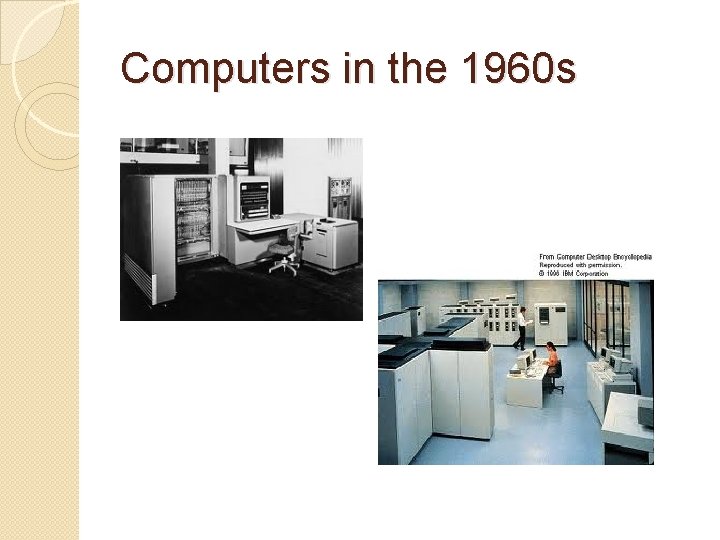
Computers in the 1960 s
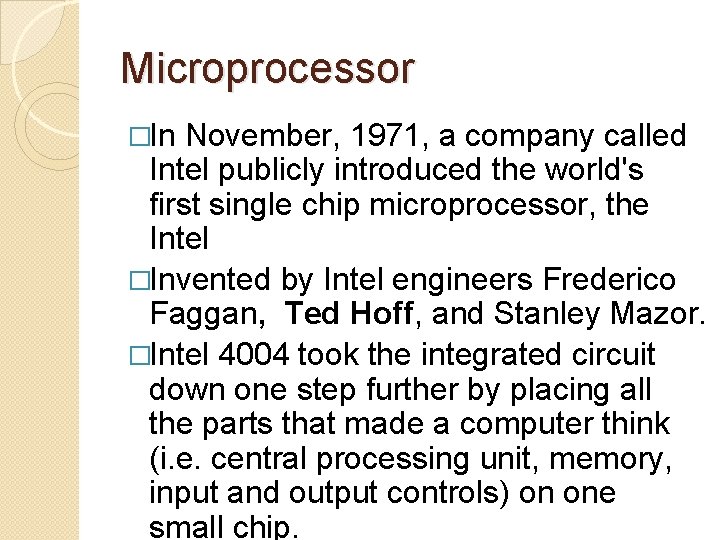
Microprocessor �In November, 1971, a company called Intel publicly introduced the world's first single chip microprocessor, the Intel �Invented by Intel engineers Frederico Faggan, Ted Hoff, and Stanley Mazor. �Intel 4004 took the integrated circuit down one step further by placing all the parts that made a computer think (i. e. central processing unit, memory, input and output controls) on one small chip.
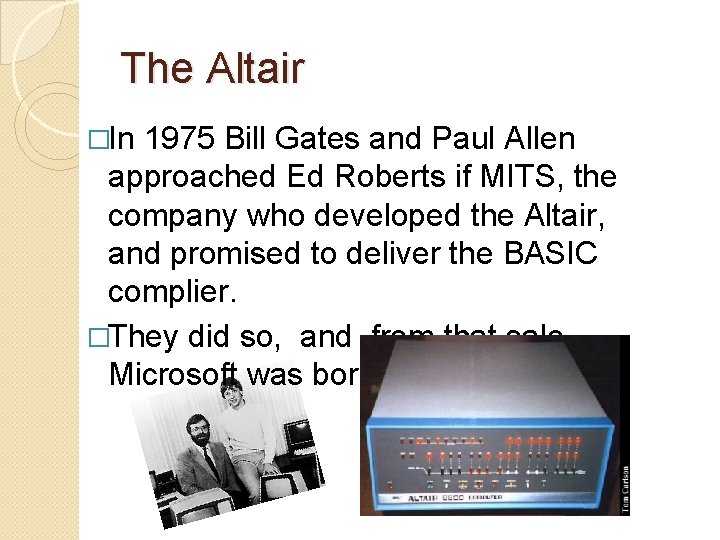
The Altair �In 1975 Bill Gates and Paul Allen approached Ed Roberts if MITS, the company who developed the Altair, and promised to deliver the BASIC complier. �They did so, and from that sale, Microsoft was born
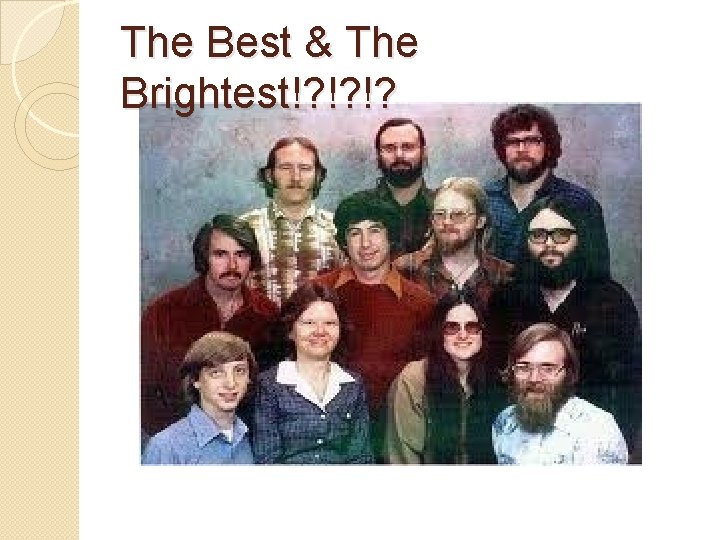
The Best & The Brightest!? !? !?
Machine Language!? !? !? �BASIC- Beginner’s All-Purpose Symbolic Instruction Code ◦ Developed by Kemeny and Kurtz in 1964, two mathematicians at Dartmouth ◦ Simple, easy-to-understand syntax allowed students to quickly learn it. ◦ Provided ease of programming and easier debugging than machine code or assembly
Other Languages � FORTRAN ◦ FORmula Translator ◦ Used for science, math, & engineering � PASCAL ◦ Developed by Niklaus Wirth in the 60’s ◦ Disciplined approach to structure and data description � COBOL ◦ Common Business Oriented Language �Data description stored separately from the pgram. ◦ C �Derivative of ALGOL �It and its decendant’s very popular today for system programming
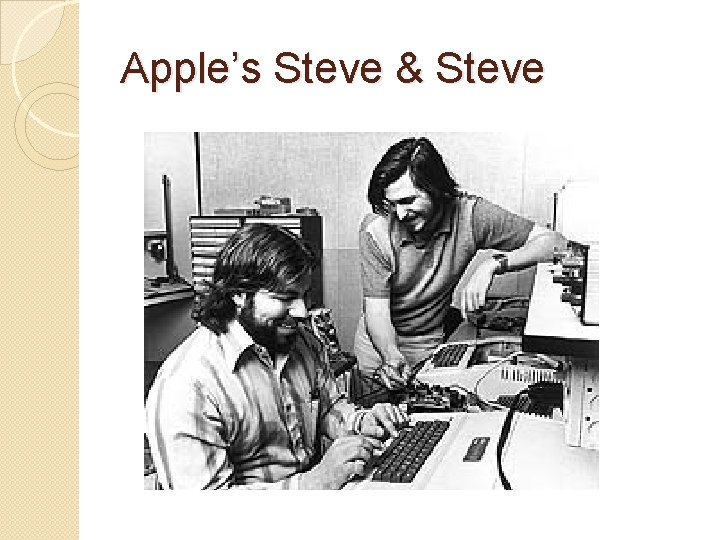
Apple’s Steve & Steve
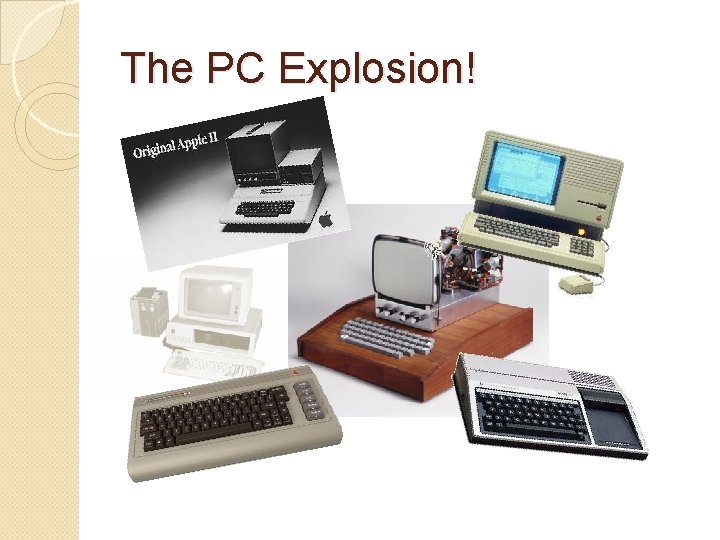
The PC Explosion!
PCs in the 20 th Century �Fast �Graphical User Interfaces (GUI) ◦ Allows you to use a mouse to control the computer ◦ Can run thousands of different sets of instructions (programs)
Internet �Sputnik �ARPANET �Internet �WWW!
The Web �The Web can be used for: ◦ Looking up information on publications ◦ Shopping for books, computers, or CD’s ◦ Investigating staff or research at universities ◦ Downloading pictures, games, or other files/ �The Web (World Wide Web) was developed at CERN lab in Zurich, Switzerland
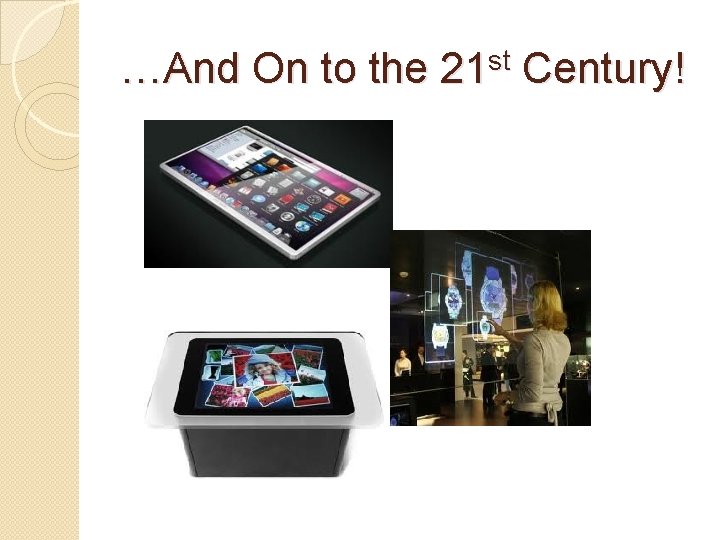
…And On to the 21 st Century!