
History of Computers Necessity is the Mother of
- Slides: 59
History of Computers Necessity is the Mother of Invention
Introduction u Our computer technology did not spring up overnight u It has evolved over millenia u Each advance has enabled later advances u Therefore, it is worth our while to examine the rich history of computing – As well as its debt to other fields of study Copyright © 1995 – 2020 by Suzanne Tomlinson and Curt Hill
First Attempts at Counting Systems u Chalkmarks - scratches on wall u Roman Numerals – mark for groups of numbers I, V, C, D u Decimal System – base 10 – invented by Hindus, century or two AD – adopted and improved by Arabs - 7 th century – Mohammed ibn Mûsâ al-Khowârizmî ~ 825 – Dutch Army Quartermaster adds digits to right of decimal in 15 th century Copyright © 1995 – 2020 by Suzanne Tomlinson and Curt Hill
Early Computing Aids u Counting Board – rocks on grooves in board or stone tablets – 5000 years BC u Abacus – beads strung on wires – positional math – 3500 years BC – still in use today Copyright © 1995 – 2020 by Suzanne Tomlinson and Curt Hill
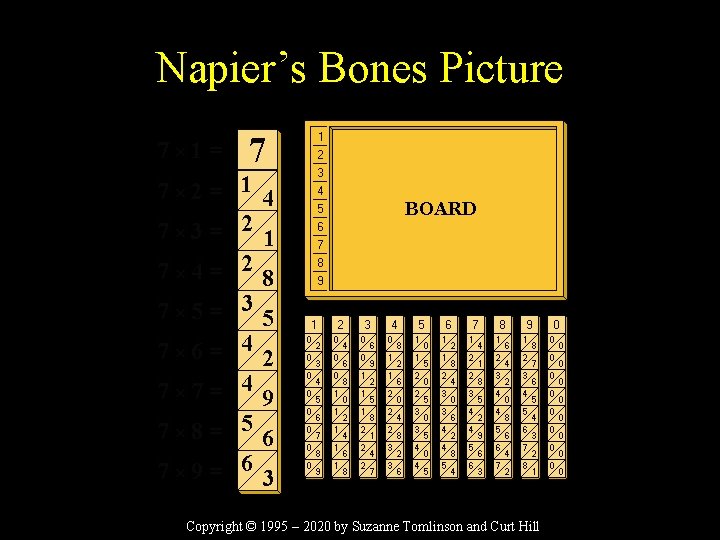
Napier's Bones u John Napier – 1614 u portable multiplication tool – ivory rods with triangular grids that when laid side by side would show answer to multiplication problem u Next comes development of the slide rule by Edmund Gunter in 1620 Copyright © 1995 – 2020 by Suzanne Tomlinson and Curt Hill
Napier’s Bones Picture Copyright © 1995 – 2020 by Suzanne Tomlinson and Curt Hill
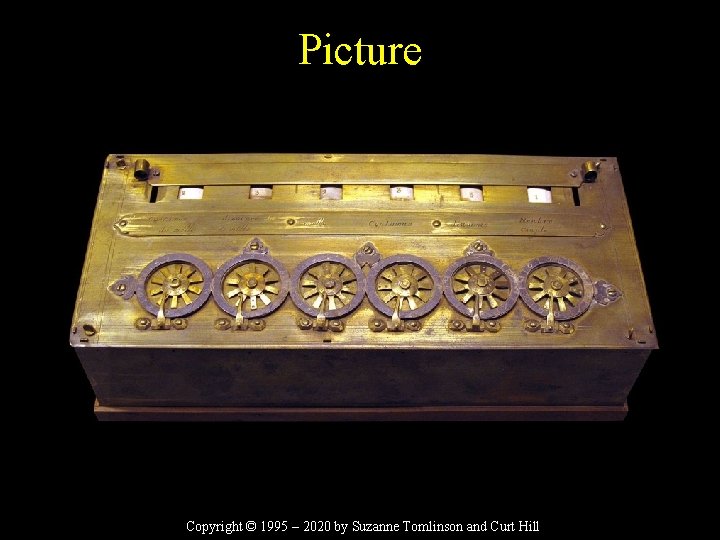
Pascaline u Blaise Pascal – French mathematician and philosopher – father was tax collector – programming language named for him u 1642 u cogs and wheels u could add and subtract – unsuccessfully marketed – mechanical accuracy issues Copyright © 1995 – 2020 by Suzanne Tomlinson and Curt Hill
Picture Copyright © 1995 – 2020 by Suzanne Tomlinson and Curt Hill
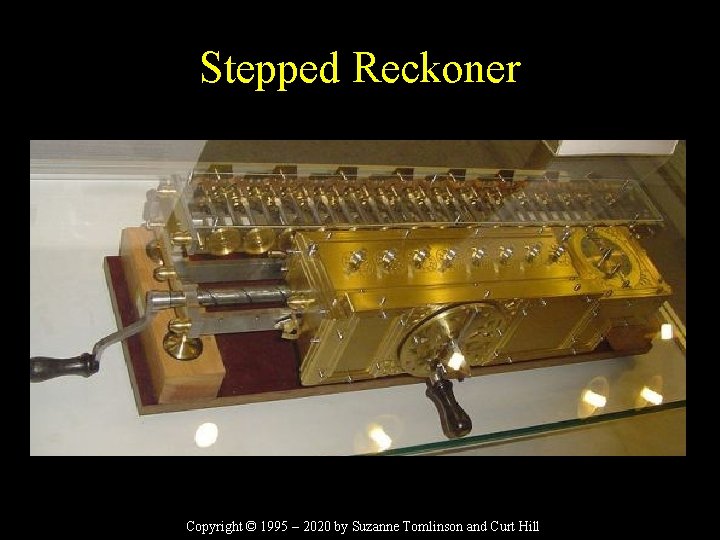
Stepped Reckoner u Gottfried Von Leibniz – Prussian mathematician – independently invented Calculus u could add, subtract, multiply and divide u 1671 started, finished in 1694 u better acceptance than pascaline u Given to Emperor of China, Czar of Russia (Peter the Great) and the French Academy of Science Copyright © 1995 – 2020 by Suzanne Tomlinson and Curt Hill
Stepped Reckoner Copyright © 1995 – 2020 by Suzanne Tomlinson and Curt Hill
Industrial Revolution u Started in England in 1760, completed by 1830 u Enlightened people as to what machines could do – Things like the Pascaline, which could not be accepted in the past, now have a much better chance of acceptance Copyright © 1995 – 2020 by Suzanne Tomlinson and Curt Hill
Jacquard Loom u Joseph Jacquard – French silk weaver u 1801 u designs for silk created by punched wooden cards – cards connected to form "belt" so design could be repeated many times u by 1812, 11, 000 looms in France alone Copyright © 1995 – 2020 by Suzanne Tomlinson and Curt Hill
u Charles Difference Engine Babbage (1791 -1871) – Classic rich, eccentric genius – Hardly ever finished what he started u 1822 -1830 u was to be used to produce star tables for navigation and be powered by steam u funded by British Govt. $7000 u funding cut off in 1842 u a machine based on Difference engine was completed in 1855 Copyright © 1995 – 2020 by Suzanne Tomlinson and Curt Hill
u Charles Analytical Engine Babbage's second idea u started 1833 u had input device, output device, control unit, internal storage and a processor u never finished due to lack of technology u built several years ago from historical notes and ran without modification u was to use punched card idea of Jacquard’s u first built in 1991 Copyright © 1995 – 2020 by Suzanne Tomlinson and Curt Hill
Additional Resources u There are videos – Difference engine and insight on Babbage – Analytic engine in several videos: v Sydney Padua v Computerphile which refers to the above u Lady Lavelace’s program and what it did Copyright © 1995 – 2020 by Suzanne Tomlinson and Curt Hill
Concept of Programming u Ada Augusta Lovelace (1815 -1852) – daughter of Lord Byron – first programmer – mathematical education u DOD language named Ada after her u recorded all information and diagrams on analytical engine u wrote the program for the analytical engine even though it was never utilitzed or tested Copyright © 1995 – 2020 by Suzanne Tomlinson and Curt Hill
Boolean Algebra u George Boole (1815 -1864) – English u 1854 u built on premise that everything can be expressed in terms of true/false u basis for use of binary arithmetic in computer u ignored until 1910 u AND OR truth tables Copyright © 1995 – 2020 by Suzanne Tomlinson and Curt Hill
Important sidelights u C. Sholes invents typewriter between 1867 and 1873 – Marketed by Remington u W. S. Burroughs invents the first modern adding machine - 1886 – Founds the Burroughs company Copyright © 1995 – 2020 by Suzanne Tomlinson and Curt Hill
U. S. Census u 1880 Census took 7 years u 1890 Census was expected to take 11 u Census Bureau approaches Herman Hollerith at University of Pennsylvania for help Copyright © 1995 – 2020 by Suzanne Tomlinson and Curt Hill
Hollerith Cards u Herman Hollerith (1860 -1926) – invented a series of machines based on punched cards u became head of Census and later formed Tabulating Machine Company (which was to become IBM) u cut time for census from 7 yr to 2 1/2 yr u 1890 6 weeks - 60, 000 cards u punched paper cards for data input Copyright © 1995 – 2020 by Suzanne Tomlinson and Curt Hill
Vacuum Tubes u Lee De. Forest – 1908 – American – "Father of Modern Electronic Communications" u Diode in 1904 u Triode in 1907 u instead of just controlling flow of electricity, could amplify it or completely switch it on or off Copyright © 1995 – 2020 by Suzanne Tomlinson and Curt Hill
Electronic Era u General time frame – Alan Turing (1924 -44) - Colossus – Vannevar Bush (1930) – Howard Aiken (1937 -1944) – Conrad Zuse (1930’s-1944) - Z 1 -Z 4 – J. V. Atanasoff (1930’s) Copyright © 1995 – 2020 by Suzanne Tomlinson and Curt Hill
Collossus 1940's n British n n used to decode German messages done by Enigma (German encoder) war effort so was secret - wasn't mentioned until 20 years later n used 1800 vacuum tubes n Copyright © 1995 – 2020 by Suzanne Tomlinson and Curt Hill
Vannevar Bush u Built a large analog computer – MIT - 1930 u Built to solve differential equations u In WW II headed Office of Scientific Research and Development u Wrote an article named “As We May Think” (Atlantic 1945) which outlines the memex – A hypothetical computer that would store all of our books and records Copyright © 1995 – 2020 by Suzanne Tomlinson and Curt Hill
Z 1 Through Z 4 u Konrad Zuse – Pronounced tsu - ze u German u 1930's through 1944 u automatic calculating machines – Used for logistics u one survived the war Copyright © 1995 – 2020 by Suzanne Tomlinson and Curt Hill
ABC Atanasoff Berry Computer u John V. Atanasoff u Professor of Physics at Iowa State u "Father of the Modern Computer" u worked with Clifford Berry, Grad Student u $650 grant u was to solve 23 simultaneous equations u due to war, ISU forgot to register patent u after lawsuit in 1973, ABC is recognized as the "First Electronic Digital Computer" u vacuum tubes and binary math Copyright © 1995 – 2020 by Suzanne Tomlinson and Curt Hill
u Electronic ENIAC Numerical Integrator And Calculator u John Mauchly and J. Presper Eckert u University of Pennsylvania 1943 u designed to solve ballistic equations for Navy 1946 -1955 u Mauchly got many of the ideas from a visit to Iowa State concerning the ABC u Founded UNIVAC which was acquired by Remington Rand Co. Copyright © 1995 – 2020 by Suzanne Tomlinson and Curt Hill
ENIAC u 18, 000 vacuum tubes u Filled a 30 by 50 room u 30 tons and two stories high u Cost $486, 840 in 1946 u 5, 000 additions per second u 6, 000 multi-position switches u 100, 000 pulses per second Copyright © 1995 – 2020 by Suzanne Tomlinson and Curt Hill
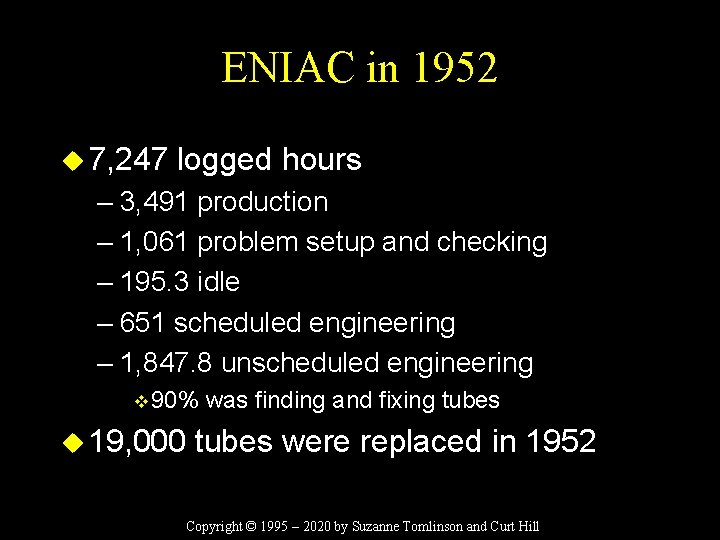
ENIAC in 1952 u 7, 247 logged hours – 3, 491 production – 1, 061 problem setup and checking – 195. 3 idle – 651 scheduled engineering – 1, 847. 8 unscheduled engineering v 90% u 19, 000 was finding and fixing tubes were replaced in 1952 Copyright © 1995 – 2020 by Suzanne Tomlinson and Curt Hill
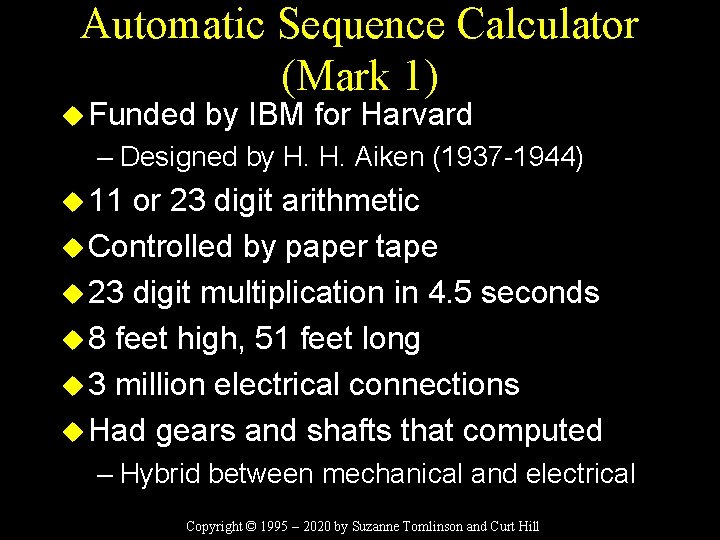
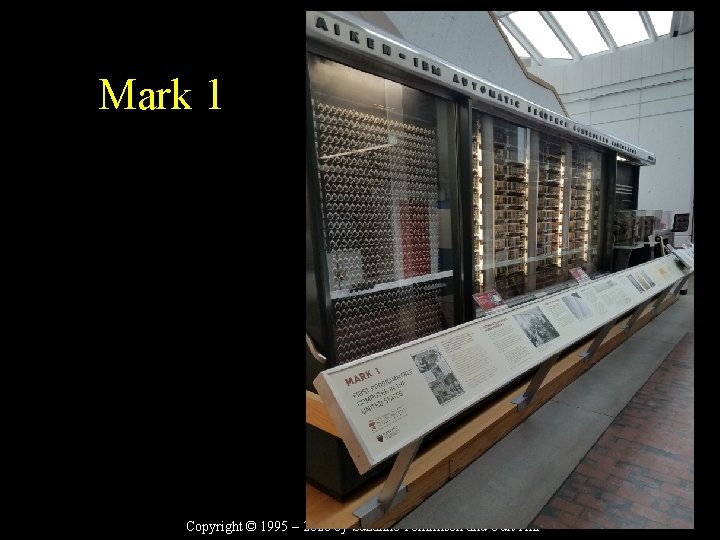
Automatic Sequence Calculator (Mark 1) u Funded by IBM for Harvard – Designed by H. H. Aiken (1937 -1944) u 11 or 23 digit arithmetic u Controlled by paper tape u 23 digit multiplication in 4. 5 seconds u 8 feet high, 51 feet long u 3 million electrical connections u Had gears and shafts that computed – Hybrid between mechanical and electrical Copyright © 1995 – 2020 by Suzanne Tomlinson and Curt Hill
Mark 1 Copyright © 1995 – 2020 by Suzanne Tomlinson and Curt Hill
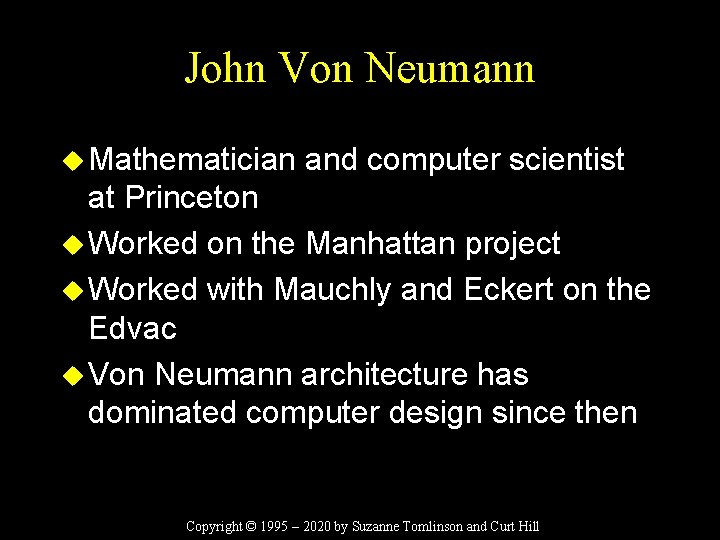
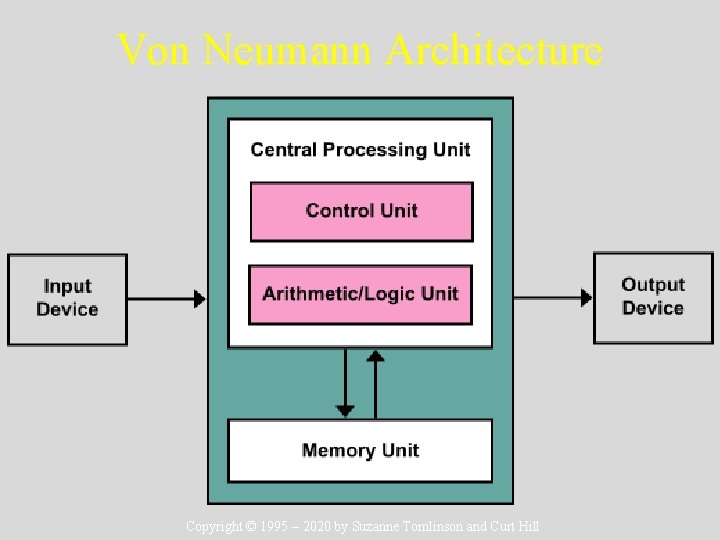
John Von Neumann u Mathematician and computer scientist at Princeton u Worked on the Manhattan project u Worked with Mauchly and Eckert on the Edvac u Von Neumann architecture has dominated computer design since then Copyright © 1995 – 2020 by Suzanne Tomlinson and Curt Hill
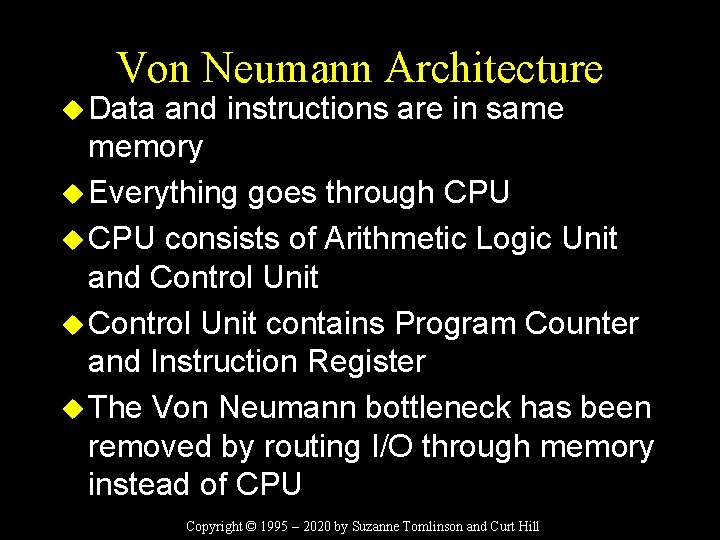
Von Neumann Architecture Copyright © 1995 – 2020 by Suzanne Tomlinson and Curt Hill
Von Neumann Architecture u Data and instructions are in same memory u Everything goes through CPU u CPU consists of Arithmetic Logic Unit and Control Unit u Control Unit contains Program Counter and Instruction Register u The Von Neumann bottleneck has been removed by routing I/O through memory instead of CPU Copyright © 1995 – 2020 by Suzanne Tomlinson and Curt Hill
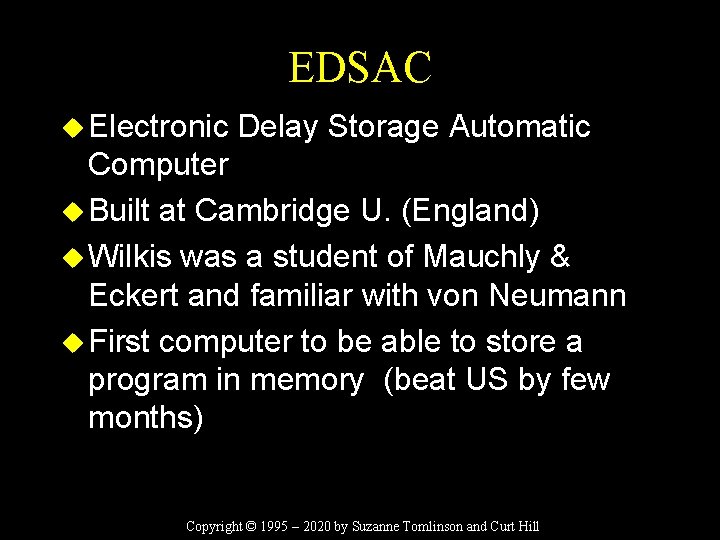
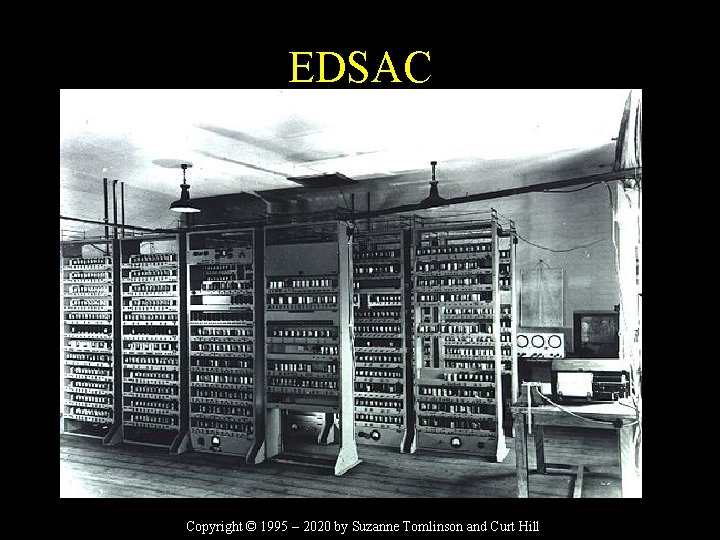
EDSAC u Electronic Delay Storage Automatic Computer u Built at Cambridge U. (England) u Wilkis was a student of Mauchly & Eckert and familiar with von Neumann u First computer to be able to store a program in memory (beat US by few months) Copyright © 1995 – 2020 by Suzanne Tomlinson and Curt Hill
EDSAC Copyright © 1995 – 2020 by Suzanne Tomlinson and Curt Hill
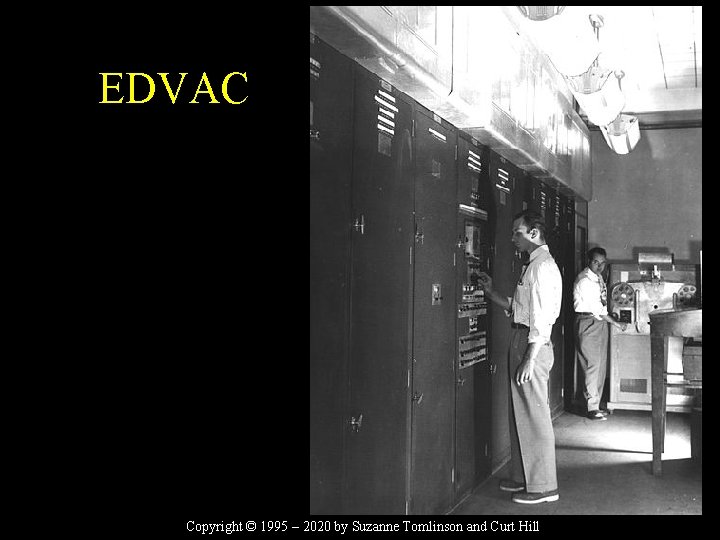
EDVAC u Electronic Discrete Variable Automatic Computer u John von Neumann (with Mauchly & Eckert) u University of Pennsylvania for US Army u 1951 became operational u change from decimal to binary number system u could store program in memory u used until December 1962 Copyright © 1995 – 2020 by Suzanne Tomlinson and Curt Hill
EDVAC Copyright © 1995 – 2020 by Suzanne Tomlinson and Curt Hill
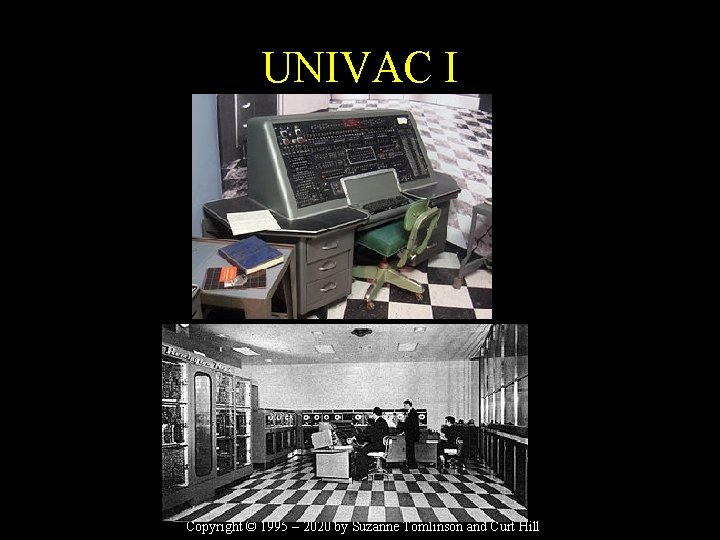
UNIVAC u First commercial computer u Start of the "First Generation“ u First two were sold to Census Bureau and next one to GE Engineering Copyright © 1995 – 2020 by Suzanne Tomlinson and Curt Hill
UNIVAC I Copyright © 1995 – 2020 by Suzanne Tomlinson and Curt Hill
Computer Generations u Four main divisions in computer hardware advancements (technology) u some believe we are starting the fifth division u to see development, need to compare the characteristics of each generation Copyright © 1995 – 2020 by Suzanne Tomlinson and Curt Hill
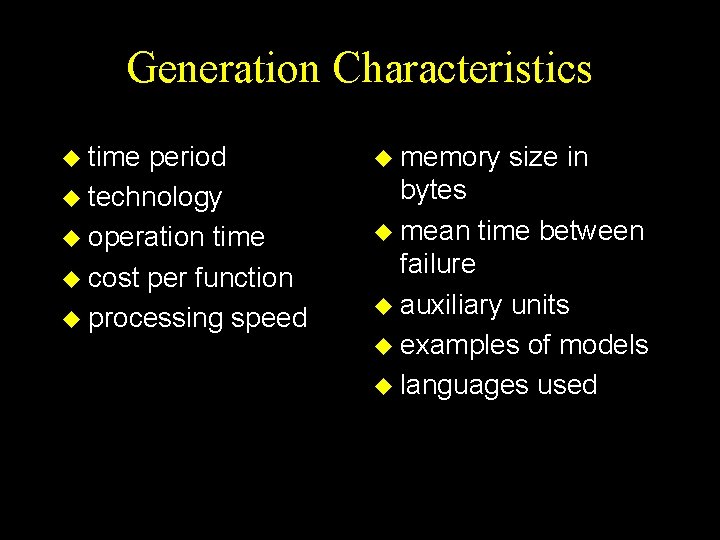
Generation Characteristics u time period u technology u operation time u cost per function u processing speed u memory size in bytes u mean time between failure u auxiliary units u examples of models u languages used
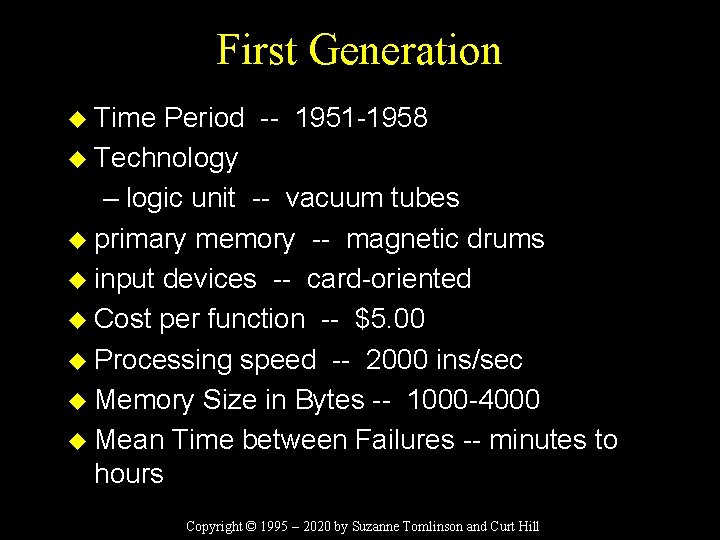
First Generation u Time Period -- 1951 -1958 u Technology – logic unit -- vacuum tubes u primary memory -- magnetic drums u input devices -- card-oriented u Cost per function -- $5. 00 u Processing speed -- 2000 ins/sec u Memory Size in Bytes -- 1000 -4000 u Mean Time between Failures -- minutes to hours Copyright © 1995 – 2020 by Suzanne Tomlinson and Curt Hill
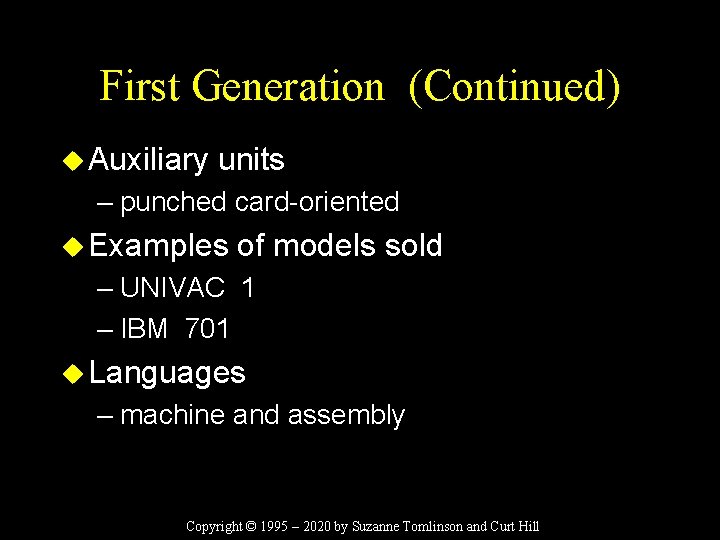
First Generation (Continued) u Auxiliary units – punched card-oriented u Examples of models sold – UNIVAC 1 – IBM 701 u Languages – machine and assembly Copyright © 1995 – 2020 by Suzanne Tomlinson and Curt Hill
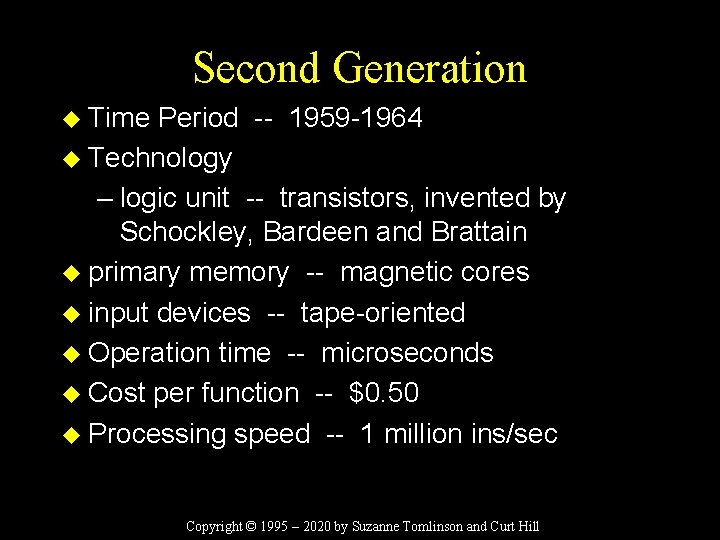
Second Generation u Time Period -- 1959 -1964 u Technology – logic unit -- transistors, invented by Schockley, Bardeen and Brattain u primary memory -- magnetic cores u input devices -- tape-oriented u Operation time -- microseconds u Cost per function -- $0. 50 u Processing speed -- 1 million ins/sec Copyright © 1995 – 2020 by Suzanne Tomlinson and Curt Hill
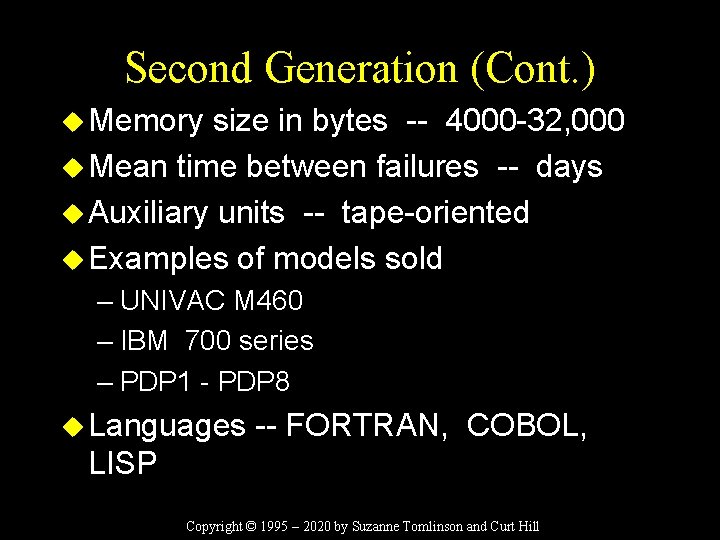
Second Generation (Cont. ) u Memory size in bytes -- 4000 -32, 000 u Mean time between failures -- days u Auxiliary units -- tape-oriented u Examples of models sold – UNIVAC M 460 – IBM 700 series – PDP 1 - PDP 8 u Languages -- FORTRAN, COBOL, LISP Copyright © 1995 – 2020 by Suzanne Tomlinson and Curt Hill
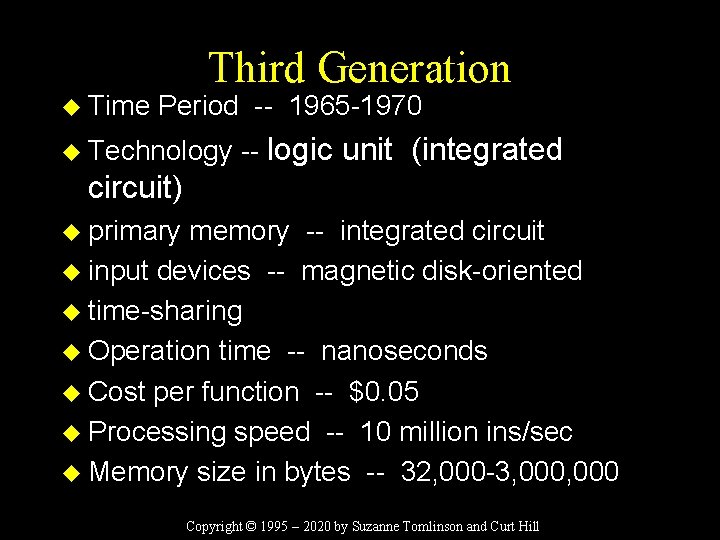
u Time Third Generation Period -- 1965 -1970 u Technology -- logic unit (integrated circuit) u primary memory -- integrated circuit u input devices -- magnetic disk-oriented u time-sharing u Operation time -- nanoseconds u Cost per function -- $0. 05 u Processing speed -- 10 million ins/sec u Memory size in bytes -- 32, 000 -3, 000 Copyright © 1995 – 2020 by Suzanne Tomlinson and Curt Hill
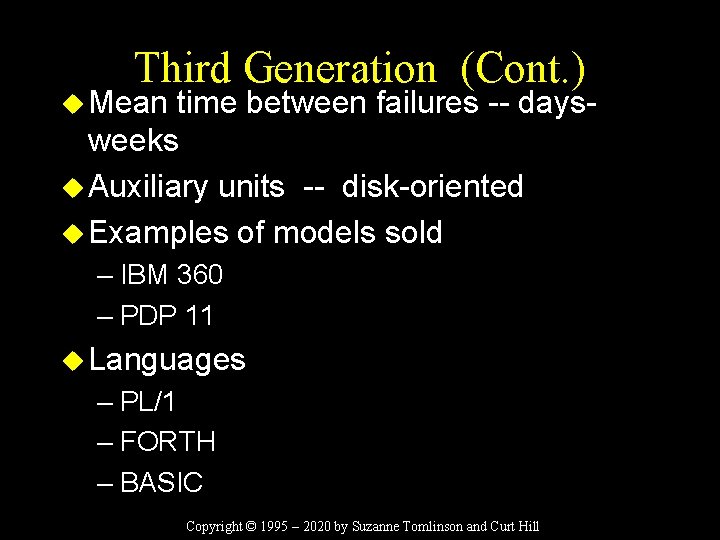
Third Generation (Cont. ) u Mean time between failures -- daysweeks u Auxiliary units -- disk-oriented u Examples of models sold – IBM 360 – PDP 11 u Languages – PL/1 – FORTH – BASIC Copyright © 1995 – 2020 by Suzanne Tomlinson and Curt Hill
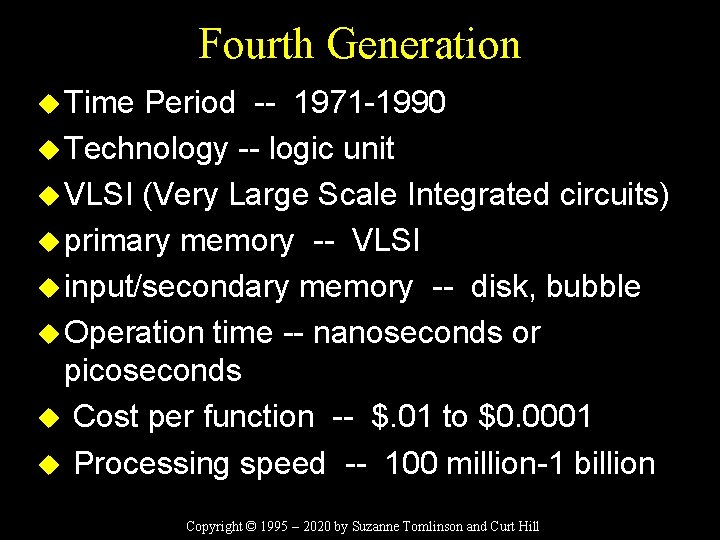
Fourth Generation u Time Period -- 1971 -1990 u Technology -- logic unit u VLSI (Very Large Scale Integrated circuits) u primary memory -- VLSI u input/secondary memory -- disk, bubble u Operation time -- nanoseconds or picoseconds u Cost per function -- $. 01 to $0. 0001 u Processing speed -- 100 million-1 billion Copyright © 1995 – 2020 by Suzanne Tomlinson and Curt Hill
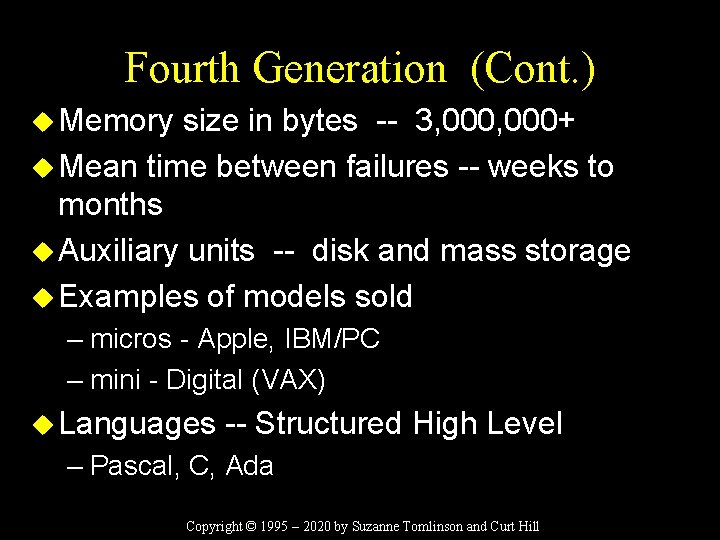
Fourth Generation (Cont. ) u Memory size in bytes -- 3, 000+ u Mean time between failures -- weeks to months u Auxiliary units -- disk and mass storage u Examples of models sold – micros - Apple, IBM/PC – mini - Digital (VAX) u Languages -- Structured High Level – Pascal, C, Ada Copyright © 1995 – 2020 by Suzanne Tomlinson and Curt Hill
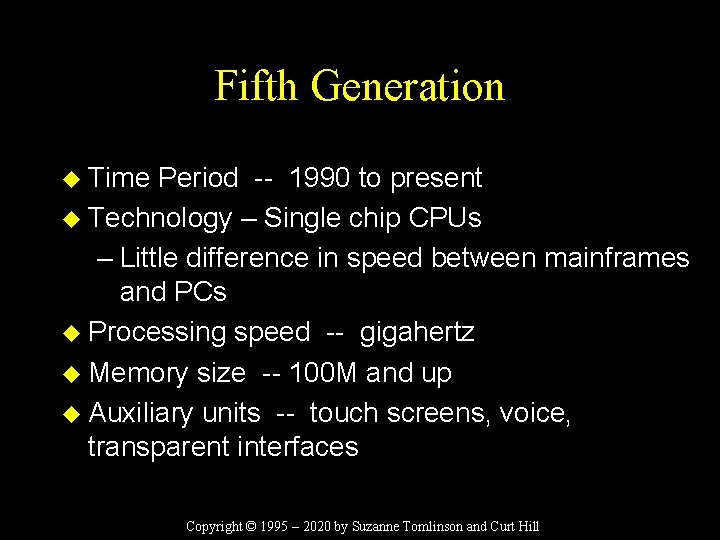
Fifth Generation u Time Period -- 1990 to present u Technology – Single chip CPUs – Little difference in speed between mainframes and PCs u Processing speed -- gigahertz u Memory size -- 100 M and up u Auxiliary units -- touch screens, voice, transparent interfaces Copyright © 1995 – 2020 by Suzanne Tomlinson and Curt Hill
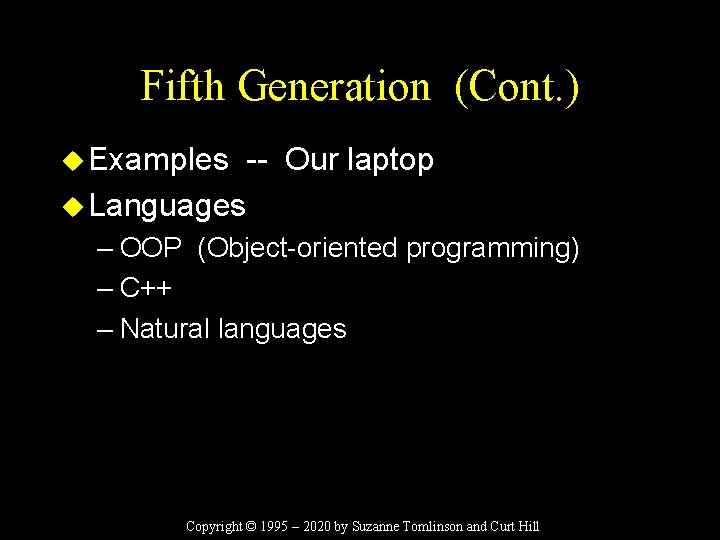
Fifth Generation (Cont. ) u Examples -- Our laptop u Languages – OOP (Object-oriented programming) – C++ – Natural languages Copyright © 1995 – 2020 by Suzanne Tomlinson and Curt Hill
Fifth Generation Parallelism u The most recent innovations are parallelism u Multi-core CPU chips u Graphics Processor Units – Specialized CPUs Copyright © 1995 – 2020 by Suzanne Tomlinson and Curt Hill
The Mother of All Demos u Doug Engelbart on 12/9/1968 u Demo included rudiments of or first instances of – Video conferencing – Desktop-style user interface – Word processing – Hypertext – Mouse – Collaborative editing Copyright © 1995 – 2020 by Suzanne Tomlinson and Curt Hill
u This Before and After demo carries the inspiration of Bush’s Memex to fruition u Prior to the demo, Engelbart was believed to be a crackpot by a significant number of researchers u After described as “dealing lightning with both hands” u Never underestimate the power of vision Copyright © 1995 – 2020 by Suzanne Tomlinson and Curt Hill
Xerox Altos u. A personal computer that was too expensive to gain traction u Introduced in 1975 u Used by Alan Kay as a prototype of the Dynabook – A laptop concept for education u Demonstrated much of what Engelbart had envisioned – GUI, Object oriented programming, networking – Inspired Mac and Windows Copyright © 1995 – 2020 by Suzanne Tomlinson and Curt Hill
Personal Computers u 1975 to 1981 u Kenbak-1 - $750 – 40 machines made and sold 1971 – All TTL chips u Altair - first popular micro sold – named after "Star Trek" destination – Edward Roberts (March 1974) – Structure: v 1 CPU (8080), 256 characters of memory, v switches and lights for I/O – sold for $397. 00 Copyright © 1995 – 2020 by Suzanne Tomlinson and Curt Hill
Apple Computers u Steve Wozniak and Steve Jobs u belonged to one of earliest and most active computer clubs - Homebrew Computer Club in Northern Calif u 1977 in garage while both teenagers u marketing strategy - give to schools, then students (and parents) will want to buy them for home Copyright © 1995 – 2020 by Suzanne Tomlinson and Curt Hill
u 1971 Other Firsts -- "floppy" disk u 1978 -- electronic spreadsheet – Visi. Calc – Apple skyrockets u 1979 -- commercial word processor Word. Star u 1981 -- IBM personal computer – shipping rate rose to 1 million units/mo u 1983 -- LOTUS 1 -2 -3 comes to market Copyright © 1995 – 2020 by Suzanne Tomlinson and Curt Hill