
History of computers Difference engine In 1822 Charles
- Slides: 10
History of computers
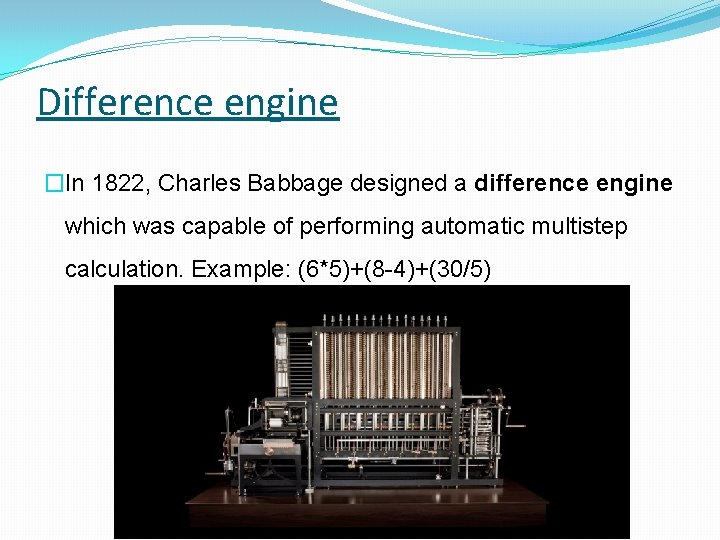
Difference engine �In 1822, Charles Babbage designed a difference engine which was capable of performing automatic multistep calculation. Example: (6*5)+(8 -4)+(30/5)
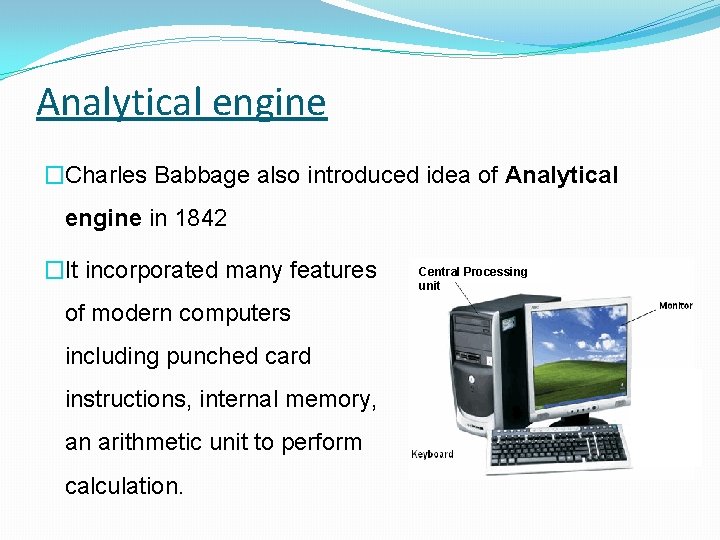
Analytical engine �Charles Babbage also introduced idea of Analytical engine in 1842 �It incorporated many features of modern computers including punched card instructions, internal memory, an arithmetic unit to perform calculation. Central Processing unit
Analytical engine �Charles Babbage also introduced idea of Analytical engine in 1842 �It incorporated many features of modern computers including punched card instructions, internal memory, an arithmetic unit to perform calculation. �Hence he is called Father of modern Digital computers.
Electromechanical computer �The Mark-I computer was developed by Howard H. Aiken of Harvard University, in association with IBM in 1944 �It was a mechanical computer, running on electricity �It is said to be the first realization of Charles Babbage’s Analytical Engine. �This machine was also known as Automatic Sequence Controlled Calculator
Electronic Era
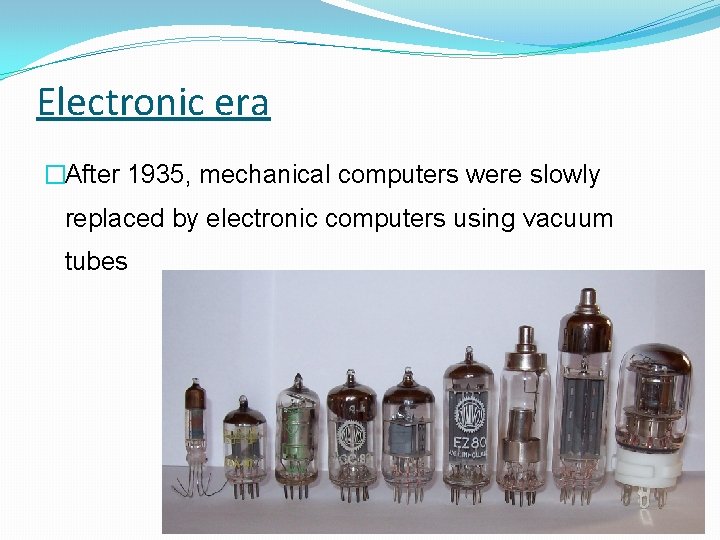
Electronic era �After 1935, mechanical computers were slowly replaced by electronic computers using vacuum tubes
Electronic era �In 1939, first electronic computer was built by John Vincent Atanasoff and Clifford Berry. It was called ABC or Atanasoff-Berry Computer. It used 45 vacuum tubes. �In 1946, ENIAC or Electronic Numerical Integrator And Calculator was developed by Presper Eckert and John Mauchly
Electronic era �The UNIVersal Automatic Computer (UNIVAC) was first commercial digital computer produced in 1951 �It was produced by many companies like IBM, Universal Accounting Company and General Electronic Corporation. �It used 5200 vacuum tubes
In the next class, we will look into different generations of computer developed during electronic era…