
History of computers Active Passive Verb Forms Active
History of computers
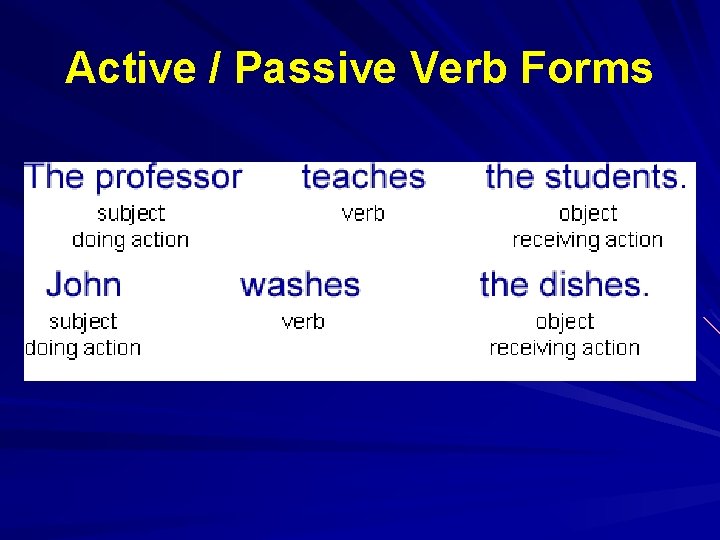
Active / Passive Verb Forms

Active / Passive Verb Forms
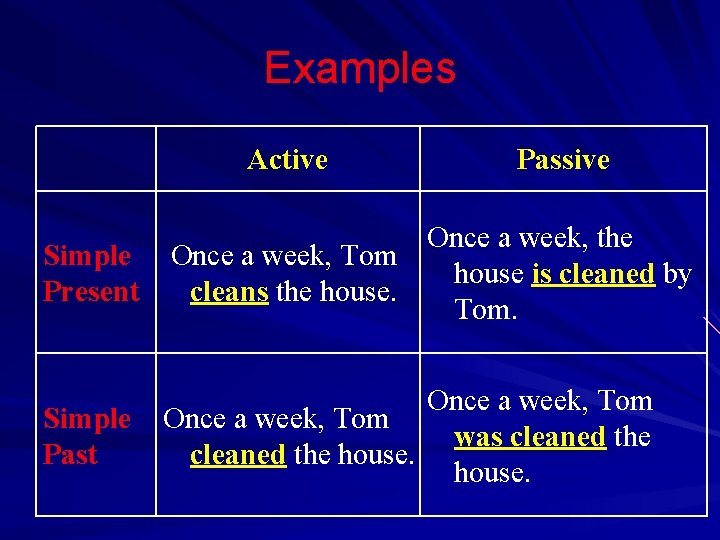
Examples Active Passive Simple Present Once a week, the Once a week, Tom house is cleaned by cleans the house. Tom. Simple Past Once a week, Tom was cleaned the house.
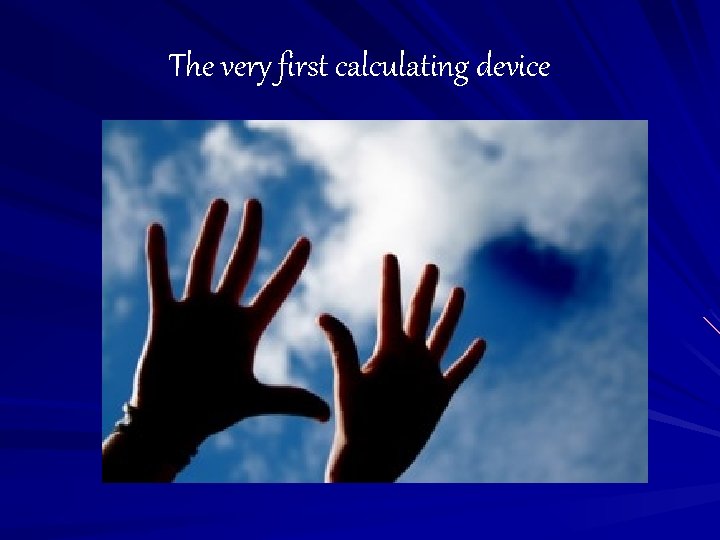
The very first calculating device
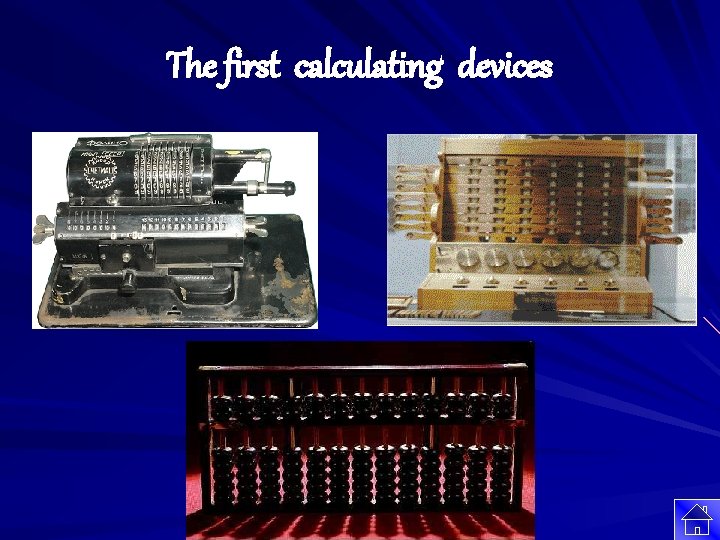
The first calculating devices
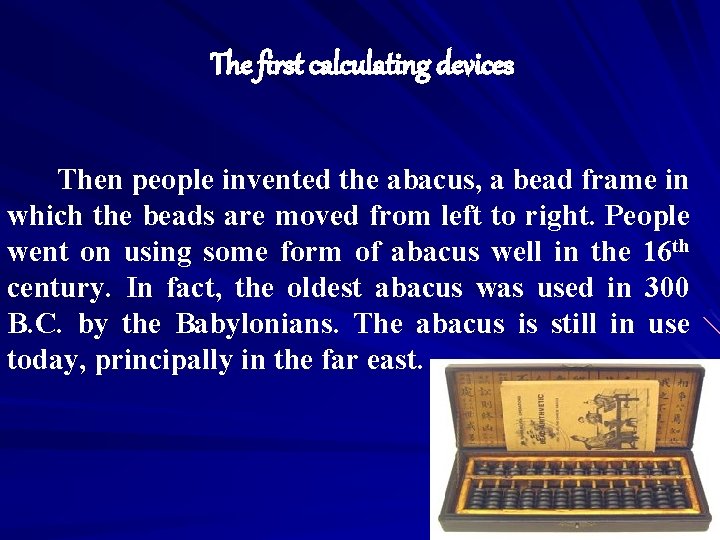
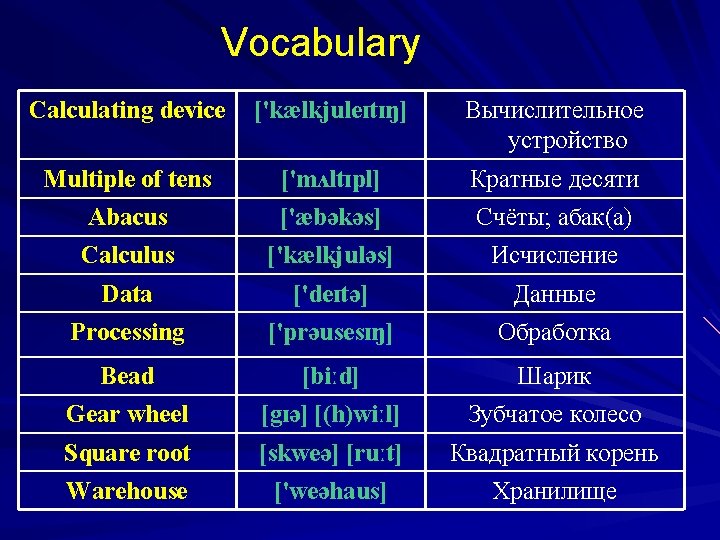
The first calculating devices Then people invented the abacus, a bead frame in which the beads are moved from left to right. People went on using some form of abacus well in the 16 th century. In fact, the oldest abacus was used in 300 B. C. by the Babylonians. The abacus is still in use today, principally in the far east.
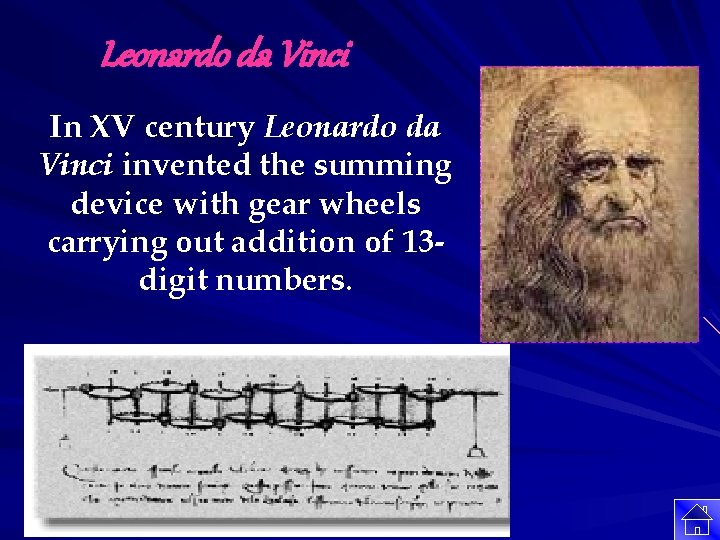
Leonardo da Vinci In XV century Leonardo da Vinci invented the summing device with gear wheels carrying out addition of 13 digit numbers.
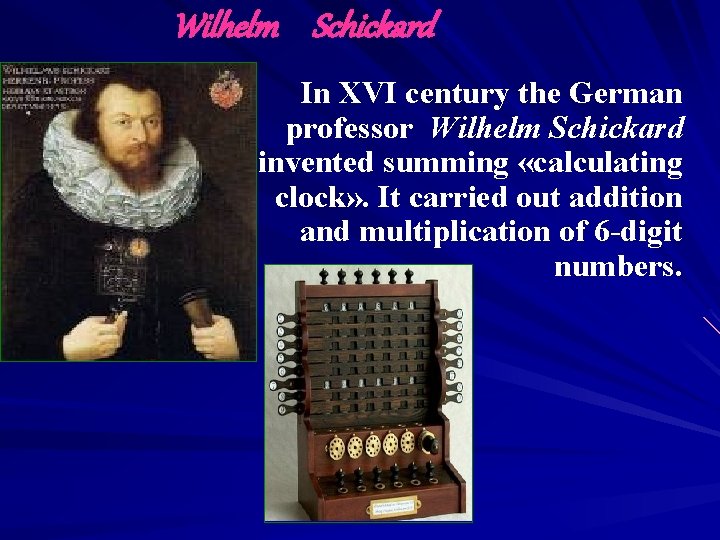
Wilhelm Schickard In XVI century the German professor Wilhelm Schickard invented summing «calculating clock» . It carried out addition and multiplication of 6 -digit numbers.
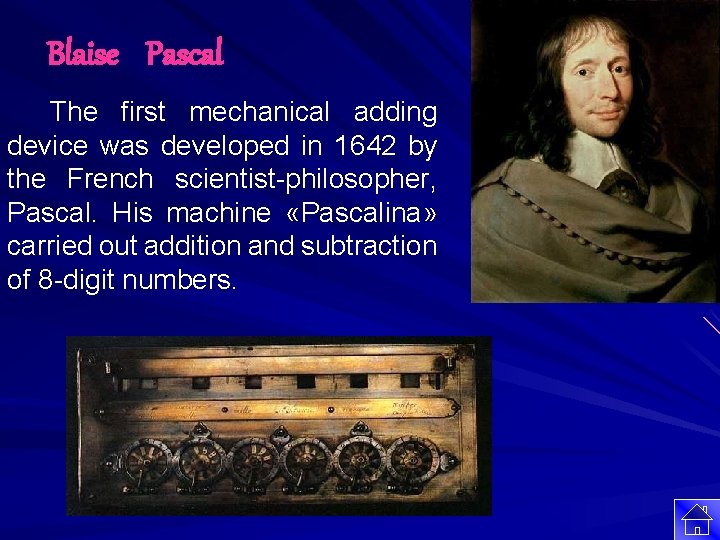
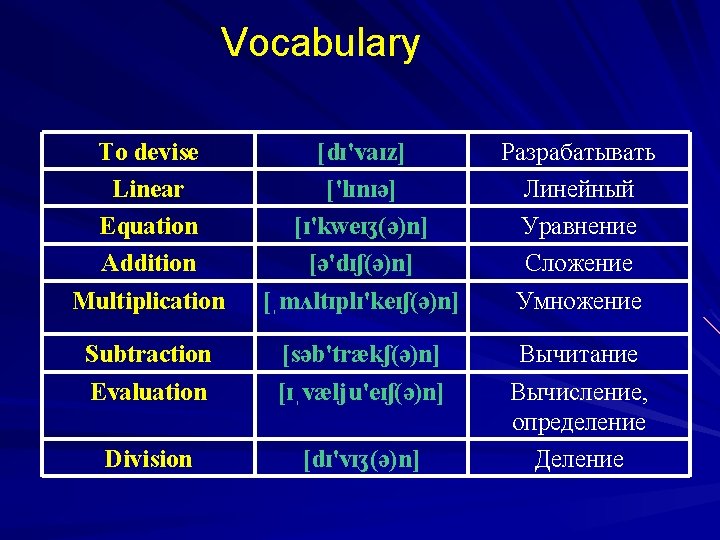
Blaise Pascal The first mechanical adding device was developed in 1642 by the French scientist-philosopher, Pascal. His machine «Pascalina» carried out addition and subtraction of 8 -digit numbers.
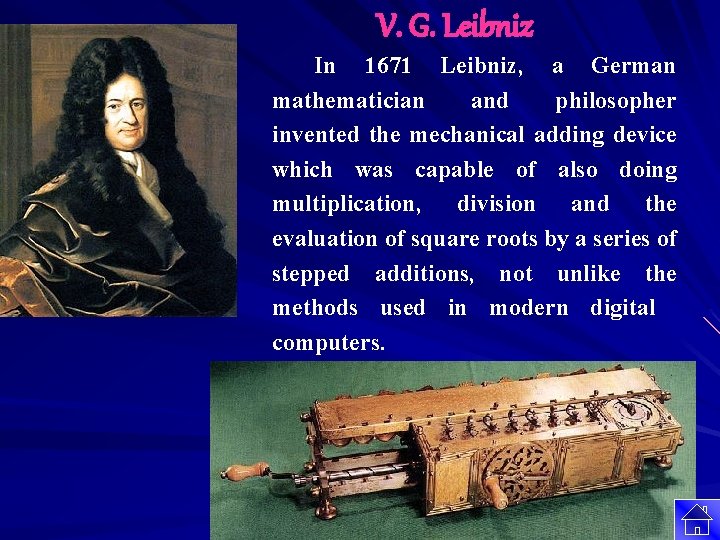
V. G. Leibniz In 1671 Leibniz, a German mathematician and philosopher invented the mechanical adding device which was capable of also doing multiplication, division and the evaluation of square roots by a series of stepped additions, not unlike the methods used in modern digital computers.
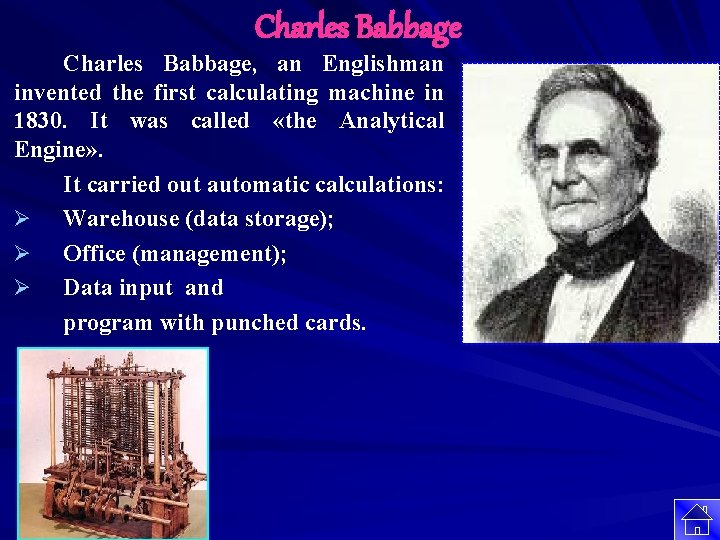
Charles Babbage, an Englishman invented the first calculating machine in 1830. It was called «the Analytical Engine» . It carried out automatic calculations: Ø Warehouse (data storage); Ø Office (management); Ø Data input and program with punched cards.
Generations of computers Ø The first generation of computers Ø The second generation of computers Ø The third generation of computers Ø The fourth generation of computers Ø The fifth generation of computers 16
GENERATIONS OF COMPUTERS Generations Components used Advantages Disadvantages Examples First (19461954) IBM 700, ENIAC, EDVAC Second(19551964) IBM 7090, IBM 7094 I, IBM 9094 II Third(19651974) IBM/370 series, Cyber 175 - Fourth(19751984) Fifth(1985 present) CRAY Y_MPC, WIPRO LANDMARK 860 - Windows 2000, Xp, Linux 17
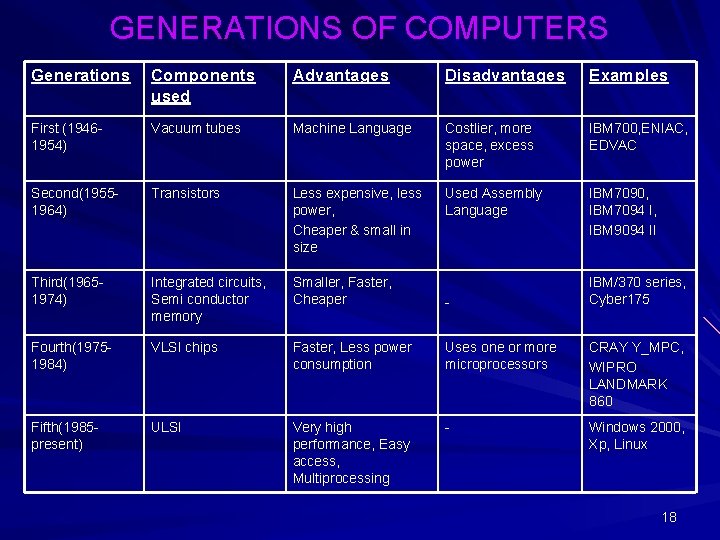
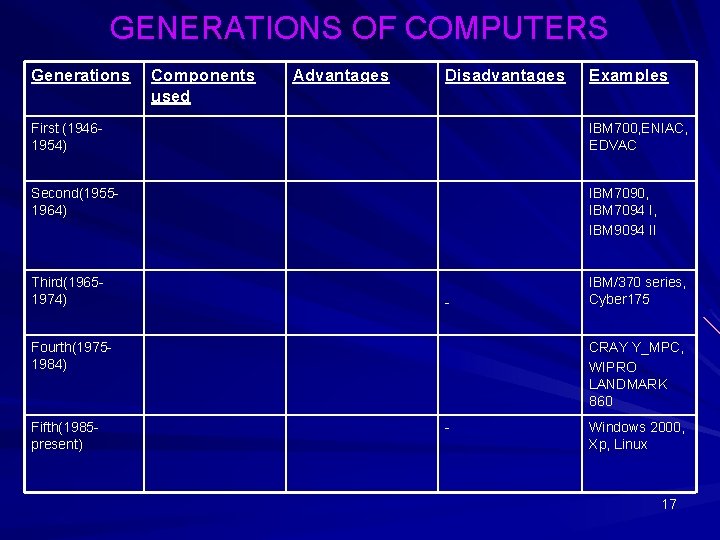
GENERATIONS OF COMPUTERS Generations Components used Advantages Disadvantages Examples First (19461954) Vacuum tubes Machine Language Costlier, more space, excess power IBM 700, ENIAC, EDVAC Second(19551964) Transistors Less expensive, less power, Cheaper & small in size Used Assembly Language IBM 7090, IBM 7094 I, IBM 9094 II Third(19651974) Integrated circuits, Semi conductor memory Smaller, Faster, Cheaper - Fourth(19751984) VLSI chips Faster, Less power consumption Uses one or more microprocessors CRAY Y_MPC, WIPRO LANDMARK 860 Fifth(1985 present) ULSI Very high performance, Easy access, Multiprocessing - Windows 2000, Xp, Linux IBM/370 series, Cyber 175 18
Frequently Asked Questions Ø Explain different generations of computers? 19
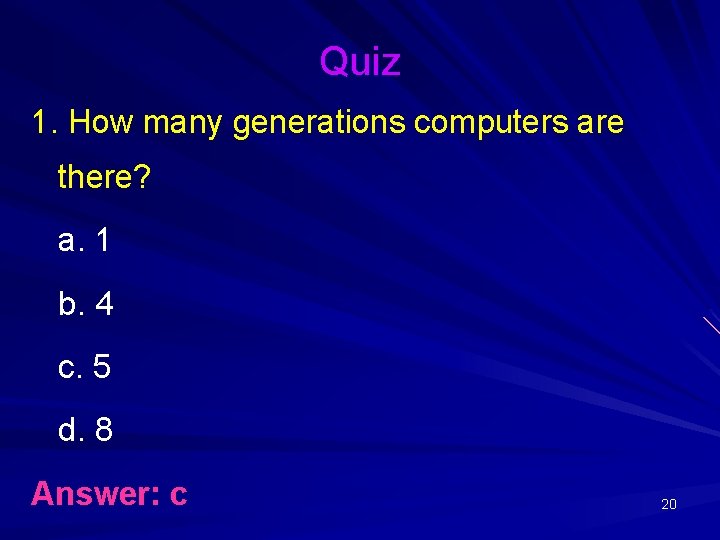
Quiz 1. How many generations computers are there? a. 1 b. 4 c. 5 d. 8 Answer: c 20
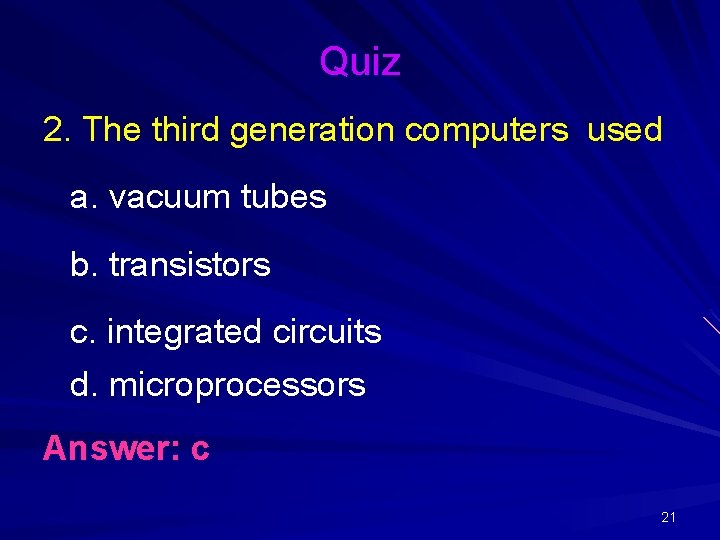
Quiz 2. The third generation computers used a. vacuum tubes b. transistors c. integrated circuits d. microprocessors Answer: c 21
Quiz 3. The second generation computers used a. vacuum tubes b. transistors c. artificial intelligence d. microprocessors Answer: b 22
Quiz 4. The first generation computers used a. vacuum tubes b. transistors c. artificial intelligence d. microprocessors Answer: a 23
Quiz 5. The fourth generation computers used a. vacuum tubes b. transistors c. integrated circuits d. microprocessors Answer: d 24
Quiz 6. The fifth generation computers used a. vacuum tubes b. transistors c. artificial intelligence d. microprocessors Answer: c 25
Quiz 7. Who is “a father of the computer”? a. Charles Babbage b. Konrad Zuse c. Blaise Pascal d. Leonardo da Vinci Answer: a 26
Homework Quantum computers Biocomputers Molecular computers Optical computers

- Slides: 29