
History of Computers 25 Jan22 History of Computers
- Slides: 36
History of Computers 25 -Jan-22 History of Computers 1
Computer • Computer derived from the word compute • Compute calculate 25 -Jan-22 History of Computers 2
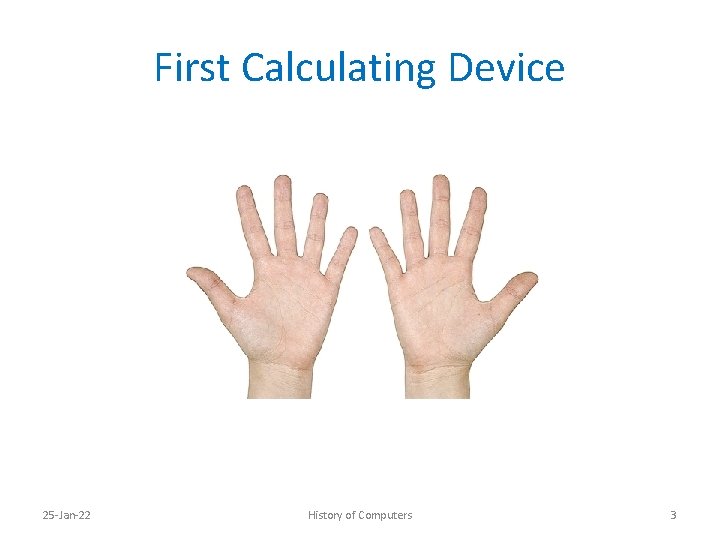
First Calculating Device 25 -Jan-22 History of Computers 3
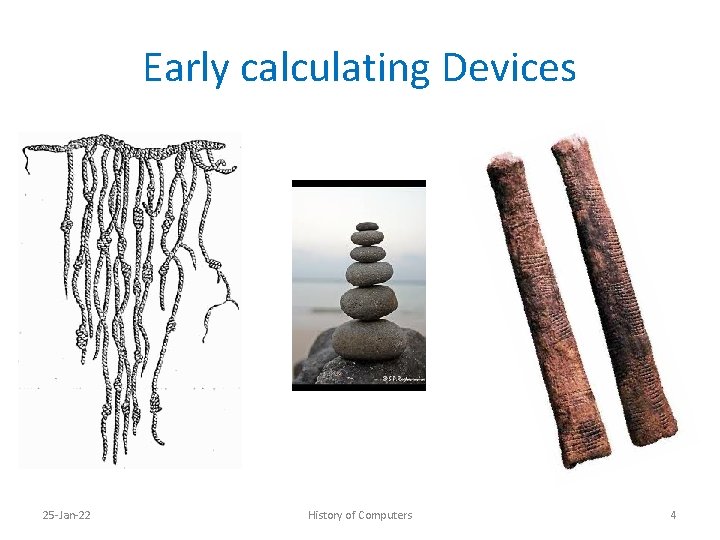
Early calculating Devices 25 -Jan-22 History of Computers 4
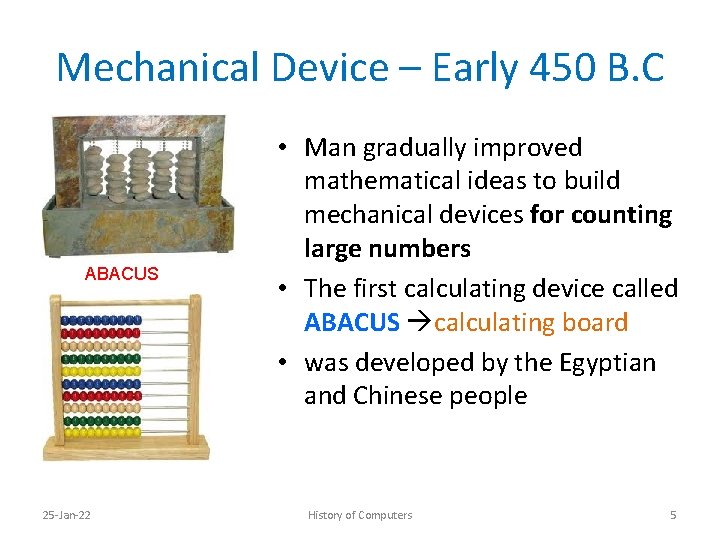
Mechanical Device – Early 450 B. C ABACUS 25 -Jan-22 • Man gradually improved mathematical ideas to build mechanical devices for counting large numbers • The first calculating device called ABACUS calculating board • was developed by the Egyptian and Chinese people History of Computers 5
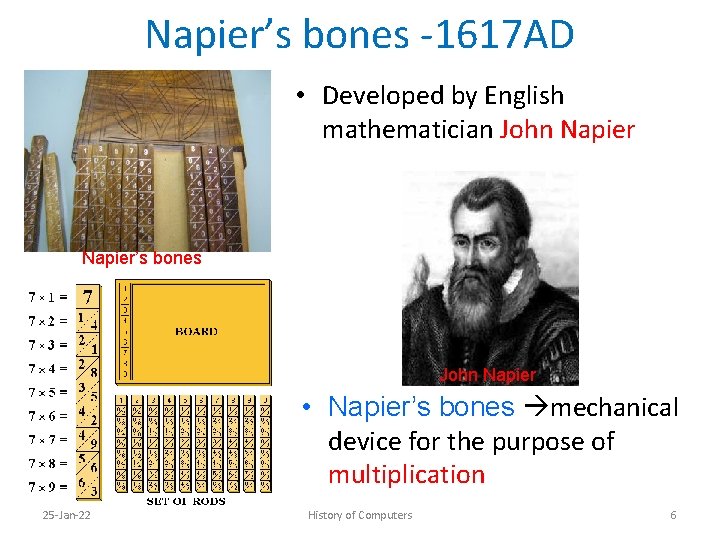
Napier’s bones -1617 AD • Developed by English mathematician John Napier’s bones John Napier • Napier’s bones mechanical device for the purpose of multiplication 25 -Jan-22 History of Computers 6
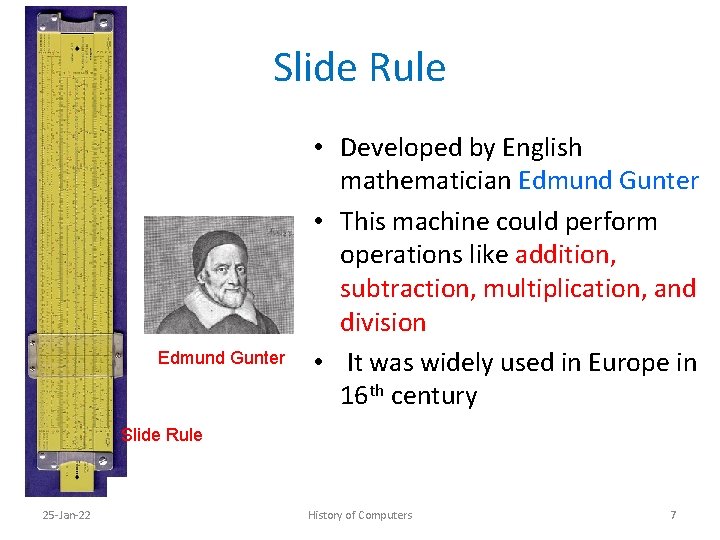
Slide Rule Edmund Gunter • Developed by English mathematician Edmund Gunter • This machine could perform operations like addition, subtraction, multiplication, and division • It was widely used in Europe in 16 th century Slide Rule 25 -Jan-22 History of Computers 7
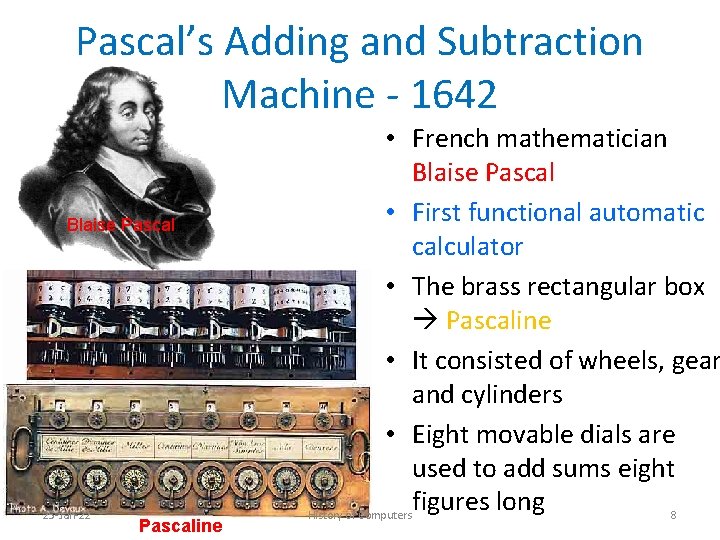
Pascal’s Adding and Subtraction Machine - 1642 Blaise Pascal 25 -Jan-22 Pascaline • French mathematician Blaise Pascal • First functional automatic calculator • The brass rectangular box Pascaline • It consisted of wheels, gear and cylinders • Eight movable dials are used to add sums eight figures long History of Computers 8
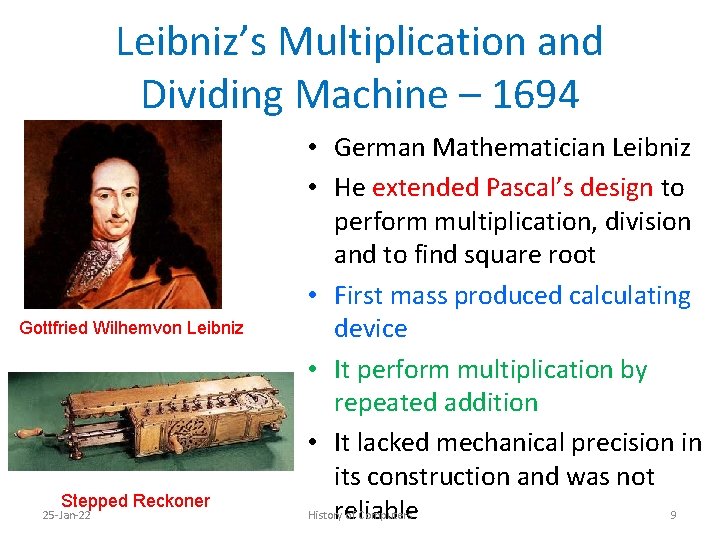
Leibniz’s Multiplication and Dividing Machine – 1694 Gottfried Wilhemvon Leibniz Stepped Reckoner 25 -Jan-22 • German Mathematician Leibniz • He extended Pascal’s design to perform multiplication, division and to find square root • First mass produced calculating device • It perform multiplication by repeated addition • It lacked mechanical precision in its construction and was not reliable History of Computers 9
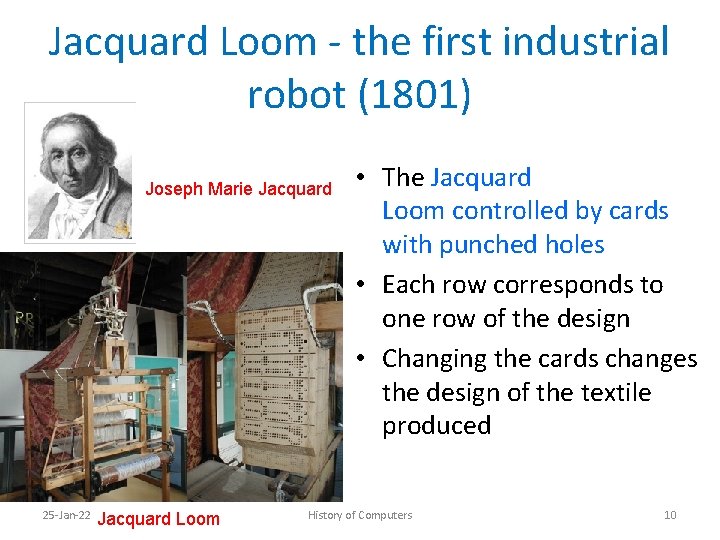
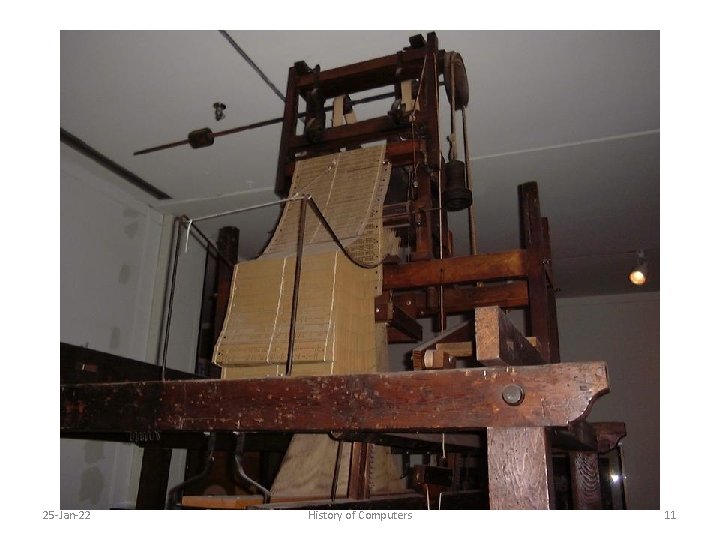
Jacquard Loom - the first industrial robot (1801) Joseph Marie Jacquard 25 -Jan-22 Jacquard Loom • The Jacquard Loom controlled by cards with punched holes • Each row corresponds to one row of the design • Changing the cards changes the design of the textile produced History of Computers 10
25 -Jan-22 History of Computers 11
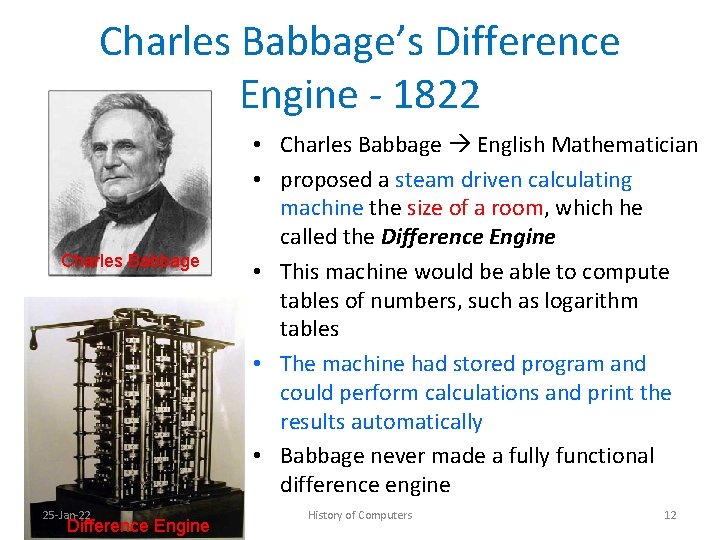
Charles Babbage’s Difference Engine - 1822 Charles Babbage 25 -Jan-22 Difference Engine • Charles Babbage English Mathematician • proposed a steam driven calculating machine the size of a room, which he called the Difference Engine • This machine would be able to compute tables of numbers, such as logarithm tables • The machine had stored program and could perform calculations and print the results automatically • Babbage never made a fully functional difference engine History of Computers 12
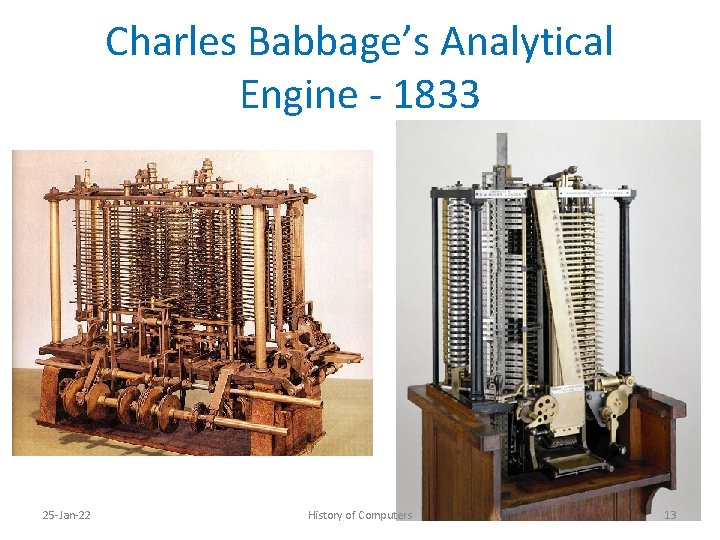
Charles Babbage’s Analytical Engine - 1833 25 -Jan-22 History of Computers 13
Analytical Engine -Continuation • This device is general purpose calculating machine, large as a house and powered by 6 steam engines • The basic design of this engine included input devices in the form perforated cards containing operating instructions ”Mill” • “store” for memory of 1, 000 numbers up to 50 decimal digits long • It also contained a control unit that allowed processing instructions in any sequence and output devices to produce printed results 25 -Jan-22 History of Computers 14
Analytical engine was never constructed – it outlined the basic elements of a modern computer Charles Babbage called the Father of computers 25 -Jan-22 History of Computers 15
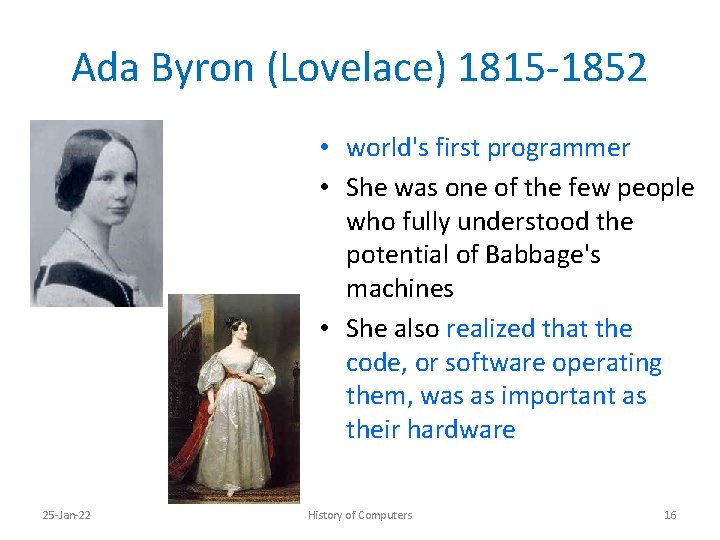
Ada Byron (Lovelace) 1815 -1852 • world's first programmer • She was one of the few people who fully understood the potential of Babbage's machines • She also realized that the code, or software operating them, was as important as their hardware 25 -Jan-22 History of Computers 16
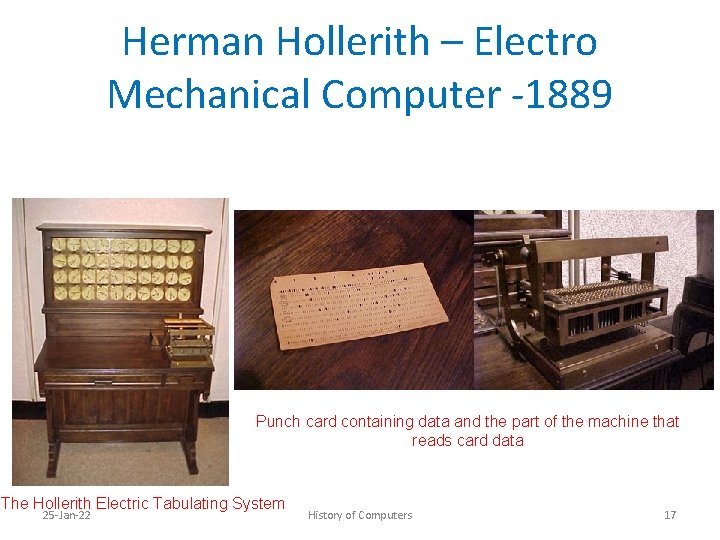
Herman Hollerith – Electro Mechanical Computer -1889 Punch card containing data and the part of the machine that reads card data The Hollerith Electric Tabulating System 25 -Jan-22 History of Computers 17
Herman Hollerith - Continuation • For the 1890 census, Hollerith developed an electromechanical computer to tabulate statistics • He chose the punched card as the basis for storing and processing information • He built the first punched-card tabulating and sorting machines as well as the first key punch • He founded the company that was to become IBM 25 -Jan-22 History of Computers 18
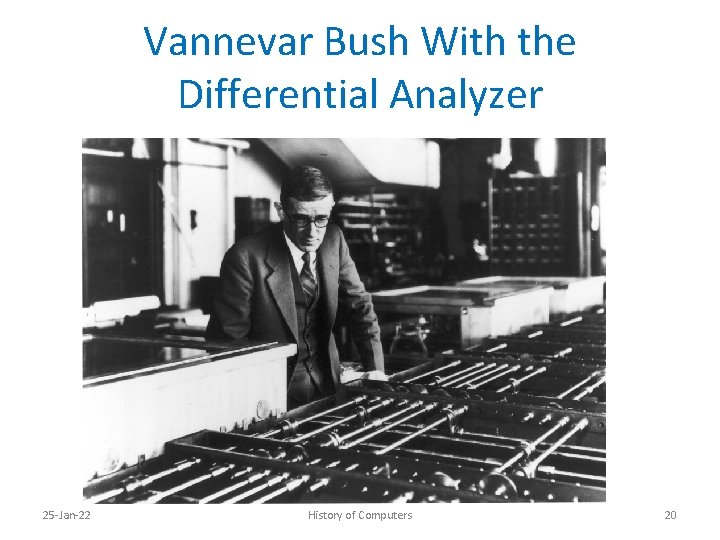
Vannevar Bush and the Differential Analyzer (1930) • In 1930, Vannevar Bush introduced the first electronic "computer" in the United States • The differential analyzer is a mechanical analog computer • It was designed to solve differential equations by integration • It used wheel-and-disc mechanisms to perform the integration • It was one of the first advanced computing devices to be used operationally 25 -Jan-22 History of Computers 19
Vannevar Bush With the Differential Analyzer 25 -Jan-22 History of Computers 20
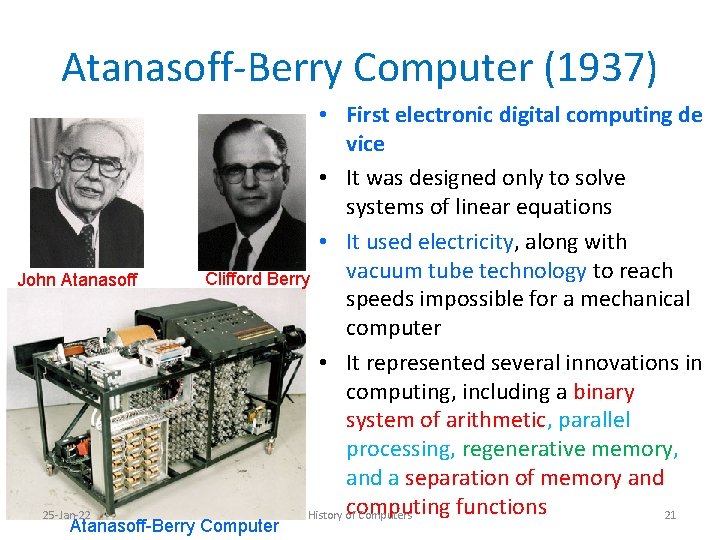
Atanasoff-Berry Computer (1937) John Atanasoff 25 -Jan-22 • First electronic digital computing de vice • It was designed only to solve systems of linear equations • It used electricity, along with vacuum tube technology to reach Clifford Berry speeds impossible for a mechanical computer • It represented several innovations in computing, including a binary system of arithmetic, parallel processing, regenerative memory, and a separation of memory and computing functions History of Computers 21 Atanasoff-Berry Computer
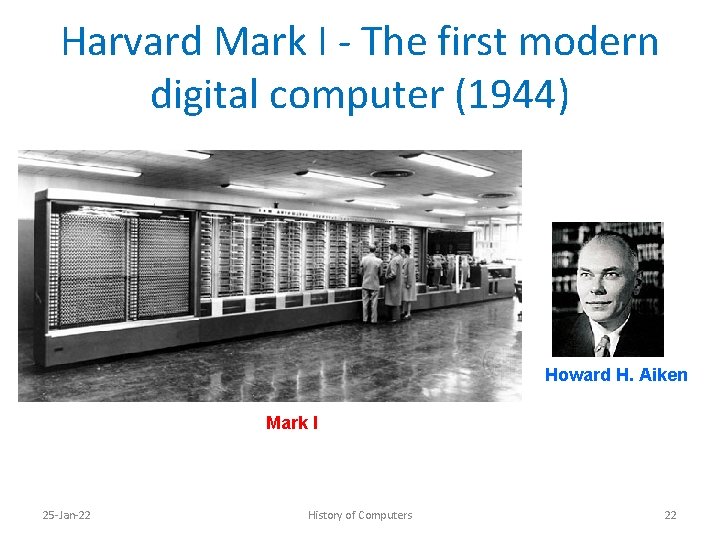
Harvard Mark I - The first modern digital computer (1944) Howard H. Aiken Mark I 25 -Jan-22 History of Computers 22
Harvard Mark I - Continuation • It was developed by Howard H. Aiken, built at IBM and shipped to Harvard in February 1944 • It used relays and electromagnetic components to replace mechanical components • It is a hybrid electrical-mechanical device, with a large shaft synchronizing the operation of its parts • It was made up of 78 adding instruments and desk calculators connected by almost 500 miles of wires • It was 51 feet long and 8 feet high and had over one million parts • It could compute 20 hours a day without breaking down 25 -Jan-22 History of Computers 23
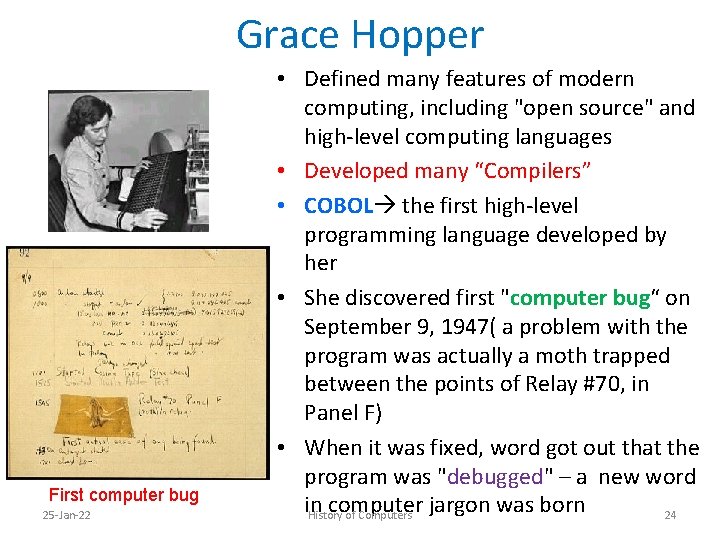
Grace Hopper First computer bug 25 -Jan-22 • Defined many features of modern computing, including "open source" and high-level computing languages • Developed many “Compilers” • COBOL the first high-level programming language developed by her • She discovered first "computer bug“ on September 9, 1947( a problem with the program was actually a moth trapped between the points of Relay #70, in Panel F) • When it was fixed, word got out that the program was "debugged" – a new word in computer jargon was born History of Computers 24
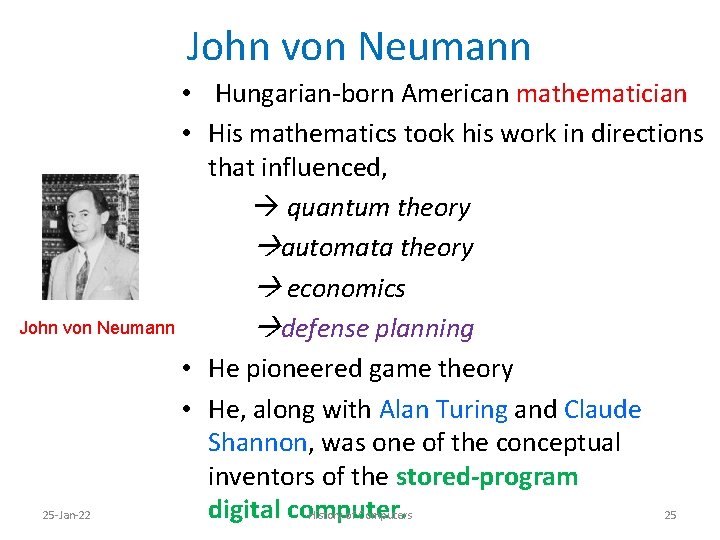
John von Neumann • Hungarian-born American mathematician • His mathematics took his work in directions that influenced, quantum theory automata theory economics John von Neumann defense planning • He pioneered game theory • He, along with Alan Turing and Claude Shannon, was one of the conceptual inventors of the stored-program digital computer. 25 -Jan-22 History of Computers 25
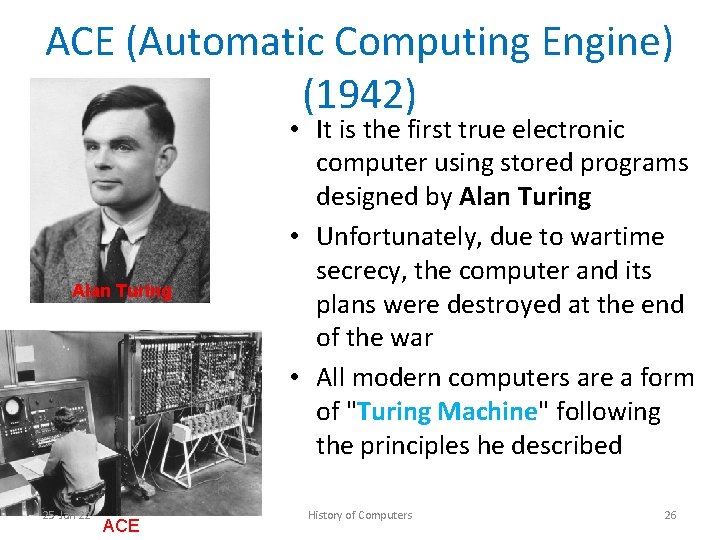
ACE (Automatic Computing Engine) (1942) Alan Turing 25 -Jan-22 ACE • It is the first true electronic computer using stored programs designed by Alan Turing • Unfortunately, due to wartime secrecy, the computer and its plans were destroyed at the end of the war • All modern computers are a form of "Turing Machine" following the principles he described History of Computers 26
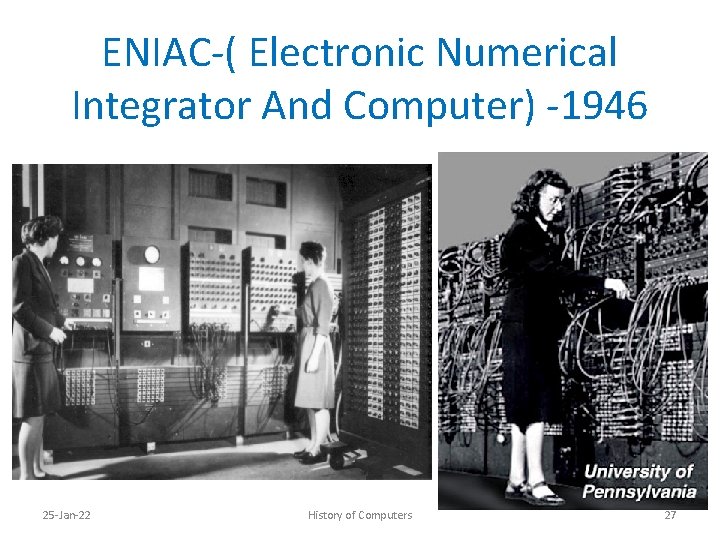
ENIAC-( Electronic Numerical Integrator And Computer) -1946 25 -Jan-22 History of Computers 27
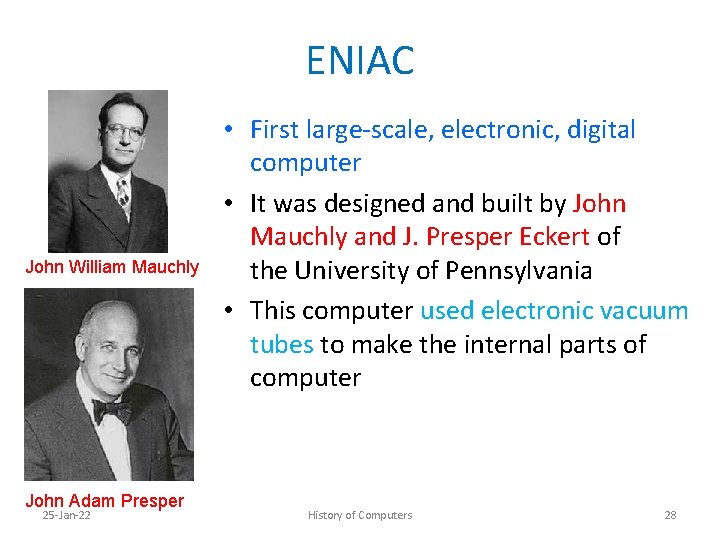
ENIAC John William Mauchly John Adam Presper 25 -Jan-22 • First large-scale, electronic, digital computer • It was designed and built by John Mauchly and J. Presper Eckert of the University of Pennsylvania • This computer used electronic vacuum tubes to make the internal parts of computer History of Computers 28
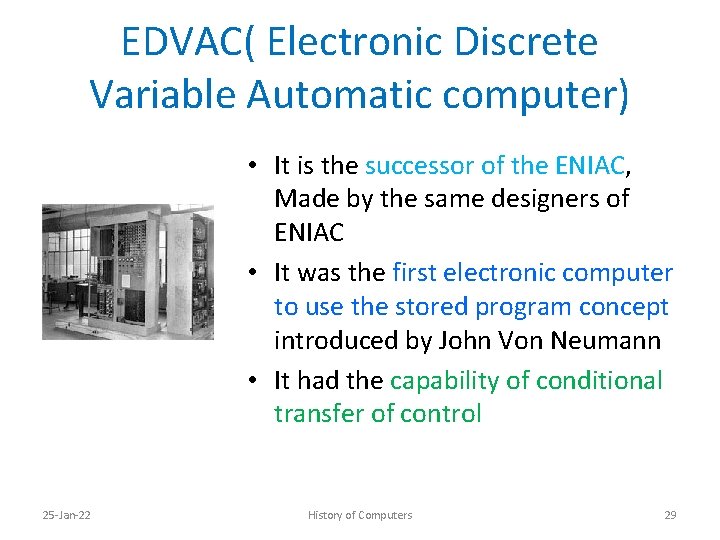
EDVAC( Electronic Discrete Variable Automatic computer) • It is the successor of the ENIAC, Made by the same designers of ENIAC • It was the first electronic computer to use the stored program concept introduced by John Von Neumann • It had the capability of conditional transfer of control 25 -Jan-22 History of Computers 29
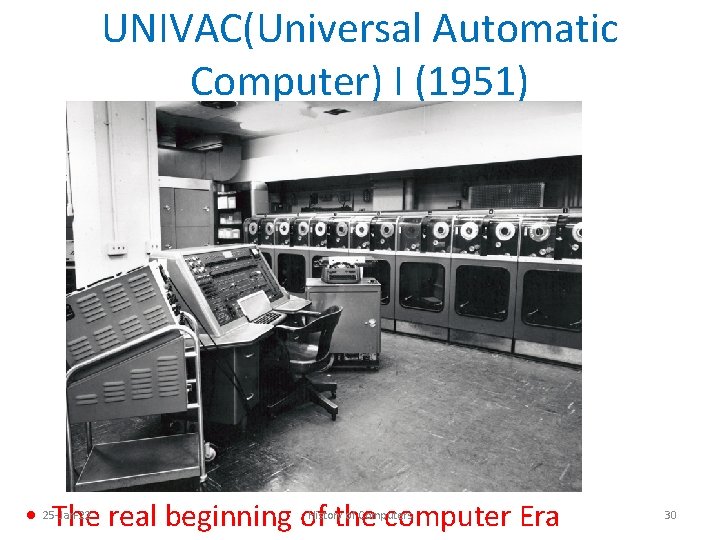
UNIVAC(Universal Automatic Computer) I (1951) • The real beginning of the computer Era 25 -Jan-22 History of Computers 30
1960 s • Turning point in this period is LARC machine • Vacuum Tubes are replaced by Transistors • It had access time less than 1µ second • Its total capacity is 100, 000 words 25 -Jan-22 History of Computers 31
1970 s • Many business organizations used computers for their offices • Entire computer assemblies became available on tiny “chips” known as Integrated Circuit (IC) 25 -Jan-22 History of Computers 32
1980 s • VLSI (Very Large Scale Integration) design was used • Hundreds of thousands of transistors were placed on a single chip • Microprocessor equipped with ROM (Read – Only Memory) were introduced • Late 1980’s some PC’s were run by microprocessors which can handle 32 bits of data at a time and could process about 4, 000 instructions per second 25 -Jan-22 History of Computers 33
1990 s • PC’s become part of everyday life • Computer networking, electronic mail and electronic publishing…. 25 -Jan-22 History of Computers 34
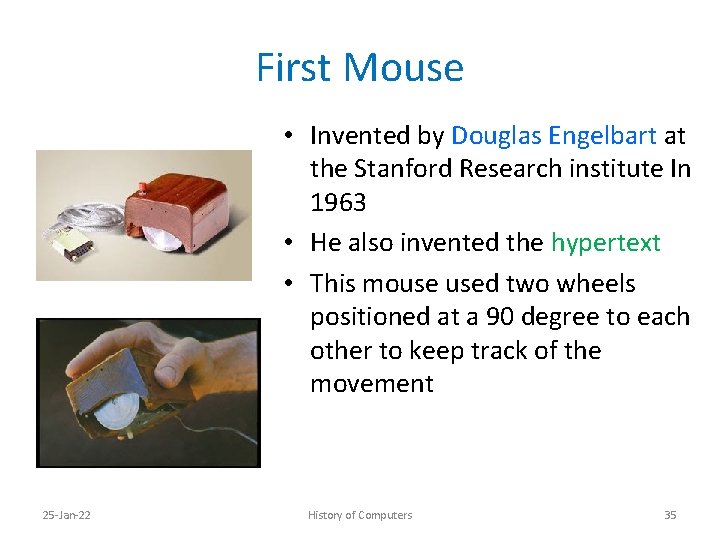
First Mouse • Invented by Douglas Engelbart at the Stanford Research institute In 1963 • He also invented the hypertext • This mouse used two wheels positioned at a 90 degree to each other to keep track of the movement 25 -Jan-22 History of Computers 35
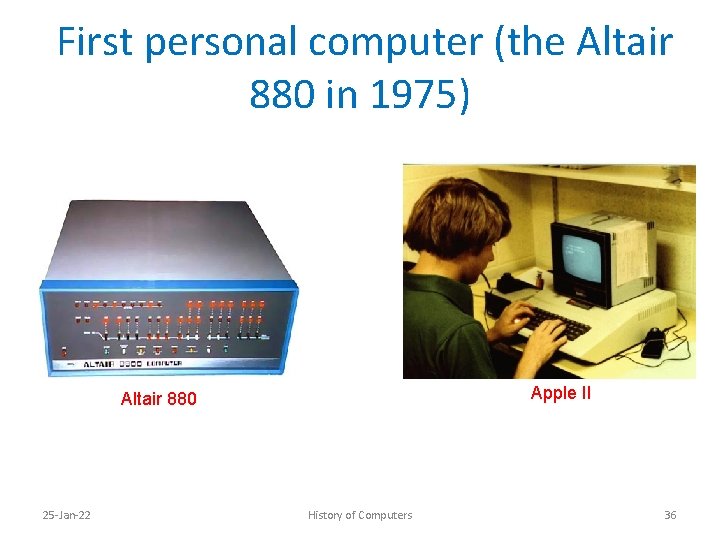
First personal computer (the Altair 880 in 1975) Apple II Altair 880 25 -Jan-22 History of Computers 36