
History of Community Development PLAN 6573 1 Outline

- Slides: 42
History of Community Development PLAN 6573 1
Outline Progressive Era 1880 s-1930 s Urban renewal 1945 -1964 War on Poverty 1964 -1970 Outline each era ◦ Leave shortcomings to discussion Nascent Community Development 1970 -1992 Mature Community Development era 1992? 2
Progressive Era Grew up in response to the immigrant slums and the disorienting features of industrialization ◦ Labor insecurity ◦ Urbanization ◦ These undermined traditional family and community relationships Questioned the assumption that the individual was solely responsible for his/her fate Did not challenge the existing political economy only sought to ameliorate its excesses 3
Progressive Era Grew up in response to the immigrant slums and the disorienting features of industrialization ◦ Along with other neighborhood initiatives sought to transfer intimate social relations from small towns to big cities Principles ◦ Physical determinism ◦ Slums breeds poverty and bad behavior ◦ Tear down slums ◦ Building codes 4
Progressive Era Principles ◦ Poor need to inculcate middle class norms ◦ Comprehensive Social services ◦ Community input ◦ ◦ Settlement house Model tenements Assimilation Schools serve socializing function ◦ Social Science should inform reform efforts ◦ Social survey 5
Poor conditions lead to poor behavior “The constant inhalation of vitiated air lowers the vitality and poisons the entire organism, and, as a natural consequence, predisposes these unfortunates to a continual desire for stimulation. …These facts account to a great extent for the large number of rum –holes found in the neighborhood of these tenant rookeries (1868, p. 557) 6
The need to Inculcate middle class norms “What can we do for them [the wretched inhabitants of the slums themselves]? We must go to Octavia Hill of London and Miss Ellen Collins of our own city. Miss Hill says ‘The people’s homes are bad, partly because they are badly built and arranged; they are tenfold worse because the tenants’ habits and lives are what they are. Transplant them tomorrow to healthy and commodious homes, and they would pollute and destroy them. There needs, and will need for some time, a reformatory work which will demand that loving zeal of individuals which cannot be had for money, and cannot be legislated by Parliament. ” (Poor. 1886, pp. 11 -13) Quoting Jim Gallatin AICP president. 7
Progressive Era Actors ◦ ◦ Philanthropists Social workers, planners Local government (zoning, building codes) Political Machines 8
Progressive Era Accomplishments ◦ Building codes ◦ Sanitation ◦ Social Science/Professional knowledge base ◦ Public health, social work, Planning ◦ Eased living conditions? ◦ Public parks, baths Failures ◦ Ignored racism ◦ Did not address causes of slums ◦ Paternalistic 9
Urban Renewal 1937 Housing Act ◦ Provided federal subsidies for slum clearance and the erection of public housing developments Title 1 of Housing Act of 1949— 1973 Federal support for clearance, land assembly and site preparation 10
Urban Renewal 1954 Act ◦ Set aside funds for public housing ◦ Allowed for rehab ◦ Workable program for community improvement ◦ ◦ ◦ ◦ Adopt housing and building codes Develop comprehensive plans Conduct neighborhood analyses Develop capacity for local planning Provide assistance to displaced households Provide means of financing workable program Involve and gain support of citizens 1956 allowed funds for relocation 1966, 1967 plans were specifically to meet needs of low and moderate income families 11
Urban Renewal Assumptions ◦ Economic growth will take care of poverty ◦ The market would not clear blight and slums ◦ The problem of piecemeal decay ◦ Downtown redevelopment would benefit all ◦ Jobs ◦ Tax revenue ◦ Removal of blight 12
Urban Renewal Actors ◦ ◦ Federal government Local redevelopment authorities Private developers Housing advocates 13
Urban Renewal Accomplishments ◦ Attracted redevelopment ◦ Cleared slums ◦ Provided impetus for neighborhood planning at the city level Failures ◦ Reduced amount of affordable housing ◦ Destroyed many functioning communities ◦ Destabilized neighborhoods ◦ Perpetuated racial segregation patterns 14
Urban Renewal Failures, public housing ◦ Housing of last resort ◦ Not to compete with private real estate ◦ ◦ ◦ Designed to stigmatize residents Socially isolating and alienating Lacked social services Cast a pall over government planning Had a devastating impact on the image of urban planning as a profession 15
1960 s Context ◦ ◦ ◦ Questioning of authority Civil Rights Movement War on Poverty Disasters of urban renewal Cold War? ? ? 16
1960 s Assumptions ◦ ◦ ◦ Bricks and mortar not enough Local activism against urban renewal The capacity of the community to organize, plan, and implement is crucial Empower neighborhoods against local bureaucracies Poor need to be reconnected to the economy ◦ Social services and empowerment would do this 17
1960 s Initiatives ◦ Gray Areas – Ford foundation ◦ Mobilization for Youth ◦ Institutions (schools, local government, welfare agencies) not serving community ◦ Empower local residents to better deal with bureaucracies and take control of their lives ◦ Demonstration programs 18
1960 s Initiatives ◦ Economic Opportunity Act of 1964 Community Action Agencies ◦ Social service agencies to foster individual upward mobility ◦ Institutions (schools, local government, welfare agencies) not serving community ◦ Empower local residents to better deal with bureaucracies ◦ Bypassed local governments ◦ Administered local service programs ◦ Administered national programs (head start, SYEP, Legal aid, Upward Bound) 19
1960 s Initiatives ◦ Community Action Agencies ◦ Maximum feasible participation ◦ CAA would provide a structure for poor communities to mobilize their resources and a platform for voicing their concerns ◦ Help individuals become upwardly mobile 20
1960 s Initiatives ◦ Special Impact Program ◦ Direct resources to poor neighborhoods ◦ Provide development funds to CBOs to design redevelopment strategies ◦ Place based strategy ◦ Precursor to CDC movement ◦ Model Cities ◦ Demonstration program ◦ Social services & New integrated housing in the inner city ◦ Cities with residents as junior partners would develop plans for a ‘model city’, local govt. had control ◦ Place based strategy 21
1960 s Failures ◦ Could not adequately address race ◦ Local politicians and institutions were hostile to the “community empowerment model” ◦ Ignored Economic forces, segregation that contributed to ghetto poverty ◦ Ignored other policies that undermined the ghetto ◦ Model cities for 6 was diluted among 150 cities ◦ Political/Bureaucratic in-fighting limited effectiveness SIP vs. CAA ◦ Too small in scope CAP and Model Cities each had less than 1 billion 22
1960 s Failures ◦ ◦ Racial integration requirements were watered down by Southern senators Nixon adopted the Southern Strategy and benign neglect Did not address wider forces buffeting the ghetto, many of which worsened. Contributed to ‘nothing works’ perception particularly as it pertains to place based initiatives 23
1960 s Accomplishments ◦ ◦ ◦ Social services improved quality of life Social services fostered upward mobility Transfers improved quality of life Served as training ground for black political class and middle class Planted the seeds for the modern CDC movement 24
Municipally Sponsored Neighborhood Planning Context ◦ ◦ ◦ Workable program for community improvement from Urban Renewal Community unrest of 1960 s Heavy handedness of planners like Robert Moses City planning was focused on citywide comprehensive land use plans Neighborhood needs were ignored 25
Municipally Sponsored Neighborhood Planning Cities established neighborhood planning programs in the 1960 s and 1970 s ◦ 1963 NYC community boards ◦ Washington DC neighborhood commissions Aim of Neighborhood Planning ◦ Give citizens a place to interact with government ◦ Review and comment on plans ◦ Develop own plans 26
Municipally Sponsored Neighborhood Planning Accomplishments ◦ Gave residents a voice in city affairs ◦ Contributes to local social capital Problems ◦ Few residents participate ◦ Not necessarily representative 27
Takeaways from History ØFocus of community development has evolved ØGeneral Assumption: At a time of rapid economic growth (e. g. US between 1870 -1970) the poor simply need to be incorporated into the broader economy ØFoci: ØMoral development of poor (Progressive Era) ØPhysical conditions (Progressive Era & Urban Renewal) ØEmpower residents & build human capital (1960 s onward) ØRedevelop places, not people (Urban Renewal, modern era) 28
Takeaways from History ØMost efforts have side stepped a key question ØWhat creates poverty? ØInstead ØMaking poor neighborhoods more livable Ø“Fix” the poor to allow them to take advantage of the larger economy 29
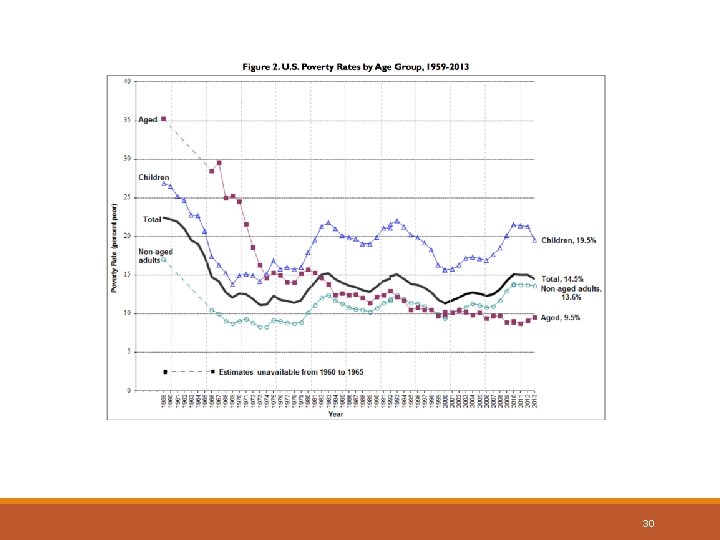
30
Discussion Identify one affordable housing, community development or local neighborhood planning initiative. Please explain if the parameters of the initiative show that we (meaning planners or community development professionals) have learned from past mistakes, or not. 31
Example 1 HOPE VI & Choice Neighborhoods ◦ ◦ Provides mobility counseling to Section 8 recipients Forbids construction of public housing in hi-poverty areas Implemented HOPE VI Started during President Clinton Administration 32
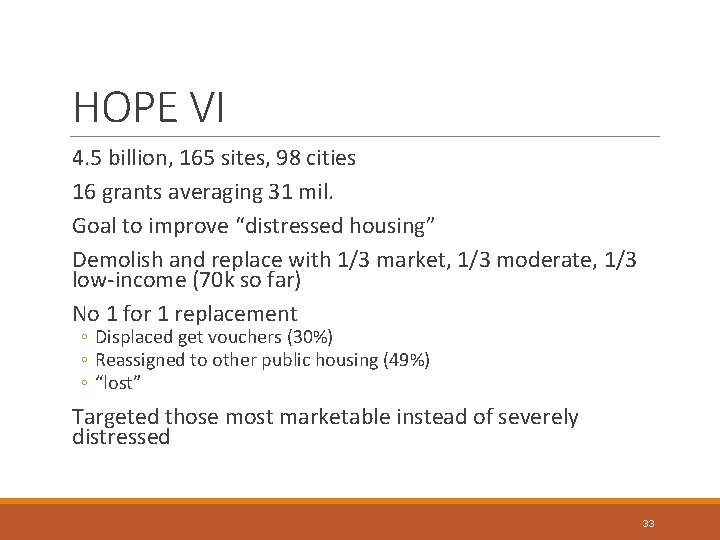
HOPE VI 4. 5 billion, 165 sites, 98 cities 16 grants averaging 31 mil. Goal to improve “distressed housing” Demolish and replace with 1/3 market, 1/3 moderate, 1/3 low-income (70 k so far) No 1 for 1 replacement ◦ Displaced get vouchers (30%) ◦ Reassigned to other public housing (49%) ◦ “lost” Targeted those most marketable instead of severely distressed 33
HOPE VI Physical Reforms Create Defensible Space (Newman 1972) High rise buildings: ◦ Prevent surveillance of the public grounds, lobbies, corridors, and stairways. ◦ Lack of surveillance renders much of the public space in high rise structures vulnerable to crime. 34
Choice Neighborhoods Modified the HOPE VI program 35
36
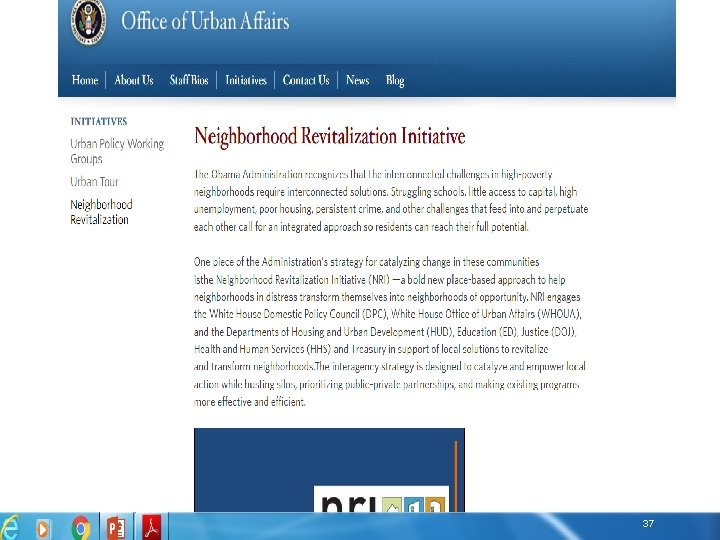
Whitehouse Neighborhood Reinvestment Initiative 37
Example 2: LIHTC Tax Reform Act of 1986 Politically popular because it is a tax expenditure rather than an allocation 38
Administered IRS States usually housing finance Agency ◦ States receive allocation based on population ◦ Developers apply for credits ◦ Approve applications based on: ◦ Cost/profit guidelines ◦ Qualified allocation plan 39
Implementation Project must reserve 20% for tenants with incomes no higher than 50% of area median income or 40% for tenants with incomes no higher than 60% of area median income Rents must not be higher than 30% of tenant income Private investors can invest cash through limited partnership Must keep projects low income for 15 years NHO have right of first refusal to purchase after 15 years 40
Implementation LIHTC expenditures are limited Everyone who wants a tax credit cannot receive it Must pay for it. Prices initially ranged from $. 52 to $. 70 ◦ Sometimes developers pay more than$1. 00 ◦ Also get depreciation ◦ Some return ◦ 2012 prices in the $. 90 – 1. 05 range (http: //www. novoco. com/low_income_housing/facts_figures/index. php) Syndicators connect investors and developers, for a fee 41
LIHTC What’s Good about LIHTC for Community Development? ◦ Creative financing requires building relationships with different groups ◦ All states get a piece of the pie ◦ Provided source of revenue and opportunity to develop skills for CDCs ◦ Benefiting FIRE professionals might be politically good ◦ Investors benefit-political ally 42