
History of Childhood Each culture and time period



- Slides: 42
History of Childhood
Each culture and time period has different concepts and values of how children should be treated. Society is evolving from the view of children as property, subject to the whims of family.
Early history of children shows children as the property of families and families being patriarchal (ruled by the father) Fathers determined how each child was cared for and if the child lived or died.
The Practice of Infanticide was practiced in many early cultures: justification by + Maintaining a healthy population without overpopulating + Maintaining the population to control limited resources – resources for only the strong and valued + Appease the gods
• Limit family size guaranteed financial security • Gender selection to guarantee provisions for elderly
Cultural differences England in the 1600’s, there was a hierarchy of rights and privileges. Children were at the bottom of the hierarchy – poor children were at the very bottom (they became slaves) Asian cultures look at family as one consistent institution for caring for the individual from birth to death.
• Native American cultures regarded children as the responsibility of the whole village • Hispanic children are the responsibility of the extended family
Discipline Corporal punishment was a means to mold children into moral, God-fearing, respectful human beings Obedience was the primary virtue of children: Age 16 or older – cursing your father or mother would result in death Educate through pain – “flappers”
Industrial Revolution Agrarian societies: education was not as important as work (school year is based on planting and harvesting crops) Then families moved to cities as factories were built. Children became indentured servants – Oliver Twist Fathers could trade their children for goods and services Dressed as little adults Often times left on their own to survive
Laws to Protect Children In 1865, the SPCA was formed to protect animals from cruel owners. In 1915, SPCC and Child Welfare laws were passed to protect children in factories. In 1974, Child Abuse Prevention and Treatment Act. In 1983, Missing and Exploited Children’s Act – authorizes interstate efforts
• Code Adam • Amber Alerts
United Nations Declaration of Rights for the Child • • Right to affection, understanding and love Adequate nutrition and medical care Free education Full opportunity for play and recreation Right to a name and nationality Special care if handicapped First to receive relief in times of disaster
• To learn to be a useful member of society and develop individual abilities • Brought up in spirit of peace and brotherhood • Enjoy these rights regardless of race, sex, color, national origin, religion or social origin
Why study Child Development? • Appreciate human development • Awareness and understanding of children and their behaviors • Apply your learning to everyday life • Learn practical techniques for caring for children
• Better understanding of self • Assist with career decisions • Recognize responsibilities of parenthood • Learn that children can be fun and fascinating • Protect children’s rights
What is Development? Process of change- physical, social, emotional, intellectual
What is the Individual Life Cycle? § Prenatal Stage § Neonatal stage § Infancy stage – Toddler stage – Preschool stage – School Age – Adolescence – Young Adult – Aging Adult
What are the factors that influence growth and development? • • • -heredity -environment -genetics -genes -potential
Genetics ü The study of heredity ü Every area of development (physical, social, emotional and intellectual) is affected by genetics ü Genetic instruction is lifelong
ü Genes affect some parts of growth more than others – hair color, eye color, blood type are determined by genes; social skills, mental abilities are influenced by both heredity and environment
ü Genes determine where a person will have a trait ü Some genes determine the range of a trait (height and ability and potential are genetic but reaching the potential are affected by environment)
Environment v. Physical conditions: basic needs v. Social environment: relationships v. Intellectual development: stimulation & experiences v. Emotional climate of environment
Heredity and environment work together: • Genes control how quickly muscles and bones (heredity) • A proper diet is needed for the proper growth (environment) • A better diet does not make bones and muscles bigger than heredity allows. (heredity & environment)
The influence of environment may interfere with the potential of heredity.
***Characteristics of Development*** These are the foundations of the study of human development. Development is 1. Continuous throughout life 2. Similar for everyone – sequenced, patterned 3. Proceeds at individual rate 4. Builds on earlier learning 5. Different areas are interrelated Describing Development activity
Differences in Rates of Growth & Development • Humans change with time – we grow, we develop skills, and we develop behaviors in expected patterns or sequences • The rate of the changes vary from individual to individual based on heredity and environment
Developmental Acceleration Performance or growth at a level beyond their stage (a 30 month old that speaks in complex sentences – a 12 year old that studies at a university)
Developmental Delays Performance or growth at a level below their stage ( an 18 month old just beginning to walk – a 16 year old reading at a 1 st grade level)
People don’t advance at the same rate or may have developmental advances in some areas and developmental delays in others
Theories of Growth & Development • Abraham Maslow – Human needs • Robert Havighurst – developmental tasks • Jean Piaget – Cognitive development • Erikson – Social/Emotional development
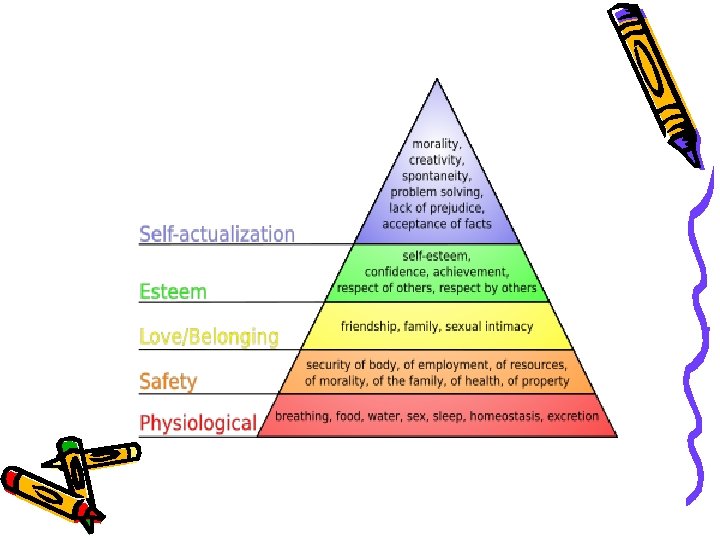
Abraham Maslow Development is the result of meeting personal needs Basic needs related to physiological needs and psychological needs Ranked in hierarchical order: lowest level of needs must be met before pursuing higher-level needs
• Adults must learn to help children meet their needs • • Provide nutritious food Make them feel secure Help them to establish healthy relationships Give children the skills to reach their potential
Robert Havighurst Developmental tasks are skills that should be mastered at certain stages of life: self-feeding, walking, language, relate to others Failure to achieve the developmental skills will lead to unhappiness and problems later
Developmental tasks come from 3 sources 1. Physical growth: helpless to walking 2. Social pressures: acceptance by others (may be based on physical abilities) 3. Inner pressures: push to achieve, to be admired
Observing children • The oldest and most common way to learn about behavior • Senses are the main tools used to learn • Observation skills must include knowledge and practice
• Observe not just the children but the adults and how they are interacting • Interpreting what you see, hear, feel • Helps to understand what you are learning
Ways to Observe Direct Observation Indirect Observations • Watching in their • Asking questions of natural people associated environment with child • Laboratory setting • observing products where specific of children (art reactions work)
Guidelines for Observing 1. 2. 3. 4. 5. 6. 7. Know your objectives Obtain permission Know what to do at the observation site Do not distract the children Be objective Record accurately Protect the rights of the observed
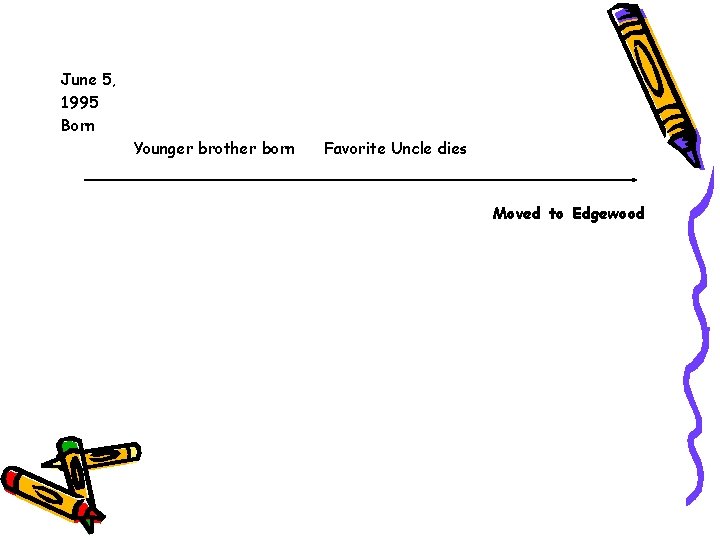
Assignment: Self-assessment of Personal Growth & Development 1. Create a personal time-line of events in your life. 2. Choose 2 of those events and discuss how each may have influenced a part of who you are today – socially, emotionally, intellectually 3. Identify a person from your childhood and discuss the influence they have had on who you are today.
June 5, 1995 Born Younger brother born Favorite Uncle dies Moved to Edgewood