
History of Cheese Making It is possible that
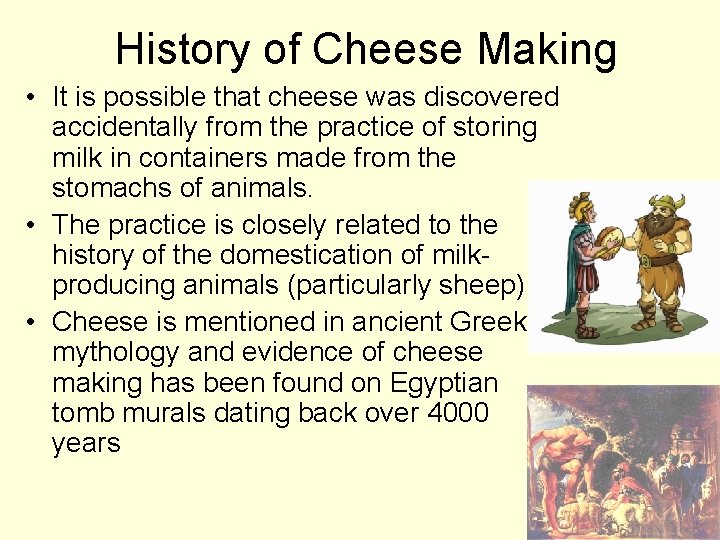
History of Cheese Making • It is possible that cheese was discovered accidentally from the practice of storing milk in containers made from the stomachs of animals. • The practice is closely related to the history of the domestication of milkproducing animals (particularly sheep) • Cheese is mentioned in ancient Greek mythology and evidence of cheese making has been found on Egyptian tomb murals dating back over 4000 years
Cheese Making Industry • Cheese making for most of the history of cheese making, the industry has been predominately an at-home or onthe-farm industry. • the first cheese producing factory came online in Switzerland in 1815 as soon as came to America that the massproduction of cheese in factories really took off. • More than 300 varieties • 14. 6 Billion dollar industry annually

Biology of Cheese Making • Bacteria like lactobacillus process the lactose sugars in milk and produce lactic acid, which lowers the p. H and makes the cheese bitter giving it flavor • Rennet from a cow’s stomach has the same affect as the lactobacillus bacteria, calves curdle mothers milk to digest it. • The low p. H causes the linear protein casein to denature and clump into balls we call curds. • The liquid left over is called whey and is used to make ricotta or whey protein powder

Improving Cheese-making Purpose: Which curdling agent produces cheese the fastest? Which curdling agent produces the most cheese? To examine numerical data for support of predictions. To examine variables that can lead to invalid experiments. Hypothesis: ______ is expected to produce the most volume of cheese in the shortest amount of time because it _____________.

Cheese-making Processes (Natural)

Cheese-making Processes (addition of “Starter” Bacteria)
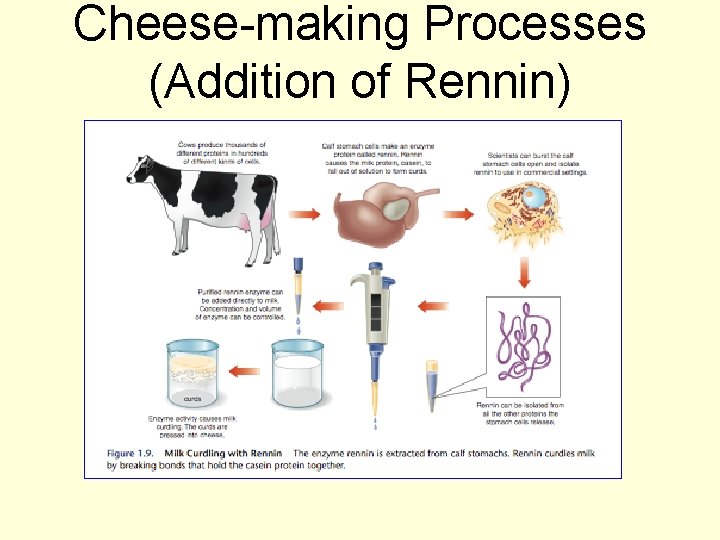
Cheese-making Processes (Addition of Rennin)

Cheese-making Process (genetically engineered Rennin, called: Chymosin)
Procedures: 1. Using transfer, transfer exactly 7 m. L of whole milk into a labeled, m. L conical tube. 2. Get a eppendorf tube filled with one of the curdling agents (250 u. L) and add it to your to the 7 m. L of milk. Rennin Chymosin (Teacher) whole milk (control) and Buttermilk 3. Cap the tube and gently mix by inverting 3 times. Record this “initial time”. _____ 4. Place the milk-containing portion of the tube deep in your armpit, like a thermometer, and incubate it there for at least 15 min. 5. Check for curdling every 5 minutes, recording the time to curdling in minutes. To check for curdling, gently tilt the tube, careful to not breakup any curds. Curds are large lumps of solidified milk. After 15 min, place the tube upright, at room temperature and check for curdling every 15 min for 2 hours. If curdling has not occurred within 2 hours, continue checking once every four hours. With the greatest accuracy possible, record the number of minutes passed until the milk had curdled to the greatest extent. 6. If curdling has not occurred by the end of the class period, bring the tube home (keep at room temperature) and back to class in 24 hours. Keep tube upright so any curds fall to the bottom of the tube.
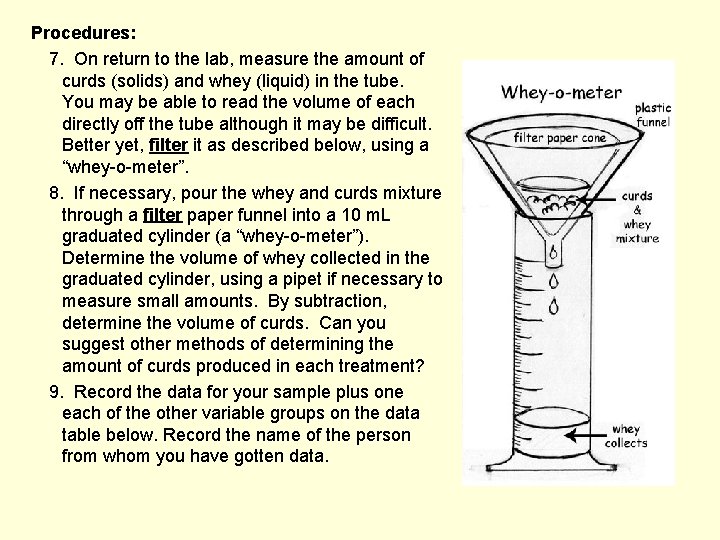
Procedures: 7. On return to the lab, measure the amount of curds (solids) and whey (liquid) in the tube. You may be able to read the volume of each directly off the tube although it may be difficult. Better yet, filter it as described below, using a “whey-o-meter”. 8. If necessary, pour the whey and curds mixture through a filter paper funnel into a 10 m. L graduated cylinder (a “whey-o-meter”). Determine the volume of whey collected in the graduated cylinder, using a pipet if necessary to measure small amounts. By subtraction, determine the volume of curds. Can you suggest other methods of determining the amount of curds produced in each treatment? 9. Record the data for your sample plus one each of the other variable groups on the data table below. Record the name of the person from whom you have gotten data.
- Slides: 10